




Abstract
To report a technique to maintain pelvic flow to an internal iliac artery (IIA) with aneurysm in a patient with Marfan syndrome, and previously treated by infrarenal abdominal aortic aneurysm open procedure. Retrograde endovascular hypogastric artery preservation (REHAP) through flexible endograft implantation from external iliac artery (EIA) to internal iliac artery (IIA) was used. REHAP was a reasonable, minimally invasive and elegant alternative (new) to maintain pelvic arterial flow in Marfan syndrome. However, the long-term durability is unknown, and so, it should be used in selected patients.
Marfan syndrome is an autosomal dominant, multisystem disease characterized by long bone overgrowth and other skeletal abnormalities, such as dislocation of the ocular lens, pneumothorax, decreased skeletal muscle mass, mitral valve prolapse, and aortic arch dilatation. 1,2 The combination of structural microfibril matrix abnormalities, dysregulation of matrix homeostasis mediated by excess transforming growth factor, and abnormal cell–matrix interactions is responsible for the phenotypic features of Marfan syndrome. 1,3,4 Aortic dilatation in Marfan syndrome is related to degeneration of the medial layer, with fragmentation, disarray, and loss of elastic lamina with replacement by basophilic-staining proteoglycan. Loss of elasticity in the media also results in a progressive increase in aortic stiffness and a decrease in distensibility. 1,5–9
Marfan syndrome is one of the most common potentially lethal mendelian conditions, with an estimated prevalence of 1 case per 3,000 to 5,000 individuals. 1,7 Although an accurate incidence is impossible to define, the occurrence of some of these features in the general population (such as scoliosis; lean, tall habitus; mitral valve prolapse; myopia) is shifting diagnostic criteria. 1,3
An association between internal iliac arteries (IIAs) and abdominal aortic aneurysms (AAAs) occurs in up to 20% of the cases, 2,7,10–14 but this association in Marfan syndrome was not previously found. Treatment choices for internal iliac artery aneurysms (IAAs) may include ligation, embolization and vascular restoration surgery, and a conventional or endovascular approach. 7,15–19
The purpose of this article is to report a case of Marfan syndrome with an internal IAA, previously submitted to an aortobifemoral bypass at another service and treated by a retrograde endovascular procedure, 15,18 with preservation of IIA vascular perfusion.
Case Report
The patient was a 45-year-old Caucasian male with a diagnosis of Marfan syndrome. He was originally operated on at another service (by other surgeons) with resection of an infrarenal AAA and common iliac artery ligation 1 year previously (aortobifemoral bypass) (Figure 1). At that time, the right internal IAA (4.2 cm diameter) was left intact (see Figure 1). The contralateral IIA was 1.8 cm in diameter, and we chose to keep it under observation. Because of the previous operation and to preserve pelvic blood flow, we decided to perform an endovascular bypass between the IIA and the external iliac artery using a flexible endoprosthesis.

A, Hypogastric artery aneurysm 4.2 cm diameter. B, With resection of an infrarenal abdominal aortic aneurysm.
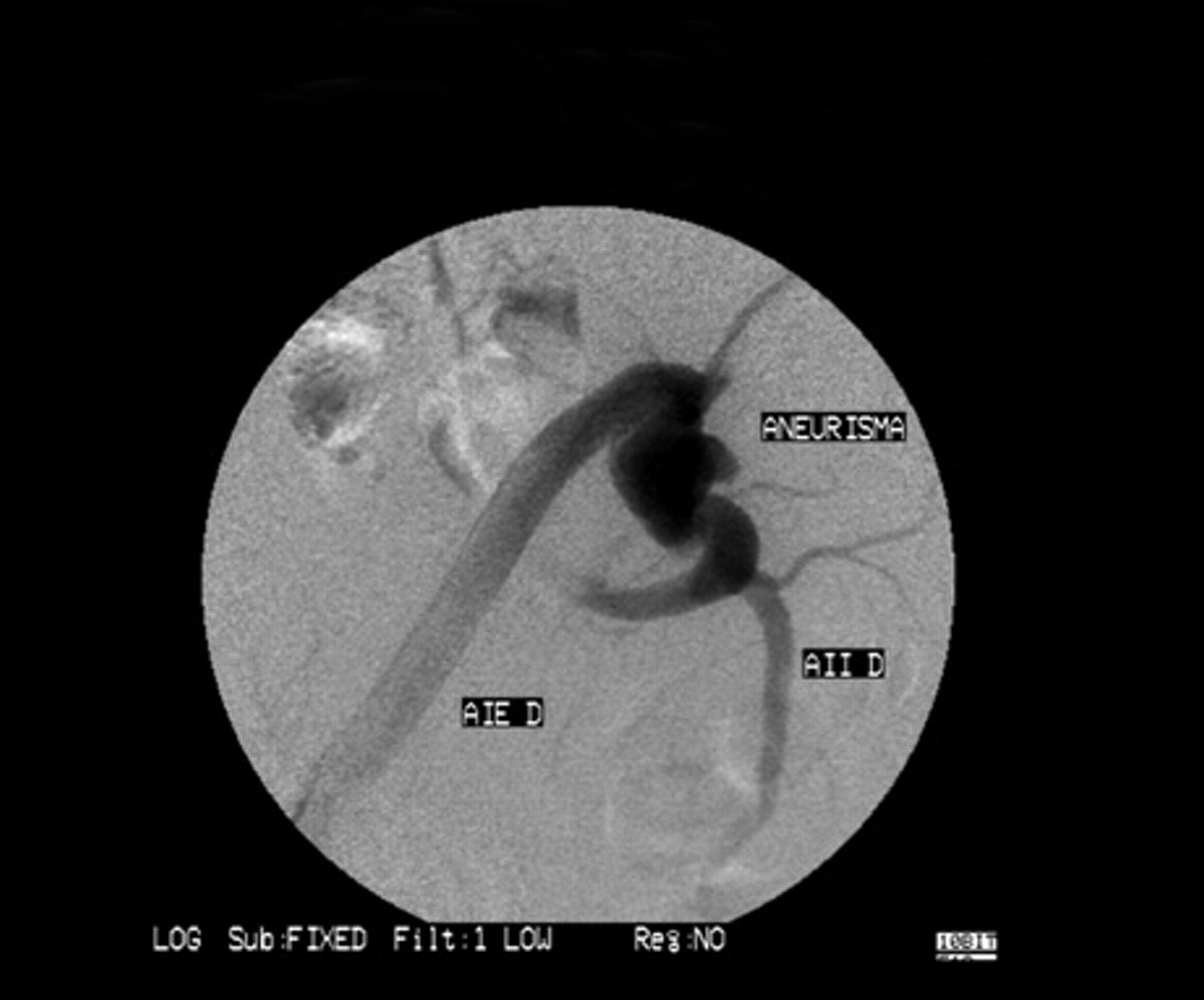
Angiogram showing the aneurysm and internal iliac artery branches.
Surgical Techique
Vascular surgical access to the proximal right superficial femoral artery (SFA) was obtained through a longitudinal incision distal to the previous incision. Following anticoagulation with heparin (5,000 U IV), a 12F, 45 cm long sheath was placed proximally by direct puncture of the SFA. Then a 5F guiding catheter (mamaria type) was selectively introduced in the ipsilateral IIA and angiography was performed showing the aneurysm and IIA branches (Figure 2). Guidewire support was obtained in a secondary order IIA branch with a 0.035-inch, 260 cm, stiff guidewire. A marked pig-tailed catheter was introduced and used for proximal and distal neck diameters and aneurysm extension measurements (Figure 3). The sheath was then advanced over the stiff guidewire to the iliac bifurcation. The 0.035-inch guidewire was replaced by a 0.018-inch wire compatible with the endoprosthesis (13 × 100 mm, Hemobahn, WL Gore & Associates, Flagstaff, AZ). A road map was used to locate the distal neck. Supported by the sheath, the endoprosthesis was advanced into the IIA, with some difficulty, which was overcome by a buddy wire maneuver with a second stiff guidewire located in the IIA, for additional trackability. The endoprosthesis was deployed easily in the selected place, sparing the pudenda and gluteus arteries (Figure 4). Proximally, the endoprosthesis was deployed in the external iliac artery. A control angiogram showed the complete technical success of the procedure, with no endoleaks, migration, or “kinking” and with preservation of the IIA branches (Figure 5). The SFA was repaired surgically by direct suture.
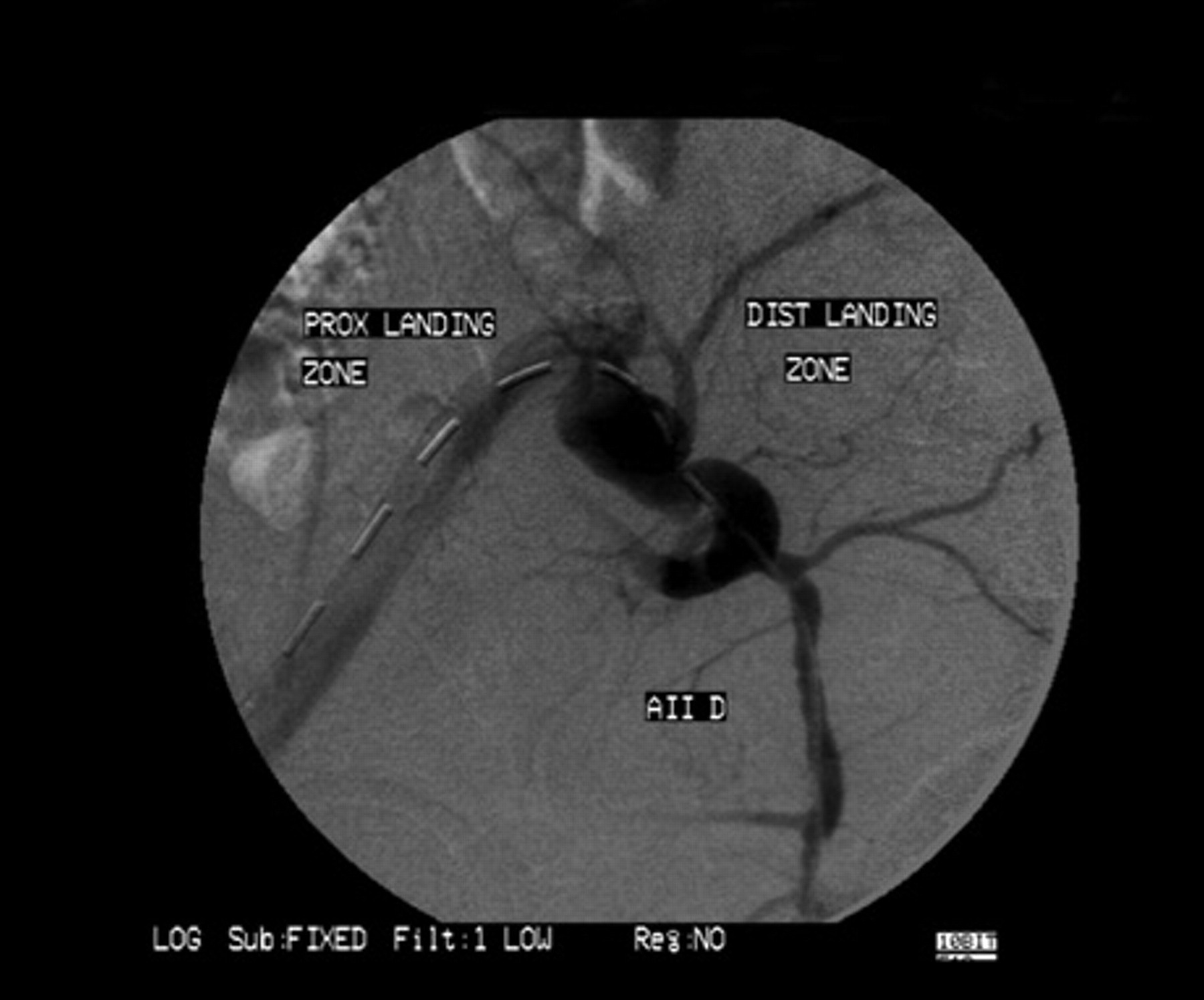
A marked pig-tailed catheter is introduced and used for proximal and distal neck diameters and aneurysm extension measurements.
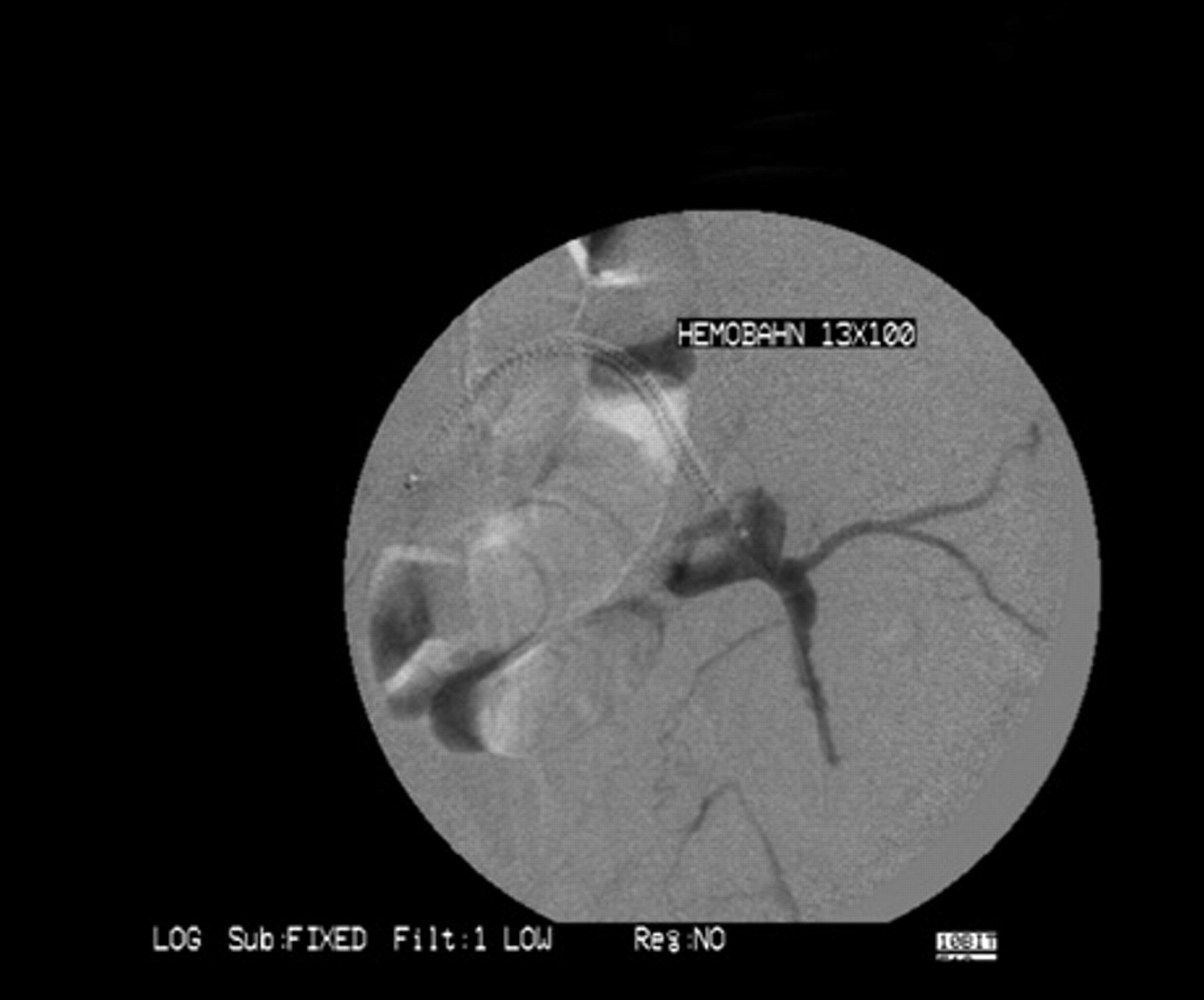
The endoprosthesis (3 × 100 mm, Hemobahn, Gore) is located in the selected place.

Control angiogram showing the complete technical success of the procedure, with no endoleaks, migration, or “kinking” and with preservation of the internal iliac artery branches.

Control angio-computed tomography was performed a month later, showing complete exclusion of the aneurysm.
The patient remained in the intensive care unit overnight and was discharged on the following day.
Surveillance was performed in 1, 3, 6, and 12 months, and then yearly thereafter, viewing both sides by computed tomographic (CT) scans. If the contralateral IIA increased in size, we tried to treat it in the same way.
Control angio-CT was performed a month later, showing complete exclusion of the aneurysm (Figure 6). The contralateral IAA was the same size as preoperative (Figure 7).

The contralateral iliac artery aneurysm was the same size.
Discussion
The criteria for IIA repair is a diameter of 2.0 to 3.0 cm, depending on the age of the patient and associated comorbidities. 1,7,10–12,14,20 Aneurysm growth has been estimated at 4 mm/yr, similar to that of AAAs, and the incidence of rupture can be as high as 67%; if these aneurysms are not operated on, an overall mortality of 71% 10,19,21 is anticipated. Data on internal IAAs are limited to small series, but larger series on common iliac artery aneurysms report operative mortality in the elective setting from 0 to 11%. 10,14,19,21 There are no reports on the incidence and treatment of IAA in cases with Marfan syndrome.
The least invasive method of IAA treatment is embolization. 12,13,17 The complications of this approach include distal embolization to the lower limb and failure to eliminate the compressive effect of these often giant aneurysms on close anatomic structures. 10,12,13,17
Simple proximal ligation of the IIA is another option, and it is relatively simple to perform, especially in type IIb IIA aneurysms, is less easy in type Iia, and can be very challenging in type Iic. 14 However, as with percutaneous embolization, ligation does not eliminate the compressive effect. Moreover, the aneurysm may expand because of backflow from distal branches. 10,21 Particularly in our patient, some difficulty could be anticipated because of previous aortic surgery.
Exclusion of the aneurysm proximally by ligating the common iliac and external iliac arteries adjacent to the internal iliac orifice, followed by obliterative endoaneurysmorrhaphy and unilateral aortofemoral bypass, is also possible and has been described. 10,21,22
A review of the literature revealed multiple colonic and pelvic ischemic complications following unilateral or bilateral IIA occlusion in the management of aortoiliac aneurysms. 15 These include buttock claudication, colon ischemia, scrotal skin sloughing, fatal perineal and buttock necrosis, sciatic neuropathy, paralysis, sexual dysfunction, and bladder sphincter dysfunction. 10–12,15,16,18,20,23,24 Most of these complications are mild and well tolerated, whereas others can be very disabling or life threatening. A recent report of the outcome of unilateral IIA occlusion after AAA endovascular repair demonstrated a 39% incidence of significant symptoms. 15 In this series, hip and buttock claudication never resolved completely during a follow-up period of 16 months. The occlusion of both IIAs will probably result in even more frequent and intense ischemic symptoms. However, the number of patients reported in these series is too small to give conclusive evidence for a treatment. Newer, standardized methods of assessment have identified relatively high rates of sexual dysfunction prior to and after intervention. 23 Aortic aneurysm patients have a baseline incidence of sexual dysfunction of approximately 30%, which doubles over the next 7 years. 12,13,20,23 Patients who had open aortic operations used to have significant sexual dysfunction during the first postoperative year. 20,22,23
Endovascular unilateral IIA occlusion results in sexual dysfunction in approximately 10% of patients, but this increases significantly with bilateral IIA occlusion. 11–13,17,20 When compared with open operations, the incidence of sexual dysfunction is lower in patients with endovascular aortic aneurysm repairs, including those who have IIA occlusion. 14,22,23
Direct revascularization of the IIA during open surgical repair of aortoiliac disease effectively prevents postoperative pelvic and colonic ischemia. 15,18,22 Endovascular treatment represents a new procedure to maintain pelvic arterial flow. 15,18 Some reports showed that revascularization with a side-branched endoprosthesis can be performed at the same time as endovascular aneurysm repair, with a 90% technical success rate and a patency rate of 92% in the short term. 25 Another option would be retrograde endovascular hypogastric artery preservation (REHAP), 15,18 which maintains pelvic arterial flow by placing a covered stent graft from the target IIA to the ipsilateral external iliac artery (EIA).
The REHAP technique was described for degenerative IAA, and there are no reports of its use in Marfan syndrome. This approach was chosen because of the previous aortobifemoral operation, which anticipated a complicated abdominal access. We also considered that pelvic flow preservation would be imperative for sexual function preservation in a young patient with limited collateral circulation and patent gluteal and pudendal arteries.
REHAP represents a new procedure to maintain pelvic arterial flow and can also be used in type IIA aneurysm in patients with Marfan syndrome. The long-term durability is unknown, so it should be used only in carefully selected patients. Nevertheless, REHAP is a reasonable, minimally invasive, and elegant option for patients who need pelvic arterial preservation, such as young patients.
Footnotes
Acknowledgment
Financial disclosure of authors and reviewers: None reported.