




Abstract
The distinctions between coaching and mentoring are not well understood. This study utilises qualitative case study methodology to explore the roles that coaching and mentoring play in addressing the leadership challenges of charity CEOs in the UK. Interpreting coaching and mentoring as types of behaviour helps to clarify how stakeholders in the charity sector make sense of the similarities and differences between each discipline. Four different forms of coaching and mentoring are described, and their impact is analysed for charity CEOs personally, relationally and strategically. Some important resulting opportunities are identified for charity CEOs and their coaches and mentors, to enhance the effectiveness of their working relationships and their conversational dialogue.
Introduction
Coaching and mentoring are “confused and contested terms” which incorporate a diverse range of overlapping practices (Western, 2012, p.41). It is widely accepted that there are no universally agreed definitions for either of the two disciplines (Koopman et al., 2021; Garvey and Stokes, 2022). Indeed, many researchers have concluded that any attempts to create theoretical distinctions are inherently futile, partly because coaching and mentoring activities are so entangled in practice, and partly because the terms have been used loosely in common parlance for so many years (Western, 2017; Gannon, 2021). This lack of clarity is problematic from a coaching practitioner’s perspective, and the uncertainty can diminish respect for the field of coaching amongst their potential clients (Bachkirova, 2024). It can also generate misaligned expectations between an individual client and their coach or mentor about the purpose of their relationship, a situation associated with ineffective coaching and mentoring engagements (Clutterbuck, 2009).
At the heart of this dilemma lies an ontological consideration about the fundamental nature of coaching and mentoring. In their literature review of research into the two disciplines, Koopman et al. (2021) observe that most research has been done from an objectivist perspective, seeking to define rather than describe them. The problem is that coaching and mentoring are, in reality, social constructions. Their interpretation has evolved over time, and will always evolve to mean different things to different people (Koopman et al, 2021; Garvey and Stokes, 2022). As a consequence, academic calls are now being made to build a better understanding of coaching and mentoring by studying them in specific social situations rather than theoretically, and together rather than separately to reflect their interconnectedness (Koopman et al., 2021; Garvey and Stokes, 2022). This study embraces this opportunity by exploring the roles that coaching and mentoring play in the context of addressing the leadership challenges of charity CEOs in the UK.
Literature review
Coaching and mentoring are forms of “developmental helping relationships” (Salter and Gannon, 2015, p.374). Bruce-Foulds et al. (2022, p.163) argue that “at their heart, coaching and mentoring are ways of having purposeful, skilful conversations that effectively support performance, growth and development”. Passmore (2020) lists a number of characteristics that are common to both coaching and mentoring, including supporting and enabling learning, setting goals and objectives, and using conversations to bring about change. The potential value of coaching and mentoring to senior leaders, in particular, lies in creating a safe space in which individuals can reflect openly on the variety of challenges concerning them (Clutterbuck, 2009; Stokes, Jolly and Cox, 2024).
Researchers also note some differences between coaching and mentoring (Western, 2017; Passmore, 2020; Garvey and Stokes, 2022). Mentoring is less likely to be a formal relationship involving the payment of fees, and is more likely to be longer term and focused on career development. Coaching is more likely to have a performance focus, with line managers typically shaping goals and reviewing progress. Mentors are likely to have less training in their discipline than coaches, but more organisational or sector knowledge. They are also more likely than coaches to utilise a directive style in offering advice to their clients.
Despite these historic distinctions, a convergence of these modalities has taken place in the coaching and mentoring discourses in recent years (Koopman et al., 2021; Garvey and Stokes, 2022). As a result, in any given situation, there is a risk of confusion over the kind of service being provided, the behaviours required, and the benefits expected (Stokes, Fatien Diochon and Otter, 2021). However, rather than trying to achieve greater clarity by seeking spurious concrete definitions of coaching and mentoring, Stokes et al. (2021) advocate that it is necessary to embrace the fundamental entanglement between the two disciplines. They argue that the immediate context in which coaching and mentoring are being used plays a critical role in determining which aspects of each discipline are useful to practitioners in addressing the work challenges involved.
To guide more practice-focused research in different social situations, Stokes et al. (2021) have proposed a contextual framework specifying four dimensions of dyadic relationships: Learning, Economic, Temporal, Sociocultural. They also suggest a spectrum, in each case, describing the range of characteristics typical in coaching versus mentoring relationships (i.e. learning objectives, economic nature, time frames, coach/mentor skill sets). This study was amongst the first to use this framework in practice, applying it to explore the roles that coaching and mentoring play in the specific context of addressing the leadership challenges of UK charity CEOs.
Coaching and mentoring practices are under-researched topics in the charity sector (Watson, 2020). Only four studies have been found involving senior executives, all of which were conducted over 14 years ago in the US. Of these, just one was published in a peer-reviewed journal, and this focused narrowly on evaluating a short-term coaching programme pilot (Fischer and Beimers, 2009). Surprisingly, there has also been little research undertaken into the roles that coaching and mentoring play for CEOs, in either the charity or the private sectors (De Janasz and Peiperl, 2015; Watson, 2020). The primary explanation given for this is the difficulty associated with obtaining access to individuals in such a busy job (Rosser, 2005).
The limited evidence that does exist in the private sector suggests that coaching and mentoring can deliver significant benefits to CEOs in terms of their leadership performance and personal wellbeing (Stevens, 2005; Gavett, 2013; De Janasz and Peiperl, 2015). Despite this conclusion, coaching and mentoring seem to be relatively underutilised by the CEOs of charities (ACEVO, 2023). A paradox seems to exist in that, although effective leadership is seen as crucial to the success of charitable organisations, using scarce resources to fund a CEO’s own professional development can generate feelings of self-recrimination and guilt (Parliament. House of Lords, 2017; Terry, Rees and Jacklin-Jarvis, 2018).
Methodology
The aim of this study was to explore the roles that coaching and mentoring play in addressing the leadership challenges of charity CEOs in the UK. Owing to the differing views about the meaning of coaching and mentoring, a constructionist ontological and an interpretivist epistemological stance was adopted (Bell, Bryman and Harley, 2019). Social phenomena and their meanings are constructed by human beings as they engage with the world and interact with each other. As a result, it is necessary to acknowledge the existence of multiple realities with multiple meanings which are observer dependent (Yin and Campbell, 2018).
The roles that coaching and mentoring play in addressing the leadership challenges of charity CEOs have many distinctive features. This means that it will not be possible to generalise the findings into theories that attempt to explain or predict the roles of coaching or mentoring in other situations (Stake, 1995). The study can only seek to generate contextual knowledge, based on the values, interests and relationships at play within the UK charity sector specifically. On this basis, the form of knowledge involved in the study is ‘phronesis’ (Flyvbjerg, 2012). Aristotle originally used the term phronesis to distinguish practical knowledge from episteme (scientific knowledge) and techne (technical knowledge) (Flyvbjerg, 2012). Phronesis involves building understanding about perspectives and behaviour in particular social situations (Schram, 2012).
To generate knowledge of this type, an abductive approach to reasoning was adopted. This differs from induction in that it refutes the assumption that because something happens in one situation, it will happen again in the same conditions. Abduction involves making judgements concerning the best explanations for the facts being collected (Bell, Bryman and Harley, 2019; Thomas, 2021). It requires “an interaction between the general and the concrete” and the use of experience to drive one’s consideration and choices (Flyvbjerg, 2012, p.30).
Qualitative, intrinsic case study methodology was chosen for the study (Thomas, 2021). One of the essential characteristics of a case study is that it involves the study of a broader phenomenon (Merriam and Tisdell, 2016). In this study, this broader topic of investigation was ‘the roles that coaching and mentoring play in addressing leadership challenges’, and the ‘unit of analysis’ was the ‘CEOs of charities’. This unit of analysis was bounded by limiting the inquiry to the CEOs of charities which are based in the UK, have an annual income above £1 million, are classified as ‘charities in law’ and are registered with the Charity Commission.
Case study methodology is well suited to situations in which the boundaries between a phenomenon and its context may not be easily distinguished (Yin and Campbell, 2018); a key characteristic of coaching and mentoring. Case studies also enable the capture of varying perspectives from different stakeholders. This feature was an important advantage for this study, as it meant that the views of a range of players within the UK charity sector could be incorporated, not just those of charity CEOs themselves.
Two data collection methods were used for the study: 29 semi-structured interviews with a range of senior stakeholders in the UK charity sector, and 14 organisational documents relating to the role of charity CEOs and some key coaching and mentoring programmes available to them. A fixed purposive sampling strategy was adopted for the interviews, and these were conducted with charity CEOs (13), charity chairs (3), coaches and mentors (5), representatives from professional bodies (3), and representatives from organisations providing coaching and mentoring programmes for charity CEOs (5). The names of the research participants quoted in this article have been replaced with pseudonyms to maintain confidentiality. Analysis of data from the various sources involved direct interpretation of individual statements, then triangulation and reflexive thematic analysis to find meaning across statements (Stake, 1995; Braun and Clarke, 2022). NVivo software was used to code the interview transcripts and organisational documents.
Given the constructionist stance taken for the study, it was crucial to embrace the interpretative role that I myself played as the researcher (Braun and Clark, 2022). This requirement was of additional importance given my involvement in the case study system as a coach-mentor for several charity CEOs. This insider role brought with it the advantages of passion, knowledge, credibility and participant access, but it also raised some important ethical considerations (Unluer, 2012; Saidin, 2016). Issues to address included the risk of subjective bias, false assumptions, role duality and maintaining strict confidentiality for participants.
Findings
Unclear distinctions between coaching and mentoring
Each interviewee was asked to share their perspectives on the similarities and differences between coaching and mentoring. In most cases, the starting point was an acknowledgement that the distinction is not clear. Immediate responses included phrases such as: “that classic question!”, “gosh, that’s difficult” and “I think it’s very confused”. It was also seen as an important question. Deborah (Programme Organiser) observed that “it’s a conversation that comes up so often…people get really exercised about it”. Alice (Coach) argued that the lack of understanding in charities about the nature of coaching was an obstacle to it being “embedded in the culture of the sector” and “credited with the professionalism it deserves”.
Some interviewees were happy to admit that they could not explain the differences between coaching and mentoring.
I find it difficult to say what I do. I call it mentoring, but others could easily call it coaching. (Anthony, Mentor)
In other instances, individuals had firm views on the subject, but their stances were often not consistent with each other. As an illustration, a Programme Organiser asserted that coaching is about helping clients “think through their own solutions”, whilst a Chair stated it involved “giving advice on how to do something”.
Similarities and differences between coaching and mentoring
Across the interviews and documents studied, coaching and mentoring were described in a variety of ways. The nature of these different ideas could be themed into three broad areas: the overall ‘purpose’ of each discipline, the different ‘activities’ involved, and the ‘principles’ underpinning their practice. Further analysis in these three areas helped to draw out several perceived similarities between coaching and mentoring (see Table 1).
Perceived similarities between coaching and mentoring
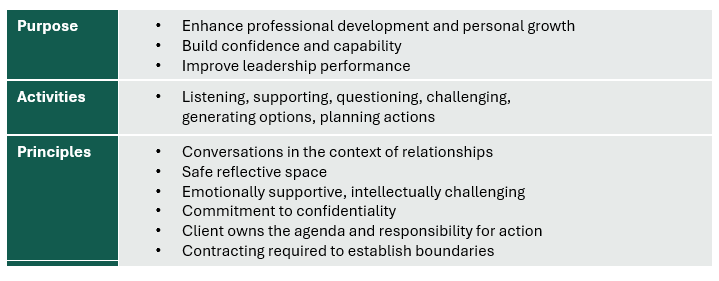
When it came to the distinctions between coaching and mentoring, the central theme that arose was that mentoring involves the use of experience in a way that is different from coaching.
I think mentoring, for me, is much more about sharing experiences, sharing learning, helping to develop somebody in terms of just showing them what are the possibilities of doing things differently. (Susan, Chair)
However, it is more difficult to encapsulate the ways in which coaching is distinct from mentoring, for two reasons. Firstly, whilst most stakeholders described coaching as less directive than mentoring, some argued that coaching is more directive, because it involves giving instruction on how to carry out certain tasks more effectively. Secondly, the practice of mentoring is not only about sharing experience. It also involves various coaching behaviours, like listening and questioning, so the two disciplines seem to be inherently entangled.
Hybridisation between coaching and mentoring
Given this lack of clarity, a central challenge in the study was attempting to distinguish between the different roles played by coaching and mentoring in addressing the leadership challenges of charity CEOs. In an initial round of analysis, the four dimensions in the contextual framework proposed by Stokes et al. (2021) were used as a basis for categorising the different types of relationships that charity CEOs had experienced with external coaches and mentors (i.e. learning objectives, economic nature, time frames, coach/mentor skill sets). However, this approach was unproductive, as a “hybridisation” of coaching and mentoring was found to be occurring in the way these relationships had been established (Garvey and Stokes, 2022, p106).
In most instances, the objectives set for coaching and mentoring relationships included a combination of both performance and learning/growth objectives, as opposed to one type or the other. Many relationships had been offered pro bono, or at least at discounted rates compared to the private sector. Contracts had usually started with short, 6-month terms, but had often extended to last several years if they had been effective. Finally, a trend was identified towards most mentors and coaches having a blend of relevant leadership experience and professional coaching expertise, rather than one or the other. For this reason, very few examples were identified of charity CEO relationships that consistently exhibited the characteristics of either a typical coaching or mentoring discourse.
Four forms of coaching and mentoring
Faced with this dilemma, further data analysis eventually led to an important insight about the significance of the behaviours involved in coaching and mentoring. Alice (Coach) explained how any coach or mentor is constantly facing a range of “choice points” about the types of behavioural intervention they can make in their conversations with CEOs. She went on to explain that “you can prescribe, you can provoke, you can ask in certain ways or you can simply listen”.
Viewing the things that go on in coaching and mentoring conversations as ‘behavioural interventions’ rather than ‘activities’ helps to clarify how people tend to make sense of the similarities and differences between each discipline. For example, stakeholders all agreed that mentoring, just like coaching, involves activities such as listening, giving emotional support, asking questions and providing challenges. However, when these activities are being carried out, they would typically describe the behaviours involved as coaching behaviours, rather than mentoring behaviours. As Clive (CEO) observed, “for me, coaching is weighted towards questioning”. In contrast, behaviours such as recounting stories and suggesting ideas were seen as mentoring behaviours. As a result, one of the main reasons that coaching is difficult to distinguish from mentoring is that mentoring activity uses many coaching behaviours.
By focusing on the types of behavioural intervention involved in coaching and mentoring dialogue, four different forms of practice were identified.
The practice of
There is also a different form of coaching which helps clients develop new technical knowledge or professional skills. For charity CEOs, this
The final form of coaching and mentoring is a
Figure 1 maps the interrelationship between these various behaviours. It draws on the concept of a directive-nondirective spectrum established by Downey (2014). However, analysis of this study’s data has inspired the novel distinction between the directive behaviours involved in sharing experience versus sharing expertise, reflecting the differences between Aristotle’s concepts of phronesis and techne (Flyvbjerg, 2012).
By understanding the different forms of coaching and mentoring in this way, it becomes possible to construct some distinctions between them at a more detailed level in terms of their purpose, principles, activities and behaviours. Table 2 describes the characteristics shared by all forms of coaching and mentoring, as well as the distinctive features of ‘non-directive coaching’, ‘skills coaching’, ‘mentoring’ and a ‘fluid’ combination of all three. The details have been based primarily on the study’s data, but the overall construction has also been influenced by the conceptualisation of different forms of coaching and mentoring developed by other scholars (Downey, 2014; Passmore, 2020: Cox, Bachkirova and Clutterbuck, 2024).

The two-dimensional spectrum of coaching and mentoring behaviours involved in addressing the leadership challenges of charity CEOs

Descriptions of the similarities and differences between different forms of coaching and mentoring for charity CEOs

Characteristics of different forms of coaching and mentoring
Based on this analysis, it became possible to categorise more clearly the different relationships that charity CEOs had experienced with external coaches and mentors. The distinctive characteristics associated with the four forms of coaching and mentoring just described were evident in the variety of relationships in which charity CEOs had been engaged.
‘Non-directive coaching’ relationships focus on helping CEOs to work through their challenges for themselves. Special attention seems to be given to helping them manage their own emotions and those of others. A consequence is that the professional coaches involved often have additional training in psychological or relational techniques.
‘Skills coaching’ tends to be most oriented towards leadership development. The relative lack of leadership training and career pathways provided for high-potential managers in the charity sector means that first-time CEOs often need some support in this area. This form of coaching typically requires coaches with leadership expertise and experience, and it is also the one that is most likely to be paid for.
‘Mentoring’, on the other hand, is more concerned with broadening the perspectives that CEOs bring to their leadership challenges. This is often done by engaging with a mentor who has charity experience. However, many charity CEOs also value the opportunity to learn from the private and public sectors. The career profile of a mentor is, therefore, a key determinant of their potential to add value, and ‘mentoring’ is also most likely to be offered on a pro bono basis.
Finally, in relationships that are more ‘fluid’ in nature, the agenda tends to focus on responding to the various challenges that arise for CEOs over time. In this scenario, coach-mentors require a suitable blend of coaching skill and leadership experience and expertise.
There is an important proviso when studying the roles of coaching and mentoring in this way. As warned by Garvey and Stokes (2022, p.19), “misplaced concreteness” can result if attempts are made to define differences between coaching and mentoring in too discrete a manner. Even when relationships appear to have the features of one of the four forms of coaching and mentoring, the reality in practice is that the differences between them are blurred. The dialogue involved in many conversations is likely to involve a range of behavioural interventions, not just the type associated with that particular form of coaching and mentoring. It is quite possible that in any given relationship, a CEO might have different objectives which require different coaching or mentoring approaches. Many examples also existed of relationships between a CEO and their coach or mentor having lasted several years, with their relationship profile evolving over time.
On this basis, whilst it is helpful to be cognisant of the differences between the forms of coaching and mentoring, defining distinct roles for them in addressing the leadership challenges facing CEOs is not possible, and potentially misleading. The conclusion that Garvey and Stokes (2022, p.18) come to that coaching and mentoring are both “the same and different” seems apposite. To fully appreciate the roles of coaching and mentoring, it is at least as important to understand the similarities between the various approaches.
The similar roles of coaching and mentoring
There was a strong belief amongst all the stakeholders interviewed that both coaching and mentoring can play an extremely valuable role in helping charity CEOs address their leadership challenges. Many of the CEOs asserted that their investment of time, and in some cases money, had made a big difference not just to their own performance, but to that of their organisation too.
It’s helped me navigate and tackle some of the thorniest challenges I’ve faced in the last five and a bit years, and I think we would be in a worse place as an organisation if we hadn’t made that investment. (Cameron, CEO)
Charity CEOs often derive support from a variety of sources in their personal network. Informal coaching and mentoring conversations can potentially take place with people ranging from family members, friends, colleagues, chairs, trustees and peers in other charities. Within this network, CEOs perceive a distinct role for external coaches and mentors based on their ability to create a safe space, in which CEOs have time to think and to talk through their issues and worries. A crucial enabling factor is the independence and objectivity of the coach or mentor, which means they have no conflicting agendas or relationships.
I’m really wanting to talk it out in quite a safe way, say things that I probably wouldn’t say to my chair or to my colleagues, and get a few things off my chest. (Camilla, CEO)
One of the distinctive characteristics of the leadership challenges facing charity CEOs is that their challenges tend to be relatively intense emotionally, owing to their values-based motivation and the concern that CEOs and their stakeholders feel for their charity’s cause and its beneficiaries. Coaching and mentoring conversations provide CEOs with opportunities to express this emotion, helping them come to terms with it and feel more supported. Many CEOs talked in the interviews about needing a “release” or “escape valve”, which enabled them to “offload” and “share their fears and concerns”.
Coaching and mentoring conversations also enable CEOs to stretch their thinking, giving them time to explore new potential ways of framing and addressing the issues with which they are grappling. Several coaches and mentors described how they facilitate this by giving CEOs space to “think out loud” and by “holding up a mirror” to reflect back what they are hearing. Celia (CEO) spoke about her coach helping to “drag some of the clarity out of me!”. Ultimately, coaching and mentoring can stimulate a CEO’s learning and help to generate changes in their mindset, action and behaviour. Clive (CEO) observed that the most useful sessions were those that led you to “change practice, change your behaviour, change the way you’re thinking”.
For all these reasons, coaching and mentoring seem to have the most impact for charity CEOs at a personal level. However, another important finding is that changes in the ways that CEOs see both themselves and the challenges they face, also generate effects relationally with their stakeholders and strategically for their organisations. By reflecting carefully on their approach to handling conversations and building relationships, CEOs can strengthen people’s engagement in their leadership agenda. Celia (CEO) explained how she had struggled to “bring other people along” with her plans for change and make them “a whole-organisation endeavour”. Her coach had helped her “think through the narrative”, because she recognised that a lot of people’s engagement depends on “how you speak about it”.
In addition, the shifts that take place in a CEO’s self-awareness and confidence can affect the way in which they show up as individuals, influencing others through the way they are being, not just through what they are saying or doing. This relational effectiveness is particularly important for charity CEOs, given the complexity of their stakeholder landscape and the emotive nature of many of the issues involved in charity work.
I think for senior leaders doing difficult jobs it can help them understand a bit about why they might do what they do, why they might behave as they do, why they might respond as they do, where their sensitive spots are. (Paula, Professional Body)
At a strategic level, the opportunity to take time out to think more broadly and systemically is also extremely valuable to some CEOs. When short term operational and financial pressures are intense, coaching and mentoring can reorientate CEOs towards the bigger picture. Cameron (CEO) described how helpful his coaching had been in enabling him to “step back and think about the strategy as a whole”. This kind of reflection can help keep CEOs focused on their organisation’s core values and purpose, as well as on their wider responsibilities at a systemic level.
Discussion
The lack of clarity and consistency in the way that stakeholders in the UK charity sector refer to coaching and mentoring supports the point of view, reached by many scholars, that there is widespread confusion about the meaning of the terms (Western, 2017; Garvey and Stokes, 2022). This lack of common understanding seems to be a constraint on the broader adoption of coaching and mentoring within the charity sector.
When faced with this complexity, several contributors to the study made the point that what matters most in a coaching or mentoring relationship is an aligned understanding of what is taking place in practice, not what you choose to call it. Brockbank and McGill (2012, p.10) support this perspective, arguing that “the name of the activity is less important than its purpose and what is actually happening, as this will influence the learning outcome”. It is for this reason that focusing on the types of behaviours involved in coaching and mentoring is so helpful in distinguishing between different forms of practice.
The frameworks in Figure 1 and Table 2 shed light on two significant causes for people understanding coaching and mentoring to mean different things. Firstly, they help to explain why differing views exist about whether coaching is directive or non-directive. Cox, Bachkirova and Clutterbuck (2024) observe that a shift has taken place in the coaching discourse in recent years, from referring to task-orientated, directive interventions to more developmental, non-directive interventions. The differences between these approaches can be clarified by distinguishing between the more directive ‘training’ behaviours involved in ‘skills coaching’ (i.e. guiding, informing, instructing) and the less directive ‘coaching’ behaviours involved in ‘non-directive coaching’ (i.e. listening, supporting, questioning, challenging). Secondly, the spectrum helps to clarify why the practices of coaching and mentoring are often seen as difficult to separate (Passmore, 2007). This is because ‘mentoring’ practice is not only perceived to involve ‘mentoring’ behaviours (i.e. recounting, suggesting, advising), but less directive ‘coaching’ behaviours too.
Being more specific about the behaviours involved in coaching and mentoring offers several other useful opportunities. Firstly, by being clearer about the role that a charity CEO is wanting a coach or mentor to play, they are more likely to match themselves with someone equipped to provide the appropriate form of support (De Janasz and Peiperl, 2015). Both parties can also align their expectations upfront about the kind of practical activities that they will be involved in together. Given the range of strategic, relational and personal challenges CEOs face, it is quite possible that different styles of intervention might be required for different topics (Howard et al, 2010). If coaches and mentors become more conscious of the behavioural choices available to them, they will be more able to adapt and signal their approach in ways that address their client’s challenges in the most helpful ways possible (Passmore, 2007; Clutterbuck, 2008).
When coaching and mentoring are understood to be characterised by certain types of behaviour, another conclusion is that they can manifest themselves in conversations with many different stakeholders in a charity CEO’s network, not just external coaches and mentors. The priority for charity CEOs is to embrace the learning opportunities provided by these many relationships and to frame conversations in ways that help them realise this potential in practice (Yip and Kram, 2017; Garvey and Stokes, 2022).
The study endorses the conclusions of other researchers that a distinctive and valuable role exists for external coaches and mentors. Their independence and objectivity, combined with an appropriate blend of professional expertise and experience, means that CEOs can explore a range of challenges with them that are too complex, emotive or personally sensitive to discuss with anyone else (Western, 2017; Garvey and Stokes 2022). The generative dialogue that takes place in these conversations enables charity CEOs to form new ways of framing and approaching their challenges (Armstrong, 2012). This enables them to lift not just their own performance as leaders, but the performance of their teams and organisations too (Howard et al, 2010).
Conclusion
This study has explored the roles that coaching and mentoring play in addressing the leadership challenges of UK charity CEOs. A hybridisation was found to be taking place between the characteristics of coaching and mentoring at a contextual relationship level. However, by focusing on the behaviours involved in coaching and mentoring, similarities and differences were identified between four different forms of practice: ‘non-directive coaching’, ‘skills coaching’, ‘mentoring ‘and a ‘fluid’ combination of all three.
Although these distinctions are not clearcut, they provide a useful framework to help strengthen the provision of coaching and mentoring for charity CEOs. By clarifying the roles that coaching and mentoring can play, charity CEOs will be more likely to seek these forms of personal support. They will also be better able to contract with coaches and mentors equipped with the experience and expertise necessary to address the particular challenges they are facing. In addition, when working with these coaches and mentors, conversations will be enhanced by both parties having a more conscious and shared appreciation of the different behaviours involved in different forms of coaching and mentoring dialogue.
Given its constructionist stance, the study’s findings and conclusions relate only to the roles of coaching and mentoring in the particular setting of addressing the leadership challenges of UK charity CEOs. On this basis, further research would be beneficial into the roles that coaching and mentoring play in supporting CEOs outside the charity sector. Particular focus could be given to the role that different behaviours play in helping to distinguish between the practices and impact of coaching and mentoring.