




Abstract
A search of two leading coaching psychology journals uncovered a gap in the coaching psychology literature regarding the concept of self as multiple. In this paper four premises are provided as to why we need to acknowledge multiplicity in coaching psychology. Mentions of multiplicity already current in the psychological literature are explored, with reasons as to why the concept is so important to coaching psychology. Finally, a 30-year journey shows how a coaching model, which incorporates “The Multiplicity Thesis” was created upon the foundation of 6 theoretical perspectives, with observations from a client, to show conceptually how the model plays out in a professional context.
1. Introduction
In the coaching psychology literature, there is a gap relating to the otherwise well-researched topic of multiplicity. Because of this gap, coaching interventions which explicitly address the coachee’s experience of multiplicity across both context and time seem to be lacking. A search of two leading coaching psychology journals, The International Coaching Psychology Review (ICPR) and The Coaching Psychologist (CP), returned various mentions of the words “multiple” (286/156) and “multiplicity” (7/27) in May 2022. However, despite the liberal use of these adjectives to describe the many facets of coaching psychology, such as factors, boundaries, domains, agendas, identities, layers, levels, models, instruments, stakeholders and more, neither word was used, at least in a paper title, to refer to the self. I regard this as a symptom of something missing in coaching psychology that this paper will elucidate: the idea that the self has multiple parts, and that coaching interventions can fruitfully capitalize on these to bring about deep personal change. The near absence of this idea in the coaching psychology literature mirrors the findings of Rowan in the context of personality psychology (1990). He says despite many references to multiplicity and sub-personalities in the psychology literature, ranging from Freud and Jung to Assagioli or Redfearn, “all the time we are talking about the same thing: this thing which is not mentioned in the textbooks of personality” (Rowan, 1990, p.8. my emphasis).
The main idea behind the multiplicity thesis is to emphasise the difference between role-playing and role-taking (Sarbin, 1972), the latter being characterised by a greater degree of subjective involvement and identification with the role and belief in it. This is more aligned with the 7Cs coaching model (7Cs), thus different behaviour, and showing up differently in different contexts cannot be fobbed off as a situational adjustment within an overarching singular personality. Rather it calls for a framework which epistemologically recognises - literally a different person is operating within that context. What appears to distinguish this understanding of multiplicity from the other 40 authors between Freud and Redfearn is, in Charles Tart’s (1986) definition: “a unique configuration or system of psychological structures or sub-systems…to which the sense of ‘I’ is given” (Rowan, 1990, p.9).
An exceptionto the gap in the coaching psychology literature mentioned above is Dodwell (2020), whose paper mentions ‘multiplicity’14 times, twice as many mentions as any paper in the ICPR or the CP. Dodwell seeks to understand how coachees can rediscover a lost sense of self, drawing on Stevens (2002) and Bachkirova (2011, 2022). However, Dodwell only sees multiplicity as one of several alternative possible perspectives on the self. For her, depending upon what has triggered the coachee’s lost sense of self, other constructions might be considered, such as a unitary-self, a dynamic-self, or no-self. In contrast, the approach developed here, as part of the 7Cs of coaching, views multiplicity in a more encompassing way – namely as a natural extension of the social constructive and psychodynamic perspective which is one of its foundational theoretical concepts.
In particular, 7Cs is committed to what I term the multiplicity thesis. This says: the self consists of multiple parts, many of which are complex enough to be full-fledged personalities. Drawing on Watkins and Watkins (1997) and Rowan (1990) the multiplicity thesis gives a plausible metaphysical account of the nature of the self. But rather than argue this on metaphysical grounds, my aim here is to argue for it pragmatically – by showing that it provides an extraordinarily useful tool to facilitate personal growth in coaching-psychology interventions. The argument for the usefulness of the multiplicity thesis in coaching psychology draws on four initial premises, and the fact that multiplicity as an everyday phenomenon has already been widely discussed in the psychological literature, (Hilgard, 1977; Elster, 1986; Rowan, 1990; Watkins 1993; Watkins and Watkins 1997, Radden, 1996; Schwartz and Sweezy, 2020). It also draws on the way in which it features in the 7Cs model, (Bates, 2016; Grimley, 2005, 2013, 2020, 2021, 2021b), and an initial description of how 7Cs was created during an Action Research journey (McNiff and Whitehead, 2000, 2006). How these four premises are prominent in a coaching psychology intervention is also articulated through a description of the 7Cs process by a coachee for pedagogical purposes.
I begin in section two by stating and then developing four premises as to why we need multiplicity in coaching psychology. I then share the extant psychological literature demonstrating the richness multiplicity brings to the coaching psychology space and its validity as an operationalized concept. In section four I show how 7Cs capitalized on these understandings and was developed during an action research journey, and provide a coaching psychology client’s perspective on operationalizing the multiplicity thesis. Section five looks at key theoretical perspectives supporting the 7Cs model, and section six looks at the key methodology of 7Cs - that is modelling and why dissociation is important in this context. Section seven looks more closely at multiplicity itself, with section eight fielding objections and replies. Finally, I conclude in section nine.
2. Why do we need multiplicity in coaching psychology?
There are at least four reasons why coaching psychology needs the multiplicity thesis.
1) Context. Personality psychology tends to posit that people have stable traits across different contexts (Costa and McCrae, 1994). However, even Gordon Allport, a key mover in early trait psychology, said that:
The ever changing nature of traits and their close dependence upon the fluid conditions of the environment forbid a conception of self that is over-rigid, or over-simple (Allport, 1937, p.312).
Indeed, during the course of any day, a coachee enters many contexts. These call upon different skills, behaviours, language use, and the appropriate internal unconscious architecture to support them. One might think that the coach can address the needs of different contexts without going so far as to posit the multiplicity of self. After all, ever since the person-situation debate launched by Fiske (1974), we understand people can make situational adjustments. For instance, the aggregation of many different behaviours in creating the higher order concept of an abstract trait allows people to behave differently in different contexts, yet still be representing the same personality trait (Epstein, 1979). Concerning apparent consistency, we find if someone values a trait more, they will show less change concerning that trait in different contexts (Bem & Allen, 1974). But this view is overhasty within coaching because clients come to us to move towards and past the third standard deviation - in other words excellence and separation from the norm. Once we have developed within a particular context, over many years using deliberate practice (Ericsson, 2016) and demonstrating “Grit” (Duckworth, 2016) to perform consistently at this level, we discover when in the performance zone that we often identify as somebody different to whom we normally are when not in that context. As we will see this is because when we have spent years sculpting and creating a persona (superhero, in 7Cs language) who consistently excels in their performance, behavioural, cognitive, affective and attitudinal change occurs much more within that contextual performance than situational adjustment allows for.
Furnham, (2008, p. 210), makes the point the multiple intelligences referred to by both Thorndike, (1920) and Guilford, (1967), are not really intelligences but rather social skills or dispositions with multiple causes and multiple consequences. He argues we know that cognitive ability will only explain a third to a half of any outcome measure, and so the remaining half to two thirds must be made up by something else. He suggests that these multiple ‘intelligences’ fit the bill and are not so much cognitive variables, but rather social and personality variables. For example, Donaldson (1987) reported the ability to decentre in children aged only 3 years and 9 months and thus see something from the perspective of another, whereas Piaget famously was of the opinion, after his well-known three mountains task that children up to the age of 9 were bound by the egocentric illusion and could not decentre (Piaget and Inhelder, 1969, p 67). Donaldson suggests this extra cognitive flexibility demonstrated by children not even 4 years old is a function of the research being embedded in a social context within which the children could imagine their role, bringing in both the social and personality aspect, and thus were additionally motivated and equipped to provide the correct solutions through decentering. Likewise in coaching, it is hypothesized, only when we appropriately situate our coachee within the context within which their important outcome lies, can we then begin to coach effectively and purposefully.
The relevance of these social variables in arriving at appropriate coaching truths is alluded to by Lakoff and Johnson (1999, p.101):
But truth is not simply a relation between words and the world, as if there were no being with a brain and a body interposed. Indeed the very idea that beings embodied in all the concept-shaping ways could arrive at a disembodied truth based on disembodied concepts is not merely arrogant, but utterly.
Cognitive ability although discreet is also inseparable from multiple contexts: it is something inextricably interwoven into both the context within which we perform and also our own experiences, motivations, personality and perception.
In summary, coaching psychology needs the multiplicity thesis to do justice to clients because different contexts trigger differing experiences as well as the associated cognitive architecture from the past. However, the best way to perform effectively within that context is to align conscious and unconscious competencies appropriately within the present and future. In different contexts such competencies will be quite differentiated, and boundaries need to be created internally as well as externally.
2) Excellent performers use multiplicity language. Coaching is typically characterized by an orientation toward helping coachees achieve and sustain
Another reason for coaching psychology to take self-reports of multiplicity from top performers seriously is that many coaches employ behavioural modelling as a method for helping clients achieve excellence. Behavioural modelling requires paying close attention to how top performers achieve excellence. This means seeking to understand and embody not just the exemplar’s skills and strategies, but also their underpinning (conscious but especially unconscious) beliefs, attitudes, assumptions, values and identity. Emulating the exemplar at these deep levels facilitates coachees, with the coach’s help, to authentically recreate top levels of performance in target contexts. It can even generate further strategies and skill according to the systems concept of requisite variety (Von Bertalannfy, 1968). It could be argued that without thorough ongoing behavioural modelling, coaches are severely diminished in their ability to co-generate equal competence and capability for the coachee: rather they create a limited and pale copy of the exemplar, with little to no generative capacity to be autonomous and creative in the ways needed for excellence in future evolved contexts which typically differ in subtle ways from past contexts.
In summary, coaching psychology needs the multiplicity thesis to do justice to the experience of many exemplars for coaching clients striving for excellent performance.
3) A multiplicity framework makes sense of triggering, and utilizes it in coaching.
Even the most skilled among us find ourselves unexpectedly triggered in particular contexts. A trigger is simply a stimulus that elicits a reaction and is a perfectly normal, non-clinical, phenomenon. But if it elicits a buried and negative reaction, this not only surprises us, it may also surprise others and can even lead to career derailment. Memory experts generally sup-port the idea of “retrieval inhibition” or “lack of rehearsal” rather than “repression”. Also what they agree on and support, is the idea our memories are consistently reconstructed and somewhat malleable (Patihis et al. 2017). So contextualised painful aspects of our personal maps may become buried and lost and therefore not updated with empowering narratives. Following Korzybski (1994), I accept the map-territory distinction. In this sense all our experience, including stimulus-response contingencies are unconscious maps of previous learning and coping, used to navigate the present, some useful, others not. However, such maps are problematic when we project an unwanted learning or coping strategy onto others and judge them for it as a way to avoid recognising the unwanted patterned response, or map of the world, in ourselves. This indeed is how Freud conceptualised projection (Baumeister et al. 1998, p.1090). An example would be the bullied child, becoming a bully himself to deal with his hurt, yet not recognising or owning the fact he is a bully and blaming others. Our response to identical behaviours is highly contextualised and contingent upon specifics in the encoding process, (Tulving and Thomson, 1973). For example, bullying on the sports field (health context), or within family (intimate others context) is met with resourceful and possibly even playful behaviour, however bullying at work (career context), is triggering in a negative sense and the coachee finds themselves ineffective and un-resourceful.
If they think of themselves as a continuous personality across all contexts coachees may struggle to recognize why bullying in one context, for example, is met with resourcefulness, yet bullying in another context is highly problematic. The mind then deploys defensive manoeuvres designed to smooth over dissonances and thus protect the self-perception of singularity (Festinger, 1957). In contrast, if they are comfortable thinking of themselves as having different personalities – or different neurological and physiological circuitries – activated in different contexts, they may be more easily able to understand and accept how triggering arises in some contexts but not others, appreciating and owning more fully their own complexity and plasticity.
4) Multiplicity as a non-clinical phenomenon. If the three considerations just given for the usefulness of the multiplicity thesis are on target, then positing the multiplicity thesis is not only highly useful for coaching, but is also a promising way to conceptualize certain important facets of normal human experience. Yet the coaching psychology literature standardly consigns multiplicity to the realm of the clinical and abnormal (Ribáry et al., 2017).
Although there are extreme expressions of multiplicity that certainly belong in this realm, I suggest that the more mundane yet empowering expressions of multiplicity should be taken seriously for a non-clinical coaching population. In addition to the reasons just given, a further consideration supports this re-frame. It is that the coach’s main clientele are more apt to accept a coaching intervention that deploys the multiplicity thesis if multiplicity is not pathologized. This clientele consists of people who would wish for coaching without the stigma some associate with psychotherapy, (Bachkirova and Cox, 2004). Among other things, desire involves wanting to be perceived as coming from a normal rather than mentally ill population.
Sebo (2014) makes an analogous point. He argues that we all have at least some different beliefs, desires, and preferences in different situations, and can thus rationally do what we think is best from the standpoint of “part of me” while acting contrary to what we think at the time of action is best from the more comprehensive standpoint of “me.” Sebo argues that we should not assign such phenomena to the clinical realm with a diagnosis of akrasia or the like, because many of us do, in fact, think and act this way in everyday life.
If multiplicity really is a feature of fully functioning human beings, it stands to reason that a person can optimise the way in which their multiple parts work together to generate their desired outcomes. This orientation reflects the positive psychology idea expressed by Seligman and Csikszentmihalyi (2000, p.5):
The exclusive focus on pathology that has dominated so much of our discipline results in a model of the human being lacking the positive features that make life worth living. Hope, wisdom, creativity, future mindedness, courage, spirituality, responsibility, and perseverance are ignored or explained as transformations of more authentic negative impulses.
In summary, the multiplicity thesis reflects everyday experiences of context-switching and triggering, it reflects the way in which many exemplars of excellent performance construe their successes, and it does not belong only to the realm of the pathological. For these reasons, the idea that the self is multiple is worth taking seriously in coaching psychology. I turn now to how psychology already represents multiplicity in the extant literature.
3. Multiplicity in Extant Psychology Literature
My citations of Rowan (1990), Watkins and Watkins (1997), Schwartz and Sweezy (2020), and the clinical work on hypnosis carried out by Hilgard (1977), all attest to the idea the self has multiple dimensions. My intention here is to simply highlight that multiplicity as a concept in psychology has always been there, and to bring the reader’s attention to the fact it has been overlooked in coaching psychology specifically.
Rowan mentions psychologists ranging from Freud and Jung to Assagioli and Redfearn, and in between lists another 38 psychologists all of whom refer to multiplicity using their own bespoke vocabulary. Rowan himself uses the term “sub-personality”, which he characterizes as “a semi-permanent and semi-autonomous region of the personality capable of acting as a person” (Rowan, 1990, p.8).
Rowan’s definition raises the question, what is on the other side of that “semi-permanence”? Is there a permanence and an autonomy at a different categorical level, which allows the sub-personality to exist occasionally as being permanent and autonomous in various contexts? My response to this is yes.
Rowan (1990) goes further than saying that sub-personalities are a coalescing of patterns in response to recurring situations in life, or that they are a coherent system of behaviour and experiences with boundaries separating them from other such systems. He says they have a separate identity. However, he insists even when we work with an idea of sub-personality as something that the client identifies as “I” in the context at hand, we are still dealing with a normal population and not a clinical one. One might worry that this attitude to sub-personalities involves reifying them, i.e., treating them as though they exist: however, this is an ontological error. Sub-personalities are mere moments in a process of change and development which is life-long.
Clues as to what makes up the other side of the ‘semi-permanence’, is seen in the central control structure of Hilgard (1977), the ego for Freud, (1933), and the self as subject (the ‘I’), for James (1892) and Mead (1934).
I hope to show that, whereas James and Mead focused on how a person’s selves develop as a rather passive and unconscious response to their environment, 7Cs emphasizes that this construction of new selves, though still a social process, can be brought more under the conscious control of the “I”, and the self as subject. Indeed, aligning with the social constructive and psychodynamic perspective of the self, I regard the 7Cs formulation as promoting Freud’s intention
…to strengthen the ego, to make it more independent of the super-ego, to widen its field of perception and enlarge its organization, so that it can appropriate fresh portions of the id. Where id was, there ego shall be. (Freud, 1933, p. 99)
Rowan (1990) tells us the idea of sub-personalities has been with us for so long and is such a part of a natural understanding of who we are and how we operate, that even psychologists who do not work from a technical perspective and have little theoretically to say about internal dynamics find it present in their work. The following citation from Carl Rogers is representative:
The next morning Jan told me that the interchange about ‘the naughty little girl’ had initiated a self-searching. She realized not only was ‘the naughty little girl’ missing, but several other parts of herself had also disappeared during the last eighteen months: ‘I realise that to face life as a whole person I need to find those missing parts of me’. She said that for her, the interview had proved to be ‘a soul shaking experience’. The process that started in the interview appears to be continuing in her. (Rogers, 1986, p208 in Rowan 1990, p 25).
I will develop how both multiplicity and 7Cs draws upon the extant psychological literature later. Here I just wanted to give a sense of how ubiquitous the idea of multiplicity is within that literature, even when referring to a normal population.
I have argued that coaching psychology is missing something important by not assimilating multiplicity sufficiently into its models and techniques, despite a significant precedent in the broader psychology literature. I now turn to my final argument for the multiplicity thesis. In summary it says that this thesis arose organically as the best explanation for client data systematically gathered over a 30-year period. Drawing on the principles of action research as construed by McNiff and Whitehead (2000, 2006), I turn to this argument now.
4. The beginnings of the 7Cs model: Action Research
The multiplicity thesis arose from an action research journey undertaken over a 30-year coaching psychology career, from which the coaching formulation ‘7Cs’ gradually emerged, (Grimley, 2002, 2005, 2013, 2020, 2021, 2021b, 2022). A coaching formulation may be defined as a systematic methodology for gathering, analysing, and interpreting various sources of coachee data (Corrie & Kovacs, 2019. p.67).
One may think of action research broadly as a way of gaining knowledge from reflecting systematically on experience. More specifically, the action research cycle as characterized by McNiff and Whitehead (2006) can be seen as a sequence of prescribed actions, leading to improved performance and understanding in a generative and cyclical way. It is important to state I did not set out to do action research, however, reading of it later, I discovered the approach resonated with me far more than a quantitative approach which focuses on generalisations, often on the back of research which has more to say in the ‘discussion’ section than it does in the ‘results’ section. McNiff and Whitehead, (2002), point out that to reduce the theory-practice gap and to be true to themselves texts need to be a ‘living out’ of everything they have said so far, ‘a portfolio of my own professional learning’ (p.19), and, after Schon (1995), ‘a form of practical theorizing in action’ (p.3).
In one action research cycle of my journey using the template of McNiff and Whitehead (2006, p.9), I began by
Due to this
The 7Cs key coaching process variables are:
The
The
The client’s
The client’s
The client’s
The client’s
The facility of
These variables served 7Cs well early on. However, by 2005 something really caught my attention and triggered another action research cycle. My clients, when first presenting, carried themselves really well. Usually they were well dressed, articulate, intelligent, and could express themselves confidently. However, as soon as they began to talk more deeply about the area of concern which they brought to coaching, it was as though they lost all connection with their resourcefulness, and often became irritated, unsure, defensive, inconsistent, hesitant, tearful, and sometimes even aggressive. It was as though they became a different person. So, my next piece of action research was to look at the different contexts which my clients brought to my office to discover answers to this phenomenon.
The following list of contexts was developed from a principal component analysis (PCA) on the output (N=200) of a questionnaire administered to my clients designed to assess participants’ ability to deal with stress in these eight specific contexts:
Intimate Others (i.e., loved ones, close friends, family)
Work Colleagues
Interpersonal Skills
Money
Career
Health
Rest and Relaxation
Relationship with Oneself
The results showed that the only context variable to be reliably related to an experience of stress was the context of one’s relationship with oneself (the Super-Ordinate +1 ). I replicated this research 15 years later, with a different sample of 200 clients, discovering the same result. The output and weightings of the principal component analyses can be seen in Tables 1a and 1b below.
One Factor Solution (PCA) of 7Cs Model (Grimley, 2005)
Replication of PCA of 7Cs Model (2017) (in Grimley, 2020)
This part of the action research journey, was quantitative and the working hypothesis was by achieved by asking coachees directly about their experience of stress and then, hidden amongst general stress filler items such as, “I feel I control my destiny” and “I find it easy to relax each day,” asking about their experiences in each of the 8 contexts, in 8 separate items. In this way I would discover if any particular context was generally associated with stress. What I discovered was the only context that loaded into the one factor solution represented in tables 1a and 1b above, was the relationship with ourselves. Needless to say each of these items by themselves was inversely and significantly correlated with the stress score obtained in the statistical output. Turning this finding into a coaching strategy what I now realized was when I coached a client, even though the seven contexts are important, the real issue was their relationship with themselves within that context – the “plus-one” context. In other words, although it initially seemed that one of the first seven contexts was problematic for the client (e.g., interpersonal relationships, money problems, or career for example), what really needed attention was the underlying issue of how the client perceived and related to themselves within this presenting target context.
This dynamic can be exemplified when seen through the eyes of a client. Reginald was a successful telecoms engineer in charge of a national team for a sector leading company. He was very happily married with children and had no financial worries. However he came to me for coaching in the context of health, and the sport he enjoyed to keep healthy. He reported he was lacking both focus and self-belief to get to the place he really wanted. Already being a top 10 world ranked indoor rower, Reginald came to coaching to help improve his performance and thus help his rankings to climb further within the top 10. A lot of the coaching work involved modelling who Reginald already was when he performed at his best, after all he was a top 10 indoor rower already. He recognized when he rowed at his very best he not only was totally associated into his body, being intimately connected to his kineasthetic circuits, but he was incredibly focused and driven. He was focused on the outcomes which had been set, and driven by the desire to be better than he was, fueled by a belief he could be better. A lot of the coaching was bringing Reginald’s attention to the fact he already had the appropriate mind set and helping him see through images and videos of other top sportspeople how this was so. We began to discover that often he would allow himself to become distracted by other aspects (contexts) within his life during his workouts, and this had become an unconscious habit that he was not fully aware of. In summarizing his block of 10 coaching sessions Reginald said:
Where I believed I was the limiting factor, you enabled me to pull on resources I never knew existed within me. You seeded and created the environment for Reginald the Rock to grow and we reaped the benefits from this. What really helped was your enthusiasm and belief in me. You pointed out if others could do it, so could I and, by paying attention to the detail of my initial mind-set, recognized I was not using my resources effectively. The modelling projects and consistent use of pictures of top athletes performing at international events helped me understand how important physiology is to performance and how initially my mind kept wandering. Your persistent belief in me and re-structuring of key workouts that really stretched me, helped me to develop ‘Reginald the Rock’. The recognition that this person had a job to do, gave him permission to be so much more focused on the job at hand. My focus now is so much better and also means when my work out is done, I am able to attend with 100 per cent attention to other contexts in my life, knowing that during my time on the rower I have given everything and not held anything back. My improvement in performance and rankings speak for themselves. Thank you so much. (personal correspondence, with permission. 2021. Name changed.).
What was different within this coaching intervention and what made it uniquely a 7Cs coaching intervention was the deliberate use of dissociation for a particular moment of time and within a well-defined context to provide the client permission to create a specific and bespoke superhero who could achieve the desired outcome. During this framing it was important to attend to health and safety features, thus, during a workout in the house gym, permission for ‘Reginald the Rock’ to attend to house safety if he smelt smoke, or to children if there was crying, and all such eventualities were negotiated. To minimize such possibilities a part of Reginald’s workout preparation was to talk with the family and frame the next hour as one where everybody could live effectively without him and pay attention in a safe way to what they were up to. What also became clear during these sessions too was how much more intelligent a coachee becomes when they are in a mindset which has an outcome that is very important to them. This is similar to Donaldson’s (1987) discovery: when a context is highly meaningful and socially relevant to the needs at hand, a child can then decentre and become cognitively more advanced, when compared with a rather sterile three mountain task, which has no personal meaning attached to it. Similarly, it seems when a coachee fully embodies and becomes immersed in their outcomes within a particular context, they do not only become more creative and expansive in their thinking, but they are also increasingly able to embody those solutions in the moment and become more intelligent regarding their choices within that context.
In summary, the action research of 7Cs showed how the multiplicity thesis developed systematically as a response to concrete needs in coaching situations. In other words, it is eminently useful – and this is a further argument for incorporating the multiplicity thesis as a working hypothesis within coaching psychology.
5. Six theoretical perspectives
7Cs draws on six theoretical perspectives in psychology: the situational perspective of the self, the social-constructive and psychodynamic perspective, the experiential perspective, behavioural modelling, positive psychology, and Hilgard’s (1977) theory of neo-dissociation. There are other perspectives too, and it is for this reason 7Cs sits within a pluralist framework (Grimley, in Shams, 2022).
The
The
The emphasis on mapping the structure of individual experience extends beyond the coachee’s experiences however, and also encompasses the experiences of people whom the coachee wishes to use as exemplars. Mapping the coachee’s own experiences is primarily a diagnostic step; the ultimate aim is to transform her experiences in a way that facilitates personal growth.
This leads to
When a person is performing excellently, they are typically in a state of flow (Csikszentmihalyi, 1993). In such a state, the unconscious mind acts on behalf of the self, and the coachee has a positive experience as if the self did not exist. Flow, however, is arguably, at root, no more than the trance state familiar in hypnosis. Indeed, some researchers (e.g., Ashinof and Ahmad, 2021) regard flow as a hyper-focused state. As for hypnosis itself, with its emphasis upon focus amongst many other psychological variables (Wagstaff, 1998), 7Cs understands this as a form of neo-dissociation (Hilgard, 1977). The reason both flow and hypnosis are implicated in behavioural modelling is that without skills in this area, modelling only attends to the more subordinate areas, leaving the more influential areas, which are higher up and often unconscious, intact. This generates internal conflict when performing, which is the antithesis of flow (Dilts, 1990, figure 2).
Because of this, dissociation and systems thinking are key operating concepts within 7Cs and Hilgard’s Neo-Dissociation theory is the
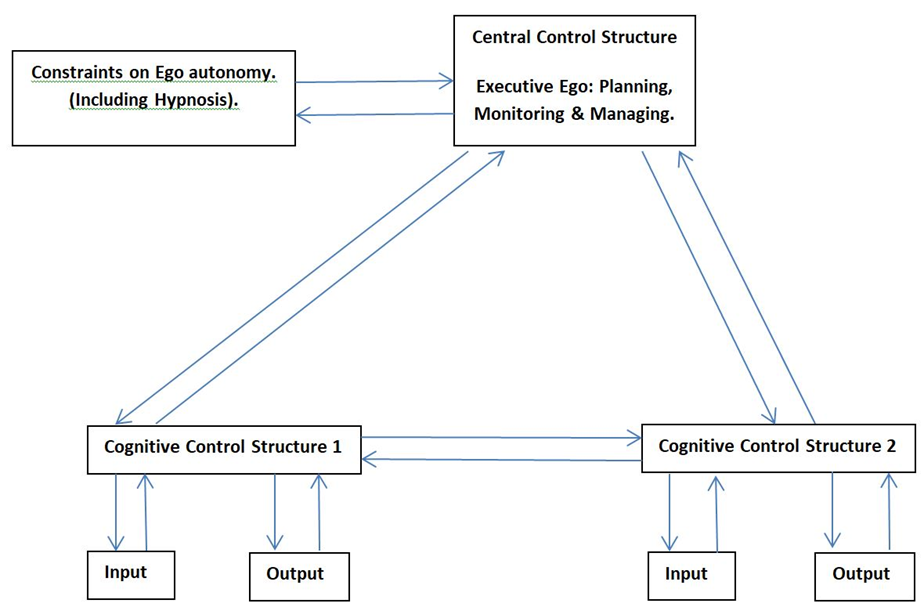
Dominant and Subordinate Control Structures (After Hilgard, 1977)
These cognitive sub-structures when highly developed within their own specific contexts generate their own hierarchy of sub-structures to such an extent they can operate independently of the person’s own CEC: for example, a writer or musician having a creative moment, a sportsperson in the zone, an experienced driver driving her car However, these roles are consistently monitored by the CEC, so at later times developments and improvements in the role (superhero in 7Cs language) can be written in when experience dictates this is necessary. It is this automaticity that provides the experience of flow and the sense of no-self that Csikszentmihalyi posits (1993).
However, the CEC is both complex and structured itself. It has two distinct aspects: an aspect that monitors the activity of specialised subordinate control mechanisms (superheroes) and the contexts in which they operate, and an aspect that assists in modifying and developing subordinate control structures in such a way that in an ever changing dynamic world, new items are integrated at appropriate levels within the subordinate structure (see figure 2). When superheroes are not particularly effective within a particular context, the monitoring aspect of the CEC, despite picking up on the lack of capability, often cannot activate the modification and development aspects in live time.
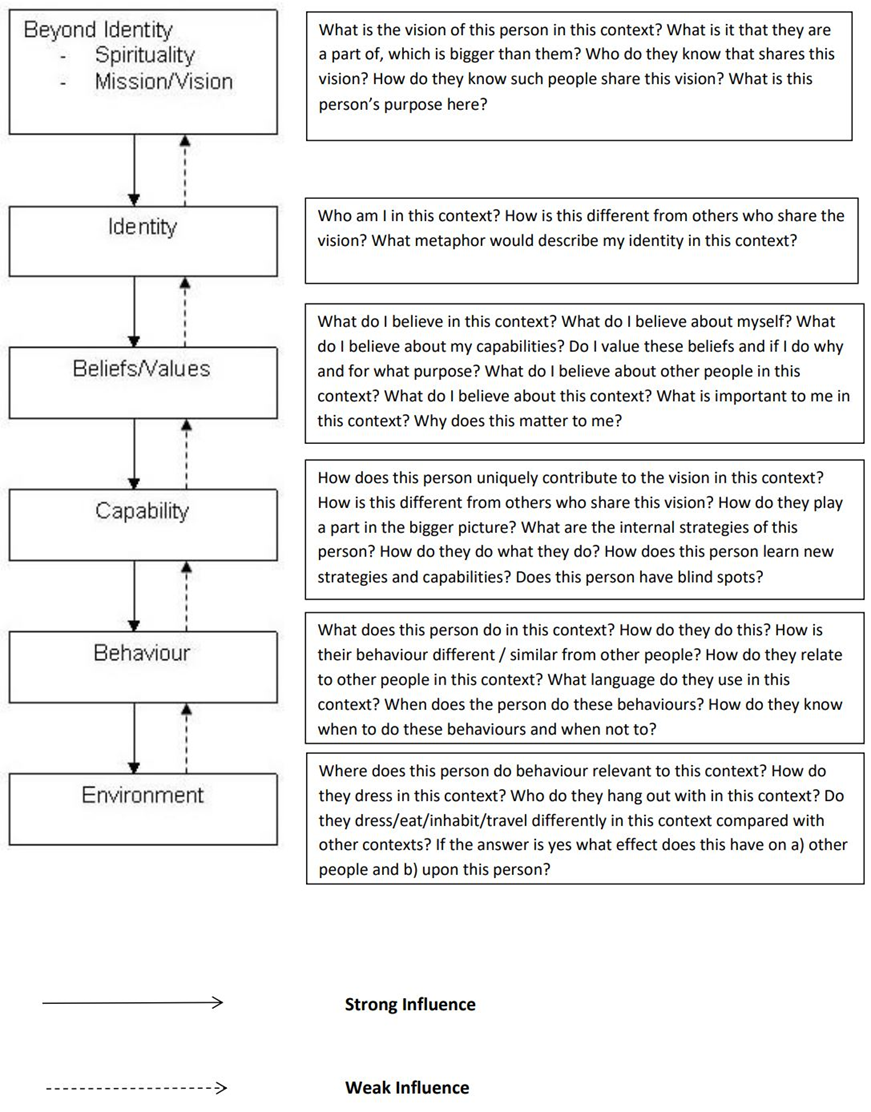
Neurological Model (After Dilts 1990)
This phenomenon is often experienced and then verbalised with such sayings as “I don’t know what came over me”, “I can’t help myself”, “I can’t do this, I am not that person” or “that was a silly thing to do/say”. Hilgard gives the clinical example of somebody suffering from Obsessive Compulsive Disorder, where the monitoring function is aware of the condition, however the executive control in this context is weaker than the subordinate control structure and thus unable to make the appropriate adjustments. Hilgard uses this distinction to explain how hypnosis works: The coach and coachee first agree on a hypnotic contract. The initiating and planning aspect of the CEC then “issues an order”(Hilgard, 1977. p231) to the monitoring function to reduce the amount of critical scanning and reality orientation; this facilitates the hypnotic induction, which readies the coachee for dissociative experiences by disrupting the ordinary continuities of memory and distorting reality orientation. Importantly, the client’s CEC is still active – it has merely granted temporary control of the relevant sub-structure to the coach, who is trained in hypnosis. It is this dissociation that allows the coach to guide the client in modifying existing sub-structures or co-creating new ones. Within a coaching intervention the coachee’s CEC dissociates itself into two distinct parts: a hypnotised part and a self-hypnotising part, and the client’s CEC remains in ultimate control. So, if the coach makes a sub-optimal suggestion, the hypnotised part passes up any suggestion that does not feel right to the self-hypnotising part that can correct any sub-optimal suggestion and substitute with one which she knows will be more effective and consonant with her goal. She then passes this back down to the hypnotised part which integrates and tests within the developed superhero.
Finally, the
The 7Cs formulation developed over a 30 year action research journey. The formulation thus reflects the epistemological assumptions of action research, since our theories are never totally complete but represent a personal journey, useful in the moment, but always liable to improvement and correction (McNiff and Whitehead, 2002, 2006).
With reference to the psychological literature, I will now show how 7Cs was built and continues to develop. I start by discussing why I believe multiplicity, at the level of identity, needs to be addressed more directly in the coaching psychology literature and will then show how the development of the 7Cs formulation addresses these needs.
6. Dissociation and Modelling
Dissociation is commonly regarded as a psychological defense in which someone avoids being fully present in situations they experience as difficult. In early psychodynamic literature dissociation is connected with hysteria and other clinical states (Gottlieb, 2003). However, there is a positive form of dissociation too, where the person dissociates into a state of flow in a task they are wholeheartedly absorbed in (Csikszentmihalyi,1990).
In the context within which the coachee wishes to perform at a higher level, yet finds they cannot, they often turn out to be anchored to a hitherto unexplored aspect of themselves, to which they are emotionally committed. This is due to the secondary gain this aspect of themselves receives from their un-resourceful behaviour. Take for example a coachee raised in a family that always emphasised safety and stability. Their CV is littered with public sector jobs providing all the benefits such an environment traditionally brings. They come to coaching because of an aggressive company takeover; the new company is high risk, fast-moving, performance-based, and micro-managed with a large staff turnover. The coachee, an executive in this new environment, lacks an internal part to match it. The part they do have does not know how to exist in this new situation, let alone excel. They can make small behavioural, linguistic and strategic changes, but this seems like merely sticking plasters onto their unconscious construct of the organisational world, which is clearly not fit for purpose within this new context. Often the coachee has become separated from their favoured cognitive, emotional and behavioural resources, because of a higher negative frame keeping the rest of the coachee’s internal structuring in a negative stuck state. In order to model an exemplar effectively it is important to dissociate from this “stuck state”.
One of many standard 7Cs moves is to have the coachee model the competencies they need in the target context from within a context where they feel competent. Take for example a client who is anxious about public speaking. When they address friends and family over a friendly dinner, they discover phenomenologically the experience is good and flows naturally. The coach and client then model that experience at each of the neurological levels and write the results down (see figure 2). This modelling project can then be anchored in a way that suits the coachee. One popular way of anchoring a constructed representation is spatially, e.g., “putting” it somewhere in the room, but there are others. After the experience has been anchored for the context in which the client feels comfortable (in this example, intimate others), we do exactly the same exercise, but this time in the target context – here, career. Often the anchored positive experience will transfer to the target context and organically deliver new unconscious resources there. We can aid this process by performing a contrastive analysis, which helps the coachee recognize what has changed, and at what level to enhance self-awareness of a new superhero in a new context.
Within the target coaching context, and the context where the client felt comfortable, there were two different “selves”. How could the client automatically address the 7Cs process variables in one context, but not in the other, despite both contexts requiring exactly the same behaviour? The answer can be seen in the illustration of the health and career contexts in Figure 3 below.
The root of the problem is the client perceiving him/herself as lacking capability. To put this another way, the client experienced stress. Extending the definition of Cooper and Palmer (2000) to reflect the 7Cs emphasis on the equal importance of each of the seven contexts yields the following characterization of stress: “Stress occurs when expectations exceed a person’s perception of capability in an area of importance” (Grimley, 2005, p.2). In other words, the client does not feel capable of doing what they expect (or are expected) to do in the target context which is very important to them. Importantly, the client maintains this perception of incapability at higher neuro-logical levels. At the level of identity, they are emaciated; at the level of beliefs and values, they have limiting beliefs; and at the level of capability, they have ineffective strategies. As figure 2 shows these levels are inter-related, any change at one level is highly likely to impact other levels. Thus, to sustain the change work, even if one is only working at one level, the other levels must typically change too. This means that, by the end of a successful coaching intervention, the coachee achieves an experience of personality change in the target context. Often at the level of identity the person literally becomes somebody else, in order to authentically discharge the required behaviour and language. That somebody else, like each of the client’s internal personalities, is a superhero.
Figure 3 contrasts two of the seven 7Cs contexts, Health and Career. In the context of health, the client, (or more specifically, the superhero active in this context), has addressed all the problems along their timeline using effective strategies, keeping a strong relationship with their self intact. Drawing on Hilgard, 7Cs hypothesizes this is the relationship between the CEC/Hidden Observer, and the context appropriate superhero. In contrast, in the context of career, the client (or more specifically, another superhero active in this context) has acquired negative ideas, with the result that, rather than congruently engaging in external behaviour promoting their Well-Formed Outcome (WFO), they hesitate, and act based on internal conflict generated by limiting beliefs and other introjected barriers. VAK in figure 3 represents the sensory and experiential bedrock of these negative introjections in Visual, Auditory, and Kinaesthetic modalities. In this context, what the client represents to other people is a mixture of who he genuinely is, and the negative accommodations he has acquired. The client represents this unconscious conflict and ambivalence externally in the target context through sub-optimal behaviour, language, beliefs, and strategies.
The client might gain felt relief from this conflict in various ways, for example through a rich fantasy life, or transference onto people who represent their superhero within this context, (such as a friend who is assertive in a way the client feels incapable of being in the career context); however, these are just coping mechanisms which do not improve the client’s subjective experience in the target context. A 7Cs coach will help such a client transform their sub-optimal career-context superhero so that they have the necessary values, beliefs, capabilities, and importantly identity, thus congruently exhibiting the necessary exemplary behaviours.
Interested readers can discover more about 7Cs elsewhere (Bates, 2016; Grimley, 2005, 2013, 2020, 2021, 2021b, 2022). The above is simply a brief introduction, with examples for clarification.
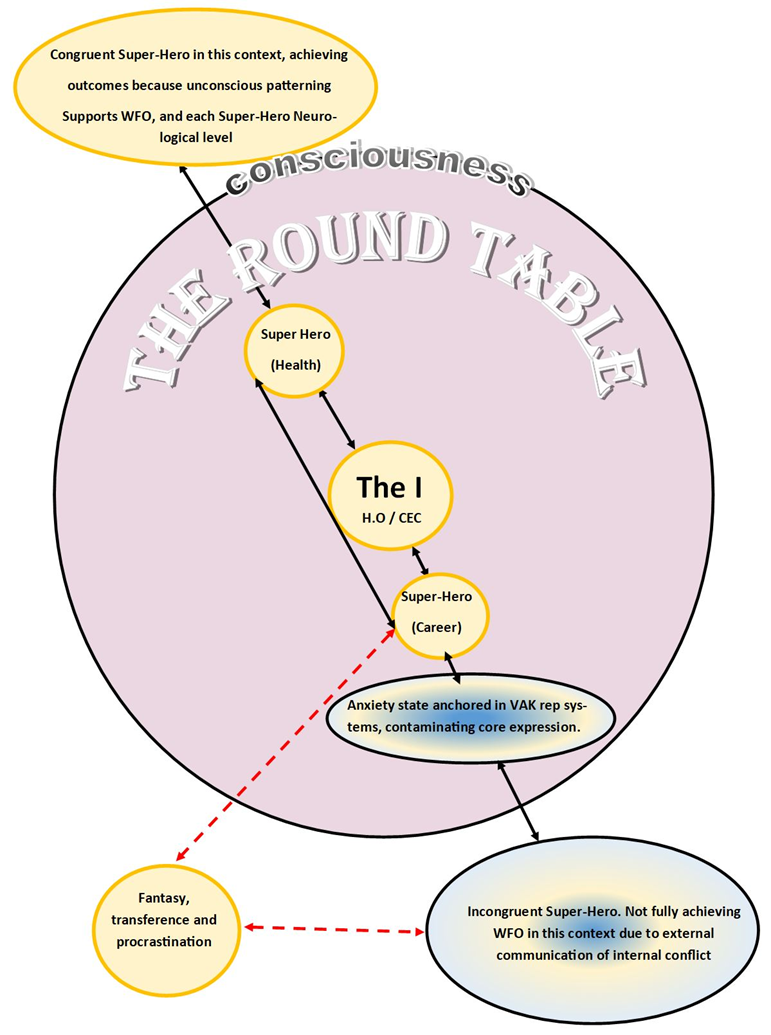
A psycho-dynamic/constructivist model of the psyche (after Grimley, 2013, p147)
7. Multiplicity
So, in my journey, what did I discover when clients, on entering the problem context changed so dramatically from resourceful to un-resourceful? Clearly, they were the same person, however, this context triggered a change in their emotional state, their beliefs, their perception, their capability, their behavior, and even their identity. In the problem context, a different complex had been activated (Jung, 1927), or a different ego state was triggered (Watkins and Watkins, 1997). These descriptions, (dissociations) also resonate with the Internal Family Systems (IFS) of Schwartz and Sweezy (2020) that views the psyche as a relational milieu populated by independent entities which, analogously to families (Satir, 1988), form a wider system (Schwartz & Sweezy, 2020).
The language of multiplicity is not just found in psychology, but also in common metaphors and phrases in everyday life. For example: “A part of me wants to but another part doesn’t”, “split personality”, “on Monday’s I get moody”, “conflicted”, “there is another side to that person”, “blowing hot and cold”, “I don’t know what got into me”, “being up or down”, “multi-talented”, “I’m a different person today”, “being in the zone”, “possessed”, “not in the mood”, “who (which version) turns up today?”, “you are not being yourself”, and so forth. These examples arguably attest to the validity of the multiplicity thesis in everyday experience.
In a scenario where two parts want different things, 7Cs takes this apparent multiplicity at face value, and encourages the client – or more specifically the “I” – to understand in which context they currently need to operate, decide which part is most appropriate for that context, and associate into that part, where associating into a part means adopting that part’s neuro-logical profile (Figure 2). For example, I am now writing a paper on multiplicity. However, there is a part of me that wants to go for a run to train for the World Duathlon Championships this year, there is another part of me that would like to walk the dog, and yet another part that would like to get a hot water bottle and snuggle up in bed. However, my current context, my career, makes those other parts totally inappropriate for the paper-writing task at hand, and to entertain them would invite conflict – also called incongruence.
Consider the example of the every-day language of multiplicity above, “A part of me wants to but another part doesn’t.” A natural interpretation is that the person uttering this sentence is meta-commenting on the conflict between two different parts. Thus the “I” belongs to a different and more complex category than the parts.
To explain what I mean by “more complex category”, I must clarify how I am thinking of the whole person in relation to the multiple selves. I can illustrate this idea with a metaphor for personal integration offered by Drazenka Milinkovi at the European Association for Neuro-Linguistic Psychotherapy conference (2022). She considers the Japanese practice of kintsugi, or gluing separate parts of a pottery piece together with gold. On the one hand, the individual shards are distinctly recognizable due to the gold supporting them from inside and joining them, yet also separating them. On the other, they are held together in a recognizable form, representing the whole person. Similarly, 7Cs suggests that, under the aegis of the whole person, the parts – or personalities, or selves, or superheroes – remain very much parts. In fact, they must do so in order to excel in their respective contexts. For each part itself, supposing that it is sufficiently developed to be a self in the sense of Dilts’ neuro-logical levels (1990), has values, beliefs, identities, and outcomes to achieve, and these may differ from those of other parts that become activated in other contexts.
Kintsugi; parts applied to coaching psychology with gold representing the diffused self at a higher neurological level connecting and directing diverse ego states unconsciously.

Thus, the whole person, contains two different types of entity within the self. The first type, superheroes, are fully formed subsequent to modelling (Bandura, 1977) and years of deliberate practice (Ericsson, 2016), and become developed enough to be called fully fledged “selves” within the multiplicity. Each superhero has its own overarching vision, identity, beliefs and values, particular capabilities, characteristic behaviors, and an environment in which it is activated, and these may differ significantly from those of other superheroes.
The second type of entity is the “I” and each person has only one of these. The “I” comprises two aspects. The first aspect is the set of all the multiple selves. Each of these selves represents one way in which the “I” expresses itself in a given context. But we must not make the mistake of Baumeister (2019) in thinking of the selves as mere “non-false self-concepts” that the “I” adopts as roles in different contexts. The fact that each self is fully formed along all seven of Dilts’ neuro-logical levels justifies calling them distinct selves. One role of the “I” is to mediate: if for example two selves have conflicting desires, the “I” can resolve this conflict by deciding to fully associate into either of the selves. But how does the “I” make this decision? It could simply be an unconscious complex anchoring between context and appropriate superhero. So, when you step up to the podium to give a talk you automatically become the appropriate public speaking superhero, within the context of career. The exact mechanism by which you make this transition requires more research to uncover. What is clear, however, is that the “I” has some capability of discerning which self to associate into in each context.
This capability, is the second aspect of the “I” and, importantly, is more than just the ability to associate into a given self in the appropriate context. It is also the ability to change, adjust, and adapt a given self when the context calls for it, and even create new selves in a bespoke manner according to contextual needs and the “I”’s own aims. Thus the “I” can tailor its selves to suit its own needs to perform excellently in a given context. In this way the “I” can refine or add to its structure of existing selves, to better represent, in any given context, who the “I” is. The “I” thus stands over, or beyond, its various selves, existing at a deeper level of complexity; this must be so if it is to exert this regulatory and generative capacity with respect to the selves.
The 7Cs formulation aims to strengthen this capability of the “I” to regulate and tailor its panoply of selves across the seven contexts. For sometimes the “I” needs help in exercising this capability to realize its goals – or more colloquially, the client’s goals – in a given context. Sometimes, due to hard knocks in life, the “I” develops selves that fit an early, difficult, context but are maladapted for later contexts in adult life. The 7Cs formulation, as described above through behavioral modeling and deliberate practice, enables the coach to assist a person in tailoring an existing self, or developing a new one, fit for purpose in the context of their present WFO. This is why 7Cs calls selves “superheroes”: they empower the “I” to realise its goals in any given context. This theoretical setup shares features in common with other views, but also departs from them in significant ways.
The categorical distinction between the “I” and the set of selves resembles Mead’s (1934) distinction between “I” and “Me”, which he borrowed from James (1892). In a similar way I agree that the multiple selves (which are analogous to James’ and Mead’s “Me”, i.e., to what they call the self as object) are socially constructed through the process of modelling diverse others and making use of language and other symbolic forms to facilitate communication. James believed that, due to the diverse contexts in society, the individual also had multiple selves fit for purpose, stating: “A man has as many social selves as there are individuals who recognize him and carry an image of him in their minds” (James, 1892, p. 46). I also agree that, whilst the “Me” reflects social influence, it is the “I”, (that is the self as subject), which ensures our individuality. It is the “I” which allows the self “to construct and organize its own self-knowledge even though this is always done within a context of multiple social influences” (Damon, 1983, p.12). Thus personality, from this viewpoint, is not (merely) biological, but highly social and situational.
That said, 7Cs differs from James and Mead in the following ways: I hope to show, whereas they focused on how a person’s selves develop in response to their environment, 7Cs emphasizes that this construction of new selves, though still a social process, can be brought much more under the control of the “I”. Indeed, aligning with the social constructive and psychodynamic perspective of the self, I regard the 7Cs formulation as promoting Freud’s intention to strengthen the ego, to make it more independent of the super-ego and with greater access to and communication with the unconscious mind. This categorical distinction also resembles the Hidden Observer phenomenon documented by Hilgard (1977). There, a higher part, (the Hidden Observer) commented on what the lower part (in his study, a person rendered hypnotically deaf, and in 7Cs language a superhero) was doing to entertain himself whilst being bored in a classroom demonstration of hypnotic deafness (pp. 186-188). What resembles the Hidden Observer is the capability aspect of the “I” belonging to a more complex category and adopting a meta-position to the parts themselves. That said, however, the capability aspect of the “I” in 7Cs differs from the Hidden Observer. The role of the latter, to observe and comment on the interplay between the various selves, is rather passive. In contrast in 7Cs the capability aspect of the “I” is one that regulates and governs the relationships between the selves, and generates new selves or moderates existing selves (or superheroes) where needed in a context. Despite this difference, Hilgard’s work, entitled “Divided Consciousness, Multiple Controls in Human Thought and Action” (1977), presents first steps to exploring the neuro-psychological underpinnings of multiplicity in everyday life and therefore also coaching.
Finally, in coaching psychology, a rare exception mentioning multiplicity at the level of identity is (Dodwell 2020). She allows for the possibility that some clients perceive themselves as “multiple selves”, contrasted with no self, dynamic self or stable unitary self, and recommends appropriate matching such as referral to hypnosis (Dodwell, 2020, p16). But Dodwell’s approach differs from 7Cs in two ways. First, Dodwell’s approach only uses multiplicity if the client is the first to bring this into the conversation. She also offers recommendations for working under the other self constructions. In contrast, 7Cs builds multiplicity into its core operations. Second, Dodwell’s approach is more open-ended, whereas 7Cs offers specific steps within a sound theoretical framework to show how a team of mini selves can be moderated or created, with reference to multiple neurological levels with a categorically more complex Central Executive responsible for the ecology of the whole system. The 7Cs coach, after establishing rapport, will inquire early on about context, seeking to understand how the coachee differs in their target context compared with other contexts. The idea of a Well-Formed Outcome will be front and centre of the coaching conversation to establish what is the attractor motivating the construction or modification of an appropriate superhero for the client. An exemplar for modelling purposes will be sourced, and so forth.
What if I need to perform a task for which I have no existing self to associate into? The coaching assignment here becomes to co-create such a part with the client, according to the necessary and modelled competencies discovered when generating a WFO (see section 6). The way forward is to be intimate with our own diverse superheroes, and recognize the unique talents they possess at every neurological level in appropriate contexts. Rather than have them fight with each other, the 7Cs coach helps the selves recognize which of them is most appropriate in any context, leading to an existence of “Successive Selves” throughout each day (Radden, 1996). This enables each self to deliver on the WFO under consideration in the target context.
What happens, however, when the context is not given by circumstances but must be chosen by the person? For example, imagine I must decide whether to spend my Saturday doing psychology or doing duathlon training, and both my academic and running superheroes want the time for their own goals. Neither will willingly cede to the other because neither automatically recognizes the context as unsuited to them. It is “I”’s job to decide which superhero takes precedence in determining how I will spend the Saturday. Does 7Cs claim that the “I” is simply able to dictate to the distinct selves? Surely this is unrealistic, for surely there will be cases when one self will not gladly cede the stage to another – for in another example, an angry self refusing to be tamed by a more cool-headed intellectual self.
This is why multiple WFO’s are necessary across multiple contexts. The competency of the “I”, with its greater complexity, is to assess during a mindfulness type exercise, preferably during the previous evening and then again in the morning for consolidation, how the day is going to go. Adopting a proactive and towards orientation during this exercise is key. It maybe the deadline for the psychology work is more pressing, and therefore needs to take precedence. During mindfulness type sessions, these communications and negotiations are gently put into place, so by the end of 30 minutes the whole team recognize, let us say, we will work on the psychology today, and do the duathlon training on Wednesday. Sequencing and timing thus are key considerations for the “I” in decision making processes. It is in this sense, 7Cs is hugely differentiated from DID (Dissociative Identity Disorder) APA 2013). There is consistent, constructive and daily dialogue, between superheroes to maximize the probability of WFO’s in multiple contexts being achieved and a proactive at cause orientation is maintained by the whole system. This is all conducted within the context of “Round Table” dialoguing (figure 3).
In summary, 7Cs posits a multiple self in the sense of, first, a set of parts, which when fully developed along Dilts’s neuro-logical levels are appropriately called selves; and second, an adjudicating “I” that has on the one hand a passive, monitoring aspect, and on the other hand an active, capability aspect.
8. Objections and Replies
One might object to this picture along the lines of Dodwell: surely there are likely to be interruptions from “their confused narrator who is battling with reconciling authenticity and multiplicity” (Dodwell, 2020, p17). This worry works from a picture of the reformed ego who already possess a versatile effective team of mini-selves. In response, within the 7Cs framework, this confusion only arises when the “I” is not fully confident of the context relevant superhero’s competency, or if one or more of the superheroes does not maintain its appropriate identity and role in its respective context. When they are fully competent and do maintain their respective identity and roles, as is the case in optimally functioning individuals, there is no confusion. For the “I” conducts the orchestra by choosing which self to associate into and when. If self 1 is at variance with self 2, and self 1 is activated in some context, then this is because the “I”, with its deeper level of complexity and overarching perspective, has granted “permission” to self 1 to activate, as indicated in the mindfulness type exercise above. The marginalised self 2 must then take a back seat and cede to this higher authority in the context under consideration.
Dodwell herself recognises that, when the selves cooperate as an internal collaborative team, a coherent narrative may result. Fingarette, (2000), however argues that such cooperation amounts to misrepresenting the individual selves due to a lack of authenticity brought about by an unwanted cooperation, (read; compromise), between the selves. Dodwell and Fingarette’s mistake lies in supposing that a conflict at the level of the selves (or superheroes) cannot be reconciled at the more complex level of processing at which the “I” operates. Thus, reconciliation and cooperation at the level of the selves is not necessary, and the necessarily bespoke competencies at the level of Superheroes can be retained. It is indeed those very individual and differentiated competencies which generate both success and excellence for the multiple selves, allowing them to achieve their context dependent WFOs. In different contexts, you literally need to be a different animal to succeed and excel, thus superheroes recognise and respect this difference.
7Cs recognizes that human beings, to operate in multiple potentially conflicting contexts, need multiple selves orchestrated by a control centre who knows which contexts to prioritize and when. This ability to develop bespoke superheroes for the contexts in which they are needed, and to develop them to such unconscious competence that they are contextually activated when needed, is a key factor in human excellence.
A second objection is this. The idea that the self consists of parts is already a common idea in psychology, including coaching psychology (Sebo 2014). Surely a coaching formulation can accomplish all it needs to without going so far as to claim that these parts are full-fledged selves, personalities or superheroes. This is exactly what I deny, and especially so concerning the psychology of excellence. A mere part need not be fully developed along Dilts’s neuro-logical levels, (figure 2), whereas a superhero does. It is this full development that enables the client, when (fully) associated into that superhero, to achieve excellence in their context. The higher levels (e.g., vision, identity, beliefs and values) are what provide the over-arching frame that orients the person toward the outcome in their target context, and energizes them to exercise the capabilities and behaviors at lower neurological levels to promote that outcome. A mere part that is not a superhero (or a self) lacks this full complement of resources, and thus the capability to deal with unexpected events which require requisite variety and generative ability to create excellent bespoke behaviours instantly.
A third objection might question 7Cs on the grounds that, with its encouraging of clients to associate into particular superheroes in particular contexts and thus dissociate from others, surely brings us too close for comfort to the well-known DID. In response, a well operating 7Cs client who has activated differently capable superheroes in the appropriate contexts differs in crucial ways from DID.
To see the differences, consider how DID works. In this disorder, dissociated parts operate independently of other parts and of controls at any more complex categorical level. It is for this reason that Billy Milligan, in the first ruling in history based on multiple personalities, was found not guilty of kidnapping, aggravated robbery and rape, even though it was uncontroversial that he did perform these acts. For responsibility can only be ascribed to whole persons (Radden, 1996, p. 269). In Milligan’s case, the crimes were deemed not to have been carried out by him, but rather at least one of his 23 separate parts, called at the time “androids” (Keyes, 1981, xiv). In somebody suffering from DID, their parts are separated from the higher cortical areas which are responsible for the ecology of the whole system of parts within the person, and also often from each other. Because of this, DID is always reactive and away from, and usually consequent to early trauma that occurred between the ages of 2 and 8 (Pica, 1999).
Let’s turn to 7Cs. The relations that it promotes between multiple selves is radically different from DID.
First, the selves in 7Cs are proactive and towards. This is towards the WFO agreed not just by the superhero in question, but by the whole complement of superheroes around the round table, under the auspices of the overseeing “I”. Rather than being triggered and thus out of the client’s control, they are activated – which is to say, the “I” is in control of their construction, and thus unconscious contextual activation. The “I” also ensures ecology with the other selves through creating a context and overseeing dialogue between multiple superheroes (the round table, figure 3). This dialogue may in the early days of the new superhero’s development be conscious, but with deliberate practice (Ericsson, 2016), will become increasingly unconscious, or automatic. Whether conscious or not, this executive control of the “I” ensures that the person remains responsible for their actions. Indeed, a well-functioning 7Cs client arguably enjoys greater self-control than before they began their 7Cs work, because 7Cs supports them in developing a well-honed system for being at cause in achieving their goals across life contexts as well as within life contexts.
Second, DID is a malfunctioning of multiplicity. That multiplicity can malfunction does not cast doubt on the idea that it can also function. As argued in section 2, multiplicity, and the associated phenomena (such as activation and excellent performance in a given context through a bespoke skill set) are parts of everyday life. Thus, not only does multiplicity have an important psychological function but we have also seen that it is conducive to excellent functioning. Because of this, since coaching presents us with growth-minded people who wish to obtain the highest prizes in life, a coaching framework with multiplicity of the self as an underlying presupposition is an advantage.
Thus far from cosying up too closely to a clinical disorder, 7Cs capitalizes on the normal functioning of healthy individuals to enable them, in a controlled and proactive manner, to promote excellence across all seven life contexts.
9. Conclusion
Attempting to condense an action research journey of 30 years into one paper is always going to be a tall order. However, in the above, hopefully the reader has a sense that in order to work with growth-minded coachees, a coaching formulation which encourages behaviour towards the 3rd standard deviation, which ipso facto is not normal, is indeed an advantage. As behaviour is always contextualized, we discover in different contexts that different language and behaviour is necessary for excellent performance. However, we also discover that, for that differentiation to be congruently and elegantly discharged in a consistent way over time, it needs to be supported by an associated internal and unconscious cognitive and affective architecture. The question of how to learn to elegantly switch at these deeper levels thus becomes another paper in itself. But with research from neuro-psychology, I contend that such flexibility is possible. For example, Szumowska and Kossowska (2017) found, although related to rigid cognitive style, “Need For Closure” (NFC) concerning tasks may enhance multitasking performance thanks to better focalisation on the main task goal and an ability to disengage in tasks unrelated to the main task goal and thereby generate better performances on multiple tasks. The gains of such an approach are interestingly alluded to when we discover Dr Harding, who was on the treatment team for Billy Milligan pointed out, strictly from a performance perspective: “The fused 23 personalities would probably be less than the sum of his parts” (Keyes, 1995, p. 368, my emphasis).
So, in conclusion, rather than invite the reader to open another fascinating facet of the 7Cs model, I would like to leave them with this paper as an introduction to “a way of looking at things” (to borrow from the title of Erikson, 1987) that might support their approach and provide them with another set of tools in their coaching tool-box.
Footnotes
Acknowledgements
The author wishes to thank Katherine Dormandy, Professor of Philosophy at the University of Innsbruck, for her analytic skills and support.