




Abstract
This paper examines students at a Hungarian university who participate as mentors in a programme designed to support primary school pupils from disadvantaged backgrounds. This study focuses on the sociocultural backgrounds of mentors, particularly their bicultural socialization. Data were collected through an online questionnaire based on a process-based framework. The results provide insights into the programme's effects on bicultural and monocultural mentors. Bicultural mentors emphasize supporting their communities, whereas monocultural mentors prioritise personal development. These findings contribute to a deeper understanding of mentors’ participation in equitable mentoring programmes by incorporating sociocultural perspectives into the analysis.
Introduction
This paper examines Hungarian university students who served as mentors between 2019 and 2022 in a programme called 'Let’s Teach for Hungary!' (in Hungarian: 'Tanítsunk Magyarországért!'). It is a structured mentoring programme in which university students serve as mentors to primary school pupils from disadvantaged backgrounds, including those from peripheral regions of the country (Papp et al., 2023). Roma students are disproportionately represented in the programme. Kende (2021), in her analysis of Hungarian education, emphasizes that the educational situation of Roma students is deteriorating across all levels.
Roma students are more likely to drop out (Kende, 2021) and become early school leavers (Kende & Szalai, 2018); moreover, segregation presents a significant barrier to accessing quality education (Kende, 2021). The 'Let’s Teach for Hungary!' programme is a cross-age peer mentoring initiative (Karcher & Berger, 2016) where mentors engage with their mentees in both school and extracurricular contexts, such as career guidance and leisure activities. The programme incorporates both location-based and community-based mentoring approaches (Sipe, 2005). In this paper, mentoring is defined as the relationship between university students, serving as mentors, and primary school pupils from rural areas, who are the mentees. In this study, mentoring is conceptualized as an equitable service aimed at supporting mentees' career guidance and preparation for secondary education. The mentoring programme seeks to prevent early school dropout in Hungary and to increase the number of youths obtaining secondary education certificates and vocational qualifications. While the impacts of the 'Let’s Teach for Hungary!' programme and similar mentoring initiatives are well-documented in the literature, research has seldom focused on the mentors themselves. This study aims to enhance the understanding of mentor development within mentoring programmes. Our research is novel in its analysis of mentors through the lens of their cultural and socioeconomic backgrounds. The programme includes children from disadvantaged backgrounds, and/or Roma children. Additionally, the mentors' socioeconomic and sociocultural backgrounds are crucial, with particular emphasis on the role of biculturalism.
Literature Review
Mentoring as an equitable service
Mentoring is applied in various educational contexts, particularly as a tool for equitable intervention with at-risk youth (Rhodes, 2005; Raposa et al., 2019; Raposa, Rhodes & Herrara, 2019). In the Hungarian context, inequality and the need for equitable services are pressing issues. Students from disadvantaged backgrounds often have limited career aspirations and fewer opportunities for further education. Additionally, they lack adequate or receive unclear career guidance (Bereményi, 2020). Hungary's largest minority, the Roma community, is affected by poverty and undereducation in a much higher proportion than the majority (Kemény, 2005; Bocsi, Varga & Fehérvári, 2023). Roma pupils face challenges related to their socioeconomic status (SES) and racial prejudice (Bocsi, Varga & Fehérvári, 2023; Varga, Fehérvári & Trendl, 2023). Research on the pathways of disadvantaged Roma adults to the labor market indicates that success requires a shift in perspective, much of which is influenced by family values and aspirations; however, institutional support is also crucial (Gerőházi et al., 2024, p. 25). In this context, the goal of mentoring is to offer equitable support to primary school pupils who encounter difficulties in advancing through the education system. Mentoring seeks to broaden pupils’ perspectives and to offer effective career guidance, which they often lack (Bereményi, 2020, 2022). Thus, mentoring strives to prevent dropout and early school leaving (Bocsi, Varga & Fehérvári, 2023) by assisting students in making more informed career choices.
Possible categorizations of mentor programmes
Mentoring can take various forms; however, the literature suggests that mentoring programmes can be categorized into distinct types. This subsection classifies mentoring based on key themes identified in the literature. Building on this foundation, the mentoring programme under analysis will be positioned within the conceptual framework of mentoring research, thereby defining its core characteristics. Mentor-mentee relationships can first be categorized by age and status. A distinction is often made between peer mentoring, involving a 0–4 year age difference, and cross-age peer mentoring, with an age difference of 4 years or more (Miller, 2002; Karcher & Berger, 2016). Literature suggests that a small age gap can be advantageous, as it may facilitate the development of a trusting relationship (Raposa et al., 2019). Additionally, there is substantial international research highlighting the unique benefits of peer mentoring (Schlesselman-Tarango & Durazo-DeMoss, 2020; Seerey et al., 2021; Sharp, 2021). Finally, according to Rhodes' (2002) definition, classical mentoring is characterized by a relationship between an older, unrelated adult and a younger individual. Mentoring programmes can be categorized as youth mentoring programmes based on the age of the mentees (Comfort, 2024). The initiation of the mentor-mentee relationship plays a critical role in the mentoring process.
Mentoring can be classified as either natural (informal and spontaneously occurring) or structured, which involves formalized guidance within an organized framework. Natural mentoring has been examined across different populations, including youth (Spencer, 2007), higher education students (Mullen, 2007), and adults (Dougherty, Turban, & Haggard, 2007). Any programme that is not naturally formed between participants—i.e., one that functions as an external or internal service—can be classified as a structured mentoring programme. Mentoring can also be categorized based on the educational or professional level of the mentee, including elementary and secondary school mentoring (Rhodes, 2005; Raposa, Rhodes, & Herrera, 2016; Spencer, 2007; Keller, 2007), higher education mentoring (Mullen, 2007; Johnson, Rose, & Schlosser, 2007), and workplace mentoring (Scandura & Pellegrini, 2007; Dougherty, Turban, & Haggard, 2007). Finally, Sipe (2005) identifies two primary mentoring subgroups: (1) location-based mentoring, which occurs within a host institution or school (Schenk et al., 2019), and (2) community mentoring, which is facilitated through community-based programmes. Additionally, some hybrid programmes incorporate elements of both location-based and community-based mentoring.
Mentors’ demographic background: bicultural mentors
Literature indicates that mentors' success and development are influenced by several factors, including professional background (Berei, 2020), personality traits (Lakind, Eddy, & Zell, 2014), mentoring experience (Beltman, Herker, & Fischer, 2019; Jones & Blankenship, 2020), and psychosocial background (Rhodes, 2005; Monjaras-Gaytan & Sánchez, 2023). Aspects of psychosocial background are connected to sociocultural similarities and ethnicity (Bereményi & Girós-Calpe, 2021; Garcia-Murillo et al., 2022), and the experiences of mentors and tutors within this context have been analysed (Orsós, 2018). The primary socialization of low socioeconomic status (SES) and/or Roma primary school pupils differs significantly from the institutional socialization they encounter in secondary education; they undergo bicultural socialization (LaFromboise, Coleman, & Gerton, 1993; Nguyen & Benet-Martínez, 2013; Stogianni et al., 2021). Biculturalism, the adaptation of individuals to multiple cultural contexts, has been extensively studied. While it was initially regarded as a disadvantage (LaFromboise et al., 1993), more recent research suggests that bicultural individuals—those familiar with elements of both heritage and dominant cultures—tend to achieve greater success across various domains of life compared to monocultural individuals, who are immersed in a single culture (Sam & Berry, 2006; Nguyen & Benet-Martínez, 2013; Stogianni et al., 2021). Successful bicultural socialization relies on a strong sense of identity in both cultures, as well as dual competence and the ability to navigate between the two societies (Varga, Horváth, & Trendl, 2024). This is particularly significant because recent research emphasizes the capital assets of minority communities, adopting a non-deficit-centered perspective (Durst & Bereményi, 2021; Durst et al., 2022). Furthermore, bicultural mentors can play a crucial role in reinforcing both identity and Roma cultural capital (Boros, Bogdán, & Durst, 2021). The overlap of socialization spaces plays a critical role in academic success. Key figures in facilitating successful bicultural socialization have been identified (de Anda, 1984). Hungarian research distinguishes between two types of bicultural actors: 'translators,' who are bicultural, and 'mediators,' who are members of the majority society (Forray & Hegedűs, 1998; Tóth, 2019). This study, however, does not adopt this dual classification; instead, it categorizes mentors into two groups: (1) bicultural and (2) non-bicultural, i.e., monocultural mentors. Mentors with similar socialization patterns to mentees are underrepresented in Hungarian universities (Varga et al., 2021). "Research underscores the importance of bicultural mentors, who share similar ethnic and demographic backgrounds with their mentees." (Bereményi & Girós-Calpe, 2021; Kraft, Bolves & Hurd, 2023; Coner, 2024). Identifying bicultural students is challenging, as the number of disadvantaged students in Hungarian higher education steadily declined between 2008 and 2018. In his study covering the period from 2015 to 2018, Proity (2020) reported that the proportion of disadvantaged students in higher education ranged from only 0.88 to 0.98 percent. According to estimates from the Roma Student College Network, the presence of Roma students at universities is even lower. We were only able to estimate the overlap between the two groups; therefore, we set the representation of disadvantaged and/or Roma students at 1.5/' (Varga et al., 2021, p. 74).
Research Objectives
The research investigates mentoring across three segments, employing a process-based approach (Varga, 2015) and guided by the following questions:
What were the goals of mentors when they joined the mentoring programme?
How do mentors evaluate the mentoring process, and what benefits do they emphasize?
How successful do mentors perceive themselves in achieving their goals within the programme?
Independent variables were introduced to examine variations in responses to these questions based on demographic data. In this study, mentors’ socioeconomic background serves as a key factor in analysing their perceptions.
Methodology
The analysed mentoring programme
The “Let’s Teach for Hungary!” mentoring programme was initiated in 2019 with the participation of four universities (Antalné Szabó, 2021). The mentees in this programme are predominantly of low socioeconomic status (SES) and/or Roma, originating from some of the most underprivileged regions in Hungary (Papp et al., 2023, p. 63). The long-term goal of the programme is to prevent dropout and early school leaving (Bocsi, Varga, & Fehérvári, 2023) by guiding students towards clearer career choices, supported by university student mentors. This structured, cross-age peer mentoring programme (Miller, 2002; Karcher & Berger, 2016) involves younger mentees and youth mentors (Rhodes, 2002, 2005). The programme is primarily based on non-formal learning contexts, functioning both alongside school activities and through off-school initiatives, in which mentors are encouraged to participate extensively (Papp, 2022). In the analysed programme, all pupils within the selected classes are included without any selection process. The average mentee-to-mentor ratio is 3–4, characterizing the programme as a group mentoring model (Jones, 2016). University students from participating institutions can voluntarily enrol in a mandatory mentor training course to qualify as mentors (Godó, 2021). Upon completing the training, they can apply to the programme, receiving financial support in the form of a scholarship or bursary. Preparatory courses began in the spring semester of the 2018/2019 academic year, while in-field mentoring commenced in the autumn of 2019 (Antalné Szabó, 2021). The programme has since expanded: by 2023, it involved 21 universities and over 100 primary schools. Although the programme has been the focus of several studies by Hungarian researchers (Godó, 2021; Kocsis, 2022; Papp, 2022; Papp et al., 2023), there are limited publications available internationally. This study concentrates on the mentors from a university that has participated in the “Let’s Teach for Hungary!” programme since its inception.
Research tools and methods
Data collection for the study was empirical, accompanied by a descriptive analysis of student participation in the programme at the university. Data on mentors was provided by the programme leader and included mentoring duration, university majors, and demographic information, covering the period from the spring semester of 2018/2019 to the autumn semester of 2022/2023. The primary research tool was an online questionnaire consisting of open-ended and closed questions. The survey targeted both current and former mentors at a Hungarian university, aiming to reach all individuals who had served as mentors between autumn 2019 and spring 2022. Many former mentors had completed their studies and were only accessible through informal networks; consequently, a snowball sampling method was employed (P=180; S=50). Respondents participated voluntarily, with anonymity maintained throughout the process, and data collection adhered to ethical guidelines. The survey was conducted in September 2022. The questionnaire comprised 27 items, including both closed and open-ended questions. Quantitative data was analysed using descriptive statistics, while qualitative responses were examined through content analysis. The analysis focused particularly on the socioeconomic status of mentors, categorizing respondents into two groups: (1) students with similar SES and/or cultural background to the mentees (SBicult=15) and (2) students from the majority society (SMonocult=35).
Population and sampling
The analysis included all students who participated in the preparatory courses (N=402) and those who subsequently became mentors for at least one semester (P=180). This study primarily examines the tendencies among students who chose to become mentors rather than mentor-candidates. Table 1 presents the number of mentors for each semester analysed.
Attributes of mentors’ population from February 2019 to June 2022 at the analysed university
Table 1 presents the distribution of mentors by semester, including those who participated in the programme for multiple semesters. Table 2 displays the total mentor population (P=180) and the research sample (S=50).
The population and sample of the study based on selected variables
The sampling included 50 out of 180 mentors (P=180; S=50), which enables the analysis of key trends related to mentoring experience. Biculturalism was defined using the following criteria: (1) respondents who self-identified as Roma, and (2) respondents who self-identified as coming from a disadvantaged background or a background similar to the mentees in the programme, however there is an overlap between these two categories. As indicated in Table 2, programme leaders at the university do not collect data on mentors' socioeconomic status, limiting the ability to assess the sample's representativeness in this aspect. However, data on student distribution in Hungarian higher education indicate that Roma and/or low-SES students are underrepresented. The estimated combined percentage of these two groups, including their overlap, is not believed to exceed 1.5/ (Varga et al., 2021, p. 74). Therefore, the sample (and possibly the analysed mentoring programme) likely overrepresents students from lower SES backgrounds and/or the Roma minority.
Results
Input: retrospective analysis of mentors’ aims
The research gathered data on mentors, focusing on their motivations for joining the programme and their reflections on their mentoring goals. Respondents were asked to retrospectively identify their primary objectives for participating in the mentoring programme. They evaluated the importance of these objectives using a 5-point Likert scale (1 = not at all important to me; 5 = very important to me). Table 3 presents the sample averages, disaggregated by independent variables.
Averages of respondents’ mentoring goals
In general, the responding mentors expressed high expectations for their work, with an average response rate exceeding 4 points on the Likert scale. When analysed by socioeconomic variables, the data reveal that bicultural mentors, with one exception, reported higher expectations than their monocultural peers. While this is an intriguing finding, it is not entirely unexpected. Bicultural mentors may experience heightened expectations due to the perceived pressure of being a "good example," a phenomenon often associated with the challenges of social mobility. This pressure can lead to decreased self-evaluation as individuals advance socially and grow more distant from their familial backgrounds (Varga, Fehérvári, & Trendl, 2023). Although mentors reported their initial expectations retrospectively, the findings suggest that these responses reflect their self-imposed expectations as mentors. A detailed analysis of the results in Table 3 will be revisited later, where the respondents’ perceptions of their fulfillment of these expectations will be examined in greater depth.
Process: “Being a mentor is good, because…”
As part of the survey, respondents completed an open-ended sentence: “It is good to be a mentor because...” The responses were analysed using content analysis, with the results broken down by variables and presented in Table 4. The length of responses varied, with some covering multiple coding categories (n = 75; 21 mentions from bicultural mentors and 54 from monocultural mentors). The table illustrates the percentage distribution of the coded items, along with the proportion of mentions attributed to each subgroup in the sample.
Number and percentage of mentions highlighting the benefits of mentoring
A total of 25 mentors mentioned personal benefits, nearly all of whom (23) were monocultural mentors. For bicultural mentors, personal benefits were less significant. Instead, bicultural mentors prioritised helping children as a key benefit, a category that was also valued by monocultural mentors, although only 28/ of their responses referred to it. Additionally, smaller coding categories were created to capture nuanced responses. Mutual development was highlighted by 10 respondents who expressed sentiments such as: “There is a lot to give and get from the programme: not only can I help the children, but it is a great experience for me, and I learn a lot from them.” As one mentor phrased it, the programme enables mentors and mentees to “lift each other.” Other frequently mentioned benefits included doing something useful and gaining experience (5 mentions each). Being part of a community was also cited. Material benefits formed the smallest coding category (3 mentions), suggesting that financial incentives were not a major motivator for respondents.
The coding categories were further grouped into broader themes:
Personal and individual benefits: personal benefits, experience, and material benefits.
Community and societal benefits: helping children, doing something useful, and community involvement.
Mutual benefits: positioned as an intermediate category between personal and societal benefits.
Monocultural mentors placed greater emphasis on individual benefits (28 mentions, 52/ of their responses), whereas bicultural mentors were less likely to mention these items (5 mentions, 24/). By contrast, bicultural mentors highlighted community and social responsibility more frequently (13 mentions, 62/ of their responses). Mutual development was similarly valued by both groups, with comparable mention ratios.
Output: the benefits of participation and the fulfillment of the mentors' objectives
To evaluate mentors' perceptions of the outcomes of their participation, respondents were asked to rate the achievement of their mentoring objectives using a 5-point Likert scale (Table 5). These statements correspond to the objectives outlined in Table 3 but focus specifically on the outputs of mentoring.
Averages of fulfilled mentoring objectives of respondents
In contrast to the high expectations recorded in Table 3, Table 5 illustrates that mentors perceive their achievement of goals at a lower level. Both the overall sample and the subsample averages fall below the baseline expectations outlined in Table 3. Although bicultural mentors in the sample did not fully meet their original goals, their achievement averages remained higher than those of monocultural mentors, despite starting with higher expectations. Notably, bicultural mentors’ perceptions of themselves as role models remained consistent, while monocultural mentors reported feeling less like role models over time. Mentors faced several challenges during the mentoring process, and it is important to note that engaging with children and understanding their goals may have influenced mentors' attitudes. The lower perceived achievement of targets could also be attributed to the schools' rigid expectations, as mentors were often constrained to operate within the schools’ prescribed frameworks.
In addition to examining the overall sample and disaggregated averages for the two subsamples, an individual-level analysis was conducted. For each respondent, the score from the performance Likert scale for a specific statement was subtracted from the corresponding input target score. This analysis offers insights into which mentors had positive or negative experiences and the degree to which they achieved their objectives. The total scores, reflecting overall achievement, ranged from -4 to +4. An averaged breakdown of these aggregated fulfilment scores is presented in Table 6.
Averages of achievement of input targets across the studied groups
Table 6 demonstrates that mentors’ average expectations—except for bicultural mentors’ aspiration to serve as role models—were not met (deviation: 0.86; min: -3.33; max: 0.83). While the questionnaire was not designed to explore the reasons for these outcomes, future research could employ qualitative methods, such as interviews, to investigate mentors’ goals, their fulfillment, and the factors contributing to the observed results. One possible explanation is that mentors were not adequately informed about their roles, leading to overly high self-expectations. Additionally, mentors’ perceptions of the programme may have evolved during their participation. They might have realized that mentoring is distinct from providing direct academic support, which can be constrained by limited time and resources. Finally, varying expectations across participating schools may have influenced mentors’ perceptions of their achievements.
Discussion
This study applied a process-based approach (Varga, 2015) to examine mentors in the "Let’s Teach for Hungary" mentoring programme (Antalné Szabó, 2021; Godó, 2021; Kocsis, 2022; Papp, 2022; Papp et al., 2023) at a Hungarian university. The sociocultural background of mentors was highlighted as an independent variable, with a particular focus on biculturalism (LaFramboise, Coleman, & Gerton, 1993; Stogianni et al., 2021). The analysis identified 15 bicultural mentors, representing an underrepresented group in Hungarian higher education (Proity, 2020; Varga et al., 2021). It is presumed that bicultural mentors were overrepresented not only in the sample but also within the mentoring programme itself. This higher participation rate may stem from their desire to assist pupils who share similar sociocultural backgrounds, aligning with existing research on the significance of shared features between mentors and mentees (Bereményi & Girós-Calpe, 2021; Kraft, Bolves, & Hurd, 2023; Coner, 2024; Orsós, 2018; Boros, Bogdán, & Durst, 2021).
Input Analysis
The retrospective questionnaire revealed that mentors had high initial aspirations for themselves and their work. These findings suggest that mentors joined the programme with significant goals, consistent with its mission of providing equitable services and career guidance (Bereményi, 2020, 2022). Bicultural mentors set higher goals than their monocultural peers, likely reflecting societal expectations for Roma individuals to act as role models within their communities (Durst et al., 2022). However, such pressures can result in polarised experiences, ranging from high satisfaction to disappointment.
Process Analysis
To evaluate the process of mentoring, data on mentors’ perceptions of the advantages of being a mentor were analysed. Differences emerged between the two subsamples: bicultural mentors focused more on helping social groups, particularly their own communities, reflecting a desire to "give back" (Durst et al., 2022). In contrast, monocultural mentors placed greater emphasis on personal benefits and development. The concept of mentoring as mutually beneficial also appeared in the findings, as noted in previous research (Beltman, Helker, & Fischer, 2019). Interestingly, respondents reported that material benefits were of little importance.
Output Analysis
The analysis of mentoring outputs involved self-reported achievements and a comparison of input and output data. Overall, respondents struggled to meet the ambitious mentoring goals they had initially set, reporting lower levels of success in achieving these objectives. However, despite their high expectations, bicultural mentors reported higher average achievements than their monocultural peers. This finding could be attributed to bicultural mentors’ unique competencies and resources. Bicultural individuals are often thought to possess skills (Sam & Berry, 2006; Nguyen & Benet-Martínez, 2013; Stogianni et al., 2021) and cultural capital (Durst & Bereményi, 2021; Durst et al., 2022) that enable them to overcome challenges more effectively. Additionally, mentors’ goals may have shifted during the process as they adjusted to their mentees’ needs and expectations.
Conclusion
This paper aimed to address three research questions within a process-based framework. The findings are summarised in Figure 1, which outlines the conclusions drawn from the research.
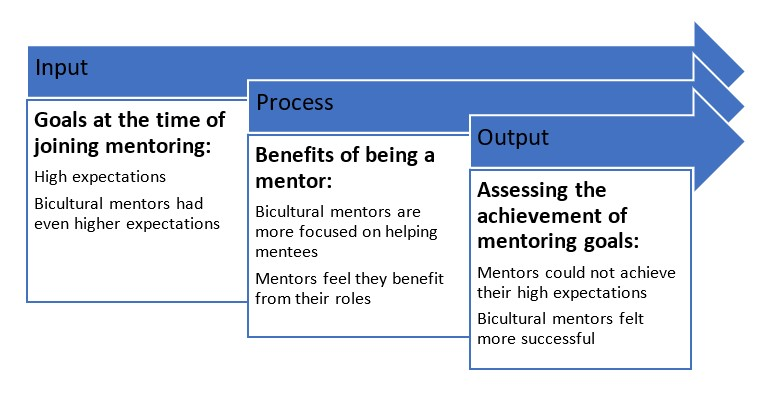
Conclusions of the research based on the process-based model
The research findings align with previous studies, emphasising the importance of considering mentors’ sociocultural backgrounds and their similarities to mentees. Our results indicate that mentors entered the programme with high expectations but were unable to achieve all their goals. This finding has practical implications: mentor training should incorporate clear communication about the limitations of the mentor role. Providing mentors with realistic assumptions about their participation could enhance their preparedness and contribute to longer-term engagement in the programme. Additionally, mentors reported deriving personal benefits from their experiences, underscoring the mutual advantages of mentoring for both mentors and mentees.
Limitations and future research directions
This study has certain limitations that should be addressed in future research. First, the small sample size primarily allowed us to characterize the study population and formulate hypotheses. While the questionnaire was effective for conducting a process-based study, it is also suitable for larger-scale national surveys, which could provide more generalizable insights. Second, the retrospective nature of the data collection means that the mentors’ self-reported expectations may not fully reflect their initial input goals. A longitudinal research design would offer a more nuanced understanding of the process over time. Third, this study did not fully explore the entire dataset, particularly the perceived challenges reported by mentors. Future research could expand on the existing data corpus by introducing additional independent variables for analysis. Finally, qualitative methods, such as interviews, would be valuable for validating the findings of this study and exploring the underlying explanations for the observed trends in greater depth.
Contributions and implications
The primary contribution of this research lies in identifying trends that deepen our understanding of the mentoring programme and similar equitable mentoring initiatives. These findings provide insights that can inform the development of good practices in mentoring programmes across Hungary and beyond. Through continued research and broader analyses, this study aims to support the enhancement of mentoring practices and contribute to the success of similar programmes globally.