




Abstract
This critical, integrative literature review examines how culture has been conceptualised and utilised in studies of mentoring schemes supporting migrants’ labour market integration. Our review revealed limited engagement with cultural concepts in past work. However, we consider how a small number of studies on migrant mentoring-to-work have approached culture – as an asset offering enrichment, as a potential barrier, and as part of power structures. Drawing on insights from the field of Cross-Cultural Management, we reappraise these approaches through three influential research traditions (cultural comparison, interpretive and critical intercultural management) to identify new ways to enrich studies on migrant mentoring-to-work programmes.
Keywords
Introduction
Mentoring is often proposed to support migrants’ transition into and across the labour market (Bagnoli & Estache, 2022a; Chevrier, Goiseau, Lugosi & Rase, 2023; De Cuyper, Vandermeerschen & Purkayastha et al., 2019; Kinos, Van den Berckt, Pambukhchyan, Kiijärvi Pihkala Kaartinen & Pirttikoski, 2023; Lee & Szkudlarek, 2021; Neuwirth & Wahl, 2017) [1] Mentoring programmes represent structured approaches to supporting and managing constructive mentoring interactions and sustained, productive relationships for migrants (Chevrier et al., 2023; De Cuyper, Reidsma, Vandermeerschen & Op de Beeck, 2022). The focus for such programmes is typically the securing of work, workplace transition and adjustment in the context of work; however, these initiatives, sometimes in conjunction with complementary support schemes, may also seek to address related challenges such as language acquisition, social integration, housing, legal support and wellbeing (cf., Bagnoli, Estache & Fourati, 2022; Chevrier et al., 2023; De Cuyper et al., 2019; Lugosi, Allis, Della Croce & Morano-Foadi, 2023; Morano-Foadi, Lugosi & Della Croce, 2023). Migrant mentoring-to-work can be defined as “a person with more localised experience (mentor) provid[ing] guidance to a person with less experience (mentee), the objective of which is to support the mentee in making sustainable progress in his or her journey into the labour market. Both mentor and mentee voluntarily commit to this and establish contact on a regular basis. The relationship is initiated, facilitated and supported by a third actor (organisation). While asymmetrical, the mentoring relationship is of a reciprocal nature” (De Cuyper et al., 2019, p. 117)
Migrant mentoring-to-work can be situated in the field of intercultural mentoring (De Cuyper et al., 2019). Migrants come from diverse cultures, and the integration of migrants into organisations always involves the interaction of several cultures (Reeves, 2017). Culture, more broadly, encompasses values, beliefs, norms, and associated customs, practices and institutions that distinguish groups and their members. However, conceptions of cultures vary; for example, some view it as systems of symbolic knowledge and meaning making that shape interpretations of reality (Geertz, 1973), as internalised mental frameworks that translate into attitudes and behaviours (Hofstede, Hofstede & Minkov, 2010), or as realms of practice that reflect and transmit wider power relations and social structures (e.g. Bourdieu, 1986). We adopt an open-ended perspective on culture to allow different conceptions of it to emerge from the reviewed papers.
Studies have suggested that culture is a key element of mentoring (De Cuyper et al., 2022; Kinos et al., 2023; van Bakel, Vaiman, Vance & Haslberger, 2022), but culture appears to have received inadequate attention among scholars interested in mentoring migrants to support their work integration. Despite its importance, for the most part, culture is neither systematically addressed empirically nor sufficiently conceptualised. To facilitate future empirical research, and advance knowledge concerning the management of mentoring schemes, it is important to initially map and evaluate the existing body of work that has considered links between culture and mentoring-to-work initiatives. We therefore conducted an integrative, critical literature review to address two research questions. First, how has culture been conceptualised and deployed in studies of migrant mentoring-to-work? Second, having identified and evaluated the strengths and limitations of previous approaches to culture, how could conceptions and techniques from the field of cross-cultural management be used to develop substantial lines of research, and to inform the design and management of mentoring-to-work programmes aimed at migrants?
We adopted an integrative approach to the review because this utilises the rigour of systematic procedures but extends beyond creating a descriptive summary of a research area by synthesising practical and theoretical insights from related fields (Torraco, 2016). Through this integrative approach, we combined inductive and deductive analysis, utilising approaches to culture that have been rigorously defined and systematically deployed in cross-cultural management. Drawing on cross-cultural management enabled us to a) evaluate how particular conceptualisations of culture shape how it can be applied in a mentoring context; and b) assess the implications of adopting specific interpretations of culture. By utilising insights from established cross-cultural management research, which recognises the implications of differing paradigmatic underpinnings, we offer a theoretical basis for advancing further empirical and applied work in the field.
Literature review
Mentoring programmes
In order to appreciate how culture is embedded in mentoring-to-work schemes, it is necessary to identify and distinguish between the generic components of formalised mentoring programmes, and to show how these elements can influence the mentoring relationships developed in the programme. Merrick (2017) outlined the essential components of structured mentoring programmes, including the programme’s goals and funding mechanisms, programme-based training and development, recruitment procedures, support for participants, the programme’s operations management, which encompass the provision of resources, and evaluation of its components and its outcomes. In this section, we draw on Merrick’s conceptualisation and discuss how culture is relevant to specific components of mentoring programmes, and we consider the implications for our examination of the extant research.
Formalisation of mentoring requires the establishment of goals and objectives, which are important for several reasons. First, they signal the value to be gained from the programme, which can be used to leverage financial and in-kind support from funders and participants (Merrick, 2017). Second, these objectives and goals are used as performance indicators to evaluate success and value for money. Consequently, the articulation of these goals creates expectations regarding what the scheme can achieve (Garvey & Stokes, 2022). Considering the links between programme goals and culture is necessary because programmes operate in a cultural context, both nationally and organisationally, which often shape the programme’s anticipated outcome and impacts e.g. to help develop culture-specific knowledge and competencies among mentees (Chevrier et al., 2023; De Cuyper et al., 2019). Evaluating the nature and extent of cultural learning and transformation among scheme participants and attributing changes to involvement in a programme requires a narrow definition of culture and focus on particular dimensions (e.g. understanding of language or norms) to enable assessments of effects and their causes.
Beyond stated goals and objectives, the recruitment and selection of participants, and matching mentors and mentees also present a series of opportunities and challenges associated with culture (De Cuyper & Crijns, 2023). Openness towards other cultures and intercultural sensitivity are key qualities that scheme managers may look for in identifying suitable mentors, particularly for programmes aimed at migrants. Knowledge of particular cultural norms or social practices (e.g. of a specific geographical community or occupational group) may be used to select potential mentors. Similarly, the desire to learn the cultural practices of specific groups (e.g. those of a particular occupation) may be used to select mentees for a scheme. Common interest in and experience with a cultural group may become the basis of matching mentors with mentees. However, culture-based value systems (e.g. regarding gender mixing or conflicting ethno-religious norms) can become barriers to matching. The capacity to anticipate and plan for potential intercultural tensions and opportunities is likely to have considerable impact on mentor-mentee interactions and the relationships they develop in the context of the scheme. This requires scheme managers, and participants, to develop a working conception of culture.
The management of mentoring programmes encompasses the design and incorporation of resources for mentors and mentees, alongside the training and development of mentors (Klasen & Clutterbuck, 2002). Training and support resources equip mentors with essential skills and tools; they also help to articulate responsibilities, define roles and thus role boundaries (Klasen & Clutterbuck, 2002). Culture-related outcomes may or may not be a formal feature of a mentoring programme’s stated objectives. Nevertheless, culture-related knowledge and capabilities are likely to be an explicit or implicit part of the programme’s content, and cultural factors will shape relationships between mentors and mentees (Kinos et al., 2023). It is essential to question where and how culture is embedded in the programme’s content, including how it is operationalised in programme-related training and support resources.
It is also important to consider how cultural elements are incorporated into programme evaluation. The outcomes of mentoring schemes may be intangible and thus difficult to capture. For example, mentees may develop through a programme greater understanding of colloquialisms or appreciation of culture-specific humour, which are subtle intercultural capabilities. Moreover, the impacts of participation on cultural understanding may only become apparent over extended timeframes, and impacts may not be limited to mentees. This raises a number of questions regarding how culture-related outcomes are accounted for in evaluation procedures; and how their impacts are conceived among diverse stakeholders and across time.
The preceding observations highlight the pervasive links between culture and mentoring programmes, and relations therein. However, despite important advances in other streams of literature, culture-conscious research on migrants and mentoring-to-work programmes remains limited (De Cuyper et al., 2019; Kinos et al., 2023; Steel, Lämsä & Jyrkinen, 2019. Before further scrutiny of the existing evidence-based studies on migrants and mentoring-to-work, we now examine the main approaches to understanding culture in organisational behaviour and management studies. We argue that drawing on the established field of cross-cultural management to understand how culture can be framed and researched, firstly, offers a fruitful terrain for enriching future migrant mentoring-to-work research; and secondly, it can inform the management of such mentoring schemes. Based on our review, we will use the diverse cross-cultural management perspectives to provide recommendations for further culture-sensitive research in the context of migrant mentoring-to-work.
Culture in organisation and management
Within organisations, culture affects work behaviours, leadership styles, motivations and communication, which may provoke misunderstandings and friction; however, positive outcomes may also arise from intercultural encounters (D’Iribarne, Chevrier, Henry, Segal & Tréguer-Felten, 2020; Hofstede et al., 2010). Cross-cultural management, in its broadest sense, seeks to understand the impacts of cultural differences in organisations and identify ways to manage emerging challenges and opportunities (D’Iribarne et al., 2020). Cross-cultural management is a diverse field and different paradigmatic traditions have emerged, which is reflected in the distinction made between three general streams of cross-cultural management research (Primecz, Lugosi, Zølner, Chevrier, Barmeyer & Grosskopf, 2023). These approaches provide diverse insights, but they can be used in a complementary way to develop a holistic perspective on the intersections of culture, management and organisation, and their implications.
The first stream focuses on positivistic research on cultural comparison, the second stream on interpretative research partially focusing on constructive intercultural interactions, and the final stream is the critical intercultural perspective (Primecz et al., 2023; Romani, Mahadevan & Primecz, 2018). We used these three streams of literature, and their underpinning paradigmatic assumptions, as part of a sensitising framework, because they provided credible, distinct and well-established approaches to conceptualising and studying culture, which could be used to interpret practices within migrant mentoring-to-work schemes. Remaining sensitive to differing perspectives on culture enabled us to move from merely giving a descriptive summary of the field to engaging in critical analysis of the implications of adopting particular conceptions of culture in this mentoring context. In the following section, we provide a more detailed overview of the three perspectives on culture.
Cultural comparison and different dimensions of culture
Cultural comparison research is mainly conducted from a positivist perspective equating culture with national culture. The broad aim in this perspective is to decipher a certain number of universal cultural dimensions, for example regarding social hierarchies, communication styles, conceptions of time and attitudes to (un)certainty, which vary in the degree of their expression. Several scholars have defined those dimensions along which cultural differences are measured statistically in a deductive manner. Work in this tradition has maintained that cultural differences are relatively stable and are the basis for predicting the quality and likelihood of cultural friction during interactions (Hofstede et al., 2010).
Interpretative research on intercultural interaction
Whereas in the previously presented approach, work on culture is focused on comparing its dimensions, other scholars ask what happens during the interaction processes of people with different cultural backgrounds. Research on intercultural interaction is mainly conducted from an interpretative perspective based on a subjectivist philosophy, which emphasises the social construction of a subjects’ lifeworld (Primecz et al., 2023). Here, culture is often understood as the shared meaning of a group leading to common behaviour, which may provoke frictions and misunderstandings in the process of interaction that have to be resolved.
Newer approaches within interpretative research argue that cross-cultural management overemphasises cultural differences and frictions, and therefore advocate a constructive intercultural management perspective (CIM) (Barmeyer, 2018). The CIM scholarship lens promotes the idea that cultural differences under certain conditions can be an asset. CIM thus focuses on the advantages and synergy effects of intercultural interaction (Barmeyer, 2018), analysing contextual influences on positive intercultural outcomes. Work in this tradition has highlighted the particular competencies of ‘boundary spanners’: individuals who engage in regular interactions across group boundaries and bring different groups together (Richter, West, van Dick & Dawson, 2006). This is an advantage particularly for network organisations, because information flows and mutual learning processes are stimulated.
Critical intercultural management
Critical intercultural management studies seek to uncover social inequalities and injustice (Primecz et al., 2023). They have an advocatory claim and try to find ways to improve society (Romani et al., 2018). Work in this tradition tries to reveal inconsistencies and micro-political power structures within teams, work contexts and organisations, with the aim of facilitating constructive dialogue (Primecz et al., 2023). Critical intercultural management researchers question the possibilities of studying culture in a neutral way, for example by studying cultural differences. Cultural differences are associated with certain attachments that are (dis)advantageous to certain groups and may provoke inequalities (Romani et al., 2018). Critical intercultural management scholars advocate reflexivity in cross-cultural management studies with regards to questions concerning whose interests research serves (Romani et al., 2018) and underline that, in its origins, it typically served Western managers handling cultural differences abroad to generate economic benefits. There is also recognition that cross-cultural management research tends to overemphasise cultural differences and may lead to, or reinforce, processes of ‘othering’ (Romani et al., 2018) by describing the relevant others as ‘exotic’ or ‘backward’. Such emphases lead to the reinforcement of boundaries and power inequalities.
In sum, work in these three cross-cultural management research traditions have provided important contributions to our understanding of culture in the context of organisations and management. In order to analyse how culture has been considered in studies of migrant mentoring-to-work programmes, and how far these cross-cultural management approaches are taken into account, we conducted an integrative literature review, the process of which we describe in the next section.
Methods
The integrative review followed the core principles recommended by advocates of systematic approaches to sourcing and selecting records, and reporting procedures (cf. Page, et al., 2021; Torraco, 2016). Figure 1 summarises our procedures. Our search strategy focused on four established databases because of their wide, multidisciplinary coverage of relevant fields (e.g. migration studies, organisation studies, management etc.): Web of Science, Scopus, EBSCO Business Source Complete and EBSCO Academic Search Complete. Our search was limited to work published between 1991 and 2023. Since the literature on migrants and mentoring-to-work is still scarce (De Cuyper et al., 2019), we widened the scope and included several synonyms in the search. We searched for the following combination of terms (and their synonyms) in the titles, abstracts and keywords of academic papers: ‘mentor’ and ‘migrant’ (OR ‘refugee’) and ‘work’ (OR ‘professional insertion’ OR ‘organi?ation’ OR ‘labor market’ OR ‘labour market’ OR ‘employment’). We limited our search to work written in English and German because the research team were fluent in these languages. This initial search returned 179 records.
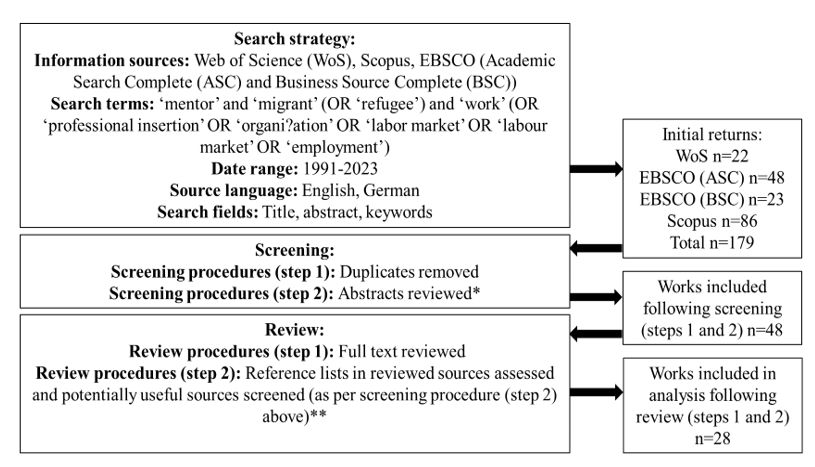
Summary of search, screening and review procedures
After eliminating duplicates, three authors manually screened sources independently to assess their relevance to the focus of our research aim. We considered empirical, conceptual and review articles. The key inclusion criteria were that the studies a) must have focused on mentoring-to-work as a substantial component of the mentoring intervention, and b) the interventions targeted migrants (encompassing refugees, humanitarian, economic and lifestyle migrants). We eliminated 131 records by carefully reviewing the abstracts and, in a few cases, checking the main content where the mentoring aspects of the work were unclear from the abstract.
Three authors read the remaining 48 papers in detail, including checking the reference lists and supplementary material (e.g. Bagnoli & Estache, 2022b) to identify any sources cited by these authors that might have been missed through our database search. 20 papers were excluded through this process because they focused on other mentoring contexts, such as youth mentoring or more generally on refugees and their social integration rather than on mentoring-to-work. Finally, 28 papers were retained for our analysis.
Analysis
The 28 sources were again reviewed independently by three authors. We made analytical notes about the applications of culture in specific works and identified relevant extracts from the text that informed our interpretations about the role that culture played in research on formal mentoring-to-work programmes. Our analysis was driven primarily by an inductive approach. However, to ensure some consistency in the focus of our analysis, we tried to ascertain how culture was defined in the selected works; or, if no explicit definition of culture was found in the paper, which view on culture was expressed by the authors, and how culture-related concepts, practices and meanings were operationalised in relation to the mentoring activities. Proceeding inductively in the first stage of analysis, and initially excluding our sensitising concepts of cross-cultural management research, helped us to remain open to the approaches we found. In the subsequent stages of analysis, we compared existing findings with cross-cultural management approaches to provide a more structured way to identify fruitful avenues of further research.
Once we concluded our independent analysis, we engaged in ongoing dialogue regarding the scope, content, focus and potential relevance of each of the papers to agree on the thematic ordering and display of our findings. Figure 2 provides an example of how we coded parts of the text to form the higher order categories in our analytical process. During this process, we sought to achieve communicative validation by presenting our individual observations on the sources, comparing our perspectives and assessing alternative explanations. We used textual extracts and our accompanying written and verbal interpretations to illustrate and support the logic of our coding and classifications. We used this ongoing dialogic process to reach consensus on the three higher-order thematic categories that we used to organise our findings.
Examples of illustrative extracts, data coding, and thematic category
Findings
With respect to our first research question, ‘How has culture been conceptualised and deployed in studies of migrant mentoring-to-work?’ we discovered that in almost a third of the selected papers, culture was not mentioned at all. Sometimes cultural issues were only mentioned briefly as part of general commentary recognising that culture has a role in mentoring migrants. Some scholars used the concept of cross-cultural mentoring where mentor and mentee belonged to different cultures (Jüngling, 2019), but did not provide details regarding the definition or operationalisation of culture. Others stated that cross-cultural training should be given to mentors and mentees but then offered no further details (Lang, 2010). Finally, some authors recommended developing culture sensitive research in their discussion sections, but without providing deeper consideration of the concept of culture (Guildford, 2007). Appendix 1 summarises the reviewed sources and their views on culture.
Nevertheless, conceptions and discussions of culture were more explicit and detailed in several papers, which we present in detail in this section. We regrouped these papers into three categories that were inductively identified in the data: 1) culture as asset, 2) culture as barrier and 3) culture as power. We first discuss the contributions of the authors in terms of culture, and we then link them to the two areas of mentoring which we examine in depth: mentoring relationships and mentoring programmes (which foster mentoring relationships).
Culture as asset in mentoring
Two aspects in particular were addressed in this context: mutual learning opportunities for mentors and mentees, and the possibility of developing intercultural competence and (inter)cultural capital. Several scholars noted that culture could be seen as an asset when mentors and mentees come from different cultures (e.g. Chevrier et al., 2023; Kinos et al., 2023). For instance, cultural capital, in a mentoring-to-work context, concerns the understanding of local working cultures, jobs and sectors (De Cuyper et al. 2023; Kinos et al., 2023). Cultural capital as one specific form of human capital (besides social, informational, psychological and economic) is country and culture specific and may be developed during the mentoring process by mentors and mentees (De Cuyper, 2022). Mentoring-to-work can thus be seen as an intercultural bridge, which helps mentees to understand the local culture and organisational context, and to generate cultural capital. Mentors therefore may serve as boundary spanners. However, it is important to recognise that mentees may already have various forms of cultural capital, for example language skills or other (inter)cultural competencies. De Cuyper et al. (2019) also emphasised that mentoring is a reciprocal relationship where both mentor and mentee can learn. Even though the mentee may gain more from mentoring, De Cuyper et al. (2019) recognised that mentors who are exposed to migrants’ points of view could also develop their intercultural skills.
Shan and Butterwick (2017) further strengthened the possibility for mentors to learn from mentoring migrants. Their study showed that mentors expanded their cultural and work-related knowledge through intercultural mentoring relationships. Young, Haffejee and Corsun (2018) also highlighted the possibility of developing cultural intelligence through these mentoring relationships. Cultural intelligence from their point of view can be defined as “one’s ability to interact effectively with those from different cultural backgrounds and in different cultural contexts” (Young et al., 2018, p. 324). By engaging in cross-cultural mentoring relationships, mentors were able to negotiate blind spots, creating awareness of things they could not see before.
From the perspective of culture as an asset in the constructive development and maintenance of mentoring relationships, several scholars raised awareness of the need to define roles within the relationship. For example, Shan and Butterwick (2017) argued that mentors should act as ‘culture screeners’, meaning that they could make explicit employers’ expectations and other cultural peculiarities in the host country. Similarly, according to Mercado and Turnbull (2018), mentors should be ‘cultural clarifiers’, helping mentees adapt to their new cultural environment by providing explicit knowledge.
Shan and Butterwick (2017) suggested that fostering intercultural learning could also have implications at the programme level. They highlighted ways that mentoring programmes could encourage two-way integration and therefore create learning opportunities for migrants (mentees) and mentors, leading to transformative social change. However, they also suggested that most programmes were set up as a one-way transmission process, with mentees learning from mentors, rather than reciprocal learning and developmental relationships. This was also highlighted in empirical research on mentoring-to-work programmes (Chevrier et al., 2023).
Culture as barrier in mentoring
Another set of works viewed culture as a barrier, stressing the need to create cultural sensitivity to overcome such barriers. Barriers were considered in two ways: first, as factors inhibiting migrants’ access to the labour market, which could be minimised through mentoring; and second, as factors that could compromise the mentoring process itself. For example, Weiss and Tulin (2019) argued that migrant mentees may face difficulties navigating the host country’s institutions and in reading ‘social cues’ related to culture. Similarly, Austin (2005) noted that migrants could experience a ‘double culture-shock’, which describes the difficulty of adapting to a new culture on both a personal and professional level. Austin argued that the latter could potentially lead to migrants’ disengagement from their professional community and a reduced level of access to employment opportunities.
Several papers discussed cultural differences as additional burdens for the mentor and mentee relationship (e.g. Chevrier et al., 2023; Steel et al., 2019). For example, Steel et al. (2019) stressed the conflicting conceptions of gender identity and roles, highlighting how notions of ‘strong Finnish women’ set expectations towards women, which tainted mentoring relationships. Holmes et al. (2013), in an interactional analysis, contrasted listening behaviours among Chinese and New Zealand participants and noted several differences which could lead to misunderstandings if not directly addressed. Several studies showed that the use of language was a culturally bound factor that required careful examination within mentoring relationships because of its power to cause misunderstandings (Chevrier et al., 2023; Woodhams, 2014).
However, beyond recognising the potential for tensions and conflicts, several scholars also viewed mentoring as a supporting practice to overcome cultural barriers, foregrounding the role of mentors in particular (e.g., Rajendran, Farquharson & Hewege, 2017). Developing ‘cultural awareness’ among mentees and mentors was viewed as a mechanism to help manage expectations, align disparate cultural orientations and question embedded assumptions (Kinos et al., 2023; Steel et al., 2019). To avoid cultural differences and shocks, Mercado and Turnbull (2018) argued that mentors should embrace their roles as ‘cultural clarifiers’ and, as Weiss and Tulin (2019) suggested, “use their knowledge to bridge informational and social inequalities” (p.123). To be able to fulfil this role, training for mentors, which helps them to anticipate immigrant mentees’ problems from the beginning, becomes vital (Mercado & Turnbull, 2018).
At the programme level, several works highlighted that intercultural training should be provided to mentors, to overcome intercultural differences and improve mentoring relationships (Kinos et al. 2023; Lang, 2010). However, despite stressing advancements and contributions at a relational level, it should be noted that authors did not address culture-related aspects at the programme level (e.g. how cultural awareness could be improved through formal programme-based training for mentors and mentees; or how scheme managers may prevent or resolve cultural conflicts).
Culture as power in mentoring
Finally, a smaller set of works viewed culture as power. We decided to categorise this topic separately because the focus differed slightly from the two previous ones: this perspective went beyond examining cultural differences that might exist between mentor and mentee, and these works critically examined mentoring as integration practice for migrants. Three contributions – two Canadian and one Swedish – directly addressed mentoring-to-work and migrants from this perspective (Allain, Crath, & Çalışkan, 2020; Risberg & Romani, 2022; Shan & Butterwick, 2017). All three studies critically examined existing mentoring programmes, arguing that power imbalances can be reproduced in the mentoring process, either by imposing views of the majority society or by marking belonging or non-belonging.
Cultural domination stands out as a factor highlighted by the three studies. Shan and Butterwick (2017) argued that mentoring might be a facade for “new forms of cultural domination” (p.4), because mentoring relationships came with social and cultural power dynamics, where the mentor transmitted his or her (then dominant) culture to the mentee. Echoing this perspective, Allain et al. (2020) emphasised that coordinators of mentoring schemes and organisers of events continuously foregrounded and interrogated foreignness by asking ‘Where are you from?’. In their analysis, they detected an underlying vision of these (non-white) migrants as ‘guests’. The authors also demonstrated that hospitality could be used as a disciplinary or regulating force, for example by mentors constantly mentioning the need to respect the rules, to share their experiences and to act as ‘grateful guests’ to be able to stay in the country. In principle, these observations concerned the nature of mentoring relations and interactions. However, these studies recognised that the pervasive assumptions framing these relations were embedded in the programme designs, which were themselves shaped by wider societal discourses and power relations.
Another cultural aspect highlighted by these critical studies is related to migrants’ identity building throughout the mentoring programme. Allain et al. (2020) showed that the host city represented an idealised conception of home, reminding migrants of their other-ness, as guest, while stressing the need for migrants to adopt the host’s norms, values and practices, which were reproduced through the mentoring programme. Romani and Risberg (2022) also highlighted concerns regarding the identities of migrants, who were expected to adapt to the country’s employment norms through their self-presentation to employers to improve their employability prospects. Again, it is important to stress that the relations between mentors and mentees were based on widely circulating cultural stereotypes, which were reproduced and thus embedded into the mentoring programme design. These findings suggest that mentoring programmes have substantial responsibility for translating and operationalising societal discourses concerning migrants and governments’ positions on integration. These studies thus raise critical questions concerning which culture is transmitted, and how integration is conceived in mentoring programmes (i.e. as the one-way adaptation of migrants to the host culture, or a bidirectional cultural co-construction). While recognising the important work done by government-orchestrated mentoring schemes, which were managed with commitment, time and enthusiasm, these studies raised concerns about their negative impact on (a one-way and suppressive) integration. They highlighted the potential limits and risks associated with mentoring programmes and the multiple cultural dimensions that need to be considered when evaluating the experiences of those involved and the consequences of the schemes.
Having discussed the contributions of the selected papers related to culture, and their links to mentoring relations and programmes, we show a graphical representation in Table 1.
The integration of culture in research on mentoring-to-work and migrants
Discussion and implications
In answering our first research question, ‘How has culture been conceptualised and deployed in studies of migrant mentoring-to-work?’ our literature review revealed eclectic approaches to and variable uses of culture. A limited number of studies highlighted the importance of culture in the context of mentoring-to-work. However, the conceptualisation of culture adopted in particular studies was often unclear and there was little reference to concepts from cross-cultural management research, despite its potential to comprehend culture and to examine it methodically. When looking for definitions of culture that research on mentoring migrants to work was built on, we found either no direct reference to work on culture, or we found references to psychological, anthropological or sociological perspectives on culture and related concepts, but without substantial methodological elaboration or detailed application. Mercado and Turnbull (2018) was one exception insofar as they explicitly based their analysis of cultural differences on Hofstede’s individualism-collectivism dimension. Furthermore, even though the impact of cultural factors on mentoring relationships and programmes was sometimes discussed, there remained many gaps concerning these interconnections. They were usually presented as a by-product of other findings.
Hence, in relation to our second research question, ‘How could conceptions and techniques from the field of cross-cultural management be used to develop substantial lines of research, and to inform the design and management of mentoring-to-work programmes aimed at migrants?’ we see considerable opportunity for research. The three streams of cross-cultural management (cultural comparison, interpretive research and critical intercultural management) can be the basis of a more precise, transparent and rigorous framework for incorporating culture in future research. With this potential in mind, and based on the three categories that we identified through our data analysis, we specifically discuss different directions for research utilising cross-cultural management. We do so by identifying gaps and limitations in each of the three categories, and by showing potential linkages with cross-cultural management approaches.
Culture as asset
As research has shown, mentoring may enhance the development of cultural capital. In these studies, culture is treated as an asset. While past work has recognised these linkages (van Bakel et al., 2022), we see substantial opportunities for further development, more generally in analysing mentoring relationships, but specifically in the context of mentoring programmes where contributions are currently limited. Mentoring-to-work research may benefit from interpretative cross-cultural management perspectives by examining how cultural capital, and inter-cultural capital especially, may be effectively generated in cross-cultural interactions and relationships. De Cuyper (2022) stressed this point, arguing that this knowledge should be incorporated into the design and management of mentoring-to-work schemes. Examples include different perceptions of time, gender roles or the ability to consider diverse actions to address power imbalances. These are practical examples of acquiring cultural knowledge that could be applied in a mentoring-to-work programme context.
Interpretative cross-cultural management approaches stress that mentoring stimulates a learning process. Viewed from an interpretative cross-cultural management perspective, learning occurs when migrants interact with actors from host societies. This enables migrants to learn norms, values and practices that can enhance their integration. By instilling mentors as role models, learning may take place because mentors inspire and guide culture-related learning regarding attitudes, language and behavioural norms. However, whether cultural learning takes place or not depends on different factors affecting the attention, retention and reproduction of certain behaviours. Influences include the personal characteristics of the individual observing the modelled behaviour, such as self-efficacy and motivation to imitate as well as the attention to the role model. Attention to the model, for example, is influenced by the characteristics of the modelling actor (including their status, attractiveness, similarity, and repeated availability). The reproduction of the observed behaviour depends on the attention paid to and effective retention of a behaviour, which is shaped by motivation, expectancies and rewards. These insights could be helpful in planning and evaluating intercultural mentoring interventions.
Mentoring schemes could be (re)designed by considering various aspects of social learning. Besides work-related content, culture-specific aspects could be included in mentoring-to-work schemes, which enhance the employability of migrants in societies by providing role models who display host cultural norms and behaviours, which – under positive conditions – are imitated by the mentee. However, critical cross-cultural management approaches highlight that it is important to recognise the potential tensions arising from the application of behavioural modelling. It risks reproducing the notion of one-way integration, which is based on asymmetric power dynamics between a ‘local’ mentor and ‘foreign’ mentee, who is expected to adopt behavioural norms (Allain et al., 2020). Consequently, beyond supporting assimilative behaviour among migrants, mentoring-to-work programmes may also promote mutual cultural learning processes and raise the cultural awareness of mentors by providing adequate intercultural preparation and support.
Culture as barrier
Research shows that cultural differences may decrease the effectiveness of mentoring. However, even if certain studies raise awareness of factors that might create barriers (Mercado & Turnbull, 2018; Steel et al., 2019), they tend not to delve deeper into these culturally bound aspects. For example, when Mercado and Turnbull (2018) identified potential conflicts between U.S. and Latin-American teachers, they did not address how and why cultural conflicts between mentor and mentee arose within the relationship, or how they could be prevented or resolved at the programme level. Furthermore, research informed by interpretative and critical cross-cultural management approaches could examine who adapts to whom in terms of cultural norms or language, and evaluate the implications, for example on power relations in the context of mentoring-to-work programmes and on migrants’ notions of identities.
Deeper explorations into these aspects suggest migrant mentoring may benefit from knowledge of interpretative or cultural comparison cross-cultural management approaches to raise participants’ cultural awareness and achieve a certain degree of sensitivity towards cultural differences. More knowledge about how cultural characteristics affect mentoring processes can help during the establishment of mentoring schemes to improve interventions and their outcomes. The relationship between different dimensions of culture (e.g., power distance, collectivism, long-term orientation, communication styles etc.) and the mentoring process as well as its consequences should be evaluated. Results of these studies may inform training programmes for mentors and mentees. In addition, the extensive literature on intercultural training and competence development may provide helpful insights to guide the preparation of intercultural mentor-mentee dyads. Existing studies show that different communication styles (e.g., more implicit vs. explicit communication) may cause misunderstandings and friction. Awareness of different communication styles may decrease friction, and participants could be trained in the context of formalised mentoring programmes to appreciate the forms and meanings of implicit communication or not to feel offended by very direct communication.
Cultural differences may be also related to different expectations about mentoring and the mentor-mentee relationship, which can be usefully comprehended through the application of cultural comparison and interpretivist cross-cultural management approaches. When seen through the cultural comparison lens, one may find that persons from more collectivistic cultures may expect a friendlier relationship than those familiar with individualistic cultures. When studied from the interpretivist approach, scholars could suggest culture-specific preparation and active reflection about cultural differences during mentoring relationships stimulated by an intercultural coach or mentoring programme coordinator, which is likely to be useful to avoid frictions and facilitate mutual learning processes. Cultural comparison research is a good starting point for reflections about cultural differences in migrant mentoring-to-work relationships. As part of programme resources, mentors and mentees should be constantly encouraged to reflect on culture’s potential impacts on their mentoring relationships. Knowledge as well as reflection on different manifestations of cultural dimensions can help mentors and mentees prepare for challenges and possible misunderstandings in their interactions.
Culture as power
The relationship between culture and power, which is inherently part of migrant mentoring programmes, has received limited attention in past studies. Drawing on critical cross-cultural management perspectives, one critique is that due to certain power asymmetries between migrants and actors from host societies e.g. employers, labour intermediaries or state representatives, mentoring programmes indirectly reinforce iniquitous relationships between ‘those who help’ and ‘those who need help’ (Shan & Butterwick, 2017). These authors argued that these tensions indirectly stimulate assimilation towards the host society rather than mutual learning processes. However, they did not expand further on these relationships and we argue that future research on power within mentoring relationships is needed. Allain et al.’s (2020) work analysing a mentoring scheme adds considerations at the macro-level, underlining the responsibility of programmes to reconsider their views on integration, which are often implicitly oriented towards assimilation.
Interpretative and critical cross-cultural management research shows that power structures influence intercultural interactions and often reproduce iniquitous structural relations. Asymmetric power dynamics in mentoring relationships may be seen to reinforce the superordination of the host societal culture. This may lead to the minimisation of diversity in organisations. Interpretative cross-cultural management research can help to identify the positive effects of a diverse workforce. Failing to recognise the impacts of unequal power relations and cultural differences during the labour market access phase in migrants’ mentoring-to-work may have unintended consequences. Alternative ways of thinking and problem solving may be prematurely de-primed, thus diminishing future valuable resources for organisations and individuals. Remaining attentive to the role of power in mentor-mentee relations, and how asymmetric power relations are embedded in the programmes (e.g. in their objectives, structures and training regimes), can be used to develop intercultural sensitivity and equitable programme designs.
Additionally, critical cross-cultural management research tries to uncover embedded social inequalities. Unquestioned assumptions of being better or less qualified or of being right or wrong instead of different are deconstructed. In mentoring processes, the evaluation of skills and asymmetrical relationships can lead to a perceived devaluation of one’s own culture, and have negative impacts on self-confidence and migrants’ job application processes. Questioning taken-for-granted ideas and power asymmetries can help to demonstrate sensitivity and prevent unintended consequences. Knowledge generated through critical cross-cultural management research may help to create mentoring schemes that exhibit sensitivity of cross-cultural power asymmetries, which are present in mentoring relationships involving migrants, thus helping to avoid negative side effects. They may provoke a questioning of supposedly ‘normal’ but power laden assumptions, positively informing sensitive wording, implicit power structures and assimilative imperatives, thus increasing a positive attitude towards diversity.
In line with this research stream, at the programme level, future research could explore links between a country’s policy objectives in terms of multiculturalism and integration and the impacts of these on the design of mentoring schemes. Our literature review revealed two Canadian studies on this topic. This might not be a coincidence, since Canada has a long history of migration and multiculturalism. Adopting the logic of cultural comparison cross-cultural management approaches, and pursuing comparative studies of national contexts could help to produce insights on countries with different migration histories, and varying strategies for facilitating integration though mentoring-to-work interventions. The data generated from this kind of comparative research could help to identify best practices for managing structured mentoring interventions to support migrants’ transition into the labour market.
Based on the limitations, challenges and opportunities that we identified through our review of existing work, and in relation to our second research question, Table 2 proposes a range of questions concerning culture in migrant mentoring-to-work research. The suggested lines of enquiry are informed by the three dominant cross-cultural management approaches. We outline questions linked to the three thematic areas: ‘culture as asset,’ ‘culture as barrier,’ and ‘culture as power,’ and we differentiate between relationship and programme focused research streams.
Potential research questions based on different views on culture and underpinned by diverse cross-cultural management approaches
Limitations and future research
We reviewed articles published in English and German. However, further research on mentoring schemes aimed at migrants’ labour market inclusion exists in other national and linguistic contexts, and future reviews should be broadened to include work in other languages. Additionally, we only identified limitations in past research and areas of development based on the topics that the selected papers addressed, and we did not discuss all the available cross-cultural management approaches and their potential contributions to mentoring-to-work (programmes) for migrants. In particular, the interpretive approach, which is often accompanied by in-depth qualitative and ethnographic methodologies, could offer other promising opportunities for the field of mentoring-to-work by providing detailed and context-sensitive insights in future research. These approaches are better able to help decipher subjective sensemaking processes concerning culture and mentoring and may provide rich data on how culture is enacted, perceived and experienced in mentoring processes.
Furthermore, we recognise that research on mentoring particular types of migrants (students, refugees, etc.), professional groups and educational settings exist, but we limited our review to papers on mentoring-to-work, since labour market integration is the basis for other facets of integration. Future research could examine the cultural dynamics and factors related to these specific groups and settings, providing a research agenda for each of them. Finally, we also recognise that there is extensive work on intercultural mentoring in contexts other than mentoring-to-work, some of which was included in our analysis because it was cited by the papers we reviewed. Future research could examine further the connections between the literature on intercultural mentoring in other contexts (e.g. mentoring in the context of schools or social communities) and the topic of mentoring migrants to work.
Conclusion
In response to our first research question, regarding conceptions of culture, our critical, multi-language integrative review highlighted the restricted or absent conceptualisations of culture and the disparate definitions adopted in past work. In order to address the limitations of existing research, and in response to our second question concerning the potential application of cross-cultural management (CCM), we proposed numerous lines of enquiry, which could utilise different conceptions of culture and apply diverse CCM perspectives to address culture-related challenges concerning mentoring relationships and the management of programmes involving migrants. Given the growing international application of mentoring to support migrants’ labour market integration, and the considerable scope to strengthen the effectiveness of structured mentoring-to-work interventions, this study’s findings demonstrate the potential of culture-conscious mentoring programme design, management and research.
Footnotes
Our use of the term ‘migrant’ encompasses people engaged in voluntary mobility, including those seeking to exploit economic opportunities or to pursue alternative lifestyles, and those experiencing forced mobility and displacement, such as refugees, who must leave their homes due to conflict or persecution, and humanitarian migrants, who move in response to violence, economic crises or natural disasters. We recognise that different types of migrants have diverse experiences and resources, and face disparate challenges, which can be addressed through various mentoring interventions.