




Abstract
Most executive coaches are not therapeutically trained and there is concern that they might have difficulty identifying and managing boundaries with therapy. This study explores how executive coaches from a non-psychology background experience the boundary. Using Q methodology, coaches ranked statements representing the range of responses to working with the boundary and overlap, leading to a proposed typology of how practitioners perceive and work in this space. Four types of practitioners were identified: Conscious, Confused, Conscientious and Confident. The typology offers executive coaching stakeholders a framework for reflection and discussion to further consider the issue in practice.
Introduction
For several decades, coaching has been establishing itself as a commercial practice in the western world with significant numbers of practitioners joining the community every year (ICF, 2023). Employers have long embraced executive coaching for senior staff to support performance improvement, moving from an offering for troubled or underperforming executives to being considered a required benefit for senior leaders (Kets de Vries, Korotov, Florent-Treacy, and Rook, 2016). Simultaneously, there has been greater understanding of psychology by the general population and increased focus on mental health, with one in six working-age adults believed to be experiencing symptoms associated with a mental health issue at any given time (MHFA, 2021).
Employers are, understandably, seeing an impact in the workplace and the World Health Organisation has called upon employers as key stakeholders to contribute to the improvement of mental health by generally supporting mental wellbeing in the workplace (WHO, 2022). Coaching is one such support which has evolved into a model that promotes performance and wellbeing (Grant, 2016). Research has shown that coaching can reduce workplace stress (Gyllensten and Palmer, 2005) and it was suggested over fifty years ago that coaching may be a socially acceptable alternative to therapy (Filippi, 1967). It is perhaps inevitable that there are times when the executive coaching experience is therapeutic and may overlap with therapy. Recent research has suggested that the future for coaching includes more therapeutic topics (Schermuly, Graßmann, Ackermann and Wegener, 2022), increasing pressure for the coaching community to be clear on both its offering and boundary with therapy.
Neither coaching nor therapy (used here to cover counselling, psychotherapy and other forms of therapeutic intervention) benefit from clear and universal definitions that would assist in identifying the boundary between them, leading to confusion for coaches and therapists.
Literature Review
Much comment on the boundary between coaching and therapy comes from psychologists, psychotherapists or counsellors voicing concern about practices of lesser trained practitioners (Buckley, 2007; Bachkirova, 2008; Baker, 2014; Grant and Green, 2018). This may have begun because the cohort moving into coaching from therapy recognised blurred lines (Berman and Bradt, 2006; Criddle, 2007) or because of the licensing debate in Colorado State around 2000 (Williams, 2018). No studies identify any harm done to coachees by crossing the boundary into therapy.
Maxwell’s (2009) research with business and therapist coaches identified major themes: opening Pandora’s box, the co-created boundary, working at the boundary; differentiation between coaching and therapy. The study identified four distinct ways of working with this co-created boundary; separation (complete avoidance of any personal issue), rational working (an invitation to explore the issue intellectually rather than emotionally), dipping in (using selective therapeutic approaches in the coaching context to address an issue) and straddling (knowingly crossing the coaching/therapy boundary). There was clear overlap of working styles between business and therapist coaches and flexibility of style between coaches, although some coaches had a dominant style.
Price’s (2009) study using a literature review and survey of coaches concluded that the boundary is subject to personal interpretation. Significantly, respondents in this research did not see qualifications, training or personal competence as a differentiating factor in distinguishing between coaching and therapy. The author observed that coaches appeared to practise differently from their theoretical viewpoint, using more therapeutic interventions. It was unclear if this is because coaches say what they think they should say about how they work or if they have a blind spot about their level of competence.
Some research considered novice coaches who might be expected to be less confident about how to deal with the boundary (Baker, 2014; Eniola, 2017). Later research explored different perceptions, identifying roles played within the coaching relationship and made a case for embracing an overlap (Sime and Jacob, 2018). Missing from the empirical evidence and the wider discussion is the voice of the current cohort of executive coaches, highly experienced in other fields and less likely to come from a psychology background (Bachkirova, Cox and Clutterbuck, 2018), who are more likely to be accredited, have more diverse training and education in coaching and operate in significantly different environments (ICF, 2020).
Methodology
This study considered how executive coaches from a non-psychology background respond to this confusing space. It uses an epistemology and ontology of Social Constructivism (Kukla, 2013) as coaches are making individual sense of their boundaries, recognising a theoretical perspective of Interpretivism (Crotty, 1998). Q methodology was chosen as a qualiquantological approach, mixing characteristics and strengths of qualitative and quantitative theory to measure subjective viewpoints in a structured and logical way (Stephenson, 1935; Stenner and Stainton Rogers, 2004). Q produces holistic data, meaning that rather than focusing on understanding one person or viewpoint at a time it considers the data as a whole and finds the relationship between themes using statistical analysis (Watts and Stenner, 2012). Q uncovers multiple viewpoints, including identifying alternative or less dominant viewpoints (Farrimond, Joffe and Stenner, 2010).
The process began with a thorough study of the topical field (concourse) through a review of the literature, empirical research and semi-structured interviews with key stakeholders (Executive Coach, Coachee, Sponsor, Supervisor and Coach Educator). Through a process of immersion in the subject matter, this yielded carefully prepared statements known as the Q-set (qualitative data), which were then sorted by participants (P-set) and analysed using a statistical process (quantitative data). The P-set is purposely selected to have opinions on the subject (Watts and Stenner, 2012) and comprised 26 executive coaches reporting to be from a non-psychology background. In Q, the statements are the variables rather than the participants, who are invited to sort the statements to reflect their subjective view of the lived experience against a pre-determined scale (Brown, 1993).
The Q-set shown in Table 1 were ranked (Q-sort) against a scale of disagreement (-5) to agreement (+5) by the P-set using an online programme QsorTouch (2021) to make data collection robust and user friendly.
Q-set statements
The P-set (Table 2) was sourced using social media, membership bodies and coaching networks and selected for a wide range of qualifications and experience.
Demographics of P-set
Factor analysis and interpretation
Data from the Q-sort was analysed through R 4.2.0 software, using factor analysis to reduce the total data, clustering results that have similarities to find viewpoints. Individual Q-sorts load onto (are assigned to) a factor (collective viewpoint) because of the similarity of the sorts. Through this process, which is mathematical using the software, four factors emerged that represent viewpoints from the executive coaching community about the perceptions of executive coaches of the boundary and overlap between coaching and therapy. It is important to remember that all participants ranked all the statements, so they all appear in each viewpoint with different levels of agreement. It is then the role of the researcher to further interpret these factors.
This four factor solution has an nload of 18, meaning that data from 18/26 Q-sorts are included. Eight participants are not included in any factor because their Q-sorts are confounded, meaning they had a significant loading against more than one factor and therefore did not represent one viewpoint. The four factor solution was selected because the combined factors have an explained variance of 67/, considered high (Brown, 1980), the eigenvalues are above 1 and reliability is near 1, indicating the data can be regarded as of value (Watts and Stenner, 2012). The correlation between factor z-scores shows the statistical differences between factors. The data shows that factors 2 and 4 have the lowest correlation (0.37), suggesting these viewpoints differ the most and have the highest distinguishing features, closely followed by factors 2 and 3 (0.42). These correlation statistics show that there is much agreement between the factors and suggest that the differences are nuanced. However, Q is a holistic methodology which requires interpretation beyond the primary quantitative data.
Findings
Factor One – Conscious Practitioners
As is typical in Q, the first factor contains a clustering of the greatest number of participants’ data, therefore interpreted as the most prevalent voice among the group. Seven participants loaded onto Factor One, accounting for a 20/ explained variance. The array, in Table 3, visualises the analysis of individual responses to create one factor. The numbers represent statements found in Table 1.
Factor One Array - (green cell denotes distinguishing statement)

Participants who loaded against this factor are predominantly female, mostly have coaching experience >10years and marginally value experience over qualification. Less than half have membership of a professional body and all participate in supervision.
This viewpoint appears to represent practitioners who are conscious about their practice choices. There are two distinguishing statements for Factor One. The first is ‘I’m a coach – I do only what I’m trained to do’, which this viewpoint disagreed strongly with (S22:-4), suggesting that this group have moved on from their initial training through considerable experience to a practice that is extended beyond basic coaching. This statement distinguishes Factor One (-4) from Factor Three (+3), who placed this statement at opposite ends of the grid, suggesting a clear difference between these viewpoints. The second distinguishing statement is ‘I am always fit to practice’ which Factor One also disagreed with (S29:-3), suggesting that this viewpoint is aware of the boundaries of their practice, including the boundary with therapy. This statement distinguishes Factor One who are the only cluster to position this statement in the negative side of the grid, indicating a unique approach.
This group strongly agree with the concept of duty of care (S7:+5) and believe that coaching is a non-judgemental safe space (S35:+5), suggesting both mindfully safe practice and recognising the importance of holding the coaching space. This factor also ranked statements 5 (+4), 10 (+4) and 30 (+4) highly, suggesting that they deal with personal as well as work content, further evidence that they work beyond basic coaching and monitor their boundary management. This viewpoint also holds the idea that the boundary is fuzzy (S12:+3) and that because of coaching’s therapy roots, the overlap is inevitable (S19:+3). Discussing boundary issues with their supervisors ranked highly (S45:+3) indicating the responsibility these coaches feel towards facilitated reflection about their practice, regarded as best practice according to the ‘rules’. They also agreed that they say coaching is not therapy when they contract (S9:+3), further suggesting their respect for rules.
They do not believe that coaching is about fixing people (S18:-5), suggesting they understand their role is not to be a therapist. Coaches in this cohort are mindful of their responsibility to work within their boundaries without being constantly aware (S44:-5). They are confident about how to signpost coachees to another more appropriate practitioner (S28:-4) and share a belief that behaviours and emotions cannot be separated (S14:-4), suggesting a level of acceptance that they will be responding to emotion.
I have called this group
Factor Two - Confused Practitioners
Five participants loaded onto the second factor with an explained variance of 18/, shown in Table 4. While this viewpoint shares some +5/+4 statements with Factor One, its participants disagreed with different statements. They rejected statements that described their work as therapeutic while agreeing with statements that imply they hold a space for their coachees that covers deeper issues, suggesting that they do not recognise what they do as being close to therapy.
Factor Two Array

The executive coaches whose voices make up this viewpoint are eclectic, mixed gender and most qualified with a Master’s degree or equivalent with varying levels of experience from <3years to >10years. All but one are a member of a professional body and most participate in supervision.
This group ranked seven distinguishing statements for Factor Two significantly differently to other factors. It is the combination of these that give this group their distinctive voice. There is some tension between the statement positions on use of therapy which support the interpretation that Factor Two is the voice of coaches who may be using a more therapeutic approach but are less aware.
They say they do not experience coachees who would rather explore deeper issues in coaching than counselling (S2:-4), a clear difference with Factor One who felt neutral about this statement. Nor do they hold a belief that executive coaching has become more therapeutic (S24:-4) or have sponsor clients who have encouraged them to work therapeutically (S47:-5), both of which were placed further towards strongly disagree by this group than any other. Statement 47 (-5) (‘the sponsor client has encouraged me to work therapeutically’) in particular distinguishes Factor Two from Factor One (-1) and Factor Four (-1).
They also feel more neutral than other groups that they coach the whole person (S37:+1), suggesting a belief that their practice is mostly focused on work related issues. However, they do not think the boundary is as fuzzy as other factors do (S12:-3), which may be because for them it is a clear line or it does not exist. This viewpoint also disagree less than other groups that they are equipped to deal with emotion (S16:-1) and are more inclined to agree that coaching is future focused while therapy is focused on the past (S48:+2) than other viewpoints, suggesting either a lack of confidence or overconfidence in their skills.
They share four statements of high agreement with Factor One (S5, S7, S10 & S30). The addition of statement 6 suggests that these executive coaches take responsibility for the session which is a statement Factor One felt neutral about. Of particular interest are the +5 statements which indicate that this cohort feels comfortable with exploratory conversations beyond traditional goal-setting sessions.
Although there is overlap with Factor One in statements with a high level of agreement, this factor's voice becomes clearer in the disagreed area of the grid. Three of these statements (S47, S2 & S24) are distinguishing statements as described earlier, which separate this viewpoint from others in the study and collectively appear to reflect a rejection that the work they do is overtly therapeutic in its nature. Comments for statement 41 suggest that this item divided participants, some of whom mention the boundary in contracting and some who do not, both by choice.
This group appear to take a unique approach to contracting. Although they firmly reject the notion of contracting to include a therapeutic response (S41:-5), they agreed that they say coaching is not therapy when they contract (S9:+2), that unclear contracting causes an issue (S26:+2) and that they have a shared understanding of what they should be discussing (S4:+3), suggesting that they do contract and use that process to mark the boundary with therapy with their clients.
Statement 24 (-4) clearly rejects the idea that this cohort believes that executive coaching has become more therapeutic. Looking at the data overall for Factor Two, although they are drawn to statements that appear to indicate they may be working more therapeutically, they seem to be either unaware or in denial, which is why I have called them
It cannot be claimed that this viewpoint represents an identifiable demographic of executive coaches as the make-up of the cohort is the most eclectic in the study. However, the statement ‘I discuss boundary issues in supervision’ (S45:+1) ranked much lower for this viewpoint than for Factor One, suggesting a lack of awareness or concern about working around the boundary between coaching and therapy.
Factor Three – Conscientious Practitioners
Three participants loaded onto Factor Three which has an explained variance of 15/ (Table 5). This viewpoint appears to recognise the value of the human relationship, respects that their coaching may take them into more therapeutic territories and are developing their skills and experience to reflect that.
Factor Three Array

This all-male cohort are all members of a professional body, receive supervision, have 7 to 10 years of experience and two have a master’s or equivalent level qualification.
There are six distinguishing statements that give Factor Three their unique viewpoint. This cohort positioned statement 12 in the neutral column while the other factors placed it in the positive or negative grid, suggesting that whether the boundary is fuzzy or not is not as important.
Several statements were positioned more positively by this viewpoint than others. For example, the positioning of statement 14 (+4) shows they believe behaviours and emotions can be separated. This might suggest a confidence in dealing with emotions in the coaching space or alternatively that their focus is on behavioural change separate from managing emotions. It is not clear, because it was outside the scope of the data analysis techniques used in Q, whether it is important that this is an all-male cohort. No data was collected about whom they coach but if their client base is also predominantly male, they may not experience an emotionally charged coaching space. Statement 21 particularly distinguishes Factor Three (+5) from Factor Two (-2), choosing a higher level of agreement that they are just one human with another human, suggesting a comfortable rapport with their coachees. Statement 32 distinguishes Factor Three (+4) from all the other factors as they more strongly agreed that ‘it’s an art and a science of a good coach to walk that tightrope’ than other groups which may indicate a deliberately less structured approach to managing the boundary.
Statement 22 distinguishes Factor Four (-1) from Factor Three (+3) because it is placed higher in the rankings than for other cohorts. Statement 19 distinguishes Factor Three (-3) from Factor One (+3) and Factor Four (+3) because this viewpoint placed the statement in the opposite side of the grid, clearly indicating that this statement did not resonate with them. The placement of these three statements (S32, S22 & S19) suggests a relaxed and experimental approach to coaching and attitude to the boundary with therapy. Statement 21 epitomises this viewpoint which recognises the centrality of the human relationship in the coaching experience. There is a recognition too of the changing nature of coaching and the content of the coaching space.
Factor Three’s statements of high disagreement do not distinguish them from other viewpoints. They are sufficiently equipped to deal with emotion (S16:-5), know that they do not want to fix people (S18:-5) and that they do not contract for a therapeutic response (S41:-4).
As with the statements with which this viewpoint agreed, the statements with which they disagreed appear to suggest that they see the changing nature of the coaching relationship as a human-to-human exchange without a therapy agenda but in need of a good underpinning of skills to deal with this.
I have called this viewpoint
Factor Four – Confident Practitioners
Three participants loaded onto Factor Four with an explained variance of 14/ (Table 6). This viewpoint appears to be confident working in the overlap between coaching and therapy.
Factor Four Array

Members of this viewpoint hold a Master’s or equivalent qualification with mixed levels of experience. The most experienced member is neither in a professional body nor receiving supervision.
Factor Four places both statement 36 (-3) and 42 (-3) in the disagreement side of the grid while other factors agreed with them. It can therefore be said that this group do not think they may cause harm by ignoring the boundary compared to other viewpoints, suggesting that either they do not agree that harm can be done or they feel comfortable working with a therapeutic response, within their personal competence. Their disagreement with statement 42 (-3) could be interpreted as an indication that they do feel confident wearing a counsellor or therapist hat.
Statement 5 distinguishes Factor Four (+1) from other viewpoints, as this statement was placed with higher agreement by other factors, suggesting that there may be less distinction for this group between personal and work related content. Statement 39 distinguishes Factor Four (-5) particularly from Factor Three (-1), indicating more confidence with a therapeutic response. Statement 41 distinguishes Factor Four (0) as all other factors disagreed with this statement. Appearing in the neutral column while other factors disagreed with the statement may suggest that therapeutic contracting is implicit given their level of competence.
Statement 40 (+4) indicates that this viewpoint is highly focused on and flexible to the needs of the coachee. This group know how to signpost to another helper (S28:-4) and feel equipped to deal with emotion (S16:-4), suggesting confidence. Like other viewpoints they have no wish to fix people (S18:-4) and this cohort do not believe behaviours and emotions can be separated (S14:-5), suggesting they deal with whatever the coachee brings.
The stand-out statement that differentiates this factor is Statement 39 (-5), suggesting that this viewpoint is very confident about working therapeutically if they believe it is of value to the coachee. In comments collected at the end of the survey, members of this cohort reference additional psychology-based learning and development they have acquired which has given them the confidence to work at a deeper level in the coaching space. It is worth noting that they were drawn to disagree with two statements about emotions, suggesting they manage emotions in the coaching space with ease.
I have named this viewpoint
Summary
The findings (Table 7) show four distinct viewpoints and imply that Confident Practitioners appear to be working within the boundary and following the guidance of ethical codes while Confused Practitioners believe they are working within the boundary but appear to be working in an overlap without realising. Conscientious Practitioners appear to be working with the whole human within the boundary yet experimentally and Confident Practitioners are working in an overlap with therapy using psychological underpinnings.
Summary of viewpoints
Discussion
The typology reflects the lack of definitions and clarity about coaching, therapy and the boundary. Understanding and agreeing on a boundary between coaching and therapy may be driven and informed by a desire for a definition shared by the coaching community and influenced by the debate on professionalisation (Grant and Cavanagh, 2004; Grey, 2011). The coaching offering is already broad and coaches self-define by aligning with niches to position themselves in an increasingly crowded market (Brock, 2008). It may be that rather than worrying about finding a shared definition of the boundary, the viewpoints have accepted and embraced the role boundaries play for all stakeholders in the coaching relationship. This would seem to align with Popovic and Boniwell’s (2007) suggestion that attempts to locate a firm boundary between coaching and therapy have been unhelpful to either field because the main distinctions offered (past versus present, ill versus well, remedial versus performance improvement) are artificially created and less distinctive in practice.
It is interesting to look at the typology in the context of the Four Stages of Learning Model proposed by Broadwell (1969) in which the journey from Unconscious Incompetence to Unconscious Competence is described (Figure 1). This model was further developed to explain the transition between the stages in the development of counsellor trainers and supervisors as Awareness, Accommodation and Assimilation (Clarkson and Gilbert, 1991). Confused Practitioners appear to be displaying behaviours similar to the Unconsciously Incompetent teacher in Broadwell’s tale; some behaviours may be below ideal but they are not yet aware of this and, like the teacher, their intention is good.
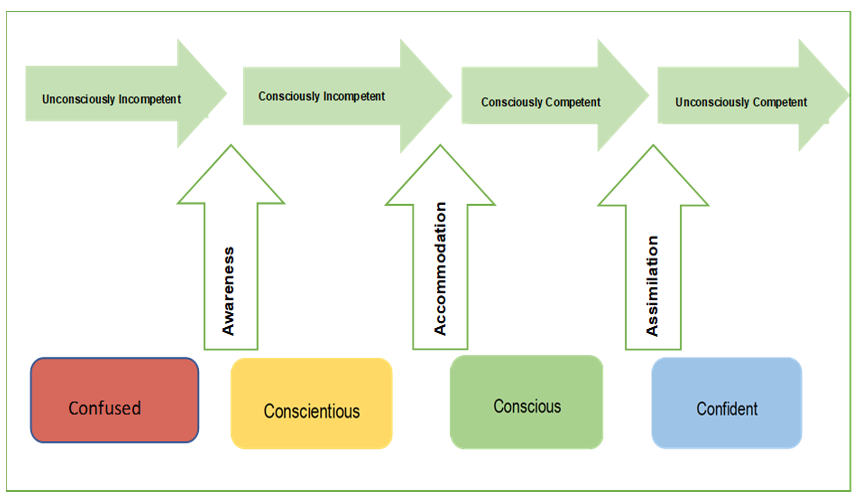
Types mapped to Four Stages of Learning Model (Kitchin, 2023)
Awareness takes the traveller to the next stage in which they become Consciously Incompetent, here represented by Conscientious Practitioners who acknowledge the limitations of their own competence and travel experimentally with their coachee as those who are ‘just one human being with another human’, responding to the moment. With Accommodation there is a move to being Consciously Competent, which could align with the Conscious Practitioners who are aware of the boundary and ethical guidelines. Accommodation involves sourcing and trying out new ideas and styles, evaluating their success, and this stage brings with it an inevitable self-consciousness which may align with an awareness of the ‘rules’. With assimilation of knowledge and skills, the traveller moves to Unconsciously Competent, in which the behaviours become an integral part of function. This may align with the Confident Practitioner who uses psychological underpinnings seamlessly in their work. It would be perhaps unfair to refer to any of the coach practitioners in the typology as incompetent and it is important to point out that in offering this comparison with Broadwell’s model it is not intended to suggest that the four types are a linear journey from one state to another. To do so would be to lose the value of the types as interrelated and holistically sourced from the Q process and also miss the probability that a coach may be in a different place on a different day with a different coachee and different content.
The findings highlight the role of supervision as a reflective space and boundary management mechanism for practitioners. Supervision has grown in popularity among coaches (Hawkins and Turner, 2014; Kitchin, 2014) and is actively encouraged by professional bodies (GCE, 2022, 4.3), especially for those who are credentialed. However, the success of supervision depends on the strength of the supervision relationship and the willingness of both supervisor and supervisee to tackle misses and near misses, while recognising the filter of self-deception (Bachkirova, 2015).
The function of intuition (how a coach knows when they are in risky territory) is illuminated by this study and may encourage conversations in supervision. Both coaching practitioner literature (Zeus and Skiffington, 2000; Starr, 2011) and research literature (Day, De Haan, Sills, Bertie and Blass, 2008; Sheldon, 2018) acknowledges the importance of intuition for coaches. There is a clear link between intuition and coach maturity, one measure of which is experience. There is a risk that, although using their intuition more consciously (Baker, 2014), novice coaches may trust their intuition too much in relation to the boundary (Eniola, 2017). More experienced coaches have better developed intuition (Bluckert, 2006; Mavor, Sadler-Smith and Gray, 2010), but may not be so conscious about using it (Baker, 2014).
This study supports previous research about the importance of contracting as a way of dealing with the coaching/therapy boundary in practice (Maxwell, 2009; Price; 2009; Eniola, 2017). Although well referenced in practitioner literature (Hay, 2007; Dexter, Dexter and Irving, 2011; Lee, 2013), it is not known if it is included in coach education or even what constitutes usual contract content. Contracts cover a wide range of subjects from logistics to process and it is not therefore known if the boundary is referenced as a matter of course for coaches. There was variation between the viewpoints about whether or not they agreed that they explicitly say that coaching is not therapy when they contract. This is consistent with the findings in Maxwell’s (2009) research in which participants said it was difficult to predict what would emerge and therefore how to contract comprehensively upfront, suggesting that coaches carefully consider their initial contracts and be prepared to recontract as necessary once work is underway.
None of the viewpoints felt that they had sufficient training to deal with everything in the coaching space. This could be because of the unpredictability of coaching or an increase since their training of more complex issues. It might also be a comment about how much their training actually prepared them for coaching and on the role continuing professional development (CPD) could be playing. CPD often concentrates on skills and knowledge but self-work is also important (Bachkirova, 2016). Coach educators may find the typology of value to consider if their offering is fit for purpose and has evolved to suit updated client requirements.
Limitations and future research
This research was conducted during the Covid-19 pandemic with physical restrictions faced by researcher and participants. This environment may also have heightened the emotional content of coaching sessions and coaches’ relationship with the issue. The study reports perceptions not reality. It is not possible to know from this study what coaches do, only what they report to do. The study has a UK bias, ignoring international portfolio of many executive coaches.
Future research could broaden the community of contributors and focus more on measuring reality. Although there is concern that a coach passing the boundary could do harm there is no available evidence of this and further research could look at both if harm happens and what is meant by harm. Further research could consider if intuition is a reliable way to navigate the therapy/coaching boundary.
The statements can be reused by other researchers to sample another section of the coaching community or at a later date to again see how the executive coaching field has evolved in their approach to working at the boundary with therapy.
Conclusion
This research contributes to knowledge by identifying four viewpoints and proposing them as a typology that represent perceptions executive coaches from a non-psychology background have of the boundary and overlap between coaching and therapy. These have not been isolated before and show subtle differences, giving insight into the positions executive coaches take and the decisions they make. The four viewpoints of Conscious, Confused, Conscientious and Confident Practitioners articulate the differences between approaches in a new way, recognising the complexity and suggesting that there is no direct alignment between coach experience or qualifications and how competently they deal with the boundary.
The typology invites stakeholders in the executive coaching field to understand the coach’s offering and approach. For example, practitioners may consider their own practice and ask, “where am I?”. Coach educators and professional bodies could ask “what is the offering to each viewpoint?”. Supervisors could consider “what questions can I usefully ask my supervisee when we are discussing boundary issues?” and “what is my own position and how does that influence how I supervise?”. Sponsors could ask “what type of coach do I want to use?” and “what type of coaching am I commissioning?”. Coachees could ask “where do I want my coach to be when they work with me?”.