




Abstract
Team coaching has the potential to enhance employee experience, one of the top trending motivators of human capital. However, a conceptual framework developed specifically for this purpose appears absent. This article describes the development of a team coaching framework to enhance employee experience. A qualitative research study with team practitioners validated the conceptual framework that was developed from academic literature. The result was the development of the SOUL team coaching framework, offering team coaches insights to facilitate employee experience enhancement interventions, founded on the theoretical foundations of constructivist and social constructionist sense-making and Frankl’s existential principles of meaning-making. SOUL is an acronym depicting the framework’s main conceptual categories – Settle, Offer, Unite and Learn.
Introduction
Employee experience has been noted as one of the most important human capital motivators in organisations (Meyer, 2019). Organisations that invest in improving employee experience are likely to be more innovative, better places in which to work and are thus likely to attract better applicants (Van Vulpen, 2019). Employee experience refers to a set of subjective perceptions employees have about their work in response to all their encounters with their organisation, including the meaningfulness thereof (Shenoy & Uchil, 2018). Positive employee experiences have been related to positive workplace outcomes, such as higher engagement levels (Asiwe, Rothmann, Jorgensen, & Hill, 2017), organisational commitment (Farndale & Kelliher, 2013), talent retention (Dana, 2018) and work motivation (Janik & Rothmann, 2015). Consequently, adopting an employee experience improvement strategy could benefit both the organisation and the employees.
Employee experience is a complex and multifaceted phenomenon, formed intrapersonally, interpersonally, and within the systemic context of the employee’s team (Lipkin, 2016). Every employee’s experience is subjective and develops through how they construct their experiences and make sense thereof (Lipkin, 2016). Employees tend to seek meaningfulness in their experiences (Lysova, Allan, Dik, Duffy, & Steger, 2019). Indeed, according to Frankl’s (1988) logotherapy, there is an inherent human quest for meaningfulness. This quest has been shown to be more important in determining most individuals’ work experiences than working conditions and pay (Bailey & Madden, 2016). The desire for meaningfulness is thus ever-present for employees in all their work-related encounters (Smither, 2003). It is therefore likely that meaningfulness could influence employee experience, which calls for integrating the dimension of meaningfulness into the employee experience definition.
As employees often work in teams (Akan, Jack, & Mehta, 2020), their experiences in these teams are likely to play a significant role in the formation of their individual experiences. Teams differ from groups in that they have common goals and shared responsibility for delivering on those goals (Katzenbach & Smith, 1993). Teams are social systems (Hackman, 2012) considered complex and dynamic (Ilgen, Hollenbeck, Johnson & Jundt, 2005). Greenberg, Sikora, Grunberg, and Moore (2012) proposed that a team member’s “feeling [of being] on a team” (p. 28) is a stronger predictor of organisational results than actually being a member of a team. Being a team member allows the employee to engage in purposeful action with others towards a meaningful or meaningless experience. These aspects bring significant complications to the formation of individuals’ experiences in teams (Lipkin, 2016).
Team coaching is a systemic team learning-based intervention (Clutterbuck, 2013; Hawkins, 2017) with the potential to enhance the employee experience as it goes deeper into the individual employee’s experience on a team level than other team development interventions (International Coach Federation [ICF], 2020), which is often linear in nature. Team coaching can create affective outcomes (Jones, Napiersky, & Luybovnikova, 2019) and enhanced employee experience can be considered an affective outcome. However, the systemic dynamics in teams provide other complications in the formation of employees’ experience in teams and thus also impact team coaching practices (Clutterbuck, et al, 2019, Hawkins, 2017).
With the ubiquity of teams in organisations and the challenge for organisations to optimise their gains from team performance (Akan, Jack & Mehta, 2020), this study explored how team coaching can enhance employee experience. We developed a team coaching framework for enhancing employee experience by using multiple perspectives from available scientific knowledge and external team practitioner expertise. The study was conducted in three phases and the findings of the study are presented according to these phases. In the first phase, we explain the conceptual development of a preliminary team coaching framework (the SOUL framework) to enhance employee experience. The second phase discusses the conceptual validation of the framework against practitioner input. In the third phase, we consolidate the first two phases to present a consolidated SOUL team coaching framework. SOUL is an acronym with mnemonic value, depicting the framework’s main conceptual categories – Settle, Offer, Unite and Learn.
Employee experience
The concept of employee experience originally developed from the better-known construct of customer experience in the field of marketing. Shenoy and Uchil (2018) defined employee experience as the employees’ subjective set of perceptions about their work experiences in response to interactions during their tenure with the organisation. Plaskoff defined employee experience as the “individual’s holistic perceptions of the relationship with his/her employing organization, derived from all the encounters at the touchpoints along the employee’s journey” (2017, p. 137). Lariviére et al. defined employee experience as the “totality of cognitive, emotional, behavioural, sensorial and social responses that result from interactions with other parties” (2017, p. 242). Indeed, the “magnitude or significance of what one feels” (Monnot & Beehr, 2014, p. 205), is a defining aspect of the employee experience.
Reflecting on the definitions of employee experience, themes emerged: 1) employee experience as a temporal dimension, occurring over time; 2) employee experience as a relational dimension encapsulated in words such as interaction and encounter; 3) employee experience as a dimension of wholeness, encapsulated explicitly in the words totality, holistic, and all (Lariviére et al., 2017; Plaskoff, 2017); and 4) employee experience as a generally neutral construct void of associated judgements or implications – it can be either positive or negative. However, the endeavour to create an enhanced employee experience, a gateway to positive organisation and individual results, suggests a need to integrate a positive indicator into a definition of employee experience to charge the definition positively. For the purposes of this study, the definition of employee experience took on the first three themes, temporal, relational and whole, in addition to charging the construct positively with meaningfulness.
Employee experience is not to be confused with employee engagement, which can be considered as more of an end state, while a positive employee experience is a means to that end (De Klerk, Joubert, & Mosca, 2021). Lemon (2019) reasons that employee experience is a transition to co-creational perspectives which are rooted in making meaning of employees’ engagement experience. Traditionally, employee engagement techniques focused on serving the organisation in aspects such as receiving a return on labour through higher productivity and reduced turnover (Eldor, 2017). In contrast, employee experience is designed to serve the needs and expectations of the employee (Lemon, 2019), with organisational benefits as an indirect outcome. Morgan (2017, p.2) attested that employee engagement initiatives tend to wear off over time. Employee engagement initiatives might work, but are limited to individual needs, which is why organisations should consider coaching interventions that are more systemic and thus likely to sustainably enhance employee experience (Nelson & Neicu, 2020).
Formation and enhancement of employee experience
Subjective and contextual sense-making
Similar to customer experience, which is focused on first understanding customers’ needs and then how to improve their experience (Plaskoff, 2017), strategies to influence employee experience starts by discovering and understanding employees’ needs. Two perspectives that can be borrowed from customer experience literature are the subjective and contextual approaches. The subjective approach, which includes the cognitive or sense-making perspectives (Lipkin, 2016), with its origins in constructivism, purports that individuals subjectively construct their experiences in their minds (Lipkin, 2016). Constructivist learning theory suggests that learning is actively acquired, not given, in collaboration and real-life problem solving in which new experiences are assimilated based on the foundation of previous experiences (Bada, 2015). Consequently, employee experience is likely to improve in a team context that promotes collaboration and problem-solving (Bada, 2015). On the other hand, the contextual approach, which includes the dyadic and ecosystemic perspectives (Lipkin, 2016), proposes that the formation of the experience is socially constructed and negotiated (Raskin, 2002).
Through adopting a constructivist approach, team members build an imagined desired experience and future expectations in their minds (Ratner et al., 2012). According to social constructionism, progress towards the desired future is co-constructed (or socially constructed) among team members through interacting with one another and their contexts (Ratner et al., 2012). Accepting personal construct psychology as constructivism (Young & Collin, 2004), Pavlović (2011) argued that adopting a double view enables employees to understand the complexities of their situation. For example, personal constructions of an imagined future that either support or resist progress towards the goal are embedded in team goals. Lipkin (2016) reasoned that the formation of the employee experience cannot be attributed to either the employee’s subjective or contextual realities, but rather comes about via the interaction of both realities.
Meaning-making
Frankl (1988) proposed that the quest for meaning is an inherent condition of being human and living a meaningful life. Frankl’s (1988) definition of meaning entails finding an experience or perception that one’s life and work are of significance. Meaning-making happens through those aspects of people’s lives that provide a positive subjective experience of meaningfulness of one’s endeavours. Bailey and Madden (2017) proposed that a sense of meaning arises subjectively in so-called peak moments through reflection and appreciation of the meaningfulness of one’s systemic context. A sense of meaningfulness has been shown to correlate consistently with almost all aspects of wellness (De Klerk, 2005); positive work experiences and orientations, such as work motivation, and organisational commitment (De Klerk, Boshoff, & Van Wyk, 2006) and job satisfaction (Van der Walt & De Klerk, 2014).
According to the Rosso et al. (2010) framework, individuals have an innate drive for agency and communion in their experiences, whether their actions are orientated towards themselves or others. Continuums of self-other and agency-communion intersect to create self-focused pathways of individuation and self-connection and other-focused pathways of contribution and unification. All pathways are available to the individual team member as ways toward meaning-making, and any activating meaning-making mechanisms in these pathways may enhance the employee experience. Rosso et al. (2010) suggested that the pathways have interactive effects, so enactment in one pathway could effect change in another. The meaning-making mechanisms within these pathways provide intricate possibilities for team members to discover meaningful experiences only available to them through their social experiences.
Given the ever-present dimension of the team member’s quest for meaning-making, we propose that meaningfulness may potentially emerge at any moment of the conversation and team interrelations. Meaningfulness positively charges the neutral definition of employee experience to generate improvement strategies and interventions, such as team coaching and positive goals.
Team coaching
Team coaching can be defined as: "partnering in a co-creative and reflective process with a team on its dynamics and relationships in a way that inspires them to maximise their abilities and potential to reach their common purpose and shared goals" (International Coach Federation [ICF], 2020, p. 4). It is the integral and systemic focus on team dynamics that sets team coaching apart from other development initiatives such as team building and consultation (ICF, 2020; Lawrence, 2019). Introducing a coach to the team's social system suggests that the coach is part of the dynamic interactions within the team coaching which is acknowledged in the definition as partnering (ICF, 2020). In the dynamic interactions, social changes emerge (Lipkin, 2016). Solution-focused approaches, such as coaching interventions, incorporate constructivist and social constructionist philosophies (Ratner, George, & Iveson, 2012).
The dyadic and contextual sense-making perspectives of team coaching align with social constructionism. When coaching adopts social constructionist learning theory, the team coaching becomes a learning intervention that resembles a dialogue (Armstrong, 2012). In this dialogue, the meaning of an experience for individual team members can be renegotiated. Both interpersonal relationships and the team as a system with its culture, shared values and structure play a role in forming the employee experience. In this partnering, coaches can use frameworks as conceptual tools to navigate any coaching intervention.
A team coaching framework could integrate reflective practices to enable the transcendence of “here-and-now” experiences toward a developing process of meaning-making (Bailey & Madden, 2017, p. 4). However, sense-making approaches such as solution-focused coaching do not necessarily ensure the significance of the experience is altered, or a focus on pathways for team members to enact meaningful experiences. Logotherapy, founded by Frankl (1988), used a technique in bereavement known as benefit-finding (Davis, Nolen-Hoeksema & Larson, 1998) to enact enlightenment – enhancing meaning through a meaning-making process (Berti & Berti, 1994). Benefit-finding is likely to enhance employee experience through activating meaning-as-significance (Davis, et al., 1998).
The sense-making and meaning-making approaches are systemically suitable for enhancing the employee experience. A sense-making approach would suggest that the employee experience is transported back and forth across a broad non-linear timeline (Lincoln & Hoffman, 2018) and experiences are processed in an iterative and circular manner subjectively and intersubjectively (Lipkin, 2016). As experience formation has a subjective and inter-subjective dimension, change can be viewed as happening in the entangled past, present and future in tenseless time (Dawson, 2014). According to the philosopher Augustine (XI, 22: 26, as cited in Popova & Cuffari, 2018), tenseless time is the three-fold present; at any given moment, individuals have a present direct experience, present memories of the past and present anticipations for the future that is ever shifting.
Developing a coaching framework for employee experience enhancement (Phase one)
Approach
A team coaching framework provides a structure and process to offer an underpinning philosophy for the coaching process that is directed towards achieving a particular outcome (Stout-Rostron, 2014). Depicting the team coaching framework as the representation of a system (Luoma et al., 2011) helps to simplify the complexity of a team coaching intervention, yet still illustrates the dynamic continuous non-linear potential of enhancing the employee experience.
In this study, we did not compare all the coaching approaches to argue or select one best option to accommodate constructionism, sense-making and meaningfulness. Instead, in developing a conceptual team coaching framework for employee experience enhancement, systems thinking was adopted as an organising principle, using the initial steps of Dubin’s Theory Building Method (Elangovan & Rajendran, 2015). The sense-making approach and perspectives of solution-focused coaching were further useful in informing the formation of the employee experience (Lipkin, 2016). The framework building could then proceed by integrating the solution-focused elements with the scaffolding to examine the relevant coaching elements. Secondly, the meaning-making process elements and their likely relationship with solution-focused elements were considered essential in the development of the framework. Both sense-making and meaning-making viewpoints and processes were thus integrated into the preliminary conceptual coaching framework.
Developing the conceptual framework
Generally, the first solution-focused element of any coaching intervention is preparing the proverbial ground (Meier, 2005), which is equivalent to setting the foundation of ICF’s original competency framework (ICF, n.d.b). However, preparing the ground implicitly suggests that setting the foundation only needs to be attended to once at the start when, in fact, it should be maintained throughout the coaching session. Team psychological safety is a shared belief that the team is a safe environment where interpersonal risks can be taken (Edmondson, 1999). This emerges through interpersonal conversations. A shared values system (Rosso et al., 2010) and establishing a sense of team psychological safety (Edmondson, 2004) in setting the foundation would give team members a compass to navigate their behaviour safely in the session, thereby encouraging meaningful experiences. In effect, it involves the team settle ecosystem (Lipkin, 2016) to likely enhance the team learning experience. Consequently, these eco-system elements could be conceptualised as ‘Settle’ and are proposed as the initial conceptual category in the preliminary framework. Settle comprises the sub-elements of setting the foundation through agreeing on team values and establishing psychological safety as indicated in Figure 1.
The second solution-focused element of the coaching framework includes goal setting (Meier, 2005) and future orientation (Szabo & Meier, 2009), which involve the team members constructing a compelling shared future outcome (Edmondson, 2004). The compelling shared outcome, which according to Edmondson (2004) must co-exist with psychological safety, is in keeping with solution-focused literature (Meier, 2005), proposing the appeal of a goal for team members as a crucial success factor in any team coaching. Part of the appeal is a perception that their contribution will make a difference to others, both in and beyond the team. Through these contributions, team members have a pathway to enhance their experience through making meaning of their perceived impact, significance, self-abnegation, and interconnection (Rosso et al., 2010). This point of interaction in the preliminary framework conceptualises the team member’s available pathway to an enhanced experience through contribution (Rosso et al., 2010) towards the compelling shared outcome (Edmondson, 2004) as ‘Offer’. The term Offer builds on the meaning element of a compelling shared outcome, which is likely to enhance the experience of impacting the team, contributing for the greater good, becoming part of something meaningful, and surrendering individual control to pursuing something bigger that is shared (Figure 2). The term Offer was selected as it aligns with the thinking that meaningfulness cannot be prescribed but offered (Frankl, 1988).
The third set of solution-focused elements involves the progress elements and is about identifying steps (Meier, 2005) in which team members participate in eliciting alternatives. This process has also been described as the scaling dance (Meier, 2005), where individuals engage in tracking progress and establish what has worked well already as resources from the past and identifying clues from the future in which small moments in the present become precursors of the preferred future (Szabo & Meier, 2009). For the team framework to capture all dimensions of these solution-focused elements in the coaching process to a broader audience of team practitioners, these activities can be represented as eliciting alternatives, tracking progress, resources from the past and clues from the future. When engaging in making progress, team members can enhance their sense of belonging. Within the preliminary framework, this type of interaction is conceptualised as ‘Unite’, meaning that the team member’s sense of belonging lies within the pathway of unification (Rosso et al., 2010). Unite comprises the elements of eliciting alternative actions by taking clues from the future and learning from the past, and then tracking progress (Figure 2). From these actions, individuals are likely to experience a sense of team identity and connection with the team and its members.
An overarching consideration in the conceptual framework was making meaningfulness literature elements central to the framework clearly and understandably. The elements’ names were derived from translating their definitions from literature as they would likely show up in a team context. The perceived impact is when team members feel that their contribution makes an impact on the team. Significance, on the other hand, is when the team member experiences that their contribution is essential for the greater good beyond the team (Rosso et al., 2010). Both interconnection and self-abnegation relate to transcendence. Self-abnegation occurs when the team member surrender(s) control by contributing to something shared (Rosso et al., 2010; Frankl, 1967), and interconnection relates to having a solid connection to be part of something greater than oneself (Burger, Crous, & Roodt, 2008; Rosso et al., 2010). The last two meaning-making processes of interpersonal connectedness and social identification relate to a sense of belonging. Through interpersonal connection, team members can enhance their experience in their connection with team members. At the same time, team members can adopt a sense of team identity through social identification. From these translations, the elements in ‘Offer’ became perceived impact on (the) team, greater good, surrender and part of something. Similarly, the elements of ‘Unite’ became a connection with the team and a sense of team identity.
Finally, although team members bring meaning-making processes to practices in setting the foundation, creating a compelling shared outcome, and making progress, it is in the final phase that the employee experience could be enhanced through an increased sense of enlightenment. Locating enlightenment after sense-making aligns with Berti and Berti’s (1994) bereavement framework. Davis et al. (1988) proposed benefit-finding, which involves assigning a positive value to an experience for the self and team, could be a guiding technique for enlightenment. Even though the self and team are discrete sources of meaning, Rosso et al. state that “individuals are ultimately arbiters of the meaning of their work, as shaped through the lens of their unique perceptions and experiences” (2010, p. 115). The term ‘Learn’ was selected for the conceptual category that embodies the significance of adopting benefit-finding principles to evoke enlightenment in the employee experience signifying that the experience can be reconstructed (Figure 1).
The relevant elements as discussed, and their conceptual interactions, are explicated in the preliminary team coaching framework (Figure 1):
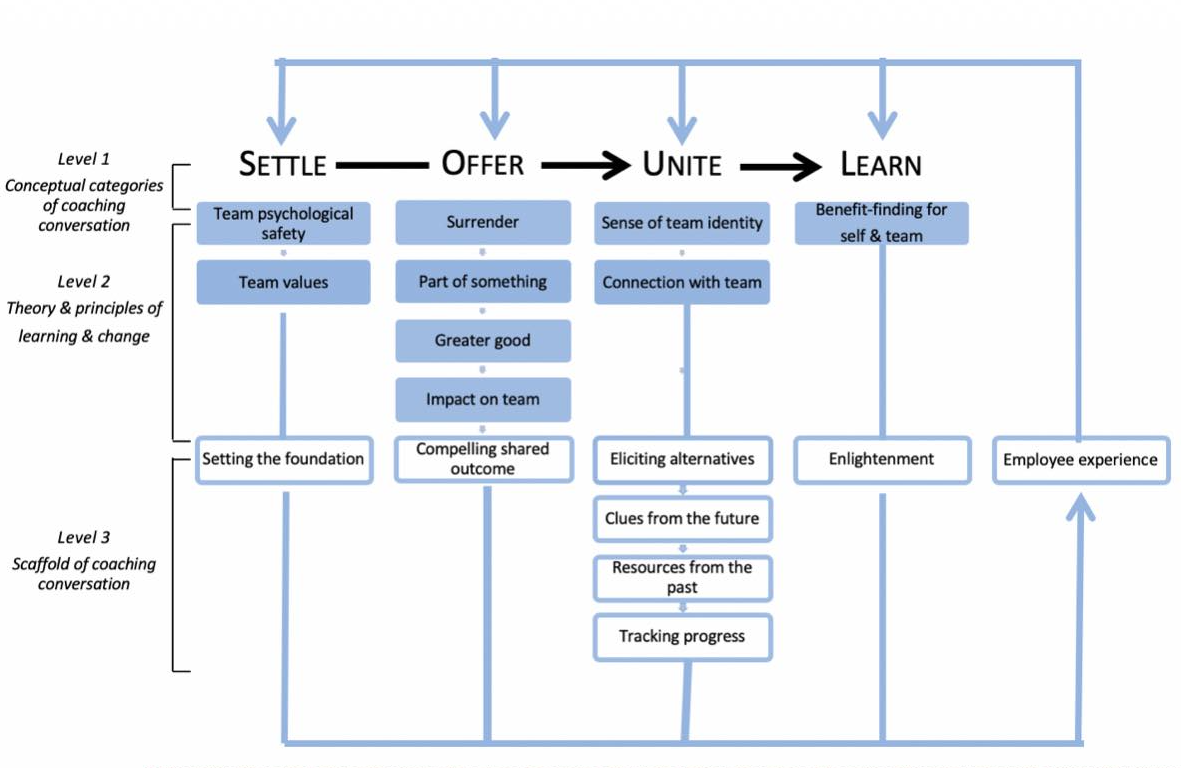
The dynamic SOUL team coaching framework for employee experience enhancement
In Figure 1, the four main categories (level 1) of the SOUL framework (Settle, Offer, Unite and Learn) reflect the conceptual foundations of coaching conversations in a “big picture way” (Stout-Rostron, 2014, p.88), represented in the acronym SOUL. The acronym serves as a metaphor for enabling team members to fulfil their soulful needs in their team experiences, as people have an inherent desire to find meaning (Frankl, 1988). The acronym also creates a mnemonic for the coaching conversation with the black arrows suggesting a map for a coach to navigate the coaching conversation in keeping with the order of related elements in the ICF core competency framework (ICF, 2020). However, the map is not the territory; the coach's skill is to partner with the team to bring the team coaching process to life (Stout-Rostron, 2014). Furthermore, theory and principles of learning and change (level 2) inform the process elements in the coaching conversation (level 3). The process elements provide detail to guide the coach in the coaching conversation. Although the framework appears to operate linearly from left to right, it should be regarded as a continuous system. The circular feedback loops of the arrows depict the systemic nature of the meaning-making process of emergence (Lipkin, 2016) throughout the process.
Conceptual validation of framework (Phase two)
Research design and sampling
An exploratory qualitative research method was selected to obtain conceptual validation of the SOUL team coaching framework. Semi-structured interviews of about one hour each were conducted with 12 professional team coaching and development practitioners. Interview questions were derived from the conceptual framework and used to gather practitioner input and perspectives to conceptually validate and consolidate the team coaching framework. Ten team coaches were recruited through convenient purposive sampling. All participants were deliberately chosen for their practitioner experience in team coaching and developing interventions, and for having a coaching perspective in line with the ICF (2020). In addition, two professionals were recruited through snowball samples as team practitioners from a related, but slightly different field, to enhance content validity (Saunders, Lewis, & Thornhill, 2016). One participant was a logotherapist who works with teams in organisations, and one participant identified as a team development psychologist.
Ten of the participants had worked with teams in the preceding three months, and all participants had delivered team coaching or therapy in groups in the previous year. Two of the participants had received mentoring as opposed to team coach training, while one participant had received no formal team coach training. Four participants had conducted team interventions only in South Africa, whereas one had only conducted team interventions in Europe. Seven participants had experience in team coaching or mentoring both in the South African and international setting, including other African countries, Asia and Europe. Eight of the participants had between 10 and 15 years of coaching experience, three participants had between 16 and 19 years of experience, and one participant had around nine years of coaching experience.
Data gathering and analysis
Because employee experience is a relatively new concept, its operational definition was explained to the participants at the beginning of each interview to facilitate the trustworthiness of their input. Participants were allowed to familiarise themselves briefly with the conceptual framework either by being taken through the various points of the framework or by reading through the framework themselves. Finally, the conceptual framework and the definition were kept in view during the interview.
Interviews were recorded and transcribed verbatim by the researchers. Data were analysed both deductively and inductively. A deductive template with a priori themes from the SOUL framework elements was developed before analysing the data through a structured coding approach. In the second stage of the analysis, a systematic process of inductive thematic analysis was undertaken to explore patterns emerging from the interviews. Emerging patterns were abstracted into themes, some with more detailed sub-themes. The findings of both analyses were synthesised and used to migrate the preliminary conceptual framework (Figure 1) into the consolidated SOUL team coaching framework (Figure 2).
Research Findings: Validation of the conceptual framework (Phase three)
Stage 1 – A priori data analysis
Level 3: Scaffold of the coaching conversation
All sense-making elements were to a large extent validated. Setting the foundation was supported by all participants and thus, eligible to be maintained in the consolidated framework. The importance of the compelling shared outcome in the framework was supported by almost all participants (n = 11). It is apparent that, for the whole team to learn and share information, there needs to be a shared goal that gives direction and provides motivation for team members (Edmondson, 2004). The motivation for team members is derived from the potential meaning they can realise from the compelling outcome (Edmondson, 2004). A compelling shared outcome was also maintained in the consolidated framework because of the participants’ support.
All participants strongly supported eliciting alternatives and resources from the past, as well as clues from the future and tracking progress, as important elements in the framework. Enlightenment received support from most participants (n=10). However, the use of the term enlightenment to represent the discovery of meaning (Berti & Berti, 1994) was criticised as being contextually inappropriate and unclear in a framework applied in organisations. In the consolidated framework, the term enlightenment was replaced by insights.
Level 2: Theory and principles of learning and change
The relevance of team psychological safety was confirmed by all participants. This finding confirms the literature on the significance of psychological safety as a key coaching condition to facilitate learning (Edmondson, 2004). All participants supported the necessity to include mechanisms to promote purpose, self-efficacy, self-transcendence, and a sense of belonging to derive meaningfulness (Rosso et al., 2010). The term surrender was criticised by six participants as sounding like giving up and suggestions were offered. As such, the term buy-in was selected for its relational component in the revised framework.
The principle of social identification in the third leg of the conceptual framework was viewed by participants to be unclear. Consequently, the principle was replaced with team member identification with the team.Furthermore, after additional consideration of the concept of connection with the team, it became apparent that the dyadic aspect of this mechanism for meaningfulness was not clear. In considering the dyadic aspect of the interpersonal connectedness mechanism, this mechanism was operationalised as positive relationships with team members.
The principle of benefit-finding for self and team in the final leg of the proposed framework was supported by all participants. The consolidated framework shows the necessity of maintaining benefit-finding as deliberate reflective practice. In addition, the self and team orientation of the benefit finding was supported and aligns with literature, suggesting that self and team are sources of meaning, owing to the self, being the ultimate arbiter of meaning (Rosso et al., 2010, p. 115).
Level 1: Conceptual categories of a coaching conversation
All participants strongly supported the importance of to first Settle. Both Unite and Learn were fully supported. Although the term Offer was supported by most participants, there was some criticism, as shown by the following statements:
Coaching is a co-creative space. Who’s offering who, what? (P8)
If a company doesn't offer, then there's nothing for the new person or the human being to come into. (P11)
I just wanted to understand the use of the word offer. I'm just not completely connected to that word. (P4)
From these statements, it became clear that the explicit purpose ofofferwas required. To remain aligned with the literature reviewed, the purpose of offer is in service of something external to the self (Rosso et al, 2010). In the team coaching model, this would be the compelling shared outcome. Also, a description of who (team member) makes the offer and for what purpose (in service of) will be included in the consolidated model.
Stage 2: Emergent themes within conceptual categories
Multiple pathways of safety
The first theme that emerged from the thematic coding indicated that the safety experience could be constructed through multiple pathways. Safety precedes the optimisation of learning enabling a team member to participate without any negative repercussions (Edmondson, 2004; Edmondson, 1999). Although the importance of psychological safety was confirmed, the physical safety of team members was also noted as an important aspect:
I always thought physical safety was a joke, but it was when we facilitate in different venues … (P9)
Upon review, the concept of team psychological safety was extended to include physical safety. The terminology was consolidated as safety.
Validate team member contributions
A theme of validating team member contributions emerged as an additional element to consider in the team coaching framework:
When we value people, when we notice and catch what they're doing right, when there's a sense of this is what I have to offer, this is my value, this is my worth that does create teams that thrive and it would launch a more positive perception for the employee in terms of how they fit into the organisation and their own role. (P5)
These sentiments from participants suggest that team members have an impact on one another’s experience, supporting the contextual lens of employee experience (Lipkin, 2016; Rosso et al., 2010). The employee has a more positive perception when their worth is noticed and communicated. Thus, validate team member contributions was added to the consolidated framework.
Multiple locations of compelling shared outcome
Analyses of the feedback from participants suggested that the location of compelling shared outcome could also be in Settle, whereas the related concept of current reality was not represented in the preliminary framework:
… psychological safety, connecting with values, setting the foundation and current reality, understanding of, you know, what's happening. (P4)
Taking into consideration the temporal dimension of the employee experience, the current reality of the employee would be in the threefold present (Augustine, XI, 22:26, as cited in Popova & Cuffari, 2018) and not sometime in the future. Consequently, compelling shared outcome could thus be located in the Settle category. Another participant supported this location:
… coming to a compelling shared outcome would always have to be at the start of any team coaching. (P12)
However, what happens to enhance the employee experience in the categories Offer, Unite and Learn is also done about the compelling shared outcome:
Everything you do needs to have a relationship with the compelling shared outcome. (P12)
The framework was thus amended so that compelling shared outcome was part of both Settle and Unite.
Collapse levels 2 and 3 into the synthesised description
The need to collapse levels 2 and 3 of the preliminary framework into a synthesised description of what is to be done under each conceptual category emerged as a theme. Participants argued that these elements are not mutually exclusive and at times it is in their relationship that meaning is created:
I'm assuming that answers the question of why we are here and our team values the foundation of safety for how we show up here and what happens here. So, it's vital. (P9)
The meaning created in the relationship between these elements was made explicit in the consolidated framework by synthesising levels two and three into the category of Settle. Setting the foundation was re-operationalised from the deductive analysis to read the code of honour. Consequently, in the consolidation of levels 2 and 3, the category of Settle is termed code of honour for learning and safety. Other relationships that did not show to be mutually exclusive were benefit-finding for self and team in level 2 and enlightenment in level 3:
The benefit, you know, for oneself and one’s team in terms of insights or enlightenment would be useful. (P8)
It appears that benefit for self and team occurs in relationship to enlightenment (insights). In the consolidation framework, these were thus collapsed into insights for self and team with a benefit focus.
The interfaces are interdependent
The interdependencies of the interfaces between levels and categories (legs) in the conceptual framework emerged consistently as a theme. For instance, ongoing reflection has important interfaces with Offer and Learn
Benefit finding the self and team then that obviously has to be something that is a recurring ongoing … benefit finding for self and teams sounds a little bit once off to me … So, emphasise that it is not just a one-off learning. (P1)
So, if there's an in-the-moment experience that's happening all the time and it's feeding into how I'm learning, is that not influencing the uniting? (P8)
This finding correlates with the notion that employee experience can shift at any point in the process because employee experience is subjectively occurring in the multiplicity of the present (Augustine, XI, 22:26, as cited in Popova & Cuffari, 2018). Similar to the category of Unite, Offer is also a pathway (Rosso et al., 2010) to an enhanced employee experience owing to its relationship with meaningfulness. Consequently, it was concluded that a similar view could be applied to the relationship between Offer and Learn. In the consolidated framework, the relationship between Unite and Learn, as well as between Offer and Learn, occurs interdependently in the Unite–Learn and Offer–Learn interfaces.
The theme of ongoing invitation emerged at the interfaces of both Settle–Offer and Settle–Unite.
I think there's always an invitation to participate … You can't force people to participate. (P8)
It appears that the term participation relates to both Offer and Unite and aligns with literature purporting that psychological safety leads to the willingness to participate in learning (Edmondson, 2004). In the consolidated framework, there is an ongoinginvitation to participate which can only occur in conjunction with psychological safety in the Settle–Offer and Settle–Unite interfaces.
In the context of ongoing invitation, the sub-theme of team member voiceemerged at the interface between Settleand Offer, while the sub-theme of collective team voiceemerged at the interface between Settle and Unite:
So, there is both the individual voice and the voice of the team. (P7)
It appears that both individual and collective voice can be located in both Settle and Offer. The importance of a collective or team voice is that it is self-governing:
So, taking the time in the team to define clearly the behaviours that support those values, because then they can call each other on it. (P1)
Voice is a necessary part of unity and is essential (Rosso et al., 2010) for the team to create a safe space for all team members to participate (Edmondson, 1999; Edmondson, 2004). This suggests that team voice relates to both Settle and Unite.
In the context of ongoinginvitation, the importance of trust emerged as a sub-theme. Trust is a consequence of psychological safety and has a unifying impact on the team:
… if you’re not going to take the time to create that psychological safety, then there won’t be trust. (P1)
… the lack of trust ... can directly impact on the progress of the team, how they are moving forward with the task. (P2)
Literature suggests that trust is a prerequisite for psychological safety and exists in the interrelationships within a team (Edmondson, 2004). Similarly, participant input suggests that psychological safety leads to trust, which positively affects unity. Consequently, trust can be consolidated in the interface between Settle and Unite.
Similarly, a sub-theme of openness emerged in the context of ongoing invitation:
Settle and Offer go together. Yeah. I think that works really well because you are, as you’re settling in, you’re settling in, you're inviting people into a space and a process. (P5)
… the importance of creating safety so that people do feel that they can surrender, they can be vulnerable and open and honest, and that it's safe to do that. (P4)
Surrender (buy-in) refers to team members subordinating themselves deliberately to something greater or external to themselves, such as a team vision or goal (Rosso et al., 2010). Earlier discussions of the findings noted the need to replace the term surrender with buy-in. The participants suggested that team members will be open to buying into the compelling shared outcome when they feel safe. This understanding of buy-in relates to the interface between the conceptual categories of Settle and Offer.
The metaphor of SOUL is apt
The SOUL acronym and its mnemonic value extend its purpose as a metaphor, which was supported by several participants:
… the name of the framework … it's something that I feel is really missing in a lot of organisations is that connection with what really matters to us at a soul level. (P5)
This finding is aligned with Frankl’s (1967) spiritual dimension in which team members’ will-to-meaning resides. SOUL, as a metaphor for a team coaching framework that incorporates and harnesses Frankl’s will-to-meaning dimension, thus remained in the consolidated framework.
Structure and flexibility of the framework are necessary
The structure is one of the key dimensions of any coaching framework (Stout-Rostron, 2014). The structure is a master plan of the coaching conversation. Within each conceptual category, there is the possibility of flexibility in the questioning structure, and techniques and tools applied (Stout-Rostron, 2014). Support for the flexibility of a systemic structure and temporal plasticity of the SOUL framework emerged as a theme:
I don't think I would change anything. It makes logical sense going the way it does. (P4)
I like to talk a lot about signs of progress and not so much about tracking progress. (P12)
Confirmation of the desirability of systemic structural flexibility and temporal plasticity, combined with continually working with signs of progress, suggested utility in synthesising several of the elements into one category and eliminating distinct levels. As a result, tracking progress, eliciting alternatives, clues from the future and resources from the past were collapsed into progress.
Turning ‘what ’and ‘why’ questions into practical ‘how’ activities
It was a consistent theme from participants that how things are done needs to be indicated more specifically and practically in the framework:
At the moment, they say more about the aspects of a well-functioning team than a coaching framework per se. (P12)
Eliciting alternatives … I can see a lot of the co-create themes having a shared purpose or compelling shared outcome, exploring what are the options or alternatives, connecting to a vision … the clues from the future … then looking at what's worked in the past and being able to monitor and track progress. (P5)
The how relating to the sense-making and meaning-making elements in each conceptual category of the consolidated framework has been addressed by replacing single words with a short sentence that describes every main category of SOUL.
Creating employee experience requires a broader perspective
In the final theme, findings showed that enhancing the employee’s experience needs to be considered in a wider context than illustrated in the preliminary framework:
Normally we look at the vision of the team … is there a team vision that aligns with the organisational one? Because, again, there has to be alignment. (P1)
… understanding the team [purpose] within the context of the full supply value chain. (P10)
… a South African … team, … [with] different histories, … it’s … quite a lot more complex. (P7)
These contributions reveal various environmental considerations affecting learning and growth not considered in the preliminary framework. In the consolidated framework, the team coaching and team-member ecosystem are embedded in a wider ecosystem to include environmental factors.
Mapping the findings into a framework – Phase 3
The synthesis of all the findings resulted in the consolidated SOUL team coaching framework for employee experience enhancement in Figure 2. The confirmation that the employee experience is enhanced in tenseless time (Augustine, XI, 22:26, as cited in Popova & Cuffari, 2018), in conjunction with confirmation of the initial four conceptual categories and the emergent commonality in the interface of the conceptual categories migrates the initial framework to a non-linear and systemic, four-vector framework. In addition, findings revealed that all elements in a team coaching framework for employee experience enhancement will systemically interact with each other as well as the environmental elements which affect employee experience.
The consolidated coaching framework presented in Figure 2 provides flexible structure and process, temporal and systemic plasticity and an underpinning rationale for the team coaching intervention for employee experience enhancement. This framework comprises all the dimensions required from a coaching framework (Stout-Rostron, 2014). The acronym SOUL has mnemonic value. Employee experience is the central point in the Venn Diagram, as depicted in Figure 2 above. The diagram comprises four circles showing where all the elements intersect and differentiate within the environment, emphasising the principles of tenseless time and perpetual occurrence (Augustine, XI, 22:26, as cited in Popova & Cuffari, 2018).
Apart from the affective outcome of the employee experience, all the areas of the four-circle Venn framework define ‘what’ happens between coach and team members with indications of ‘how’ these things happen. The environmental elements interact with all the areas in the framework.
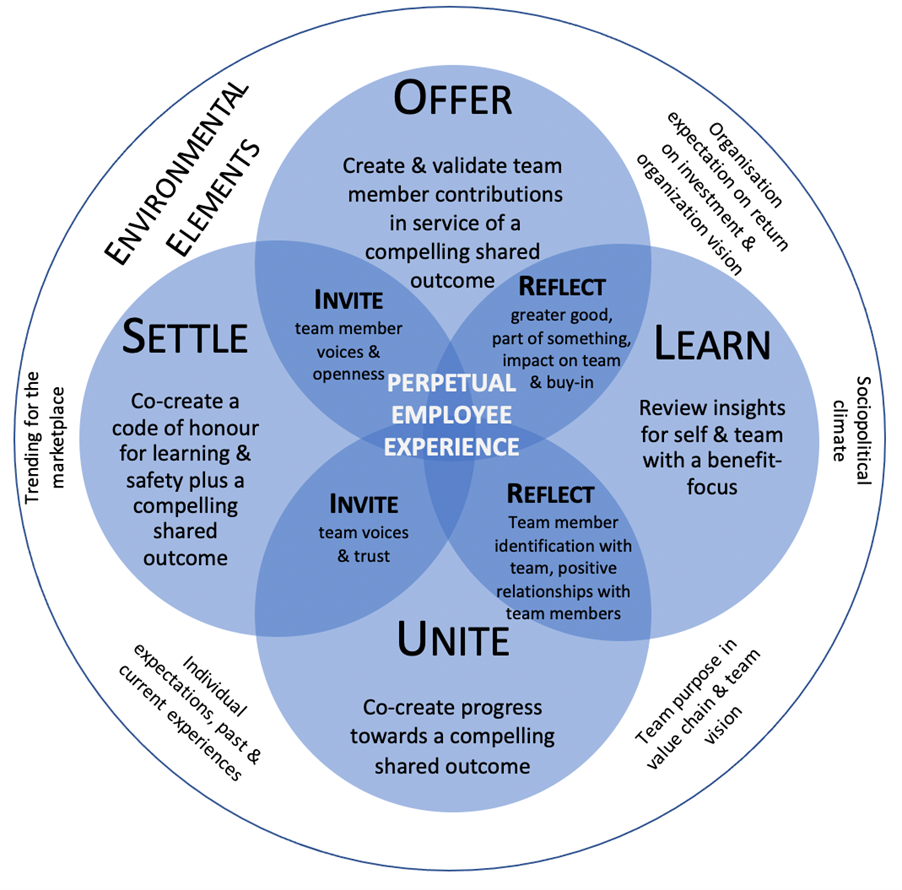
Consolidated SOUL team coaching framework for employee experience enhancement
Conclusion
Developing the SOUL team coaching framework for employee experience enhancement integrates three areas of current academic knowledge, which have not been found together in prior studies, namely team coaching, employee experience and meaningfulness. Integrating meaningfulness into the framework is particularly novel and could affect the current thinking on the employee experience in organisations. As a guide that was conceptually validated by experienced practitioners, the framework offers the coach practitioners a conceptual approach to enhance the employee experience. This guide could be used by coaches external to the organisation, as well as internal and leader coaches. In addition, the framework can support researchers in exploring the complex phenomenon of enhancing employee experience through team coaching.
As with any study, this study has some limitations. Most importantly, the framework offered in this study was only conceptually validated according to its face value and requires empirical validation in future research. Further research could also be undertaken by applying the proposed framework to actual team coaching interventions to determine how it performs in reality. This study relied on a relatively small sample of practitioners, primarily from South Africa, adopting principles from the International Coaching Federation. It is not clear whether the framework would be conceptually validated similarly by a different set of team practitioners, especially those from other cultures. Further research with larger samples and in other contexts is recommended. It will be valuable for such research which will combine interviews with both coaching practitioners and employees who have experienced team coaching to enhance employee experience and meaningfulness in teams. The purpose would be to expand the picture of employee experience within the team context and to gain further insight into the perspectives of team coaching interventions. A further suggestion is that this framework is taken further through action research that would include suggesting improvements around the application of the framework and that provide an assessment of outcomes for organisations.
The conceptually validated framework offers a novel approach for practitioners potentially to enable a more positive team member experience through team coaching. This development is significant as the enhanced employee experience is likely to benefit employees individually as well as organisations. It is hoped that this development will initiate further research and practices to enhance employee experience.