




Abstract
This review investigates the relevance of socio-cognitive mindfulness (Langer, 1989) to wellbeing coaching by systematically synthesising the evidence to understand how socio-cognitive mindfulness interventions work. The search yielded 2,867 peer-reviewed studies with twelve papers meeting the eligibility criteria. The interventions induced socio-cognitive mindfulness with non-clinical adults via one or more psychological processes to achieve intrapersonal, interpersonal and environmental wellbeing. Six of the studies employed exercises to produce boosts in wellbeing, whilst six conducted extended programmes, of which three demonstrated sustained wellbeing improvements. The findings indicate that socio-cognitive mindfulness could provide valuable insights for practitioners and synergistic benefits for wellbeing coaching.
Introduction
In the 1970s, social psychologist Ellen Langer and colleagues studied the pervasiveness of mindlessness, characterising it as the automatic reliance on fixed and prearranged rules and the ignorance of contextual information (Langer et al, 1978). Langer observed that people spend most of their time in a mindless state much to the detriment of their competence and wellbeing, even going so far as to claim that “virtually all of our problems – personal, interpersonal, professional, and societal – either directly or indirectly stem from mindlessness.” (Langer, 1989, p.xiii). Langer worked on the prevention of mindlessness (Langer & Piper, 1987) and developed an approach to mindfulness which is based on creating new distinctions and drawing attention to the present moment and context (Langer, 1989).
This form of mindfulness goes by various names but will be referred to as socio-cognitive mindfulness henceforth due to its emphasis on flexible cognitive processing within social contexts (Pirson et al., 2018), and to also differentiate it from the more commonly known meditative form of mindfulness (Kabat-Zinn, 1982). Although Langer‘s approach does not require meditation practices, she has described five psychological processes which instead help to stimulate her socio-cognitive form of mindfulness (2014, pp. 63-80):
“welcoming new information”; attending to novelty and variability
“more than one view”; viewing from multiple perspectives
“control over context”; flexible reappraisal of ‘fixed’ situations
“creating new categories”; actively producing new distinctions
“process before outcome”; responding to choices instead of over-focusing on outcomes
There have been numerous experimental studies where socio-cognitive mindfulness has been induced via one or more of the processes during a brief intervention. This typically involves providing study participants with instructions or exercises to evoke a mindful condition which can lead to enhanced health and wellbeing outcomes, such as increased self-acceptance, improved relationships and decreased stress and burnout (Hart et al, 2013). Examples of brief interventions include asking orchestral musicians to ‘actively create novel distinctions’ whilst playing their instruments, resulting in enhanced performances (Langer et al., 2009), and instructing participants to use four different categories to sort the same set of photographs, leading to reduced stereotyping behaviours (Djikic et al., 2008).
As most socio-cognitive mindfulness intervention studies tend to focus on very specific situations and outcomes it is difficult to interpret and generalise the findings for audiences outside of experimental conditions. As a result, there does not appear to be accessible guidance for anyone hoping to increase their capacity to function in a socio-cognitive mindfulness mode, unlike the array of options for anyone looking to practice meditative mindfulness. This seems a missed opportunity since socio-cognitive mindfulness has been associated with a wide range of health and wellbeing benefits (Langer, 2010).
As such, the authors of this review who are practising coaches with a shared interest in wellbeing development, agree that it is worthwhile exploring the integration of evidence-based strategies from socio-cognitive mindfulness theory with coaching to promote wellbeing outcomes for coachees. Theories focusing on human flourishing, such as those accruing within the positive psychology literature, are of particular utility for coaching research (Green & Palmer, 2018). An example of this is the development of a coaching approach based on the established PERMA model of wellbeing to promote improvements in positive emotions, engagement, relationships, meaning and accomplishment (Seligman, 2011; Falecki et al., 2018).
Mindfulness has also been identified as a useful theoretical perspective with evidence-based strategies for facilitating positive change within coaching contexts, and with the potential to enhance coach and coachee wellbeing (Virgili, 2013; Shelly & Zaidman, 2021). Furthermore, as coaching can be understood to be an inherently social process which requires an understanding of social contexts (Shoukry & Cox, 2018), socio-cognitive mindfulness appears to offer an especially useful theory for coaching. Socio-cognitive mindfulness encourages self-regulation, active learning and creative problem-solving (Baer, 2003) which are all valuable strategies to incorporate into coaching practice. Nevertheless, there appears to be a lack of existing research investigating how socio-cognitive mindfulness can be applied in practice.
Therefore, the objective of this study is to conduct the first systematic review of socio-cognitive mindfulness interventions to understand how they work to improve wellbeing in order to offer insights for practitioners. A synthesis of the findings could lead to implications for the application of socio-cognitive mindfulness in coaching contexts and provide evidence-based recommendations to coaches. Accordingly, this review will target adults from non-clinical contexts to align with most coaching approaches which focus on solutions and optimal functioning, and less on identifying problems and therapeutic care (Grant & Green, 2018).
The primary review question for this study is: How is socio-cognitive mindfulness induced in non-clinical adult populations to promote multidimensional wellbeing? The following sub-questions help to answer this overarching question and to provide a systematic approach:
How are socio-cognitive mindfulness interventions implemented?
What psychological processes are posited to influence socio-cognitive mindfulness intervention outcomes?
What are the multidimensional wellbeing outcomes of socio-cognitive mindfulness interventions?
What are the benefits and limitations of socio-cognitive mindfulness interventions in terms of generalisability, feasibility and sustainability?
The secondary review question is: Which insights from the socio-cognitive mindfulness findings may be relevant for wellbeing coaching research?
Method
A systematic review of the current literature on socio-cognitive mindfulness was carried out to narratively synthesise the findings from a collection of primary research studies (Boland et al., 2017, pp. 1-8). A protocol was devised following the Preferred Reporting Items for Systematic Review and Meta-Analysis (PRISMA: Page et al., 2021). The review commenced as soon as it was registered and accepted by Prospero on 5th January 2022 (registration number: CRD42022298522).
Eligibility criteria
Eligibility for included studies (Appendix 1) was influenced by the aims of the research and by PRISMA guidance (Moher et al., 2009) by selecting studies against the following PICOS criteria:
Population: non-clinical adults
Interventions: based on Langer’s socio-cognitive concept of mindfulness (1989), which may be referred to by other names, such as ‘mindful learning’.
Control/comparator: could be passive, e.g., a control group, or active, such as comparing to other interventions, or
Outcomes: validated measures of mindfulness and wellbeing following the intervention, with the PERMA-V wellbeing model (Seligman, 2011; Eacker, 2020) used as a guideline for eligible wellbeing outcomes (with the V representing Vitality).
Study types: peer-reviewed quantitative, qualitative or mixed methods
Eligible papers were required to be published from 1989 to align with the publication of Ellen Langer’s seminal book ‘Mindfulness’ which presented the accumulation of research into Langer’s concept of mindfulness. Papers also needed to have an abstract available in the English language to ensure the concept of wellbeing was not being interpreted differently in other languages. The reviewers referred to a table capturing the inclusion and exclusion criteria (see Appendix 1) to support consistency.
Search strategy
The search strategy for this review was optimised for sensitivity to ensure all forms of mindfulness which have derived from Langer’s concept could be located. Table 1 captures the search terms which were adapted for use in combination with database-specific filters for the nine chosen bibliographic databases. Backwards and forward citation searches were conducted using Google Scholar to locate any further relevant publications. Electronic alerts were also created across all databases to notify when a newly published study had met the search terms which were last checked on 30th June 2022.
Search terms by database/register
Study selection
Once all databases and registers were searched as described, the primary reviewer (KC) used the reference management tools, Zotero and Rayyan, to administer the screening and selection processes. The retrieved papers were first screened by title and abstract against the eligibility criteria. Next, full texts were retrieved for the remaining studies and assessed for eligibility, with the final studies proceeding to the synthesis stage. The steps in the review were recorded using the PRISMA 2020 flow chart (Page et al., 2021). To mitigate bias, a second reviewer (KS), independently assessed a random 20/ selection from the screening stage and the full-text stage against the eligibility criteria.
Data Extraction
A master data table collated descriptive content relating to the aims, methodology, population, and key findings of each study, with additional tables capturing relevant information relating to the intervention design, outcomes and the psychological processes used or discussed. To ensure the chosen categories for extraction were fit for purpose, the data tables were piloted using 25/ of the final studies to ensure all relevant data had been gathered per the research aims and checked by the second reviewer (KS).
Synthesis approach
The review was expected to produce significant heterogeneity across the study outcomes; therefore, it was planned for the data to be synthesised narratively rather than meta-analytically. To ensure the research questions were answered methodically and transparently, the four stages outlined within the Guidance on the Conduct of Narrative Synthesis in Systematic Reviews (Popay et al., 2006) were followed, albeit in an iterative manner:
The role of theory in evidence synthesis supported the initial interpretation of the final studies by referring to Langer’s concept of mindfulness (1989).
Identifying common features within the disparate array of extracted data helped to develop preliminary synthesis by clustering studies into groups based on these patterns.
To explore relationships within and between studies, the variability in design, outcomes and psychological processes of the interventions was thematically analysed to form categories. A concept diagram was then created based on the synthesis results.
To evaluate the rigour of the synthesis, each study was appraised for its quality of evidence to ensure that the synthesis could offer trustworthy insights on socio-cognitive mindfulness.
Quality assessment
The primary reviewer employed a quality assessment tool based on the Evidence for Policy and Practice Information (EPPI) Weight of Evidence framework (Gough, 2007) to assign low, medium or high scores against three areas: trustworthiness, appropriateness and relevance. The three scores were then used to produce an overall score for the study’s quality of evidence. A spreadsheet was created to provide clarity and transparency for the quality assessment by developing signalling questions which were specific to this review. The second reviewer (KS) assessed 25/ of the included studies for quality, and there were no disagreements with quality appraisals across both reviewers.
Results
The database and register search yielded 2,867 papers with 672 duplicate records removed and a further 2,140 manually excluded and recorded. Fifty-five full texts were sought for retrieval with an additional record found via citation searching. Figure 1 depicts the full results of the systematic search.
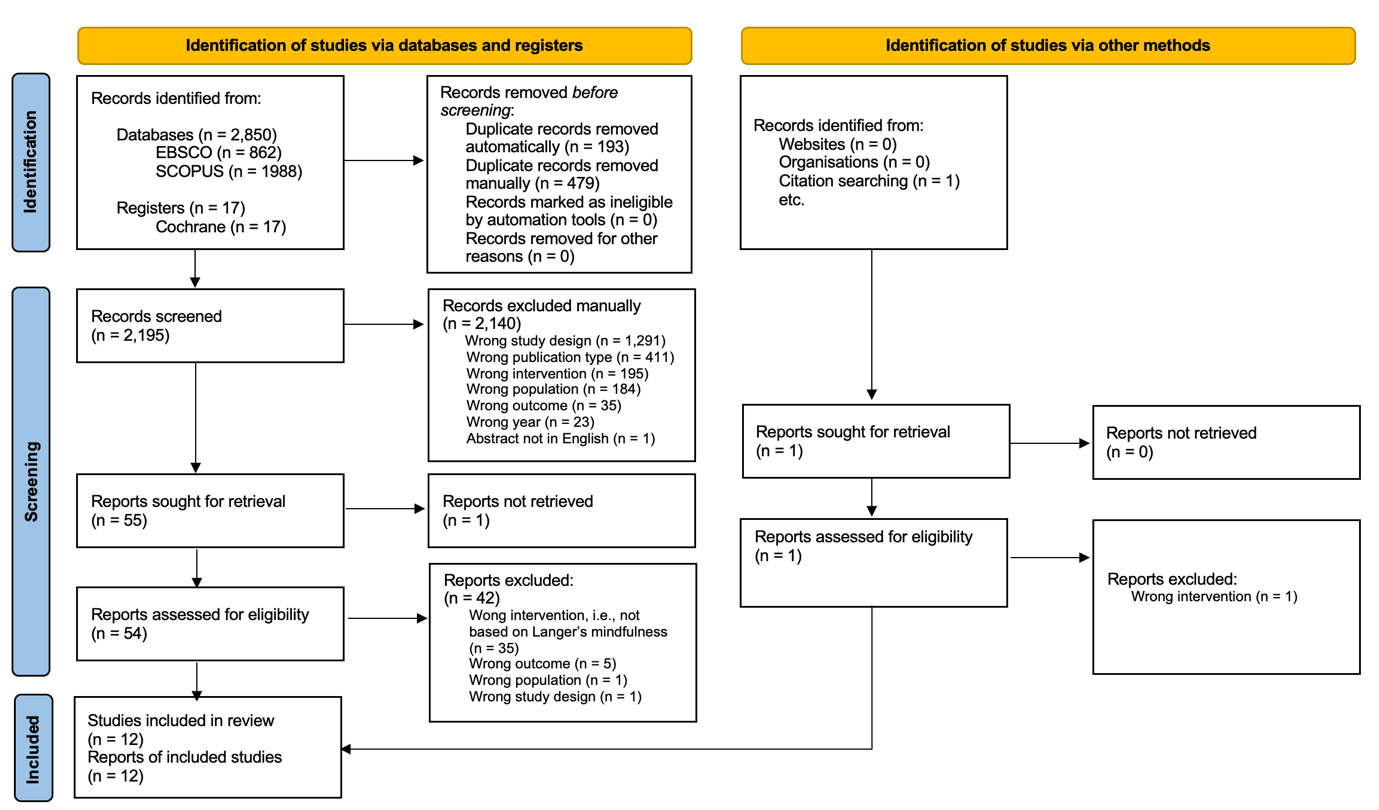
Flow diagram of systematic review search (Source: Page et al., 2021)
Characteristics of studies
Table 2 presents the 12 studies which met the full eligibility criteria and were included in the synthesis stage (more detail is given in Appendix 2). Although socio-cognitive mindfulness is a concept originating from the West (Hart et al., 2013), five of the studies were conducted in the East, thus offering a reasonably balanced representation of Eastern and Western cultures within the review. 1,175 adult participants were included in the overall review, with the mean ages ranging from 19.3 to 67 for the nine studies which provided demographic details. Overall, there were more women represented than men. The sample sizes ranged from 22 to 149, except for one which recruited a total of 253 participants across four sub-experiments. Every study included control groups and/or comparison groups, therefore, the group sizes participating in the socio-cognitive mindfulness interventions ranged from eight to 122.
Final studies in socio-cognitive mindfulness
Quality of studies
The quality assessment of the final studies produced mixed results, with three studies scoring low (1, 2, 5), seven studies scoring medium (3, 4, 6, 7, 10, 11, 12) and two studies scoring high (8, 9) for overall quality (see Appendix 3). Although strict selection criteria were applied and all eligible studies had employed RCT methodology - except for one controlled non-randomised experiment (1) - there were still quality issues amongst some studies, such as small sample sizes, and insufficient detail of the intervention design. However, such quality issues were factored into the synthesis of the results by placing more credibility and emphasis on studies with a higher weight of evidence.
The key features of the design, outcomes and processes of the interventions were next captured and categorised in Table 3 and discussed in the subsequent sections.
Intervention designs
The variability in intervention design and format was analysed to answer the first review sub-question: How are socio-cognitive mindfulness interventions implemented? The analysis identified two predominant approaches to the interventions: brief mindfulness induction and extended mindfulness programme.
Brief mindfulness induction
Half of the studies were laboratory-based experiments adopting brief mindfulness induction interventions. Four of these were written exercises involving answering open questions for 15-20 minutes (5, 6, 9, 10), and one study involved four separate written exercises over four days, thus totalling two hours for the intervention (3). The most common written exercise asked participants to categorise numerous items against differing standards. Further examples included participants writing about seemingly negative events from a positive perspective or recording the new things they noticed within their environment. The only study which did not involve writing instead instructed its paired participants to notice different things about their partner during a conversation (4).
Extended mindfulness programme
The other six studies adopted a field-based approach and were significantly longer than the brief interventions, ranging from one to six weeks. At the shorter end of the range were three studies requiring participants to maintain mindful attention to a specific area, such as heart rate variability (1), fluctuation in pregnancy sensations (12) and creative opportunities (11). The remaining studies were longer still as they involved weekly training sessions across five or six weeks. One study involved an art course (2), another taught key features of Langer’s construct of mindfulness (7) and the third combined both areas by teaching and applying principles informed by socio-cognitive mindfulness to a creative project (8). All extended programmes involved participants integrating the intervention tasks into their ordinary routines, such as completing exercises at home and maintaining a record of their experiences.
Intervention outcomes
Due to the subjective nature of wellbeing the search strategy was intentionally broad to answer the sub-question: What are the potential multidimensional wellbeing outcomes of socio-cognitive mindfulness interventions? Thus, the final twelve studies represented a variety of wellbeing outcomes and with this, a diverse array of measures. Although this made it too difficult to statistically combine or compare the study results, it was possible to identify three thematic categories relating to the study authors' findings against their targeted wellbeing focus: intrapersonal, interpersonal and environmental.
Key features of socio-cognitive mindfulness interventions
Intrapersonal
Nine of the studies targeted wellbeing outcomes that related to intrapersonal development and coincided with four of the six PERMA-V wellbeing domains (Seligman, 2011; Eacker, 2020). Positive emotions and engagement were represented via increases in positive affect, life satisfaction, self-esteem and mindfulness (2, 3, 6, 7, 12). Some studies measured accomplishment, either through goal attainment scores (8) or by formal assessment of performance on creative projects (2, 11). There was also interest across the studies to measure participants' perception of their accomplishment (5), their self-efficacy with creativity (11) and their sense of environmental mastery (8). Vitality was targeted in one study by measuring participants’ heart rate regulation (1), and in another by including self-reported improvements in energy levels (7).
Interpersonal
One study had a primary focus on the relationship domain within PERMA-V and measured participants' heart rates to gauge interpersonal synchronicity (4). Another study detected an increase in participants’ positive relations within their range of wellbeing measurements (8). Additionally, the increases in intrapersonal wellbeing within the caregiver studies could lead to improved relationships with the recipients of their care, although this was not directly measured (3, 7).
Environmental
Two of the studies measured increases in mindfulness, which falls under the engagement domain of PERMA-V, however, their main outcomes were increases in connectedness to nature (10) and pro-environmental behaviours (9). It could be argued that the wellbeing outcomes for the two studies also represent the meaning domain. For example, one of the studies was based on self-expansion theory (9), whereby individuals derive meaning and increase self-efficacy through the ‘inclusion-of-other-in-the-self’ (Aron & Aron, 1986), which can include a sense of connection to environmental phenomena.
Intervention processes
The studies were next examined to answer the sub-question: What psychological processes are posited to influence socio-cognitive mindfulness intervention outcomes? This was not a straightforward procedure since different terms for the processes were sometimes used or terms were used interchangeably. This corresponds with Langer’s explanation that the five psychological processes or ‘states’ within her mindfulness construct are different versions of the same thing (1997, p. 23). Nevertheless, the following examination endeavours to differentiate the processes employed within the interventions based on the interpretations of the study authors.
Welcoming new information
Welcoming new information was the most common process and was activated in seven studies through various approaches, such as noticing novelty and attending to variability. Participants who noticed novelty increased their attentiveness, sensitivity and creativity toward their surroundings (11). Noticing novelty also reduced cognitive biases, such as shallow thinking and leaping to conclusions, which improved rationality and decision-making (6). This was extended to improve interpersonal decisions since noticing novelty about another person can lead to more accurate perceptions (4). Participants who attended to variability in their heart rate were able to control its regulation, an ability that could potentially extend to the regulation of emotions (1). This seemed to be evident when the pregnant participants paid attention to their fluctuating pregnancy symptoms and noticed the impermanence of negative sensations, which in turn boosted positive affect and prevented decreases in wellbeing (12). Similarly, another study discussed that having an awareness of the multiple reasons behind symptom variability can result in an increased sense of control and understanding (7).
Creating new categories
The process of creating new categories was included in five interventions and involved participants using different standards to categorise given items or think of unusual uses for common objects. For example, one study asked participants to progress their art project without the use of a standard piece of equipment such as a paintbrush (8). The active creation of new categories interrupted the participants’ routinised cognitive modes to induce a different consciousness which could be more open and tolerant (10), leading to more harmonious associations with others and the environment (9). When the caregiving participants developed new and more positive categories about the care process, rather than relying on previously formed illness-related categories, they were able to respond more adaptively to their existing environment and context which resulted in increased wellbeing (3, 7). This also stimulated multi-perspective thinking about their roles, which is an example of how the socio-cognitive mindfulness processes influenced and interacted with each other.
Viewing from multiple perspectives
Four of the interventions encouraged participants to look at situations from multiple perspectives. The caregiving participants viewed their role from different angles to suspend their conventional way of thinking about illness, and instead, develop more positive outlooks on their experiences and achievements (3, 7). Other participants were encouraged to adopt multiple perspectives when observing other people’s seemingly negative behaviour to seek alternative justifications and positive intentions (7, 8). By removing existing mental barriers, participants could open their awareness beyond the self to recognise the needs of other people and their environment, which was believed to promote prosocial and altruistic behaviours (9).
Control over context
Control over context is not explicitly referenced by the authors and appears to crossover with the process of viewing from multiple perspectives. For example, the participants in one study were advised that judgements are context-dependent and can be changed when viewed from alternative perspectives (5). Participants were encouraged to be more flexible with the context surrounding what may initially be perceived as a negative event, and instead reappraise situations from a more positive viewpoint (5, 8). Similarly, when caregivers were able to reframe their roles by controlling interpretations of their personal circumstances they could cope better with role-related challenges which in turn improved their positive emotions (3, 7).
Process before outcome
Process before outcome was included in two of the studies and was the primary focus of one intervention that provided process instructions during an art course. Although this resulted in increases in participants’ self-esteem, the process instructions did not provide a significant enough difference from the outcome instructions in improving their understanding of art. Both groups made improvements which were posited to be due to the participants learning about the course and being encouraged to actively make distinctions. The second study suggested that participants who focused on the process before the outcome during creative projects were more actively engaged in the present moment and more aware of context and new information (8), once again, demonstrating how the socio-cognitive mindfulness processes reinforce each other.
Intervention benefits and limitations
The studies were next examined to answer the final sub-question: What are the benefits and limitations of socio-cognitive mindfulness interventions in terms of sustainability, feasibility and generalisability? First, the brief exercises proved to be useful for inducing mindfulness quickly, without the need to commit to long-term practices. However, it may be unrealistic to expect such short and simple interventions to achieve the full anticipated effects (4). As most of the brief interventions were only able to target one or two socio-cognitive mindfulness processes, several authors recommended addressing a full range of mindfulness techniques in future research (9, 10). Correspondingly, Langer et al. (2010) acknowledge that “Perhaps more training is necessary to fully reverse a lifetime of making evaluative judgments” (p.72). This may also account for why the authors of the brief interventions did not conduct follow-up measures to track any lasting effects, which they admitted limited their studies (3, 9).
In contrast, three of the extended mindfulness programme studies did include follow-up measurements. A two-week-long intervention resulted in improvements in psychological wellbeing which were sustained one week after the intervention, but not one-month post-intervention (12). However, a five-week intervention maintained some of the wellbeing outcomes, such as emotional wellbeing and social functioning, at least one month after the intervention (7), while a six-week-long intervention sustained increases in environmental mastery three months post-intervention (8). The two longer studies also included all five of the socio-cognitive mindfulness psychological processes within their intervention, possibly due to their increased capacity.
The extended programmes required a significant commitment from participants. This led to smaller sample sizes than the brief interventions, and some studies experienced high dropout rates impacting feasibility (1, 7). The longer training programmes demanded more resources in terms of acquiring experienced instructors and training venues. However, two of the studies delivered their interventions online, with the authors suggesting this led to enhanced feasibility due to their ease of use and reduced demand on participants (7, 11). Nevertheless, all extended interventions were conducted in everyday settings, therefore offering greater ecological validity than the laboratory-based brief interventions.
The type of intervention material used also influenced feasibility and effectiveness. For example, intervention instructions were either generic, such as organising random words into different categories (10) or they were relevant to the study’s aims, such as basing written exercises on a picture depicting a caregiver scenario (3). It was argued that although generic learning materials are more accessible and may be easier to use within interventions, they require sustained usage to achieve results. In contrast, targeted learning materials for specific groups produce results quicker, although their purpose is limited (3).
Finally, the generalisability of half of the studies may be limited due to their recruitment of young university students (1, 4, 5, 9, 10, 11), whilst four studies recruited specific populations, such as older women (2), pregnant women (12), or carers (3,7). Only two studies recruited the public (6, 8). Some studies excluded data relating to the clinical proportion of the population, which further impacted generalisability (3, 7, 12). Nevertheless, all participants from this review were non-clinical and could be potential audiences for coaching.
Discussion
This review has produced findings related to the design, process, outcomes and limitations of socio-cognitive mindfulness interventions which were interpreted to answer the review’s main question: How is socio-cognitive mindfulness induced in non-clinical adult populations to promote multidimensional wellbeing? In summary, socio-cognitive mindfulness can be activated via one or more psychological processes to produce a variety of wellbeing benefits. The psychological processes include welcoming new information, creating new categories, viewing from multiple perspectives, controlling the context, and attending to the process before the outcome. One or two of these processes can be activated during a brief exercise to quickly produce a state of socio-cognitive mindfulness to achieve temporary increases in wellbeing. Alternatively, the processes can be induced multiple times and can interact with each other throughout an extended mindfulness programme to potentially achieve prolonged wellbeing improvements. Since socio-cognitive mindfulness includes a focus on social aspects, it was not surprising that some of the interventions produced increases in interpersonal wellbeing. Yet, most of the wellbeing outcomes recorded in this review represented increases in intrapersonal wellbeing, with some also demonstrating increases in environmental wellbeing. These findings are summarised within a visual framework in Figure 2 to support further research and application.
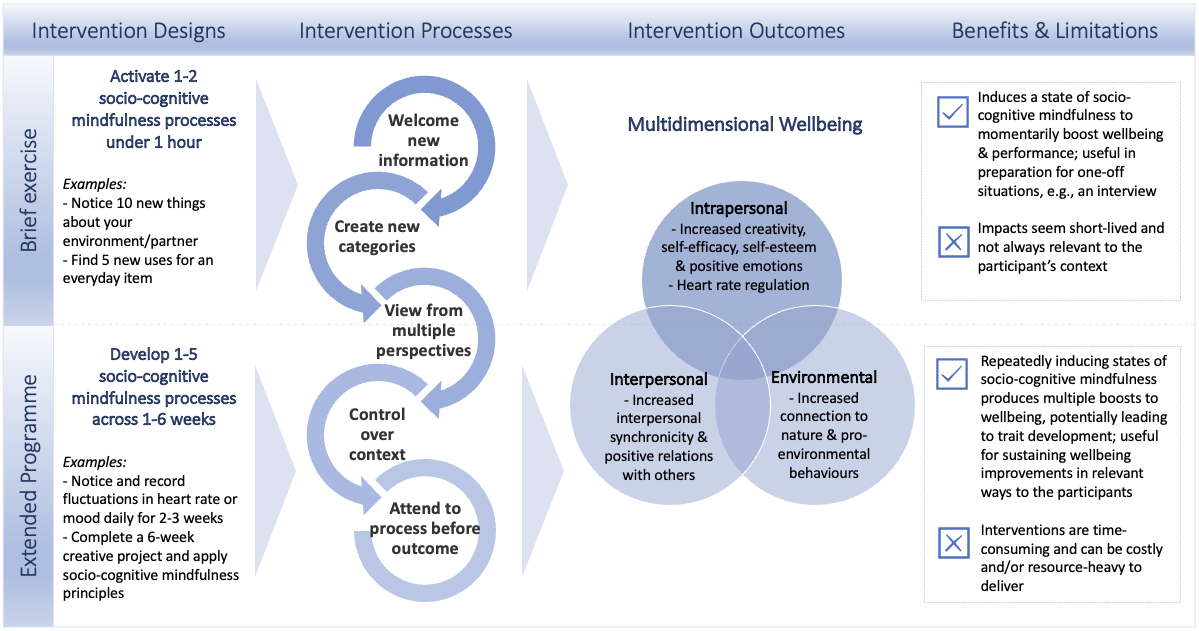
Synthesis of systematic review results
There may be advantages and disadvantages associated with applying the two different intervention approaches in practice. Some might find inducing a temporary state of mindfulness via a brief exercise helpful to better manage an imminent challenge or improve performance on a specific task without the commitment of a regular long-term practice; a requirement often associated with meditative mindfulness. Whereas others may be willing to commit their time and resources to develop socio-cognitive mindfulness on an ongoing basis to maintain increases in wellbeing. The latter resonates with other positive psychology intervention studies which aim to go beyond generating short-lived boosts in wellbeing to achieve more sustained wellbeing improvements through extended and effortful practices (Lyubomirsky et al., 2011; Dundas et al., 2016). The results also suggest that frequent activation of states of socio-cognitive mindfulness may strengthen dispositional socio-cognitive mindfulness, which is a trajectory that has been demonstrated with state and trait meditative mindfulness (Kiken et al., 2015), and in time, could also lead to changes in related behaviours (Djikic et al., 2008).
To understand how to activate socio-cognitive mindfulness to reap its associated benefits, this review has provided insights into the five psychological processes first introduced by Langer in 1989 which have been integrated into numerous experiments since. It is worth noting, however, that some of the processes share similarities with other established theories. For example, attending to the process before the outcome echoes Dweck’s (2006) concept of nurturing a growth mindset and enjoying the process of learning with less emphasis on performance outcomes. Likewise, welcoming new information is very similar to the open awareness required within meditative mindfulness, although socio-cognitive mindfulness differs by intentionally reconstructing items of awareness (Cavanagh & Spence, 2013, p. 116). Thus, in a coaching context, the socio-cognitive mindfulness approach to finding solutions may be preferable to the “placid acceptance” that can sometimes be associated with meditative mindfulness (Bachkirova & Borrington, 2020, p.20).
Implications for wellbeing coaching
The second review question asked: Which insights from the socio-cognitive mindfulness findings may be relevant for wellbeing coaching research? The synthesis from this review provides a framework for the application of socio-cognitive mindfulness theory, which could be applied to coaching to support coachees with wellbeing development. Examples are provided in the following sections to demonstrate how this integration might work in practice which would be worth researching further to understand their efficacy within coaching contexts.
Coaching processes and outcomes
According to the findings of this review, there is a wide range of wellbeing improvements that can be achieved via socio-cognitive mindfulness. A coach can enhance a coachee’s autonomous motivation towards their personal goals by empowering them with choosing which wellbeing outcomes are most relevant to them (Falecki et al., 2018). Once a wellbeing goal is selected, some coaches may find it useful to understand which processes are more likely to lead to which wellbeing improvement. Figure 3 provides an overview of how often each process led to outcomes within each wellbeing domain.
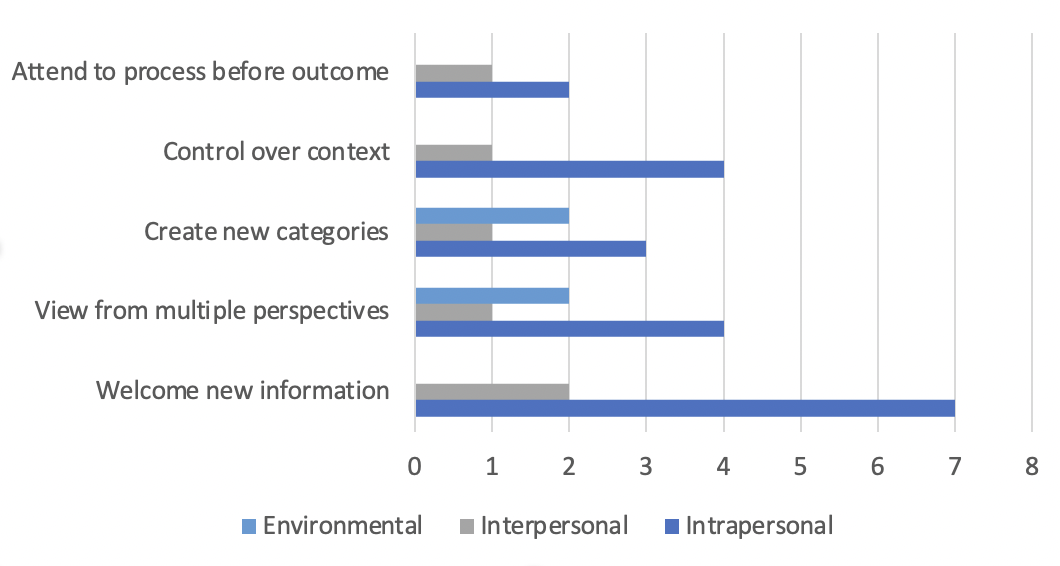
Frequency of socio-cognitive mindfulness processes leading to wellbeing outcomes
If a coachee wanted to increase their connectedness to nature, for example, a coach could support this goal by integrating the process of creating new categories or viewing from multiple perspectives into their coaching approach. However, that is not to say that the other processes may not also have positive impacts on environmental wellbeing, only that there are no studies that met this review’s criteria that have demonstrated it. In fact, Langer advises that each socio-cognitive mindfulness process “leads to the others and back to itself” (1997, p. 23), suggesting that the processes work in an integrative and congruent manner.
The studies in this review demonstrated that all five processes led to a spectrum of improvements across both the intrapersonal and interpersonal domains. Furthermore, various correlational studies have demonstrated positive relationships between trait socio-cognitive mindfulness and an array of wellbeing areas, such as self-fulfilment and resilience (Ghanizadeh et al., 2019), marital satisfaction (Burpee & Langer, 2005), affective and cognitive empathy, (Trent et al., 2016) and sustainable consumption and environmental concern (Helm & Subramaniam, 2019). Hence, there may be an opportunity for coachees to embrace a more multidimensional and holistic approach to their wellbeing (Lomas et al., 2015) rather than targeting one specific area. Nevertheless, it is in keeping with the socio-cognitive mindfulness approach for the coach to encourage coachees to attend to the process before the outcome by pursuing wellbeing development that is enjoyable and rewarding in itself, rather than over-focusing on the end result (Gantman et al., 2014).
Brief coaching exercises
The two intervention designs offer both short-term and long-term options for integrating socio-cognitive mindfulness into wellbeing coaching, and a coach can identify the utility of using one approach over another. For example, coaches can support coachees to induce states of socio-cognitive mindfulness via brief interventions during sessions, much like how meditative mindfulness can be stimulated during coaching via breathing techniques and body scan exercises (Virgili, 2013). A coach may feel that a coachee would benefit from activating a state of socio-cognitive mindfulness to broaden their thinking and produce more options and solutions throughout the coaching session.
There are several approaches for a coach to induce socio-cognitive mindfulness during coaching. A coach could introduce a brief exercise which can be unrelated to the coaching topic but designed to stimulate socio-cognitive mindfulness to prepare the client for more flexible thinking during the session. For example, a coach could encourage a coachee to create new categories by asking them to select an everyday item, such as a pen, and produce ten different uses for said item. Alternatively, the exercise could be related to the coaching topic, such as asking the coachee to describe their current opportunity or challenge from the viewpoints of five different people which would encourage thinking from multiple perspectives. Coaching questions can also be framed in such a manner as to stimulate socio-cognitive mindfulness, for example, a coach could encourage a coachee to control the context by asking “How could your perceived weakness be seen as a strength in a different context?”
Since the findings suggest that repeatedly activating states of socio-cognitive mindfulness may lead to more sustained wellbeing improvements and perhaps associated behaviour change, a coach may opt to integrate a variety of socio-cognitive mindfulness exercises and questions across multiple sessions.
Extended coaching programmes
Another option to support socio-cognitive mindfulness trait development for sustained wellbeing results is to adopt a similar approach to the extended programmes in this review. Based on the findings, an example may be a six-week programme of weekly coaching sessions which incorporate psychoeducation on how to activate socio-cognitive mindfulness and how to integrate relevant exercises into everyday routines. This method was adopted by Spence et al. (2008) who theorised that the meditative mindfulness training they integrated into their health coaching intervention helped to psychologically prepare coachees to make the required changes needed to achieve their health goals.
In practice, this may involve the coach introducing and demonstrating each of the socio-cognitive mindfulness processes across the sessions and setting home-based assignments to help coachees to embed the learning. Examples of assignments could be to maintain a record of the variance of a particular emotion or sensation that a coachee has been experiencing, such as frustration or energy levels, to notice the fluctuation across a week. Or the coachee could be tasked with noticing ten new things about a person during one conversation per day. However, personalisation of the coaching activities is key to ensuring coachees are engaged in the process and possess the autonomous motivation to approach their wellbeing development in a meaningful manner (Spence & Deci, 2013).
Coaching considerations
As highlighted in the results, an extended programme can require significant resources and commitment from both coaches and coachees. However, the studies also offered options for increasing feasibility which could also apply in coaching contexts, such as conducting sessions and knowledge sharing online. This helps to reduce travel time and costs and is more manageable for people to fit into busy schedules. Some of the programmes also incorporated online software, such as an “application” or automated reminders to make it easier for participants to complete their assignments. To alleviate the demands on a coach’s time the coaching sessions could also be conducted in groups, rather than on an individual basis, as some of the studies did. There also appears to be a logic to offering socio-cognitive mindfulness coaching in group settings since it offers opportunities for knowledge-sharing within a social context (Yeh et al., 2020) and practising interpersonal exercises in a safe psychological space.
Limitations of review
The heterogeneous outcomes of the studies prevented statistical comparisons and reaffirmed the decision to synthesise the results narratively, although this can be less precise and requires a more iterative process. Additionally, the variance in populations limits the generalisability of the review’s findings. The checklist from the PRISMA Statement (Page et al., 2021) was closely followed to uphold the review’s rigour and enable study replication. The Risk of Bias in Systematic Reviews (ROBIS: Whiting et al., 2016) tool was also employed which judged the risk of bias as low for the overall review process (see Appendix 4), however, the final synthesis did rely on a degree of interpretation which cannot fully eliminate the risk of bias. Finally, due to the lack of qualitative data across the final studies, some of the interpretation of this review has been based on the study authors' speculations of what was happening psychologically with their participants during the interventions.
Further research
During the search phase of this review, it became clear that there was a dearth of qualitative investigations into socio-cognitive mindfulness interventions, which limited the current review’s ability to explore how socio-cognitive mindfulness is experienced by participants. A recent study highlighted the need to research coachees’ views on how mindfulness is experienced within coaching (Van Den Assem & Passmore, 2022). Thus, examining how coaching based on socio-cognitive mindfulness is experienced by coachees first-hand would expand coaching psychology research, whilst adding a qualitative perspective to the socio-cognitive mindfulness literature. It may highlight other domains of wellbeing that have yet to be tested, since participants may offer new insights that have not been considered by researchers of this phenomenon.
Conclusion
Given the array of positive wellbeing results accumulated so far within this review and related studies, it seems appropriate to find ways to support people with how to develop socio-cognitive mindfulness to experience its benefits. The findings and recommendations from this review could help to encourage coaches to explore socio-cognitive mindfulness within their professional practice, and for coaching psychology researchers to conduct further investigations into its efficacy.
Footnotes
Appendix 1: Study eligibility criteria
Appendix 2: Characteristics of Final Studies
|
|
|
|
|
|
|
| Delizonna (2009) | To investigate whether mindful attention to changes in heart rate (HR) would result in greater control over HR. | 43 hospital staff members & university students (27 females/16 males). Mean age = 31.2 |
1. Attention to HR Stability 2. No HR Monitoring |
Heart rate | All participants’ heart rates slowed during the decrease phase. Participants monitoring HR fluctuations performed better than the group monitoring HR stability on the increase phase of the HR control task. |
| Downey (1991) | To examine the effect that process and outcome instructions have on the mindfulness levels of older women. | 56 older women. Mean age = 67 |
1. Outcome instruction group | RSE DCM LSI |
There were no statistically significant differences between the process and outcome groups. However, a significant increase was found over time for both groups on the Essay Distinction Scale. |
| Geng (2019) | To assess whether mindfulness is an effective method to proactively increase the positive feelings of family caregivers. | 60 caregivers of cancer patients (gender unknown). Mean age unknown |
1. Mindlessness group | LMS CRA PAC |
The groups differed significantly in LMS scores post-intervention suggesting the intervention to be effective. The mindfulness group reported higher levels of positive feelings. |
| Haas (2014) | To investigate whether mindfulness can increase interpersonal synchronicity. | 90 university students (49 female/41 male). Mean age = 23.0 |
1. Control group | LMS Heart rate |
Partners in the mindfulness group showed a closer matching in their heart rates and reported higher levels of enjoyment and comfort. |
| Langer (2010) | To explore the effects of social comparisons on personal views of performance and whether mindfulness can protect against any negative impacts. | 82 university students (Gender and mean age unknown) | 1. No treatment & no comparisons 2. No treatment & making comparisons |
LMS | The mindfulness intervention seemed to reduce the negative impacts of participants making downward comparisons but was not fully effective for upward comparisons. |
| Maymin (2021) | To test whether mindfulness decreases cognitive biases. | 109 anonymous people and former college students (Gender and mean age unknown) | 1. Low mindful group 2. Mindless group |
LMS14 | The mindful group became more mindful, scoring higher in 11 of the 14 LMS questions and were more 'rational', showing less bias on 19 out of 22 cognitive bias questions. |
| Pagnini (2021) | To explore the impact of Amyotrophic Lateral Sclerosis (ALS)-specific online mindfulness training on the quality of life of ALS caregivers. | 22 caregivers (12 females/9 males). Mean age = 60 |
1. Wait-list control group | SF-36 ZBI |
The mindfulness group reported lower levels of care burden, depression, anxiety and role limitations, with higher levels of energy and emotional wellbeing. Most differences remained stable one month after training. |
| Spence (2019) | To examine the efficacy of three different approaches to mindfulness training on mindfulness, wellbeing and goal attainment: | 72 adults looking to improve self-management (54 female/18 male). Mean age = 42.47 |
1. Meditation training 2. Attention training 3. Control group |
MAAS SPWB SWLS ABS |
Mindfulness training was associated with significant increases in mindfulness and goal attainment. The socio-cognitive mindfulness group reported better quality interpersonal relationships and they maintained increases in environmental mastery 3 months post-intervention. |
| Tang (2017) | To explore the differential effects of mindful learning on pro-environmental behaviour from a self-expansion perspective. | 253 university students (122 female/131 male). Mean age = 20.3 |
1. Mindlessness group | LMS CSEBQ |
The mindless and mindful learning groups differed significantly on LMS suggesting the intervention to be effective. The mindful group reported significantly higher CSEBQ scores than the mindless group. |
| Wang (2016) | To test whether a mindful learning intervention can lead to increased levels of connectedness to nature. | 134 university students (86 females/48 males). Mean age = 19.3 |
1. Mindless learning | CNS LMS INS |
The mindless and mindful learning groups differed significantly on the LMS, suggesting the intervention was effective. The mindful group also scored higher on the INS scale. |
| Yeh (2020) | To examine whether smartphone-based mindful learning could improve creativity and creative self-efficacy. | 149 college students (114 females/35 males). Mean age = 21.21 |
1. No treatment control group | ICSE | Participants in mindful learning groups improved their creativity and had more improvements in creative self-efficacy than the control group. |
| Zilcha-Mano (2016) | To examine the effects of both state mindfulness and trait mindfulness on expecting mothers’ wellbeing. | 105 women in Weeks 25–30 of their first pregnancy. Mean age = 28.71 |
1. No-treatment control group 2. Exposure control condition |
MHI PANAS RSE SWLS LMS-14 |
Participants reported greater increases in positive affect and wellbeing levels, with greater decreases in negative affect and emotional distress levels post-intervention. |
Note: ABS Affect Balance Scale (Bradburn, 1969); CNS Connectedness to Nature Scale (Mayer & Frantz, 2004); CRA Caregiver Reaction Assessment (Given et al., 1992); CSEBQ College Students’ Environmental Behaviors Questionnaire (Kaiser et al., 2007); DCM Desired Control Measure (Reid & Ziegler, 1981); ICSE Inventory of Creativity Self-Efficacy (Yeh & Lin, 2018); INS Inclusion of Nature in the Self Scale (Schultz, 2001); LMS Langer Mindfulness/Mindlessness Scale – 21 items (Bodner & Langer, 2001); LMS-14 Langer Mindfulness Scale – 14 items (Pirson et al., 2012); LSI Life Satisfaction Index (Adams, 1969); MAAS Mindful Attention Awareness Scale (Brown & Ryan, 2003); MHI Mental Health Inventory (Veit & Ware, 1983); PAC Positive Aspects of Caregiving scale (Tarlow, 2004); PANAS Positive and Negative Affect Schedule (Watson et al., 1988); RSE Rosenberg Self-Esteem Scale (Rosenberg, 1965); SF-36 The Medical Outcomes Study 36-Item Short-Form Health Survey (Ware & Sherbourne, 1992); SPWB Scales of Psychological Wellbeing (Ryff & Keyes, 1995); SWLS Satisfaction with Life Scale (Diener et al., 1985); ZBI Zarit Burden Interview (Zarit et al., 1980).
Appendix 3: Quality ratings of final studies
Source: Weight of Evidence framework (Gough, 2007)
Appendix 4: Risk of bias tool
Source: ROBIS Risk of Bias Tool (Whiting et al., 2016)