




Abstract
This study aims to explore the impact of team coaching on organizational outcomes. To achieve this, a mixed-method approach integrating action research and longitudinal evidence of quantitative business indicators is employed. The research examines the team coaching process of a large team (24 individuals) within a major bank. The findings reveal enhancements in team capabilities, as well as their market impact and key business indicators. These results endure over time, post the conclusion of the team coaching intervention, providing objective evidence of the outcomes of a team coaching process, incorporating management variables and business results.
Introduction
In the current business environment, which is increasingly competitive, unpredictable, and subject to digital disruptions, organizations need to break down silos and enhance collaboration both internally and externally (with clients, regulators, and social actors). To achieve this, they are placing greater emphasis on networks of agile teams as a means to achieve sustainable growth (Deloitte, 2018). Given this reality, academia has long emphasized the need to focus coaching interventions not only on individuals but also on teams to accommodate the growing focus on facilitating collective leadership (Hawkins, 2021) or utilizing group coaching as a means of creating change in organizational contexts (Brown & Grant, 2010). In response to this need, academia has made efforts to clarify and define the concept of team coaching, in order to clearly differentiate it from team training, team development, and team building interventions (Jones et al., 2019). These authors define team coaching as:
“team-based learning and development intervention that considers the team to be a system and is applied collectively to the team as a whole. The focus of team coaching is on team performance and the achievement of a common or shared team goal” (Jones et al., 2019, p.73).
This definition implies that the objective of team coaching is to enhance team performance by generating sustained change over time. However, the same authors point out that this assertion requires quantitative studies to corroborate it, particularly from the perspective of the team coaching procurer. This approach is consistent with the analyses of executive coaching conducted by Athanasopoulou and Dopson (2018), who argue that outcomes measurement should relate to the executive's and sponsoring organization's bottom-line performance. They also emphasize the need for more relevant empirical studies for organizations, drawing data from multiple sources, both pre- and post-coaching, and even during coaching. This same need can be attributed to research on team coaching, as recent studies highlight the lack of empirical evidence in this practice (Maseko, van Wyk, & Odendaal, 2019; Fernández Castillo & Salas, 2023).
To address this gap, the present research adopts an action-research approach in a team coaching process with a large team in a major company. The analysis is conducted from a longitudinal perspective over two years, incorporating objective management data as a measurement criterion.
The following is a brief review of empirical literature on team coaching. Subsequently, the methodological approach is detailed, followed by the obtained results, and finally, the conclusions and implications derived from this research are presented.
Literature review
Team coaching in organizations is becoming increasingly common, yet there is simultaneously a lack of clarity about what it entails and what makes it effective (Lawrence & Whyte, 2017). At the same time, there is a growing demand and necessity for organizations to enhance the effectiveness of their teams, given the increasingly complex and rapidly changing environment (Hawkins 2021; Clutterbuck, 2013). In academic literature, there are examples of specific cases (Anderson et al., 2008); partial theoretical proposals (Rezania, 2008) or exploratory studies in the field of health (Godfrey et al., 2014) that provide interesting elements but are not sufficient to draw generalizable conclusions or practical guidelines. Several comprehensive reviews have been conducted in academia regarding works related to team coaching (Carr & Peters, 2012; Peters & Carr, 2013; Britton, 2015; Corral, 2016), as well as some shorter reviews (Hicks, 2010; Salihovic, 2021). Synthesizing the conclusions of these works, the following points are evident:
The disparity of concepts encompassed by the same term.
The diversity of variables addressed under this type of intervention.
The heterogeneity regarding intervention formats.
The lack of agreement on whether individual coaching can be included with team coaching or whether it can be combined.
The scarcity of empirical and objective evaluations of its effectiveness.
Regarding the effectiveness of interventions, evaluations based on perceptions or questionnaires predominate rather than on objective data (Carr and Peters, 2012; Corral 2016; Lawrence y Whyte, 2017). Jones et al. (2019) argue for the need to continue investigating team coaching quantitatively and longitudinally. Since the aim of the present research is to evaluate a team coaching intervention based on management indicators, the literature selected in Table 1 focuses primarily on synthesizing works that offer empirical evidence and objective data concerning improvements in team performance. Hence, recent and compelling studies from different viewpoints, such as that of Zheng and Wang (2023), are not included in the table, as they do not specifically investigate the impact of team coaching on team performance. See the
Hackman and Wageman (2005) were pioneers in advancing a theory of team coaching, defining it as an intervention “that focuses specifically on team effort, strategy, and the knowledge and skills that facilitate team effectiveness more than interventions focusing on members' interpersonal relationships” (p.274). A team, in this context, is understood as a group of individuals who are interdependent in achieving a shared objective, requiring coordinated efforts and complementary skills. The success of such a team is not determined solely by individual competencies, but by the collective alignment of team members towards common goals, particularly in larger teams where managing internal dynamics becomes increasingly complex.
Subsequently, Wageman et al. (2008) investigated the characteristics and performance of 120 senior leadership teams, shaping a model that identifies essential conditions (necessary for the proper functioning of teams) and facilitating conditions (which enhance their effectiveness). As key attributes of the best-performing teams, they identified:
The external focus-internal focus dimension, where external focus refers to attending to matters beyond the team and within the broader environment, while internal focus pertains to the development and structuring of the team itself. Only the best teams effectively balance both aspects, while others tend to neglect internal focus.
The importance of norms, which the authors categorise as part of team structure, and which serve to distinguish the best teams from the rest. Indeed, norms emerged as the most significant differentiator among all the factors analysed in their study.
The model proposed by Hackman and Wageman (2005) received partial empirical support. While their focus was primarily on task-related coaching, Liu et al. (2009) concluded that interactions between team members mediate overall team effectiveness. In a larger team, such as one comprising 24 members, the challenge of maintaining effective interpersonal dynamics and alignment towards shared goals becomes more pronounced, particularly when balancing external and internal focuses. Liu et al. suggest the discovery of a second dimension: the axis between task completion and the team's internal processes. This was further supported by Rousseau et al. (2013) who, using structural equation modelling (SEM), confirmed the significance of this dimension. Their research provided additional evidence that team coaching directly influences the team's work process, which, in turn, indirectly affects outcomes.
Subsequent studies have nuanced Wageman et al.´s (2008) model. For example, Buljac et al. (2013) found that the components of a “real team” should be analysed separately when teams are unstable, lack clear boundaries, or exhibit high interdependence, as these variables influence performance differently. This is particularly relevant for larger teams, where issues of team cohesion and the management of interdependencies require deliberate attention. Dimas et al., (2016) expanded on Wageman et al.'s conclusions, identifying peer coaching as a distinguishing feature of high-performing teams. Rapp et al. (2016) further corroborated the importance of the organisational context. Table 1 synthesises the findings of these studies, which both validate and refine Wageman and his colleagues' initial model, contributing to a robust empirical knowledge base.
In summary, Wageman et al. (2008) identified the external-internal focus axis, noting that only the best teams manage to balance it effectively. In subsequent studies, their task-centric intervention model was expanded to include the team’s internal processes, thus introducing a second axis of analysis. These two axes—task vs process and external vs internal focus—were later incorporated into Hawkins (2021) team coaching model. This empirical foundation serves as the reference for the intervention described below.
Methodology
Action research (AR) stands as a robust and suitable methodology for studying the effects on human behaviour within the context of change management (Coughlan & Coghlan, 2002). It is a participatory and iterative methodology, aimed not only at solving practical problems but also at generating knowledge through continuous cycles of action and reflection. One of the most significant aspects of AR is its collaborative approach, where researchers and practitioners implement changes in real-world settings, reflect on the outcomes, and adjust their actions based on the findings. This approach is particularly well-suited for studying coaching processes, as it enables coaches to explore their own practices, reflect on their effectiveness, and make data-driven adjustments that enhance both their professional development and the performance of those they coach (Day, 2013). In fact, AR has been successfully employed in real coaching projects to improve productivity (Olivero et al., 1997), as well as in recent research evaluating the impact of coaching on health programmes (Romano et al., 2023) and team effectiveness (Yates & Scott, 2019).
In this instance, the AR methodology developed by the first author was implemented in the subsequent case study, with the organisational context and framework detailed below.
Organization and team
The organization is one of the main financial entities in Spain. As requested, we must respect their confidentiality and exclude some information or names that could identify the company.
The work team with which the team coaching process was conducted is the steering committee of a wide region, with a significant direct impact on the results of the bank. Based on their level of responsibility, they are a “senior leadership team” (Wageman et al., 2008). The region consists of 1,000 people and its structure is complex, encompassing territorial services (TS) and different heads of offices or centres, each focused on a specific type of segment: individuals, companies, institutions, and private banking. The structure consists of a matrix characterized by a high level of interdependence among TS directorates, various heads of areas or centres, and among the latter themselves, aiming to maximize all potential synergies.
In total, 24 people participated in the project (the extended management committee, including, TS, Segment Managers, Zone Managers and New Segment Manager). Several people in key positions had been in office for less than six months. The diverse array of external clients and stakeholders, both internal and external, underscores the potential for systemic conflict among various leaders, each prioritizing different stakeholders (Hawkins & Turner, 2019). Consequently, it was crucial to strengthen leadership skills comprehensively throughout all levels and aspects of the organization.
The objective of the intervention was to enhance the effectiveness of the leadership team to achieve an exceptional result in quality perceived by the client and better business results.
Procedures
The intervention was guided by a series of principles that have proven useful in team development actions (Salas et al., 2008; Salas & Rosen, 2013; Salas, et al., 2015; Lacerenza et al., 2018) (1) clarifying specific needs, (2) ensuring the conditions for tangible action plans and the availability of timely data (3) creating a psychologically safe environment, (4) focusing on results and work processes, and (5) addressing good practices and possible failures.
The project began with a diagnostic phase between June and July 2016. The sessions took place between September 2016 and March 2017. During the project, only three changes were made between team members, thus maintaining most participants.
All sessions ended with a specific action plan, with objective indicators and those responsible for their implementation. The evolution of these plans was shared at the beginning of the next session, using method similar to “debriefing” (Eddy et al., 2013; Tannenbaum & Cerasoli, 2013; Reyes et al., 2018; Lacerenza et al., 2018;), also known as “after action review” (Mathieu et al, 2019).
The data were collected from both participants and the entity's management system, ensuring a robust triangulation of sources that enhanced the objectivity of the findings. Additionally, the case draft was reviewed by several professionals within the organisation, further strengthening the reliability of the data and establishing a clear chain of evidence. As a result, the research meets the three criteria for construct validity as proposed by Yin (2009), namely the use of multiple sources of evidence, the establishment of a chain of evidence, and the review of the case study draft by key informants.
In the first session, the team collectively defined the vision to truly make it a compelling purpose and established the team norms (Wageman et al., 2008). Figure 1 reflects the synthesis of the vision and the specification of expected results formulated by the team itself, grouped according to the Balanced Scorecard framework (Kaplan & Norton, 2000; Llach, Bagur, Perramon, & Marimon, 2017). The adoption of this framework incorporates recommendations from authors such as Kaiser et al. (2008), who propose including these types of outcomes in empirical studies to enhance their relevance to organizations. Furthermore, they argue that no single measure will suffice as an adequate index of team or organizational effectiveness because optimizing organizational effectiveness requires considering multiple outcomes simultaneously. This methodology has proven to be useful in evaluating executive coaching processes (Fernández-Llano et al., 2023).
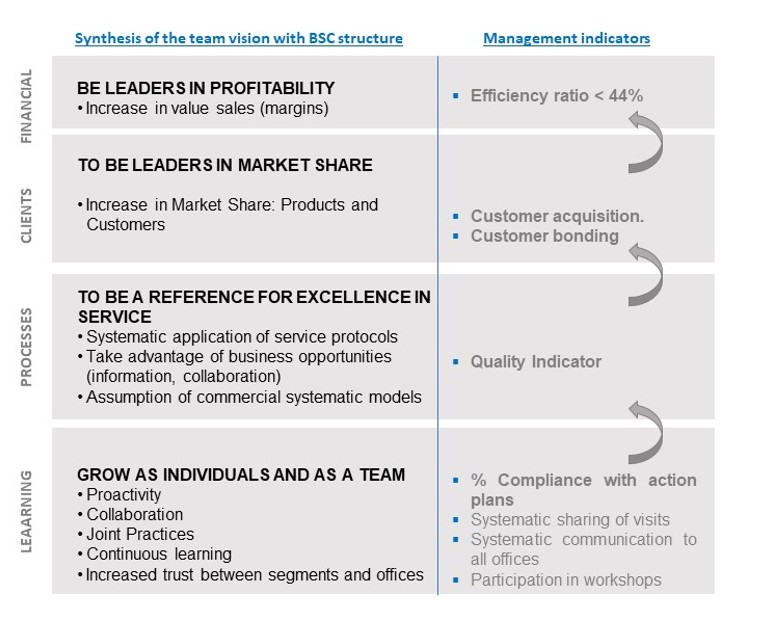
Shared vision formulated by the team
Throughout the sessions, particular attention was given to refining both the work approach and the substance of action plans, aiming to foster collaboration and individual development through collaborative work processes (task-process axis) (Liu et al., 2009; Rousseau et al., 2013). Additionally, attention was given to linking the proposed alternatives with external opportunities and stakeholder needs, followed by reflection on the team's performance and how it could continue to improve (external-internal axis) (Wageman et al., 2008).
Variables
As a global measurement framework of the tangible business outcomes, the research adopted the Balanced Scorecard (BSC) that combines four perspectives: financial, customer, internal process, and organizational learning. BSC puts strategy and vision at the centre and helps managers understand many interrelationships ( Kaplan & Norton, 2000).
This approach is consistent with claims that the performance level of a complex team is best analysed using various types of indicators. This diversity of indicators compared in longitudinal series allows continuous benchmarking (Mathieu et al., 2001; Rapp et al., 2016). Using the BSC has important additional benefits:
Avoiding common dichotomies between stakeholder goals and organizational goals (Athanasopoulou & Dopson, 2018).
Averting biases frequently identified in research related to coaching by using objective variables (Grant et al., 2010; Fillery-Travis & Passmore, 2011; Jones et al., 2016).
Incorporating into a leadership development initiative objective indicators that facilitate formative evaluation, that is, the degree of quality and involvement during the process, as well as a summative evaluation, the final result, which some authors prescribe as an ideal practice (Ely et al., 2010).
To detect possible variations, the research design have adopted the approach proposed by (Gerring & McDermott, 2007): pre-intervention, intervention, and post-intervention time series, large enough to enable longitudinal comparisons (two full years). This design conforms to the conditions established by (Yin, 2009) for the analysis of time series.
The management confirmed that the study variables are representative of the team's collective effort; they depend on internal effort, with no variations in calculation methods. According to the perspectives proposed by Kaplan and Norton (2000), the variables listed in Table 2 were selected as a synthesis of the shared vision.
Variables Organised by Balanced Scorecard Perspectives
Learning Perspective
Compliance with Action Plans during the team coaching process: Shared and simultaneous efforts to promote best practices, to empower teams, to work in depth on possible synergies, to emphasize messages or recognizing achievements quickly. These actions are consistent with the essence of team coaching (Hackman and Wageman, 2005). These plans involved the implementation of behaviours included in learning and people development and shared efforts focused on the market, affecting the marketing of services and customer relationships. All these levers were necessary to improve quality and results in a sustained and simultaneous way, in a wide territory, with geographic dispersion and a matrix structure. Additionally, two items related to team sustainability proposed by Wageman et al. (2008) were included: personal development and teamwork capacity.
Internal Process Perspective
Quality Indicator: Indicator of customer satisfaction with the services provided, assessed through telephone surveys by an independent agent of the bank. It includes two different aspects: 1) the quality perceived in the treatment and provision of the requested services and 2) the proactivity in the contact and the information offered. It serves as a critical early indicator of commercial success.
Customer Perspective
1. Customer Bonding: Measures the average number of products current customers have purchased. It is an indicator of both customer fidelization (the higher the number of products purchased, the more difficult it is for customers to leave the brand) and commercial success (it reflects commercial proactivity in offering products or services to the current customer base).
2. Customer Acquisition: Measures the number of new customers acquired in the small business segment. It is a direct consequence of commercial proactivity in generating new contacts, identifying opportunities, generating suitable offers, and ultimately translating them into effective sales.
In commercial terms, the first indicator assumes a “Farmer” approach (generating sales from maintaining and enhancing existing customer relationships) and the second a “hunter” approach (prospecting for new customers) (DeCarlo & Lam, 2016).
Financial Perspective
Efficiency Ratio: Commonly used in the Spanish financial sector and measures the productivity of an entity. It is the result of the quotient between operating expenses and gross margin. The gross margin is fed by three factors: interest margin (what an entity charges for loans minus what it pays for deposits), net commissions (for services or for the sale of non-financial services), and the result of financial operations.
The results from each perspective are described in the next section.
Results
The results include the summary of evolvement of the key indicators of the BSC perspectives described above.
Learning Perspective
The team's action plans aimed to address an initial gap identified in sharing best practices and fostering synergies between different business segments. Compliance with these plans reached 90/. The following indicators are associated with these action plans: the number of joint visits between different business segments, the organization of joint events, strategy communication by leaders to groups of employees (via "road shows"), and participation in workgroups or workshops to enhance customer interaction. For instance, joint visits between two different segments led to a 7.5/ increase in commissions, despite a decline in the entity's overall performance (according to internal management data). This evolution was not attributable to global market fluctuations but rather to the proactive and specific efforts of those involved in the project. Participants identified several behaviours as key to progress, including improved communication (clarifying why and the benefits gained), consistency and follow-up, analysis, identification, and focused action, reflection, and active listening (empathizing with others), promoting common benefit, and team empowerment (providing perspective and recognition).
In terms of the evaluation criteria outlined by Wageman et al. (2008), a clear improvement was observed in both teamwork capacity and the personal learning and development of each member. Table 3 presents the average scores along with qualitative comments illustrating participants' experiences.
Team effectiveness evolution
Wageman et al. (2008) propose performance as the third evaluation criterion for team effectiveness. In this research, this variable has been operationalized through various management indicators whose values have been collected over two years, as detailed below.
If the evolution in the learning perspective indicates positive progress, we can expect its impact to be reflected in the process perspective and consequently, in the customer perspective, and finally in the financial perspective. To verify that these impacts are significant the Wilcoxon signed-rank test for related samples was used. This is a nonparametric test recommended for small samples and has been utilized in similar studies based on AR methodology (e.g., Wagstaff, Hanton, & Fletcher, 2013), in the analysis of aggregate measures when using the BSC (e.g., Davis & Albright, 2004), in the analysis of factors that determine impact on profitability (e.g., López & Martínez, 2006), and also in coaching studies (e.g., Vidal-Salazar, 2012, and de Haan & Nieß 2012). The evolution of key indicators of the Process and Client perspectives are presented in Table 4.
Wilcoxon signed rank test
*p<.05. **p<.01
Perspectives of processes, clients, and financial
Internal Processes Perspective: The “Quality” indicator reflects a positive and significant evolution (higher in 2017 than in 2016), and the improvement trend continues after completing the coaching process. The standard deviation (SD) pre-team coaching is three times higher than the SD post-team coaching. Globally, continuous improvement in results and less dispersion provides evidence of internalization, as confirmed by the testimony of the bank: evolution in compliance with very solid protocols, with this Territorial Department receiving six national quality awards. The awards were won by centres of different business segments, of different sizes, and in different provinces, which reflects the widespread effort and message.
Customer Perspective: The indicator “Customer Bonding” (figure 2) shows a constant upward trend, with a significant difference both between full years and between the pre-team coaching and post-team coaching periods. The sustained performance post-intervention and a 25/ reduction in SD pre-team coaching compared to post-team coaching also suggest the internalization of proactive commercial habits and cross-selling techniques essential for fostering customer bonding. Conversely, the “Customer Acquisition” (figure 3) displays a seemingly upward trend, albeit irregular and statistically insignificant, with no improvement in SD. This pattern suggests that the observed improvements stem from specific reactive efforts triggered by external pressures, such as market dynamics or internal organizational pressures, rather than from a sustained effort driven by personal conviction.
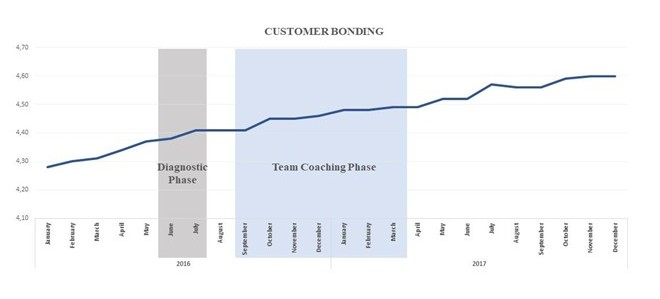
Customer bonding evolution
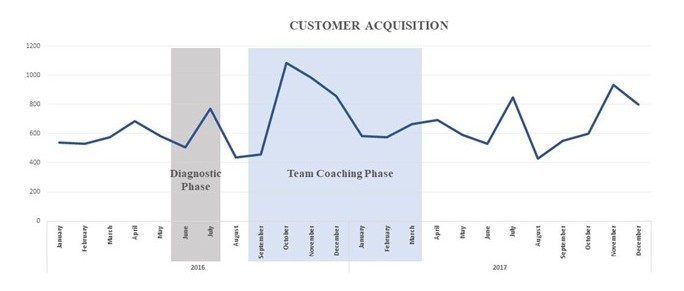
Customer acquisition evolution
Financial Perspective: The efficiency ratio has improved due to commercial efforts and remains below the target figure (44/) for both 2016 and 2017. Table 5 provides details regarding sector and bank averages. Comparisons between these figures dismiss the influence of global trends or other external factors, reinforcing the notion of a cohesive, focused, and effective effort within the Territorial team. Additional data provided by the entity confirms that it significantly surpassed the established challenge for gross margin, primarily driven by commissions. This effect cannot be attributed to a global market trend, as, during the period 2016-2017, the sector's gross margin declined by 3.5/ (BBVA Research, 2018). Hence, the positive evolution of this indicator appears to suggest a potential improvement in the ability to proactively generate value-added sales among existing customers, potentially leading to an increase in commission revenue.
Sector and Bank Averages
The lower this ratio is, the better the result.
Conclusions
This study investigated the effects of team coaching on a leadership team across various organizational outcomes. Utilizing an action research approach within a large service organization's territory, the analysis relied on objective management indicators and adopted a longitudinal perspective. Leveraging the BSC measurement framework facilitated the evaluation of diverse variables, revealing significant progress in various outcomes.
This research provides additional evidence that the team coaching has contributed to developing more collaborative work, effective interaction strategies, and shared commitment to a compelling purpose (Wageman et al., 2008). These efforts have favoured service quality and customer bonding processes. In turn, these customer-related improvements have been levers of improvement in value sales, generating more commissions with a positive impact on the efficiency ratio. The results indicate a significant improvement compared with the rest of the organization and regarding the sector.
The longitudinal approach reflects continuous improvement, stability, and reduced degrees of dispersion of specific variables over time. The observed chain of impacts aligns with the findings of Rousseau et al. (2013), who identified the influence of team coaching on team attitudes and skills, resulting in improvements in their work processes and overall performance. This consistency is further supported by empirical research on the BSC, which identifies similar impact patterns (Llach et al., 2017), as well as studies on the impact of executive coaching on organizational outcomes (Fernández-Llano et al., 2023). In this regard, this study provides additional evidence supporting the successive sequence of impacts: the team coaching can enhance teamwork capacity, and the development of the individuals involved, enabling stable improvements in their work processes that can ultimately impact business indicators.
The use of the BSC (Kaplan & Norton, 1992) provides a variety of objective indicators in this context and highlights the usefulness of objective and multiple indicator systems to measure evolution in complex management situations (Mathieu et al., 2001; Rapp et al., 2016), because in this case, an aggregate or partial measure could have led to the wrong conclusions. To the best of our knowledge, this approach has not been previously utilised to measure development initiatives like team coaching. It enables us to circumvent criticism regarding the potential bias in the measures used concerning coaching outcomes (Grant et al., 2010; Fillery-Travis & Passmore, 2011; Jones et al.2016), and to more effectively evaluate both the process and the final results (Ely et al., 2010). Therefore, the BSC introduces a new avenue of research or complements existing research directions with a more precise analytical methodology for assessing the impact of team coaching on organisational outcomes.
Regarding managerial implications, in the field of management, an intervention aimed at enhancing team leadership capabilities has helped to improve process indicators (such as quality perceived by the customer) and to increase client bonding (through a greater number of products sold to existing customers). However, this same effect is not observed in customer acquisition. Therefore, the real availability of internal capabilities appropriate to this external opportunity should be reviewed to propose complementary actions. For example, these actions could involve reviewing profiles because, in the commercial field, the “farmer” and “hunter” profiles are usually differentiated (DeCarlo and Lam, 2016), with the former being particularly adept at building customer relationships and maintaining long-term partnerships, and the latter being very good at recruiting new customers or detecting new opportunities. The presence of these profiles in the teams could also be analysed to improve the farmer-hunter balance. Another possible approach would be to promote specific actions for developing recruitment skills. In parallel, this categorisation may be improved by involving both managers and employees, as some studies have shown that a dual focus on client recruitment and client engagement can be fostered simultaneously (DeCarlo and Lam, 2016). Lastly, the incentive policy could be revised because performance evaluation and compensation practices have also proven useful in enhancing desired behaviours.
Limitations and future directions
The study is not without its limitations. This research has focused on a single case study involving a senior leadership team within a prominent banking institution. Therefore, caution must be exercised when attempting to generalise the findings to other types of teams, diverse organisational contexts, or sectors. Additionally, it would be advisable to test the evaluation methodology using larger samples and more robust analytical methodologies. This approach would provide a stronger foundation for broader generalisation or applicability of the findings.
As future lines of research, it would be interesting to test the applicability of the proposed evaluation model based on the BSC in other industrial sectors, in small- and medium-sized companies, and in other countries, to corroborate whether cultural factors or size present any limitations or require modifications.
Footnotes
Appendix
(part 3)
| Empirical foundations of Team Coaching related with Team Effectiveness (III) | ||||
| Dimas et al. (2016) | 75 teams from various sectors and organization sizes | Multiple linear regressions Cross-sectional survey Effectiveness based on quality and quantity of work |
The intensity of |
Peer coaching serves as a mediating variable in the impact of leader coaching on team performance and member satisfaction. It emphasizes the importance of the team's internal process |
| Rapp et al. (2016) | 70 customer service teams in a large multinational company | SEM, team members surveys Effectiveness based on aggregate of objective measures of service calls, machine reliability and response time |
Evidence supports the positive impact of team coaching conducted by an external coach on team performance. Identify the influence of the organizational context. |
Identify chain of impacts: the team's resources and strategies improve, which positively impacts work processes and consequently, team performance. Organizational support and HR policies facilitate this positive impact. |