




Abstract
The purpose of this article is to understand the influence of a Peer Mentoring Activity on the experience and academic performance of higher education students. The mixed method research was carried out at a private university in the North of Portugal, considering the low renewal rates of enrolment. Implemented in the 2022/2023 and 2023/2024 school years, the Activity aimed to increase the academic success rate of first-year students. The main results of this case study show an increase in problem-solving and academic success, in which pedagogical practices in the context of supervision promoted soft skills.
Introduction
Attending the first year of a bachelor’s degree involves overcoming complex and demanding challenges (Staniforth & Harland, 2006). These challenges range from understanding and mastering the procedures and processes inherent to the course and the structure of the Higher Education Institution (HEI) to navigating broader and more diverse dimensions. In this regard, several studies emphasize the challenges faced by students in higher education (Boynton, 2020; Fleming, 2021; Grant, 2021). If HEIs aim to establish themselves as genuinely inclusive spaces, they must address these challenges, which may include cultural aspects, social vulnerability, prior academic underachievement, the need to develop soft skills, among others.
In response, peer mentoring programs have been implemented across various HEIs (Dufrene, Noell, Gilbertson & Duhon, 2005; De Backer, Keer, Valcke & 2012; Guccione & Hutchinson, 2021). These initiatives represent dialogic activities in which traditionally more experienced students (mentors) support their peers (mentees) (De Cuyper et al., 2019), sharing experiences, offering guidance, and contributing to academic integration and development. Such activities are significant in the context of higher education, as fostering a sense of belonging and developing interpersonal and academic skills are crucial for educational success. Studies highlight that peer mentoring can positively impact the development of soft skills by cultivating a collective culture of mutual support within the learning process (Gisbert-Trejo et al., 2023; Steyn & Barnard, 2024).This article presents the findings of a study conducted at a private university in Northern Portugal, which experienced a high dropout rate and low enrolment renewal rates in the first years of its programs. Only three out of nineteen programs managed to retain all students initially enrolled in the first year during the 2021/2022 academic year. In other programs, the enrolment renewal rate for the 2022/2023 academic year decreased by an average of 20.2/. This situation necessitated the implementation of interventions tailored to students’ needs.
To address these challenges and improve problem-solving and academic success rates among first-year bachelor’s degree students by at least 8/ compared to the 2021/2022 academic year, an activity titled Peer Mentoring for First-Year Students was implemented over the subsequent two academic years. This initiative was part of the Inovar & Capacitar II Project, funded by the Human Capital Operational Program (POCH), with the primary objective of promoting academic success and the development of soft skills through pedagogical supervision practices and facilitating students’ integration into the university environment.
The primary goal of the Peer Mentoring for First-Year Students activity was to enhance the academic experience for all participants—mentees, mentors, and supervising professors. The actions undertaken were directed towards collectively creating an environment conducive to the personal, academic, and professional development of all involved. The initiative sought to promote students’ integration into the academic environment, foster interpersonal relationships through interaction, share experiences, and encourage cultural exchange, among other aspects.
Simultaneously, the activity aimed to increase students’ engagement in the teaching and learning process, fostering academic success through active participation. A significant focus was placed on developing soft skills, which are essential for autonomy and adaptability in diverse learning environments, thereby enhancing students’ well-being and sense of belonging within the university.
The initiative also incorporated a pedagogical supervision dimension, aimed at bringing faculty members closer to students’ specific needs. This approach enabled the development of appropriate pedagogical practices tailored to diverse learning contexts, contributing to a more inclusive educational experience. Consequently, the activity emphasized active teaching and learning methods in collaborative settings. Reflective, critical, and creative perspectives on core aspects of student integration within the academic context were both demanded and encouraged.
To gain deeper insights into how peer mentoring programs in higher education differ from other student support mechanisms and to understand the dynamics within peer mentoring relationships, an investigation was conducted from the outset of the activity. The study aimed to explore the influence of peer mentoring on students’ academic experiences and performance. The guiding research question was: How does peer mentoring influence students’ academic experience and performance in higher education within the context of pedagogical supervision? To address this question, the study focused on the development of the activity and the set of collectively designed pedagogical actions aimed at achieving educational success.
Using a mixed-methods approach (Creswell, 2014), data were collected from the perspectives of mentors (second- and third-year undergraduate students), mentees (first-year undergraduate students), and supervising professors (faculty members from the students’ respective programs).
Literature review
Peer Mentoring in Higher Education
Peer mentoring is widely recognized as an activity that can contribute to the development of students in higher education (Gisbert-Trejo et al., 2018; Arantes & Viegas, 2018). It is generally an institutional initiative aimed at promoting the academic, personal, and social integration and inclusion of students. This interactive activity occurs when a more experienced student (mentor) guides another (mentee), fostering the exchange of experiences, emotional support, skill development, and improved academic performance (De Cuyper et al., 2019; Jeske & Linehan, 2020).
One of the main benefits of peer mentoring is the development of soft skills, such as communication, collaboration, and problem-solving (Coutinho et al., 2020). These skills, essential for both academic success and the labor market, are developed by both mentors and mentees (Griffin & Coelhoso, 2019; Gisbert-Trejo et al., 2023). For mentors, the process enhances leadership and critical thinking skills while fostering a sense of belonging to the academic community (Erickson et al., 2017). For mentees, interaction provides greater integration into the university environment and increased confidence in facing academic challenges (Jordaan et al., 2018).
Moreover, peer mentoring fosters social and academic integration, which are essential factors in reducing dropout rates in higher education. Peer mentoring initiatives in various countries have shown positive results in reducing student attrition and improving their academic trajectories (Gisbert-Trejo et al., 2018). Experiences with such activities highlight the importance of careful planning, which includes the meticulous selection of mentors, proper training for all involved, and the establishment of clear and aligned objectives that meet participants' needs (Kokt & Dreyer, 2024).
In Portugal, where academic dropout rates remain significant, particularly in the first years of undergraduate studies (Lopes, Pereira & Vaz, 2023), implementing peer mentoring activities can present an opportunity. National and international studies emphasize that this approach can not only help retain students but also foster a culture of collaborative learning and pedagogical innovation in higher education (OECD, 2018; Konle-Seidl & Bolits, 2016; Oliveira, 2021; Torres et al., 2020). This reflects a commitment to the quality and success of students' educational journeys, which involves integrating practices that promote well-being and the development of soft skills to ensure readiness for the challenges inherent to higher education and the numerous transitions life entails (Almeida & Castro, 2021).
The benefits of mentoring initiatives extend to mentors as well, particularly in terms of skill development. In the mentoring relationship, the "mentor contributes with their knowledge, experience, and perspectives, developing academic skills. Their primary role is to guide the mentee in their personal and academic development, enhancing their psychosocial competence. In practice, mentoring encompasses a combination of emotional and practical support" (Arnesson & Albinsson, 2017, p. 203).
However, research indicates that the potential of peer mentoring activities is directly linked to the quality of pedagogical supervision (Jeske & Linehan, 2020). For example, Erickson et al. (2017) demonstrate that the training and continuous support of mentors are critical factors in ensuring the success of peer mentoring. The lack of adequate supervision can result in a misalignment between participants' expectations and institutional goals, compromising the initiative's outcomes.
Pedagogical Supervision and Peer Mentoring
Pedagogical supervision plays a fundamental role in the success of peer mentoring activities by providing structured support to mentors and ensuring the quality of the mentoring process (Alarcão, 2020). This type of supervision involves continuous monitoring, where teacher-supervisors oversee, guide, and evaluate the activities carried out by mentors. It is a complex process, rooted in human interactions and therefore described as "a psychosocial activity of intra- and interpersonal construction, deeply rooted in the knowledge of the self, the other, and the contexts of action-formation in which they operate" (Alarcão, 2020, p. 31).
Thus, the importance of the interaction between thought and action is emphasized, aiming to "better understand to act better" (Alarcão, 2020, p. 31), based on recognizing the uniqueness of each context, each student, and each established relationship. To this end, it is crucial to intersect experiences, interests, and expectations, making this a process that must be collectively constructed through pedagogical supervision conducted in context.
In this understanding, pedagogical supervision requires planning, observation, reflection, and dialogue. These elements are essential for creating inclusive and reflective learning environments where both mentors and teachers can grow personally and professionally (Pawlas & Oliva, 2007). Through interactions, pedagogical supervision contributes to fostering autonomy, assertive communication, and problem-solving skills (Garza et al., 2019). It also serves as a means for the professional development of teacher-supervisors, directly influencing the improvement of their pedagogical practices (Glickman et al., 2023).
Pedagogical supervision is thus particularly important in the context of peer mentoring activities, as it promotes the continuous training of mentors and allows for adjustments in pedagogical practices according to students' needs. In this way, teacher-supervisors act as mediators between institutional objectives and students' expectations, ensuring that mentoring is tailored to the specific needs of each context (Coimbra et al., 2020).
Methodology
The research developed is subordinate to an interpretative paradigm (Creswell, 2014) from a mixed approach, using a case study (Yin, 2013). The study focuses on the development of a Peer Mentoring Activity in the context of a private University in the North of Portugal. The Program was structured following the eight stages present in the model of Vance et al. (2017). Figure 1 shows the steps involved, which also supported the data collection process.
The Peer Mentoring Activity was conceived with the purpose (Step 1) of reducing academic abandonment in higher education so that all those involved - mentors, mentees, and teacher-supervisors - have a better experience in the academic context. The aim was thus to increase the involvement of students in the teaching and learning process, promoting academic success through active participation.
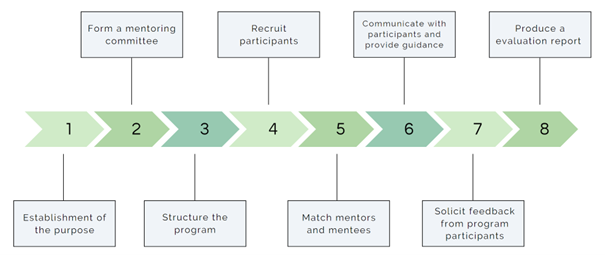
Stages of the Mentoring Activity
For the development of the Activity in the 2023/2024 school year, a mentoring committee was constituted in the previous school year (Step 2), based on the work of two coordinators, nine teacher-supervisors, and two mentoring specialists, who were responsible for the training of mentors and teacher-supervisors. The structuring of the Activity (Step 3) was carried out from the definition of the communication and dissemination strategies, the recruitment process of mentors and mentees, as well as the criteria for performing the pairing. In addition, the monitoring and evaluation process was defined, as well as the timing. The recruitment of the participants (Step 4) was carried out through dissemination via e-mail, Moodle, the Project website, and the University itself, in addition to the University's social networks. All this work was articulated with the coordinators of all courses of the University for effective dissemination. After the approval of the Ethics Committee, registrations were opened for voluntary participation in the Activity, and resulted in 71 students from the 2nd and 3rd years of 16 undergraduate courses (mentors); 94 students from the 1st year of 11 undergraduate courses (mentees); and nine teachers-supervisors of the faculties involved.
The establishment of pairing (Step 5) privileged the following criteria: gender similarity; age (mentors older than mentors); and similarity between the areas of the different courses. It should be noted that a maximum of three mentees were assigned by each mentor.
The communication and guidance to the participants (Step 6) was carried out at different levels and times: (i) the work of the mentor was accompanied by a teacher-supervisor; (ii) the mentors and the teacher-supervisors attended monthly workshops and actions with specialists for the training, which involved the reflection and discussion about the reasons and benefits of the Peer Mentoring Activity in Higher Education; the skills and characteristics of the mentors and the teacher-supervisors; the issues of the supervision and mentoring process; and the tools and techniques of coaching in mentoring. In addition, a Reflective Network was built, catalysed by a mentoring specialist, to promote the sharing of experiences between the work in progress by mentors and for the supervision and monitoring of the development of the Activity. After the completion of the training process, the mentors were able to start the individual sessions between mentors and mentees, which were developed and tailored to the needs of the mentees. These needs were limited to more technical issues, such as procedures and processes inherent in the course and the structure of the University, as well as more diverse issues, such as cultural, academic, social vulnerability, and skills development, among others.
After the start of the Activity, the data collection process (Step 7) was carried out through permanent monitoring and evaluation mechanisms, which allowed the continuous consideration of the perceptions of mentors, mentees, and teacher-supervisors. This made it possible to adapt the interventions themselves from the feedback obtained through the application of three evaluation questionnaires of the Peer Mentoring Activity, aimed at mentors, mentees, and teacher-supervisors. In addition, five focus groups were held with the mentors from the reflective networks.
The data collected through the analysis of the 42 reports of the 2 actions, 6 workshops, 6 meetings and 21 supervision meetings together with the transcripts of the 5 focus groups, were subjected to content analysis (Bardin, 2016) in order to understand:
The potential of mentoring for the development of Soft Skills in mentors;
The potential of mentoring for the success of the mentees; and
The pedagogical supervision of mentors as a tool for professional development.
Regarding the Peer Mentoring Activity Evaluation Questionnaire, the open questions were also analysed via content analysis, while the closed questions constructed using 5-point Likert scales were object of statistical analysis.
To ensure the development and sustainability of the Activity, weekly coordination meetings were held for organization and monitoring. The mentor's activity was mentioned in the diploma supplement and the mentees received a certificate of participation. Certificates were issued to all participants in the workshops and actions.
Finally, a final evaluation report was produced (Step 8), which integrated improvement actions and recommendations on the continuity of the program. The results present in this report also support the development of this article, which considered the ethical aspects indicated by the Committee on Publication Ethics (Wager & Kleinert, 2011).
Findings
In this section, the findings from the research are organized around three main axes: the potential of mentoring to foster the development of soft skills in mentors, the potential of mentoring to enhance the success of mentees, and the pedagogical supervision of mentors as a tool for professional development. Each of these axes reflects fundamental dimensions of Peer Mentoring Activity, highlighting the interactions among mentors, mentees, and supervising professors.
For each axis, the analysis focuses on interrelated aspects that contribute to understanding the impact of the Mentoring Activity. Based on participants' perceptions, the study examines the contribution of the Activity to the development of soft skills such as communication, autonomy, and problem-solving, and its influence on academic performance. Simultaneously, the role of supervising professors in supporting the actions is considered, emphasizing pedagogical supervision as a structuring practice that promotes critical reflection and alignment of mentors' actions with mentees' needs. Finally, participants' perceptions of the contribution of workshops and actions carried out within the scope of the Activity are analyzed, highlighting these spaces as opportunities for capacity building, sharing, and strengthening the competencies of those involved.
1. The potential of mentoring for the development of Soft Skills in mentors
The results relating to the responses obtained by the survey by questionnaire to the mentors indicate that the frequency of contact with the mentors was 1 to 3 weekly meetings, favouring contact by message (84/) and face-to-face (36/). The least privileged means were contact outside the university (4/), by telephone call or videoconference (8/) or e-mail (8/). This highlights the importance of diversifying the communication process, from a design adjusted to the needs and availability of mentors and mentees.
The mentoring process focused on the support of mentors to the mentees through academic support, the availability of materials, support in the preparation of works, among others (52/); social integration with invitations to lunches and other social events (40/); in the relationship with the services of the University, such as academic services and library (24/); in addition to emotional support, such as listening to “outbursts” and giving advice (32/).
Regarding the perception of the mentors, 48/ revealed that the Peer Mentoring Activity contributed positively to their performance / academic success, while 76/ reported that the Activity had a positive influence on the development of their soft skills, with emphasis on communication, cooperation, and problem-solving, as indicated by the excerpts present in table 1.
Mentors' perceptions of the contribution of the Activity in the development of soft skills
The follow-up of the teacher-supervisors was recognized by 88/ of the mentors as performed promptly, with the appropriate frequency, having a positive influence on their performance as a mentor.
Another highlight is related to the workshops and actions offered to mentors, in which 92/ revealed interest in the topics addressed, recognizing the adequacy of the contents to the proposed objectives and the usefulness of these actions and workshops for the exercise of mentoring. Most mentors (80/) show satisfaction in participation and would like to remain involved with the Activity (96/).
2. The potential of mentoring for the success of mentees
The mentees privilege the means of contact promoted by the mentors, namely: contact by message (88.2/) and face-to-face (41.1/). Likewise, they do not value the meeting outside the university (17.6/) or by telephone call or videoconference (23.5/).
The support needs raised by the mentees were based on academic support through the availability of materials, support in the preparation of works, among others (58.8/); on emotional support, such as listening to “outbursts”, giving advice (23.5/); on support in the relationship with the services of the University, such as academic services, library, among others (23.5/) and social integration (11.7/).
Regarding the mentees’ perceptions of the contribution of the Activity, 47/ recognize the positive contribution in the academic dimension and the development of their soft skills, with emphasis on communication (35.2/), cooperation (11.7/), and problem-solving (23.5/). In addition, 41.1/ of the mentees report that the Peer Mentoring Activity had contributed to its integration into the academic environment, as indicated by the excerpts in Table 2.
Mentees' perceptions of the contribution of the Activity to academic support and integration into the University
The majority (82.3/) of the mentees show satisfaction in participating in the Activity and would like to remain involved, while mentored (64.7/).
3. The pedagogical supervision of mentors as a tool for professional development
Most of the teacher-supervisors (55.5/) held 1 to 3 weekly meetings with the mentors, and face-to-face contact (66.6/) was privileged, complemented by a message (55.5/). Likewise, in the mentor-mentee contact, the least used means were e-mail (11.1/) and telephone call and/or videoconference (11.1/). The teacher-supervisors (55.5/) reveal that the supervisory activity had a contribution to the performance of their functions as teachers, improving their pedagogical practices. The supervising teachers report that they became aware of the practices they already carried out and can now confer greater intentionality. In addition, they state that the Activity promoted a greater approach to students and their realities, as indicated by the excerpts presented in Table 3.
Teacher-supervisor perceptions of the contribution of pedagogical supervision in the relationship with students
All teacher-supervisors considered that the dissemination of the actions/workshops was carried out correctly, and promptly, with appropriate schedule and duration. The majority (77.7/) showed interest in the topics addressed and verified the adequacy of the contents to the objectives proposed by the Activity, recognizing that the specialist responsible for the dynamization of the workshops showed competence in the field of the themes. In addition, the majority (88.8/) recognized the usefulness of the actions/workshops in which they participated for their function as a supervising teacher.
The majority (88.8/) of the teacher-supervisors showed satisfaction with their participation in the Activity and would like to remain involved.
Discussion
From what was specific to each of the mentees, their courses and contexts, the Peer Mentoring Activity was developed in various ways, considering the needs of each subject, and meeting the recommendations of Jordaan et al. (2018). The individual was considered from a holistic perspective, paying attention to differences, and based on concerns for the well-being of each of those involved. For this, the Activity focused on experiences based on the pillars of solidarity and inclusion, and on the person and human dignity. Given that the intervention was tailored to the needs of the mentees, it was important to cross-reference the perspectives of mentors, mentees, and teacher-supervisors. This made it possible to highlight aspects that contributed to combating abandonment and academic failure, and improved the conditions of reception and support for every student, including students with special educational needs.
At the level of communication, in the mentor-mentee and teacher-supervisor-mentor relations, it was seen that, in general, between one and three weekly meetings were held by message or in person. The flexibility of mentors and teacher-supervisors stands out, in the sense of understanding the needs of the mentees and intervening through assertive communication in a way adjusted to the objectives outlined and defended by Kokt and Dreyer (2024). It is also important to mention the conditions made available to teachers by the HEI so that the monitoring would become feasible.
The concrete actions developed in the mentor-mentee relationship focused, above all, on academic support, without ignoring other dimensions such as the social integration and emotional support recommended by the OECD (2014). It is in this sense that the purpose of the Peer Mentoring Activity was based on the promotion of equity and academic success, through the implementation of personalised strategies, to address possible barriers to learning. This dimension was fundamental to prevent abandonment and ensure that all students can achieve academic success. The creation of an inter-help network in the academic, cultural, and social spheres reinforced this purpose, strengthening ties within the student community and providing mutual support to overcome academic and personal challenges.
The Activity promoted empathy and ethics by demanding rigor and attention to differences based on the relationship between peers. That is why it appeared as an opportunity to develop, in mentors and mentees, important soft skills such as communication, cooperation, and problem-solving. In this sense, the development of soft skills was recognized by all participants as an important component of their personal and professional path, showing a positive contribution to the academic performance/success of mentors and mentees. At the same time, there was recognition of the contribution of specific actions and workshops to support the activity of mentors and teacher-supervisors, highlighting aspects such as the organization, the relevance of the themes worked, and the stimulation by a specialist in the area. The contribution of the Peer Mentoring Activity to the development of essential soft skills such as communication, teamwork, and problem-solving is clear, and in line with the work of Jeske and Linehan (2020) and Griffin and Coelhoso (2019).
The monitoring of the supervision of the mentors was recognized as fundamental for the development of their activities. The presence of teacher-supervisors was an opportunity to bring them closer to the specific needs of the first year students. This enabled an understanding of pedagogical practices more consistent with the various modes of learning and contexts, stimulating innovation in pedagogical methodologies and teaching practices. It also contributed to the promotion of success, namely of students with profiles associated with a higher risk of abandonment and academic failure. In this sense, teacher-supervisors revealed that the supervisory actions had a positive influence on their professional development, improving their pedagogical practices. This is because the awareness of their own practices allowed them to confer a greater pedagogical intentionality, indicating that the exercise of pedagogical supervision, in a context of mentoring, influences the development of teacher-supervisors, in coherence with what Glickmam et al. (2023) argue. Therefore, the diversification of the participation of students from various courses and years, as well as teachers-supervisors contributed to an inclusive aspect, which also integrated a dimension of intervention, which implies the guarantee of the continuous improvement of the pedagogical actions of the University.
Since the development of the Activity was supported by a culture of continuous monitoring, there was the opportunity to adapt the Activity, as well as identify opportunities and aspects to improve. In this sense, a set of synergies not foreseen in the application of the project were also developed, namely:
the monitoring of the implementation of the Mentoring Activity of a Grouping of Schools in Braga;
the development of strategies in conjunction with the Department of Computer Engineering of the same University where the Peer Mentoring Activity took place, expanding the possibilities of contacts, learning, and interventions;
the development of a specific peer mentoring activity for the Social Work course of the same University, on the initiative of the Course Coordinator, who is also a teacher-supervisor in this Activity. This proposal is based on the development of peer mentoring, with support and recourse to professionals who are already inserted in the labour market.
Conclusion
The Peer Mentoring Activity, as previously mentioned, was part of a funded project aimed at increasing problem-solving skills and academic success among mentees. Comparing the baseline data (academic year 2021/2022) with the data from the academic year 2022/2023—the period marking the Activity's inception—revealed a 21.95/ increase in problem-solving skills and academic success among mentees, exceeding the projected target (8/).
Overall, the Peer Mentoring Activity met its proposed objectives, significantly surpassing the goals outlined in the project proposal, which demonstrates that the selected practices were effective. Mentors, mentees, and supervising teachers expressed satisfaction with the dynamics of the program, highlighting its positive impact on their personal, academic, and professional development. The diverse approach to the types of support offered and the means of interaction showcased the adaptation of strategies to the individual needs of the mentees—a key principle of the Activity. Additionally, participants reported a desire for its continuity, reflecting a clear recognition of the utility and contribution of the workshops and actions provided, as well as the Activity’s relevance. This recognition underscores the emotional value and personal enrichment that the Peer Mentoring Activity fostered.
The results obtained indicate that peer mentoring is a tool that contributes to promoting social and academic integration, problem-solving, and the development of key skills necessary for success in Higher Education. Thus, the Peer Mentoring Activity fostered the creation of an innovative approach in Higher Education, enhancing the academic experience for all participants (mentees, mentors, and supervising professors). This was achieved through activities that encouraged interpersonal relationships, sharing of experiences, cultural exchange, and other aspects.
Regarding mentees, the results show that the problem-solving rate and academic success significantly increased, surpassing the initially projected targets. This improvement also highlights the potential of this approach to mitigate structural challenges, such as those introduced by the COVID-19 pandemic. Furthermore, mentees reported an enriching experience marked by personalized support, constructive feedback, and the development of soft skills such as communication and teamwork.
For mentors, involvement in the activity was equally transformative. They enhanced leadership skills, problem-solving abilities, and communication while strengthening their connection to the academic community.
The role of supervising teachers as mediators and monitors of the process was crucial in ensuring quality and alignment of practices with the established objectives. This structured pedagogical supervision contributed to creating an environment of support and mutual learning—an essential element for the success of mentoring—and to the professional development of the supervising professors.
With the implementation of this Activity, it was also possible to contribute to a more inclusive University. The assumption that this is an activity that promotes inclusion was thus fulfilled, as it considers various dimensions that may constitute barriers to the learning process of the mentees and offers the opportunity to define strategies to overcome them, based on the mentors' experience and the monitoring by the supervising teachers.
Based on the perceptions of those involved, in line with the comprehensive analysis of the Activity, we highlight fundamental aspects for the development of peer mentoring activities, whether in the context of this University or in other Higher Education settings, with the following implications:
For future research, we suggest conducting longitudinal studies to understand the contributions of mentoring in the medium and long term, both in the academic life and professional integration of students. Studies that consider the diversity of contexts between different institutions and countries can also provide important insights into the influence of the contexts themselves on the development of mentoring activities. Additionally, a deeper exploration of the role of pedagogical supervision in sustaining the quality and sustainability of mentoring activities is crucial.
In summary, this study demonstrates that peer mentoring, integrated into a pedagogical supervision context, is a device for promoting inclusion and academic success in Higher Education. The contributions recognized by mentees, mentors, and supervising teachers highlight the value of the Activity as a key element in overcoming the challenges faced by Higher Education institutions in ensuring the success of all students. Thus, in response to the research question, we can assert that peer mentoring, within the context of supervision, positively influenced both the academic experience and student performance within the case study institution. This influence occurred through a holistic model that combined emotional support, interpersonal interaction, exchange of experiences, and pedagogical supervision. Moreover, it fostered a more inclusive and welcoming environment, in which the individual needs of students were addressed in a personalised manner.