




Abstract
This article, drawing on qualitative Narrative Inquiry doctoral research, investigates how executive coaches support Leader/ship identity work among senior leaders, based on insights from 34 expert coaches operating across 10 countries worldwide. Leader/ship identity is conceptualised as a unified construct encompassing both Leader and Leadership dimensions. The article presents two conceptual frameworks on identity and Identity work, alongside with an empirical Mechanism of Executive Coaching, centred on three themes: Holistic and Dynamic Identity Work, Contextual and Intrinsic Influences, and Coaching Support Enables. Coaching is positioned as an Identity Enhancement Space, with the article offering conceptual, practical and global contributions, and calling for future longitudinal, multi-perspective research.
Introduction
Over the past two decades, identity theory has become central to leadership development, with increasing attention on how identity shapes and is shaped by leadership roles (Vogel et al., 2021). A key contribution of this article, based on doctoral research (Koroleva, 2024) is the conceptual distinction and integration of Leader identity, Leadership identity and the unified construct of Leader/ship identity. Introduced in Koroleva’s (2024) doctoral research, the integrated concept of Leader/ship identity captures the dynamic interplay between self-perception (Leader identity) and the broader social and organisational landscape (Leadership identity). Leader/ship identity work recognises identity development as a holistic process, simultaneously psychological and social. These constructs offer a nuanced framework for understanding both the internal and external dimensions of leader/ship and executive coaches’ support of Identity work.
Leader identity refers to how individuals see themselves as leaders, shaping their motivation, behaviour and leadership engagement (Day, 2000; DeRue & Ashford, 2010; Skinner, 2000a). This identity is introspective and personally constructed through experience and reflection (Kragt & Day, 2020). In contrast, Leadership identity encompasses the social and relational processes of leading, constructed through group dynamics, cultural norms, and organisational context (Haslam et al., 2022; Day & Harrison, 2007; Miscenko et al., 2017). DeRue and Ashford (2010) outline key components of Leadership identity development: individual internalisation, relational recognition and collective endorsement. These highlight how identities are socially reinforced through feedback, group validation and self-reflection (Brewer & Gardner, 1996; DeRue et al., 2009).
Identity work, how individuals construct, negotiate and evolve their identities, is central to this process (Snow & Anderson, 1987; Sveningsson et al., 2021). Identity work is deeply relational and influenced by demographic, organisational and cultural contexts (Ashforth & Mael, 1989; Mead, 2015; Petriglieri, 2015). It is especially crucial during leadership transitions, where role shifts require a realignment of self-concept and purpose (Ibarra, 1999; Jeong et al., 2024).
Executive coaching has proven to be a powerful intervention supporting this identity evolution, offering a reflective and developmental space (Corrie & Lawson, 2017; Skinner, 2000a, 2014). Executive coaching facilitates this complex work by creating a structured yet flexible space for reflection, meaning-making and feedback (Dugan, 2024; Middleton et al., 2019). Coaches help leaders interpret experiences, navigate values and align their identities with evolving responsibilities.
Despite the theoretical richness in leadership and identity research, executive coaching literature lacks both conceptual depth and empirical exploration. Most studies (e.g., Bennett, 2021; Skinner, 2000a, 2000b, 2014; Steyn & Barnard, 2024) focus narrowly on the coachee’s experience, neglecting the conceptual clarity, coach’s perspective and cultural breadth. By focusing on Leader/ship identity work, this article contributes to leadership and coaching theory, enhances practice and informs stakeholders, such as HR leaders and organisational developers, on how to support leaders. Understanding Leader/ship Identity work as dynamic, contextual and holistic is critical for developing resilient leadership in today’s complex world.
The following section explores the conceptual foundations of Leader/ship identity work. It draws on interdisciplinary literature to define and distinguish the constructs of Leader, Leadership and Leader/ship identity, providing the theoretical clarity needed to understand how executive coaching supports Identity work.
Conceptual Foundations of Leader/ship Identity Work
Identity has become an increasingly significant area of study, particularly within the context of leadership and executive coaching, due to its profound influence on individual experience and performance (Brown, 2015, 2017, 2022). Identity is a dynamic, socially constructed process (Alvesson & Willmott, 2002; Gioia et al., 2000), encompassing personal (DeRue et al., 2009) and social identity (Tajfel, 1982). Identity is inherently fluid, evolving over time as individuals undergo personal transformation (Brygola, 2011) and is closely tied to emotions (Kalkhoff et al., 2016) and adaptive strategies (Collins & Bertone, 2017). Ramarajan (2014) describes identity as the subjective knowledge and experiences individuals use to define themselves. This process is socially constructed, continually negotiated and reconstructed through interactions (Alvesson & Willmott, 2002; Gioia et al., 2000), and represents an individual’s self-understanding (Albert, 1998). Such changes are gradual, unfolding through negotiated adaptation, such as during career transitions (Pratt et al., 2006).
While identity is fluid, it often develops along a discernible trajectory, emphasising the importance of self-awareness in its formation (Alvesson & Willmott, 2002) and aligning with Giddens’ (2023) concept of self-identity. Identity influences key psychological constructs, such as self-esteem, self-efficacy and self-worth (Brenner et al., 2018), which are crucial for understanding Leader/ship identity work in executive coaching. Leaders navigate multiple identities (Debebe & Reinert, 2014; Gabriel, 2020), with coaches needing to be aware of which identity aspects are salient in various situations. Identity salience refers to the likelihood of an identity being activated during social interactions (Morris, 2013), influencing how individuals present themselves (Merolla et al., 2012; Stryker & Serpe, 1982). Role-specific self-esteem and self-efficacy are important aspects of identity in executive coaching. Role-specific self-esteem reflects how individuals assess their worth within a specific role, and positive feedback in leadership tasks can enhance self-esteem, reinforcing leadership confidence (Burke & Stets, 2022). In contrast, diminished self-esteem can impact motivation and leadership effectiveness. Understanding the interplay between self-efficacy and self-esteem is vital in leadership development (Brenner et al., 2018).
Leader identity and Leadership identity, though related, have distinct implications. Leader identity focuses on self-perception in leadership roles (Day, 2000), whereas Leadership identity reflects relational and collective aspects (Haslam et al., 2022). Leader identity pertains to how individuals perceive themselves in the role of a leader, influencing their behaviour (Day, 2000; DeRue & Ashford, 2010), while Leadership identity encompasses broader relational and collective dimensions, influencing others and fostering group cohesion (Haslam et al., 2022; Miscenko et al., 2017). Early research accentuated the importance of viewing oneself as a leader for leadership development (Lord & Hall, 2005), with Leader identity linked to enhanced leadership competence (Kragt & Day, 2020) and effective leadership emergence (Lee Cunningham et al., 2023). A strong Leader identity encourages leaders to seek leadership opportunities and develop self-awareness and adaptability (Ashford & DeRue, 2012; Day, 2010).
Furthermore, identity development is influenced by social identities such as race and gender, which shape an individual’s self-concept and leadership perception (Tajfel, 1982; Westen & da Graça, 2024). This intersectionality is crucial for understanding Leader/ship identity development, as it impacts how individuals navigate multiple identities, particularly those from marginalized groups (Abes et al., 2007; Workman et al., 2020).
The integrated concept of Leader/ship identity merges both dimensions (Koroleva, 2024; Orsini & Sunderman, 2024; Sunderman & Orsini, 2024). The integration of Leader/ship identity work (Koroleva, 2024) reinforces the dynamic interplay between individual Leader identity and relational Leadership identity. In executive coaching, this integration is crucial because empirical data shows that coaches work holistically with both identities. By addressing both the personal, internalised aspects of leader identity and the relational, collective aspects of Leadership identity (Clapp-Smith et al., 2019; Day & Harrison, 2007), coaches can support leaders in navigating the complexities of their roles. This integrated approach offers a unified perspective that deepens our understanding of Identity work in executive coaching. Figure 1 represents this conceptual integration, illustrating Personal, Social, Professional, Leader, Leadership and Leader/ship identity domains and showing how these identities influence one another.
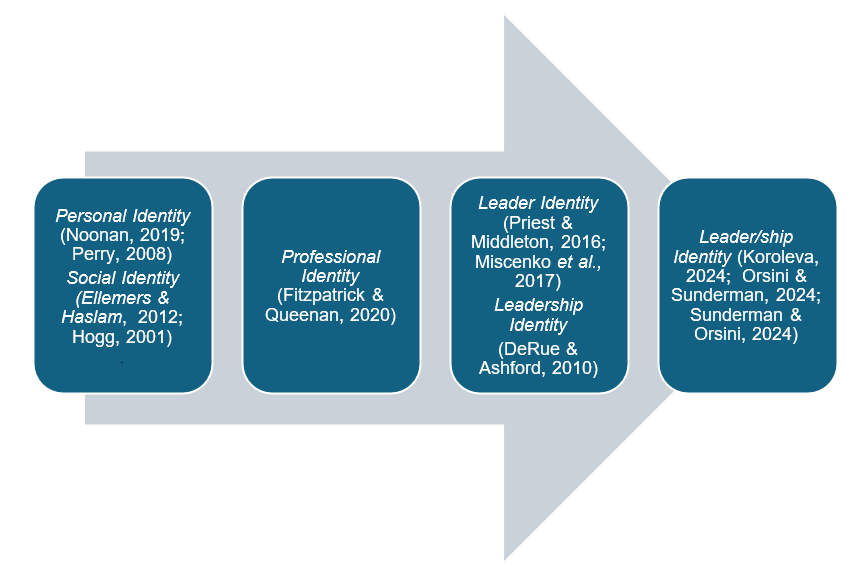
Conceptual Framework Integrating Personal, Social, Professional, Leader, Leadership and Leader/ship Identity (Koroleva, 2024)
Personal and social identities shape individual perceptions and interactions (Ellemers & Haslam, 2012; Hogg, 2001; Noonan, 2019), while professional identity connects personal values with career roles (Fitzpatrick & Queenan, 2020). Leader and Leadership identities focus on how individuals view their leadership responsibilities, behaviours and impacts (DeRue & Ashford, 2010; Miscenko et al., 2017; Priest & Middleton, 2016). The integrated Leader/ship identity enhances self-awareness, promotes clearer communication and supports context-driven development, essential for executive coaching.
Building upon this Conceptual Framework that integrates Personal, Social, Professional, Leader, Leadership and Leader/ship Identity, Figure 2 provides an integrated, conceptual framework that outlines three interconnected domains: Leader, Leadership and Leader/ship Identity Work. Identity work, central to leadership development, involves constructing and revising self-concepts (Brown, 2022). Drawing from identity, leadership and management literature it aims to inform and advance executive coaching research and practice. The Leader domain focuses on the individual’s self-concept, personal values, and psychological development. The Leadership domain centres on practices, relational dynamics and organisational expectations. The hybrid Leader/ship identity work bridges the two, emphasising how individuals navigate, negotiate and integrate personal and collective dimensions of identity. This framework supports a nuanced understanding of how coaching can facilitate Identity work by addressing tensions between authenticity and performance, self and role, and internal and external validation. It encourages executive coaches to adopt a more reflective, identity-informed approach to leadership development, offering a more sophisticated lens for supporting clients in complex, evolving roles.
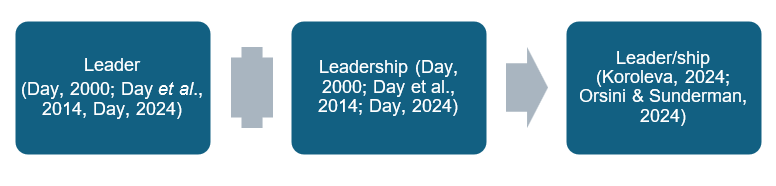
Conceptual Framework of Leader, Leadership and Leader/ship Identity Work Domains (Koroleva, 2024)


The framework is structured in three sections: top, middle and bottom, each contributing to understanding the complex nature of Identity work. The top section clarifies the distinction between leader development and leadership development (Day, 2000) and integrates both internal (leader) and external (leadership) dimensions, underlining the holistic nature of Leader/ship identity work (Koroleva, 2024; Orsini & Sunderman, 2024). It underscores the importance of a leader's self-concept and how it interacts with their leadership role and wider contexts. This section provides a lens for exploring how leaders' identities are shaped within both individual and social frameworks.
The middle section synthesises key conceptual literature on Leader and Leadership identity work. DeRue et al. (2009) conceptualise Leader identity as a dynamic interplay of claiming and granting, where self-assertion and external validation are essential. Hammond et al. (2017) further define identity formation through four dimensions: strength, integration, level and meaning, highlighting the continuous negotiation of identity through phases of conflict and interaction (Lührmann & Eberl, 2007). Brown (2022) expands on this by identifying cognitive, discursive, physical and behavioural aspects of identity, while Caza and Posner (2010) propose a framework of individual internalisation, relational recognition and collective endorsement in shaping Leadership identity. This synthesis shows that Identity work is not only personal but deeply relational and social.
The bottom section of the framework incorporates the Coaching Alliance (Lai & Smith, 2021) and Contextual Developmental Perspectives, including situational, social and historical factors (Abbas et al., 2022; Benmira & Agboola, 2021; Bolden et al., 2023), to highlight the dynamic interplay between the coaching relationship and the broader environment shaping Leader/ship identity work. Additionally, the framework integrates Coaching Support for Leader/ship Identity Work (Koroleva, 2024), emphasising how coaching practices can be intentionally designed to facilitate identity negotiation and transformation. This integrated view positions executive coaching as a critical space for contextual, relational and reflective Identity work. Taken together, the framework provides a multidimensional lens to explore how identity is constructed, challenged and reconstructed. This sets the stage for the next section, which turns to executive coaching literature review to deepen our understanding of how identity is transformed through coaching interventions.
Executive Coaching Literature: Review and Research Opportunities
Executive coaching has become a crucial tool for enhancing the leadership capabilities of senior leaders, focusing on both personal and professional growth (Jackson et al., 2003; Niemes, 2002; Trathen, 2007) and often centres on performance, motivation and decision-making (Lai & Palmer, 2021; Parsons et al., 2021; Passarelli et al., 2022). However, Identity work, a key element in leader and leadership development (Carroll & Levy, 2008; DeRue & Ashford, 2010; Guillén et al., 2015), remains underexplored in executive coaching literature. Executive coaching is recognised as a vehicle for Leader identity development (McInerney et al., 2021), yet theoretical and empirical exploration of identity work remains limited (Szekely et al., 2024). Drawing from systematic literature reviews (Szekely et al., 2024; McInerney et al., 2021), conceptual framework (Skinner, 2000a) and qualitative and quantitative studies (Bennett, 2021; Freischlag, 2019; Skinner, 2000b; 2014), this review establishes a foundation for advancing future research and practice in the field.
Executive coaching is widely recognised for its positive impact on leadership development, but its role in shaping leaders' identity work has been underexplored. Recent systematic literature reviews (SLRs) by McInerney et al. (2021) and Szekely et al. (2024) address this gap by examining how executive coaching influences Leadership identity. Szekely et al. (2024) propose that Identity work is a proximal outcome of coaching and can be conceptualised through the salience of leadership identity, influenced by Stryker and Serpe's (1982) work. Their SLR identifies four key outcomes of executive coaching linked to identity work: internalised Leadership identity, authenticity of Identity work, pivotal moments for identity transformation, and strengthened leadership presence (Freischlag, 2019; Rathmell et al., 2019; Skinner, 2014; Trevillion, 2018). However, the review is limited by the reliance on only four studies, including personal accounts and case studies, which restrict the generalisability of findings (Tsang, 2014). Furthermore, Szekely et al. (2024) highlight the need for greater awareness of Leadership identity in coaching but fail to provide practical guidance for coaches.
In contrast, McInerney et al. (2021) explore transformative learning as a mechanism within executive coaching and its influence on Leader identity development. They suggest that executive coaching enables leaders to test and refine their identities through self-generated and social feedback (Illeris, 2014). However, their reliance on four studies (Freischlag, 2019, Rathmell et al., 2019, Skinner, 2014; Spence et al., 2019) also limits the breadth of the findings. Both reviews share common themes around self-efficacy and self-awareness, underscoring the need for more comprehensive research on executive coaching and Identity work.
Steyn and Barnard (2024) contribute to these debates by using hermeneutic phenomenological methods to explore Identity work in coaching, focusing on senior female leaders in South Africa. They identify key themes like self-exploration, self-awareness, and self-actualisation but do not specify the identity theory employed, which complicates interpretation (Brown, 2015). Their study's small sample size and cultural specificity may limit its generalisability.
Skinner’s (2000a) Leader Identity Formation Theory (LIFT) provides a framework for understanding how leader identity evolves across different stages of an individual's life. It highlights that leader identity formation is a dynamic, evolving process influenced by internal, relational and collective factors, spanning work, family and community domains. LIFT defines three stages: the Under-Developed leader identity, where individuals don't see themselves as leaders; the Forming leader identity, where individuals begin experimenting with leadership; and the Well-Developed leader identity, where leadership becomes fully integrated into one's self-concept (Skinner, 2000a). This theory supports executive coaching by offering insights into how coaches can assess and facilitate Leader identity development (Epitropaki et al., 2017; Spence & Oades, 2011).
However, limitations exist, such as ambiguity in the terms Leader, Leadership, Effectiveness and Development, which could lead to inconsistent applications. The empirical foundation of LIFT, based on Skinner’s (2014) study with only 11 senior women in Australia, limits its generalisability and sample size, which deviates from recommended grounded theory methodologies (Creswell & Poth, 1998). Furthermore, a mismatch exists between the empirical findings of Skinner (2014), which focus on executive coaching themes, and the broader lifespan theory of LIFT (Skinner, 2000a), creating confusion in their application.
Skinner’s (2014) study identified key executive coaching themes, such as the coach as a role model, managing motivation, and leading with authenticity, highlighting important gender dynamics in organisational contexts. However, these themes are often conflated with Skinner’s LIFT theory (2000a), which presents a broader, lifespan-oriented perspective on identity formation. While the 2014 themes offer practical insights into leadership coaching, they do not fully align with or directly support the theoretical scope of the LIFT model. This disconnect may create confusion. A more integrated approach would help clarify how these coaching themes relate to Identity work across the leader’s developmental journey.
Expanding on this, Skinner’s (2000b) quantitative study tested LIFT across 1,018 participants, suggesting that executive coaches play a crucial role in leader identity formation. However, the general application of LIFT to a broader population outside of executive coaching risks overlooking critical coaching dynamics, such as the role of the coach as a model and the specific gender dynamics observed in coaching senior women leaders (Skinner, 2014).
Complementing these perspectives, Bennett’s (2021) study offers a detailed exploration of leader identity work through the lens of Interpretative Phenomenological Analysis (IPA). By focusing on the lived experiences of six South African executives undergoing organisational change, the study provides valuable insights into how coaching supports identity development during periods of personal uncertainty. Key themes, such as personal uncertainty, Identity work and its outcomes, highlight how leaders made sense of their evolving roles, with most participants reporting enhanced confidence and agency. Although the study effectively integrates concepts of identity work and sensemaking (Weick et al., 2005), a lack of clarity around whether participants actively received coaching introduces some ambiguity regarding the direct influence of coaching on identity transformation.
Furthermore, Freischlag (2019) offers a personal reflection on her leadership journey, illustrating how coaching and mentoring supported her transition from clinical practice to high-level leadership roles. Her account emphasises the ongoing value of coaching across career stages, particularly in navigating the unique challenges faced by female leaders. Similarly, Rathmell et al. (2019) document the developmental journey of a male academic transitioning into executive leadership, highlighting how coaching influenced his leadership style and identity. However, both Freischlag’s (2019) and Rathmell et al.’s(2019) studies focus on single individuals, limiting the generalisability of their insights and introducing potential biases such as personal reflection and retrospective interpretation.
While these studies offer rich, qualitative insights into the process of Leader identity formation, several limitations persist. Small sample sizes, specific demographic and cultural contexts (e.g., Australian female executives or South African business leaders), and methodological constraints such as limited application of constructivist principles (Maxwell & Chmiel, 2014) reduce the transferability of findings. These limitations highlight a need for broader, more diverse studies that integrate longitudinal data and cross-cultural perspectives. In summary, the empirical literature illustrates that coaching can play a vital role in shaping Leader identity, especially in times of transition and uncertainty. However, to enhance our understanding of Leader/ship identity work and increase the relevance of findings across diverse organisational settings, future research should address current methodological limitations, diversify participant samples and aim for clearer alignment between theory and practice.
These gaps in the literature point to a clear need for more inclusive, contextually sensitive, and methodologically robust research on Leader/ship identity work within executive coaching. In response, the following section outlines the research philosophy, pilot studies and final study design that shaped Koroleva’s (2024) doctoral research. It explains how the methodological choices were informed by the limitations identified in prior studies, with a focus on enhancing rigour and transferability.
Research Philosophy, Pilot Studies and Final Study Design
This study is grounded in the social constructivist paradigm, which asserts that knowledge is socially constructed through dialogue and interaction (Vygotsky, 1978; Lincoln & Guba, 1985). It reinforces multiple realities, where meaning is derived from individuals' experiences and interactions within a specific context (Adams, 2006; Candy, 1991). This inductive research (Thomas, 2006) utilised two pilot studies to refine the methodology before conducting the final study. Pilot Study 1, involving interviews with UK-based leaders, indicated the necessity to focus on expert executive coaches, as initial findings revealed the leaders’ perspectives diverged from the research aim. Pilot Study 2 tested the refined interview questions with UK-based executive coaches, improving data collection for the main study.
The final study, involving 34 expert executive coaches based in 10 countries: Canada, France, Greece, Hong Kong, India, Italy, Malta, Spain, the United Kingdom and the United States, sought to gain comprehensive insights into Leader/ship identity work. The study adopted Narrative Inquiry (Clandinin, 2007; Clandinin et al., 2009) to explore the experiences of expert executive coaches in facilitating Leader/ship identity work. Unlike Grounded Theory (Charmas, 2006) and Phenomenology (Van Manen, 2016), Narrative Inquiry prioritises personal stories, offering rich, context-specific insights into coaching practices. This method supports in-depth exploration, aligning with the research’s aim and avoiding biases in structured questioning (Anderson & Kirkpatrick, 2016; Bruner, 1986; Webster & Mertova, 2007).
Given the international scope and expertise of the participating coaches, it is valuable to consider how their demographics align with global coaching trends. The following section outlines the participant profile and discusses its relevance in relation to the International Coaching Federation (ICF) Global Coaching Study (2023), offering context and credibility to the study’s contributions.
Participant Demographics and Relevance to the ICF Global Coaching Study
The participant demographics in this study align closely with findings from the Global Coaching Study 2023, conducted by the International Coaching Federation (ICF) in collaboration with PricewaterhouseCoopers (PwC). The ICF study highlights key trends in the coaching profession, particularly in terms of the growing experience and specialization of executive coaches working with senior leaders. In this study, 34 expert coaches were selected based on strict criteria, including engagement with Identity work and ICF certification (MCC or PCC), ensuring a high standard of professional expertise that mirrors the ICF’s emphasis on certification as a benchmark for credibility in the coaching industry. The ICF study also notes the increasing representation of female coaching practitioners, which is reflected in this study, where 76.5/ of participants were women. This growing gender diversity in coaching practitioners is in line with the ICF’s findings, which reported that 72/ of coaches were female in 2022, up from 67/ in 2015.
The age range of the participants in this study, from 40 to 67 years, with a mean age of 53.3 years and average tenure of 12.2 years also mirrors the ICF’s observation that experienced coaches, with longer tenures, tend to work with senior leaders. The ICF Global Coaching Study (2023) suggests that over half of the coaches’ clients are senior leaders, which aligns with the study’s participants, who worked with top executives, CEOs, CFOs and other high-level leaders. Additionally, the geographical diversity in this study reflects the global reach of the coaching profession highlighted in the ICF study. The ICF Global Coaching Study indicates that coaches from diverse regions increasingly work with multinational companies, which is also evident in the study's sample, where coaches worked across various industries, from healthcare and technology to government agencies and NGOs.
By mirroring the trends identified in the ICF Global Coaching Study, this research provides valuable insights into how experienced executive coaches from diverse cultural and professional backgrounds support Leader/ship identity work in senior leaders, therefore reinforcing the contemporary relevance and global applicability of the findings.
Data Collection and Data Analysis
To explore coaches' experiences in supporting Leader/ship identity work, narrative interviews were complemented by semi-structured interviews (Brannen, 2013; Anderson & Kirkpatrick, 2016). This flexible approach enabled in-depth exploration while accommodating diverse backgrounds (Barriball & White, 1994). A conversational tone and confidentiality) fostered trust and reflection (Au, 2019). Interviews were audio-recorded and self-transcribed, allowing deep interpretive engagement (Kvale & Brinkmann, 2009; Lapadat, 2000; Riessman, 2008). Materials were securely stored; one transcript was shared with a participant for marketing purposes.
For this research, Reflexive Thematic Analysis (RTA) (Braun & Clarke, 2019, 2021, 2023) was selected over narrative analysis due to its flexibility, inductive potential and emphasis on participant subjectivity. RTA aligns with constructivist principles and allows for the exploration of diverse coaches’ perspectives on Leader/ship identity work while balancing both semantic (descriptive) and latent (interpretive) coding (Byrne, 2022). The method’s ability to foreground subjectivity, context and relational dynamics was vital to capturing the complexity of coaching practices (Sutton, 2024). The final themes: Holistic and Dynamic Leader/ship Identity work, Contextual Factors and Intrinsic Aspects Influencing Leader/ship Identity Work and Coaches’ Support of Leader/ship Identity work, developed through semantic and interpretative engagement with the data, ensuring alignment with both the empirical evidence and research aim.
Ethical Considerations and Trustworthiness in Research
The ethical framework of this Narrative Inquiry was shaped by the Oxford Brookes University’s Ethics Committee feedback (approved 10 June 2019, UREC Registration N:191303), prompting refinements in informed consent, confidentiality and participant protection (Gregory, 2003; Halai, 2006; Sayer, 2011). Participants received detailed study information, provided voluntary consent and were assured of their right to withdraw. Pseudonyms and de-identified quotes ensured confidentiality (Wiles et al., 2008). Emotional risks were addressed through support resources, and cultural sensitivity was prioritised (Madsen & O'Mullan, 2018). Trustworthiness in research was addressed through credibility, dependability, transferability and confirmability (Lincoln & Guba, 1985). Prolonged engagement with empirical data (June 2020 - August 2024) enabled deep analysis (Silverman & Marvasti, 2008), while standardised protocols supported dependability (Shenton, 2003). Although full replicability is unattainable in narrative research (Riessman, 2008), thick description of research findings allows for contextual transferability (Lincoln & Guba, 1985). Reflexivity and documented decisions supported confirmability and researcher transparency (Chowdhury, 2015).
Grounded in a robust ethical framework and methodological rigour, the research was designed to explore the underlying Mechanism through which executive coaching supports Leader/ship identity work in practice.
The Empirical Mechanism of Executive Coaching to Support Leader/ship Identity Work
Based on the research findings, the researcher developed an empirical framework: the Mechanism of Executive Coaching to Support Leader/ship Identity Work. This framework, illustrated in Figure 3, integrates three themes: the Holistic and Dynamic Leader/ship Identity Work, Contextual Factors and Intrinsic Aspects Influencing Leader/ship Identity Work and Coaches' Support of Leader/ship Identity Work.
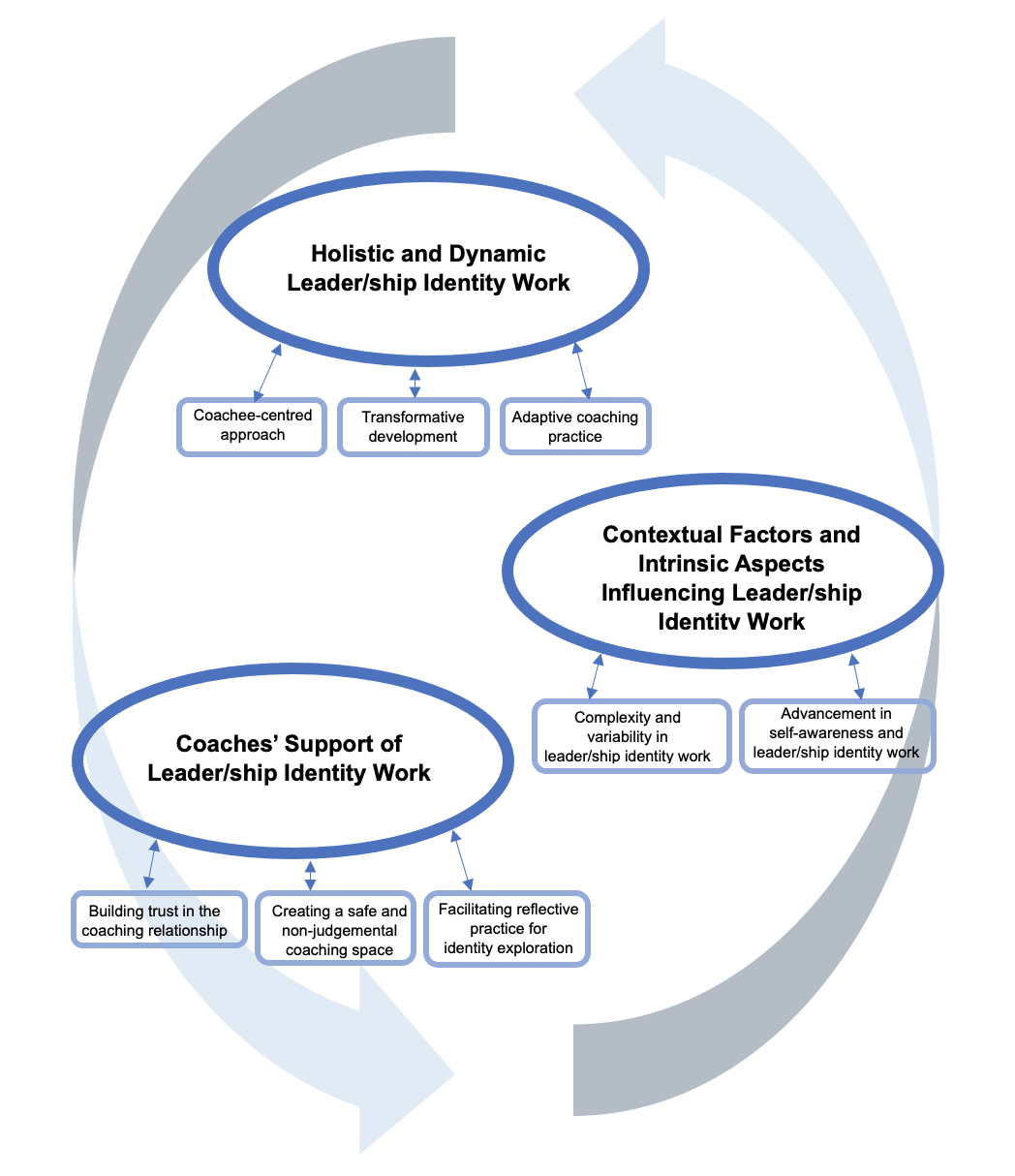
Mechanism of Executive Coaching to Support Leader/ship Identity Work (Koroleva, 2024)
The Mechanism of Executive Coaching to Support Leader/ship Identity Work reflects a comprehensive, holistic and dynamic approach. It recognises that Leader/ship identity is not static but an evolving integration of personal values, lived experiences and professional aspirations. This identity formation process is inherently fluid, requiring continuous reflection and adaptation to align one’s inner self with the demands of external leadership roles (Skinner, 2000a, 2000b). The empirical findings reveal three interrelated sub-themes: Coachee-centred approach, Transformative development and Adaptive practice, which underscore the complexity of executive coaching. Scott (a pseudonym) emphasises the importance of tapping into leaders' personal values, not viewing them as extraordinary figures, but as human beings. He states:
I assist leaders in tapping into their inherent power, not as a “superhero”, but as a human being. This process involves recognising and harnessing their authentic strengths. By focusing on personal empowerment, leaders can align their actions with their core values and goals, leading to a more genuine leadership in a way that is true to their own identity and experiences.
This process involves recognising and harnessing their authentic strengths, aligning actions with core values and goals. By focusing on personal empowerment, leaders can develop a leadership style that is genuine and true to their own identity and experiences, fostering trust, integrity and more effective leadership. Similarly, Thomas advocates for a more holistic view in executive coaching: He articulated:
Focusing on a leader’s professional role in executive coaching, not the person, we will miss the whole Universe. Without considering their personal context, we will miss the full spectrum of who they are.
These align with socio-cognitive, discursive, and dramaturgical theories of Identity work (Brown, 2017, 2021). A coachee-centred approach tailors the coaching experience to individual leaders, supporting coherence between self-identity and leadership responsibilities (DeRue et al., 2009; Snow & Anderson, 1987). Transformative development emphasises the integration of personal values and leadership goals, enabling growth through reflection and narrative construction (Ainsworth & Hardy, 2004; Sveningsson & Alvesson, 2003). Adaptive practice reflects the evolving nature of Leadership identity, highlighting the need for flexibility to meet shifting organisational and social challenges (Fachin & Davel, 2015; Steyn & Barnard, 2024).
Additionally, Contextual Factors and Intrinsic Aspects Influencing Leader/ship Identity Work, play a crucial role in shaping Identity work. External factors such as organisational structure, industry norms and cultural dynamics shape how leaders construct and enact their identity. As McInerney et al. (2021) suggest, effective coaching tailors support to these external influences, enabling leaders to adapt their leadership style to complex and shifting environments. William’s perspective below highlights that, based on his experience of working as an executive coach, many leaders struggle with self-esteem and clarity about their identities. They often feel a vague sense of untapped potential and are paralysed by fear, only seeking self-discovery when significant personal or professional events compel them to. Therefore, addressing these challenges proactively, rather than waiting for external triggers, is essential for meaningful growth and realising their potential. William revealed:
Over 16 years of experience, I have seen that many leaders struggle with self-esteem and a clear understanding of their own identities. They often have a vague sense of their aspirations, paralysed by fear and a gut feeling of untapped potential. Yet, the path to realising this potential remains unclear, like a latent fire within them waiting to be ignited. Many do not actively seek to discover who they are, until something happens in their environments, personal or professional lives.
Beatrice’s reflection complements William’s perspective, by stressing how significant life changes, such as becoming a parent or developing an illness, can profoundly impact a leader’s sense of self and subsequently their role performance. She mentioned:
Life changes, such as becoming a parent or developing an illness, can profoundly impact a leader’s sense of self, shaking up their identity and affecting their performance in their roles.
Kelly underscored the critical role of interpersonal relationships in leadership effectiveness. She observed that difficulties in personal connections, whether with partners, followers, or team members, not only hinder a leader’s performance but also affect their self-perception and sense of identity, diminishing leadership effectiveness and disrupting team cohesion.
The quality of their personal connections directly influences a leader’s confidence and presence. Struggles in these areas can undermine leadership performance, overall team cohesion and their sense of who they are.
Theories like Social Identity Theory (Tajfel & Turner, 1979) and Self-Categorisation Theory (Turner & Reynolds, 2012) illustrate how Leaders’ identities are influenced by group membership and social roles. Narrative Theory (McAdams & McLean, 2013; Ricoeur, 1980) and Dramaturgical Theory (Goffman, 1959) further support the notion that leaders continuously construct and perform identity through storytelling and context-specific adaptation. Heightened self-awareness, supported by reflective practice, promotes greater authenticity and alignment between inner values and external roles (Eagly & Karau, 2002; Mead, 2015). Therefore, the framework supports the idea that coaching must be context sensitive.
Moreover, executive coaches act as key facilitators in this Identity work. By building trust, providing psychological safety and encouraging reflection, they help leaders explore and navigate identity challenges (Bennett, 2021; Snow & Anderson, 1987). Augusta and Victoria highlight the fundamental role of trust in achieving meaningful personal development. Augusta’s quote below affirms that trust is essential for leaders to engage in deep and authentic self-reflection and self-discovery. By fostering an environment of trust, coaches help leaders confront their vulnerabilities, understand their true selves and align their leadership practices with their authentic identity. She told:
Trust is built over time and is crucial for coaching, because it enables open communication, fosters vulnerability and ensures that the coaching relationship remains consistent and reliable. Trust in coaching is the bridge between vulnerability and growth, allowing leaders to explore their true selves.
Victoria’s quote highlights that earning trust demands consistent reliability, empathy, and respect, which are essential for fostering deep self-awareness and Identity work. Without trust, the coaching process cannot be fully effective. Trust forms a strong foundation for a productive coaching relationship, enabling leaders to engage in meaningful self-exploration and align their leadership practices with their authentic selves. Victoria expressed that:
Earning trust involves demonstrating reliability, empathy and respect consistently throughout the coaching relationship. This trust is essential for fostering deep self-awareness and facilitating identity work. No trust, no meaningful work.
Coaches enable narrative exploration in a non-judgmental space, fostering deeper self-understanding and more integrated Leader/ship identities (Brown, 2017; McAdams & McLean, 2013). This dynamic interplay between personal reflection and contextual awareness allows leaders to move beyond fixed identity constructs and embrace adaptive, inclusive and effective leadership (Haslam et al., 2022).
In summary, this empirical framework offers an integrated model for understanding how executive coaching supports Leader/ship identity work. By combining reflective, individualised coaching practices with contextual sensitivity, coaches facilitate the emergence of authentic, adaptive and resilient leadership. Trust-building, narrative engagement and reflexivity are central mechanisms through which coaching empowers leaders to align who they are with how they lead (Drinka, 2018).
Building on this foundation, the proposed concept of executive coaching as an Identity enhancement space deepens our understanding of coaching’s transformative potential, not only as a developmental intervention, but as a relational and psychological environment where leaders can explore, shape and strengthen their Leader/ship identities.
The Concept of Executive Coaching as an Identity Enhancement Space
The concept of executive coaching as an Identity Enhancement Space reiterates a supportive environment where leaders can explore, develop and align their personal and professional identities. In this space, coaching aids leaders in reflecting on their values, strengths, and challenges, fostering growth and transformation. Through reflective practices and targeted feedback, coaches support leaders in navigating their evolving self-concept, helping them align their personal identity with their leadership roles and aspirations.
This notion aligns with Petriglieri's (2012) concept of Identity workspaces, which encourages leaders to explore the intersection of personal values and professional roles. Like Petriglieri, Thwaite (2022) underscores the dynamic and evolving nature of Identity work, where leaders refine their self-concept within specific organisational and contextual frameworks. Coaches facilitate this process by creating a safe, supportive space for self-exploration, helping leaders confront personal and professional challenges that impact their Leader/ship identity.
Additionally, executive coaching as an Identity Enhancement Space recognises the significance of reflective practices in identity development. Coaches guide leaders to articulate their experiences and clarify their leadership values, which is crucial for navigating role conflicts and enhancing resilience (Thwaite, 2022). This aligns with the findings of Haynes et al. (2014) and Petriglieri and Petriglieri (2010), who point out the intensity of identity work during career transitions, where coaching can play a critical role in facilitating identity realignment.
Moreover, this framework resonates with the triangular coaching relationship (Lai & Smith, 2021), where the coach, coachee and organisation collaborate in identity development. Drawing from Social Identity Theory (Tajfel & Turner 1979), the interaction between these three parties helps to align individual Leader/ship identity with organisational goals, reinforcing both personal and social aspects of Leadership identity (Tajfel & Turner, 1986). Ultimately, viewing executive coaching as an Identity Enhancement Space promotes the integration of personal development with professional effectiveness, benefiting both leaders and organisations.
Implications for Theory and Practice in Executive Coaching
This research provides novel insights into executive coaching by exploring how coaches support Leader/ship identity work among senior leaders across culturally diverse and globally varied coaching practices. The findings contribute to both academic literature and practical coaching by highlighting the importance of viewing Leader/ship identity work as an integrated, relational and evolving process. This challenges traditional views that compartmentalise personal and professional identities, aligning more closely with contemporary perspectives of leadership as fluid and interconnected (Day & Dragoni, 2015; Sveningsson & Alvesson, 2003). The study also highlights how personal values and life experiences continuously shape leadership roles, pushing existing theories and practices to consider the complexity of identity work in coaching contexts.
A key theoretical contribution is the recognition of Leader/ship identity as a dynamic construct, rather than a static set of competencies. This aligns with calls for leadership development frameworks that incorporate context into the research design (Day et al., 2014). By integrating socio-cognitive, discursive and symbolic approaches to Identity work (Brown, 2017, 2021), the research enriches our understanding of how leaders navigate their evolving identities in the coaching process.
From a practical perspective, the research underscores the importance of creating a safe, supportive Identity Enhancement Space for leaders to explore their identities. This aligns with Thwaite’s (2022) notion of identity workspaces, providing a structured environment for self-exploration, particularly during significant career transitions (Haynes et al., 2014; Westenholz, 2006). The triangular coaching relationship (Lai & Smith, 2021) emphasises the collaboration between the coach, coachee and organisation, enhancing the alignment between personal leadership development and organisational goals. Ethical considerations, such as maintaining professional boundaries and upholding confidentiality, are crucial in facilitating this identity work (Iordanou et al., 2016). Informed stakeholders, such as leaders, HR and organisational development teams, can apply these insights to design more focused coaching programmes, strengthening the leadership pipeline and improving organisational performance.
Research Limitations and Future Directions
While this study provides valuable insights into Leader/ship identity work, certain limitations must be acknowledged. The sample, focused on senior leaders, limits generalisability across diverse roles, industries and cultural contexts. Although the participating coaches represent ten countries, the cultural and organisational settings in which they practice and the leaders they support, may not reflect the full diversity of global leadership experiences. As such, there is potential for a Western-centric bias in interpretation used, which may restrict the transferability of findings. Additionally, reliance on self-reported data introduces potential biases, including social desirability and selective recall (Bergen & Labonté, 2020; Bernardi & Nash, 2023).
To enhance future research, more diverse samples incorporating emerging leaders, varied sectors and non-Western perspectives are needed. Longitudinal designs could deepen understanding of Identity work overtime. Triangulating data through client feedback, peer evaluations and objective outcome measures would help mitigate self-reporting bias. Moreover, blending insights from both experienced and novice coaches may foster innovation and challenge dominant assumptions. Further investigation into how reputation, cultural affiliation and institutional ties influence perceptions of coaching competence, and how objective indicators can provide balance, would enrich the understanding of executive coaching practices. Collectively, these steps would support a more inclusive, dynamic and evidence-informed approach to researching Leader/ship identity work.