




Abstract
It is estimated that around 10/ of the UK population experiences traits of dyslexia. The aim of this exploratory action research study was to examine the process of coaching dyslexic clients, in terms of both verbal communication skills and overall coaching approaches. A model for coaching dyslexic clients was developed and tested through cycles of coaching and interviews with seven dyslexic participants. It identifies key strategies, techniques, tools and approaches which could ultimately help support the coaching process and experience for generalist coaches and such clients.
Introduction
The overall aim of this study has been to explore and analyse the process of coaching dyslexic clients, in order identify coaching approaches and strategies which are likely to work most effectively for them. Whilst there is guidance available on how to support dyslexic adults in the workplace generally (Bartlett et al., 2010; CIPD, 2018; Reid, 2020; BDA, 2021), there is little relating this specifically to coaching. My research objectives therefore have been firstly to identify the characteristics of dyslexia which may affect a client’s experience of coaching, both positively and negatively. Secondly, through an action research methodology, I set out to develop a simple model or checklist for generalist coaches which identifies those techniques, strategies and approaches which are likely to be particularly effective when working with dyslexic clients.
Dyslexia is the most common category of neurodiversity identified in the UK, and is estimated to affect around 10/ of the population (Snowling, 2019). It is traditionally linked to difficulties with reading and writing, especially in education. However, the underlying traits, which affect people at all ages and ‘across the range of intellectual abilities’ (Rose, 2009) are known to be genetic and lifelong (Snowling, 2000). These characteristics typically include weaknesses in short-term memory, phonological awareness, verbal and/or visual memory and processing speed, and there are very often accompanying issues around lack of self-esteem (CIPD, 2018; BDA, 2021). Although such traits may often be perceived as weaknesses, these differences can also manifest as significant strengths, paradoxically in spoken communication skills, as well as in creative thinking and problem solving (Bartlett et al., 2010; CIPD 2018).
The following section summarises literature which analyses in more detail these dyslexic traits and their potential impact on the coaching conversation. It then highlights evidence of the longer-term emotional impacts of dyslexia on people’s well-being and self-esteem. The subsequent sections explain how this research study explored these impacts further, and started to develop simple guidelines for coaching dyslexic individuals, applying an action research methodology involving seven dyslexic participants. This leads to the presentation of a proposed two-part model, which outlines techniques and approaches which may be effective for generalist coaches working with dyslexic clients.
Literature review
Dyslexia and the coaching conversation
Of particular interest for this research are studies which explore the impact of dyslexia on adults’ spoken communication skills. These features are significant because of the way they could manifest in a coaching conversation, and how they might either help or hinder the coaching process.
Speech production is one potential area of difficulty, where there is evidence of possible weaknesses in terms of speed, clarity and fluency (Bartlett et al., 2010). Producing sentences is complex; Wiseheart and Altmann’s study (2018) study showed that it took dyslexic adults longer to form and speak sentences than their non-dyslexic peers, and that they were less fluent and precise. In particular, they found that dyslexic adults tend to make ‘slower responses, with more dysfluencies, grammatical errors and incomplete messages’ (p.367), including ‘significantly more vocal pauses, false starts, repetitions, reformations and interjections’ (p.358), adversely affecting both fluency and speed.
Conversely, there is also evidence that some dyslexics demonstrate specific strengths in oral expression and vocabulary, and may be compensating for compromised executive function through their semantic knowledge (Kasirer and Mashal, 2017). So, on the one hand, ‘many dyslexic people are extremely articulate’, while others ‘find it very hard to convert their thoughts and ideas into spoken words; and their oral expression becomes muddled and difficult to follow’ (Bartlett et al., 2010, p.174).
Another point which emerges is that some dyslexic adults find spoken communication hard work (Wiseheart and Altmann, 2018). Compromised short-term memory and slow verbal processing speed can make following a discussion difficult (Bartlett et al., 2010; Kasirer and Mashal, 2017), especially if the speaker’s sentences are long or complex syntactically. This can also lead to difficulties with maintaining focus and attention during a conversation, and ‘distractibility’ (Smith-Spark et al., 2016, p.325). A dyslexic person may forget what they were trying to say mid-sentence, or ‘tune out’ during the middle of a discussion. They may consequently feel anxious when speaking out loud in a conversational setting, and worried ‘that they will appear slow or stupid if they do not come up with an instant answer’, with the danger of ‘an incoherent and stumbling reply’ (Bartlett et al., 2010, p.187). These issues have clear implications for pace and attention in a coaching context, and for a coach to make sure their own sentences are clear, concise and grammatically straightforward.
Much has been written on the possible preference that dyslexics may have for visuo-spatial strategies over verbal strategies (eg Shaver et al., 1981; Bacon and Handley, 2010). Karolyi et al. maintain that adults with dyslexia demonstrate an ‘enhanced ability to process visual-spatial information’ (2003, p.427). Interestingly, there is also evidence of a far greater variance in visuo-spatial skills amongst the dyslexic population at either extreme end of a normal distribution (Chamberlain et al., 2018), which would indicate either an exceptionally strong, or unusually weak, preference for visual thinking strategies. This suggests that many but not all dyslexic adults may benefit from using visual strategies in their thinking and reasoning, which could be of relevance when selecting different coaching tools and approaches.
Emotional impact of dyslexia
A second area of literature considers the long-term emotional impact of dyslexia, as well as the positive strengths of resilience and determination which can result, and issues around disclosure (Nalavany et al., 2018). These all have implications for the overall coaching approach, the content of the sessions and the coach’s relationship with the client (de Haan and Gannon, 2017; Rogers, 2016).
The impact of dyslexia on adults has been shown to have a negative effect on mental well-being, reflecting earlier work by Bandura linking self-efficacy and job satisfaction (1977). Over the longer-term, ‘the daily questioning of one’s abilities and capacities will slowly but surely erode self-esteem’ (Bartlett et al, 2010, p.53). Evidence suggests that dyslexia-unfriendly work environments and unsympathetic, unsupportive colleagues can contribute to this stress (Constantini et al., 2020), which in turn leads to ‘lower levels of work self-efficacy, competency, and work anxiety’ (Nalavany et al., 2018, p.17). Further research suggests that this can adversely affect promotion and career prospects (Doyle and McDowall, 2019). Evidence also suggests that some adults choose not to disclose what may seem a negatively perceived disability, for fear of labelling or discrimination (Constantini et al., 2020). On the other hand, as a result of the challenges they have had to face at work, possibly labelled or stigmatised, many dyslexic adults develop great resilience and determination, as well as extremely effective and creative problem solving strategies (Davis and Braun, 1995).
There is some evidence of literature evaluating coaching interventions designed specifically for dyslexic adults in the workplace, reporting ‘success in improving self-efficacy in workplace contexts’ (Doyle and McDowall, 2019 p.7; Beetham and Okhai, 2017). There is also limited research into counselling and therapeutic support for dyslexic adults (Kjersten, 2017; Elftorp and Hearne, 2020). What seems to be missing, however, is research which considers how generalist coaches might work effectively with dyslexic clients, hence the focus of this study.
Methodology
Action research
My pragmatist paradigm, and the nature of the research objectives, led to me to select action research as the most effective and appropriate methodology for this study (Herr and Anderson, 2015). As Saunders et al. explain, ‘for a pragmatist, research starts with a problem, and aims to contribute practical solutions that inform future practice’ (2019, p.151), very much the aim of this study. Reflecting the Kolb learning cycle, action research works through a series of action planning and reflection steps, thus learning through action (Kolb, 1984). The five steps (adapted from Cox et al., 2020, p.149) for this study were therefore formulated as:
Clarify the issue – explore the processes involved when coaching dyslexic clients, with reference to literature and professional experience
Plan a course of action – draw up a draft checklist with specific techniques and coaching approaches to try out
Test out the approaches – carry out individual coaching sessions with dyslexic participants using those techniques
Collect data after the coaching session by interviewing the participants, analyse it and reflect on it
Conceptualise the approaches and replan – restart the cycle with more dyslexic participants
The first two steps of the process led to an initial simple checklist for coaching dyslexic clients (Figure 1), derived from the key points identified in the literature review, and from my own professional practice:
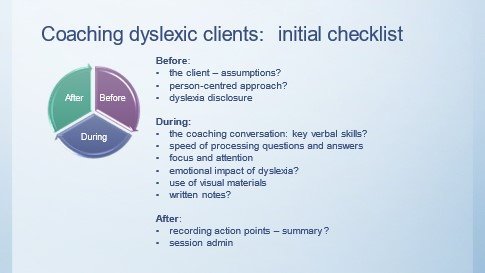
INITIAL COACHING CHECKLIST BEFORE ANY COACHING SESSIONS
Participants
The active participation of both researcher and participants is an essential and fundamental element of the action research process, involving participants who ‘represent the eventual target audience’ (Cox et al., 2020, p.157). Identified through professional dyslexia networks, seven adults (aged from early 20s to late 50s) took part in the study. All were working and all had completed some kind of formal assessment for dyslexia (not seen, for reasons of professional ethics and confidentiality).
Each had a one-hour coaching session with me, covering general topics raised by the participants (career plans, work life balance etc), followed by an interview, both on line (during the 2021 pandemic). The first three participants’ coaching sessions were used to test out elements from the initial coaching checklist, and to initiate revision and planning for further testing in a second cycle of four more coaching sessions with four more participants. The process of completing these seven coaching sessions, further reflection, discussion and rethinking resulted in a final iteration of the model, as summarised in Figure 2:
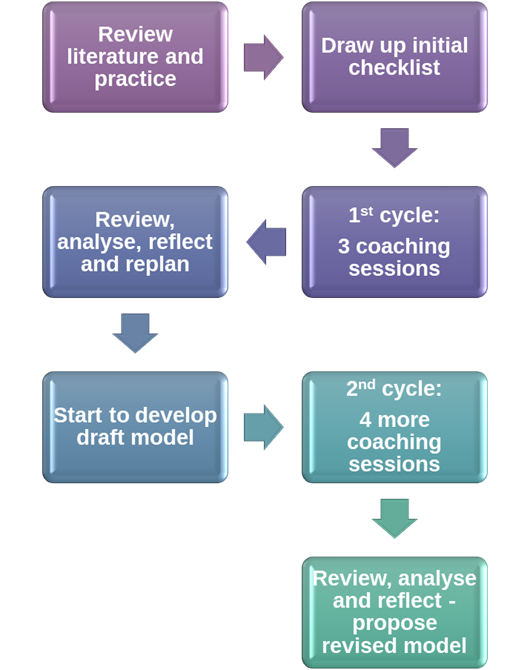
OVERALL ACTION RESEARCH PROCESS FOR THIS STUDY
Data collection and analysis
Analysis of data and reflection after each session enabled me to revise and reconsider different elements of the initial checklist, to plan for each subsequent session, and to refine and develop the model. Data was assimilated from different sources in order to ensure reference to different perspectives and thus strengthen the depth of description (Barends et al., 2014). This thick description was achieved by referring closely to participants’ own words through detailed session notes and full interview transcripts, as well as data from the literature, workplace studies, colleagues and my own professional practice (Barends et al., 2014). Practitioner evidence is highly pertinent to my study and its action research approach ‘because it reflects the specialised knowledge acquired by repeated experience and practice of specialised activities’ (Barends et al., 2014, p.9). I have over 12 years’ experience supporting dyslexic students in higher education, and also several years’ experience working as a generalist workplace coach, often with neurodiverse clients. In this research study, I was fulfilling the role of practice designer/developer which ‘often requires specific technical and contextual knowledge of the problem that is not required in many other methodologies’ (Cox et al., 2020, p.151).
A possible limitation here could be that, as a perceived dyslexia specialist, the balance of power in the coaching relationship might be affected to the detriment of ‘authentic collaboration’ (Herr and Anderson, 2015, p.150). I hope that my consciously analytical approach to reflexivity helped mitigate this, in an attempt to be ‘honest and reflective about the limitations of one’s multiple positionalities’ (p.59).
Findings and discussion
Key elements of the initial checklist were explored, starting with the mechanics of spoken communication, listening and questioning skills, and the use of visual coaching strategies. It became increasingly clear that pace and focus were significant for these dyslexic clients, and that written administration could, not surprisingly, be a challenge. A new dimension emerged to do with participants’ perceptions of their dyslexic traits – metacognition – which was added to the draft model after the first coaching cycle.
Aspects of the participants’ experience of dyslexia, their strengths and challenges, and issues around disclosure were also explored throughout the seven coaching sessions. It became increasingly apparent that a person-centred approach was essential, and that a focus on positive strengths was particularly effective.
So over the course of the seven coaching sessions, the initial draft checklist was gradually expanded and refined, and restructured into a two-part model. The first part includes aspects of the coaching conversation itself, while the second part focuses on the dyslexic client more personally. The development of this model is now explained in more detail.
The model: Part 1 – ‘the coaching conversation’
Fluency, focus and pace
It was perhaps unsurprising to find that many of the dyslexic characteristics identified in the literature did indeed manifest in the conversations with these participants. One frustration mentioned by several participants was around finding the right word, with comments such as: ‘I find a lot of my pausing is my brain trying to find the word. It happens to me almost every time I speak.’ However, it was also made clear that a coach should not attempt to help by providing the word or finishing a sentence. Conversely, we know from the literature that some dyslexic adults are exceptionally articulate and confident speakers. Two of the participants demonstrated such characteristics, with one admitting that ‘I can, you know, stand up eight hours in the shop and talk no problem without a break!’ All participants said they were comfortable talking during a coaching session, but several mentioned their tendency to go off at tangents or to lose focus, or that their thinking followed ‘less of a linear process’.
It was interesting to note, having edited the interview transcripts, how much the participants spoke in lengthy combinations of short phrases, or fragments, rather than in discrete, complete sentences. We know that this lack of fluency is a characteristic of some, but by no means all, dyslexic adults, relating to issues of short term memory and processing speeds (Wiseheart and Altmann, 2018). One can see how it might be perceived in a workplace or coaching context as hesitancy, or lack of confidence, or even distress (Heron, 2001), where there is a clear incongruence between the ideas expressed and the actual process of speaking. However, what the findings confirmed was the need for more time for clients to think and respond, with careful attention being paid to pace, waiting and allowing silence – all key skills in coaching but of particular benefit here (van Nieuwerburgh, 2017).
Asking questions and active listening
Participants said they found it difficult to respond to questions which were unclear, arguably an issue for all clients. Effective questioning is fundamental to coaching (Cox et al., 2018), but with dyslexic clients, the coach needs to be even more mindful of the actual phrasing of their questions. As Rogers points out, ‘it will only confuse your client if you have long preambles followed by many dependent clauses’ (2016, p.92). Questions with these clients need to be short and clear – perhaps only ‘between 7 and 12 words long’ (p.95). It was also clear that the coach should avoid multiple questions (van Nieuwerburgh, 2017) because of issues with both cognitive overload (Sweller et al., 2019) and short-term memory (Baddeley, 2000).
Active, attentive listening was shown to be essential, especially if, as with several of these participants, their speech demonstrates any variable fluency and focus, rapid expression or a tendency to digress (Snowling, 2000, Bartlett et al., 2010). In order to help the client retain focus, techniques of pausing, restating, paraphrasing, reflecting and summarising are all essential (Peltier, 2010). Support for this came from several participants who said they welcomed an element of direction occasionally: ‘I think I was actually hoping that you would bring me back to the question’, so some light sense of structure or direction from the coach can be helpful. Not only is it important that dyslexic clients should feel that they have expressed what they really mean, but also that they feel it has been understood. Cox points to the need for active listening which is not only about the accurate listening of content, but which also generates ‘the feeling of being heard’ (2013, p.46).
Metacognition
One unexpected finding which emerged concerned the objectivity and insight the participants expressed regarding their own thought processes. Metacognition is a key skill in learning to learn (Scharff, 2017), and is often included as a key support strategy for dyslexic students in education, because it helps learners to understand how they learn (eg Chevalier et al., 2017; aDShe, 2021). It encourages dyslexic learners to explore in practical terms the benefits of their diverse thinking, and how it can be used to positive effect, rather than feeling it as a burden. This could arguably be just as valuable in a coaching scenario, with the coach and client working together to discuss how the client thinks, what they find challenging, and increase ‘the self-knowledge of the individual’s own processing skills’ (McLoughlin and Leather, 2013, p.46).
Multi-sensory coaching techniques
The use of visual tools was included in the draft checklist and then tested in this study, because of the known links between dyslexia and visual perception (eg Karolyi et al., 2003). All seven participants said they enjoyed using photographs as part of coaching, some specifically mentioning their effectiveness as a non-judgemental trigger for discussion, and that they relished the diversion from verbal to visual processing. Photographs have been shown to contribute to both psychotherapeutic and coaching contexts in terms of eliciting deeper reflection and initiating more detailed narratives (Rose, 2007).
More generally, it seems likely that neurodiverse clients benefit from these more diverse coaching methods. This is underpinned by educational theory and practice which overtly encourages multi-sensory strategies for neurodiverse learners (Snowling, 2000; Kelly and Phillips, 2016; aDShe, 2021). There is some evidence that multi-sensory approaches are being increasingly introduced into coaching, although there is still heavy reliance on the traditional one-to-one, face-to-face spoken conversation (Gash, 2017).
Written text, action points and coaching admin
Another element explored in the research cycles was the possible benefit of the coach making notes of key points during the coaching conversation. One participant for whom I recorded action points in the chat function (this was on-line coaching) was enthusiastic because ‘my notes are useless’. However, another was less interested and found the text on screen ‘distracting’, reflecting the known cognitive challenge of both reading and listening simultaneously (eg Snowling, 2000). However, most participants welcomed a short written summary of key action points to be sent on to them afterwards. As well as helping to mitigate the challenge of written text, visual confirmation of goals and action points from a coaching session provides reinforcement and encourages greater commitment to their being achieved (Peltier, 2010).
Evidence from this study also showed that five of the seven participants found the administration of the coaching sessions a challenge. There were examples of misread emails regarding details of dates and times, spelling errors and long delays between correspondence. One participant would not answer emails and preferred to phone instead. This is unsurprising, given our knowledge of dyslexic traits (eg Snowling, 2000; Moody, 2006; Reid, 2020), but nevertheless a useful reminder to coaches working with such clients.
As a result of these findings and reflections, the first part of the model was developed as a much more detailed and comprehensive checklist of techniques and skills connected with ‘the coaching conversation’ itself (Figure 3). These are presented as a series of circles, in order to avoid any sense of hierarchy or chronology.
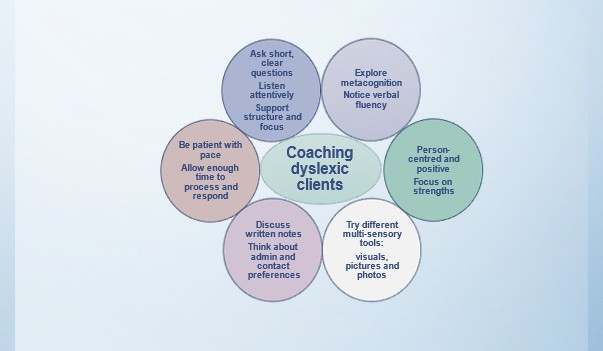
REVISED MODEL PART 1 - ‘THE COACHING CONVERSATION’
The model: Part 2 – ‘the dyslexic client’
Positive and negative experiences
It became very clear during the course of both the coaching sessions and interviews that all seven participants had had challenging experiences throughout their lives, demonstrating the long-term and complex impact of dyslexia (eg Snowling, 2000; Bradshaw et al., 2021). For several of them, their relationship with dyslexia has been a major challenge: ‘I've always seen it as a negative. I’d have to call it the most negative thing in my life….’ Most had experienced difficulties at school, either undiagnosed or unsupported (or both) as dyslexic learners, which in turn had an impact on their education, work, careers and studies, as well as their personal lives and self-esteem, all topics likely to come up in coaching (Rogers, 2016).
In particular, it was significant that every participant used the word ‘struggle’ at some point in discussing their relationship to dyslexia, one of the effects that a life-time of negative feedback and sense of failure early on may have on adults with dyslexia (Eide and Eide, 2011). This brings to mind more general psychological theory which considers the influences of childhood experiences which can affect an adult in later life, such as Freudian determinism (1922), and how early experiences may ‘determine people’s destinies’ (Nelson-Jones, 2015, p.159).
Focus on strengths
Given this background, I explored the effect of focusing increasingly overtly on positive strengths in the coaching sessions. This was picked up on by the participants, as clearly some of them were used to addressing only their weaknesses: ‘I think it's helpful when you asked about like my strengths, but I was almost waiting for you to ask for my difficulties… And you didn't! The importance of focusing on strengths is supported by research which suggests there is a link between people realising and valuing their strengths, and the subsequent connection with resilience and emotional well-being (Seligman and Csikszentmihalyi, 2000; Francis and Zarecky, 2017). When people are aware of their strengths and are able to use them, they are likely to feel a greater sense of self-worth and satisfaction (Govindji and Linley, 2007; Schutte and Malouff, 2018).
Indeed, perhaps it is these positive affirmations of the client’s ‘worth, qualities… and actions’ (Heron, 2001, p.6) that are most needed by these adults, to celebrate resilience and achievements, and to offset any particularly negative feedback experienced in the past (Seligman et al., 2005). There is already strong interest in positive psychology for coaching more generally (Panchal et al., 2019), and approaches such as Boyatzis’ Intentional Change Theory (2006) and theories of flourishing (Green and Palmer, 2018) could also be of value here.
Person-centred approach
We know that dyslexia is an umbrella term which includes a wide variety of traits and characteristics which will be different for each individual (Snowling, 2000), which was clearly evidenced by the participants. This supports the importance of taking a person-centred approach when coaching such clients, at least as a starting point. Coaching has long links with person-centred psychotherapeutic approaches (Rogers,1951) and this sits well with the need to allow a neurodiverse client ‘to feel accepted and understood’ and to work with their coach in a manner which is ‘genuinely mutual and collaborative’ (Joseph and Bryant-Jefferies, 2019, p.136).
Disclosure and assumptions
Another element tested out for this research study was the question of disclosure. I asked all the participants whether they would mention their dyslexia before or during coaching, or not at all, resulting in a wide range of reactions. One participant was very clear: ‘Yeah, I probably do disclose it. It will always come up because it's a big part of me’. However, another said they definitely would not. I also asked how they thought coaches should deal with the issue of disclosure, with their responses pointing to the importance of careful and detailed questioning, and being ‘open and curious, rather than prescriptive and pathologizing’. This reflects the strategy of ‘empathetic curiosity’ – suggested by Lancer et al. for cross cultural coaching (2016, p.263), but equally relevant for neurodiversity.
The literature suggests, as did some of the participants’ comments, that disclosure of a disability can lead to inaccurate assumptions and discrimination in a work environment, and the sense of being judged for what is in effect an invisible disability (Friedman, 2017). Participants said they would want the coach to focus on the individual, and to try and see the world from their perspective, a key aim of coaching (Rogers, 2016; Heron, 2001). This ultimately begs the question as to whether it actually matters if the client chooses to reveal or discuss their dyslexia, and there can be no assumption that they will.
The second part of the model therefore emerged as a summary of the key issues that a coach might need to think about and be
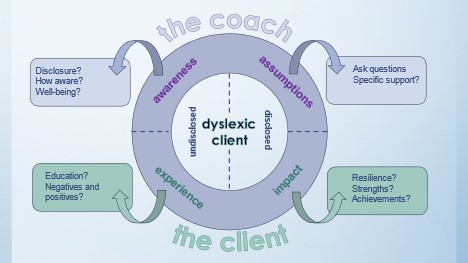
REVISED MODEL PART 2 - ‘THE DYSLEXIC CLIENT’
Conclusions
One of the aims of action research methodology is to share the outcome of the collaborative research process with other stakeholders (Herr and Anderson, 2015) and to improve ‘a coaching model or practice or the development of a cohort of practitioners over time’ (Cox et al., 2020, p.156). In developing this model for coaching dyslexic clients, I have a practical, and I hope straightforward, means for doing so, to raise awareness of key issues relating to coaching dyslexic clients, and to present techniques, strategies and approaches which might be effective. Ultimately it is arguably likely to be the quality of the coaching rather than a specific methodology which is of most importance (Stober and Grant, 2006), but nevertheless, I hope this ‘evolutionary action research’ is a useful start to developing coaching practice in this emerging field (Cox et al., 2020, p.156).
It is time for the coaching profession to turn its attention more seriously to neurodiversity, as it is already doing with culture, age and gender (eg Cox et al., 2018; Baron and Azizollah, 2019). In the business world, neurodiversity is emerging as an exciting new dimension, with increasing interest being shown in the creativity, inventiveness and entrepreneurial skills of people with diverse thinking, and their contribution to the changing workplace (Logan, 2009; CIPD, 2018; Made by Dyslexia, 2021, Genius Within, 2021). Coaching professionals should embrace this too. There would be very distinct benefits for practice generally in thinking more about neurodiversity, because coaching is ultimately about exploring relationships, and developing ‘shared vocabularies for making sense of our experiences and increasing our understanding of both each other and ourselves’ (Chapman, 2020, p.220).