




Abstract
This study explores the moral purpose (telos) of coaching. Whilst much has been written about outcomes-based or instrumental purposes of coaching, there is little understanding of the ultimate end or moral purpose of coaching. What is the ultimate ‘good’ that we aim to achieve as coaches? This research contributes to the continuing debate regarding the status of coaching as a profession and where there is a gap in the literature on moral purpose. Thirteen experienced coaches and eleven clients were interviewed as key stakeholders in coaching practice to determine their understanding of the moral purpose of coaching in the context of the workplace. Data was analysed using reflexive thematic analysis. The moral purpose of coaching was found to be the flourishing of the client through the development of self-awareness, identity and agency. These were found to link to two instrumental and subsidiary purposes which are ‘outcome’ and ‘movement’. The paper proposes a conceptual model for further testing and professional reflection.
Introduction
Coaching has rapidly grown over the last few decades, and is projected to be a US$ 27 billion industry by 2032 (Future Market Insights, 2022). Along with this continuous growth is a debate regarding the status of coaching as a profession, discipline or craft (Fillery-Travis & Collins, 2016) and the establishment of frameworks with which to understand, evaluate and develop coaching practice, for example through training and accreditation (Gannon & Myers, 2018). The accrediting bodies, such as the International Coaching Federation (ICF) and the European Mentoring and Coaching Council (EMCC) have developed competency frameworks (that include consideration of ethical codes) that are used as guidelines for professional practice.
A complementary lens through which to consider coaching as a profession is a virtues framework, based on Aristotelian philosophy (Oakley & Cocking, 2001; MacIntyre, 2007; Aristotle, 2009). In the context of a profession this requires consideration of the moral purpose of the profession, as well as the character or virtues needed to practice the profession well (Pellegrino & Thomasma, 1993; Oakley & Cocking, 2001). In Aristotelian understanding, moral purpose describes the ultimate end of the profession, termed telos in philosophy.
The moral purpose of coaching must be distinguished from the more instrumental, often performance-based, purposes about which much has been written, in particular in relation to the business case for coaching (Passmore, Peterson, & Freire, 2013; van Nieuwerburgh, 2017; Jones, 2021). Using an Aristotelean framework, we view these instrumental purposes as subsidiary to the ultimate end as they are not an end in themselves, but rather a means to that end.
We propose that an exploration of the moral purpose of coaching provides an important contribution to the debate regarding the status of coaching as a profession. This is because other people-focused professions such as medicine, nursing, or teaching, which can provide a benchmark for the evolution of coaching into a profession, do reflect on the moral purpose of their professions (Caram, Peter, & Brito, 2019; Arthur, Earl, Thompson, & Ward, 2021; Schwartz, 2022; Sotomayor & Sheehan, 2022; Biesta, 2023; George, Urch, & Cribb, 2023). While many coaches will have an implicit understanding of their moral purpose, it is important to articulate it so as to have a common understanding as a profession. This would be a step towards the development of a virtues framework that can be used for professional reflection, navigating ethically complex areas, and for connecting practitioners to their motivation for coaching. It will therefore have implications for the education and development of coaches. This study aims to explore the moral purpose of coaching, through the experiences of two key stakeholders in the coaching profession: coaches and clients.
We have sought to answer the following research question: How do those with experience of coaching view its moral purpose? The paper starts by exploring the advancement of coaching as a profession; the concept of moral purpose; and the existing literature on the purposes of coaching. We then describe the research methodology, data analysis and finally the outcomes in relation to existing knowledge.
Literature Review
The professionalisation of coaching
Fillery-Travis and Collins (2016) draw on literature to identify the key characteristics of a profession when they debate and contrast whether coaching should be viewed as a profession, discipline, or craft. They highlight a number of criteria for a profession including: a) requirement for a recognised and regulated qualification in order to practice; b) the development of phronesis via professional reflection; c) a restriction on who may practice the profession; d) a high element of financial or reputational risk associated with the practice; and e) the existence of professional bodies and associations who protect and regulate the profession. Other key criteria identified in the literature include a knowledge base founded on research into theory and practice; a code of ethics; and service for the public good (Lane, Stelter, & Stout-Rostron, 2018). Coaching has developed some of these features, including a growing research-based foundation of knowledge; academically based education programmes; and the rise of accreditation bodies who aim to regulate practice, training, and standards. However, coaching still fails to reach all such criteria and falls short as a profession particularly in relation to criteria a) and c) (Hawkins, 2008; Fillery-Travis & Collins, 2016; Lane et al., 2018).
This paper seeks to further the movement towards the professionalisation of coaching. Coaching aligns with people-focused professions such as medicine, teaching and nursing. As discussed above, such professions have identified the importance of the moral purpose to their work. For example, Campbell (2008: 371) describes teaching as ‘a role that reflects a clear sense of moral purpose and ethical obligation’. If we are to advance our progress towards professional status for coaching an understanding of moral purpose will be essential.
Virtues framework and moral purpose
One approach is to use a virtues framework that builds on the work of philosophers such as Aristotle. Virtue ethics was revived and reinterpreted in the second half of the 20th century (MacIntyre, 1998; Rachels & Rachels, 2007), perhaps most notably by MacIntyre (2007) who argued the need for a teleological approach to ethics.
The moral purpose (termed telos in philosophy) is a central concept in a virtues framework. Something is recognised as good if it fulfils its purpose. A watch is good if it keeps time, because that is its purpose (MacIntyre, 2007). Purpose is important for individuals and occupations. The moral purpose should encompass both a moral and functional purpose (MacIntyre, 2007); a doctor cannot aspire to be morally good while not providing good treatment for patients (and vice versa). Similarly, a good coach will be directed to a goal that is both practical and morally good.
Aristotle considered that there was a hierarchy of goals, with instrumental goals being below constitutive goals (those that are an end in themselves). The moral purpose is the ultimate end, so this hierarchy does not continue ad infinitum, and that end has to be a good in and of itself (Aristotle, 2009; Fowers, 2012). The second feature of virtues framework is the consideration of the virtues that are needed to achieve this (Annas, 2011).
Macintyre (2007) applied the concept of virtues to ‘practices’, by which he meant an activity that is cooperative, complex, linked to standards and excellence and results in internal goods (internal goods being benefits that result from the skilled exercise of a practice). Professions, and other occupations, can be understood as such practices (Oakley & Cocking, 2001). This requires an understanding of the moral purpose of the profession, which needs to describe the good (moral and practical) that should result from the profession. For example, the moral purpose of medicine has been described as: ‘to help people flourish by enabling them to optimise their health’ (George et al., 2023).
The moral purpose unifies a profession, even when the skills and approaches used within that profession are diverse (doctors share a common moral purpose, though the practice of a surgeon and psychiatrist differ (Pellegrino & Thomasma, 1993)). The moral purpose, together with virtues, provides a framework for ethical decision-making (George, 2021; George & Rose, 2023) and professional reflection (George et al., 2023).
The moral versus instrumental purpose of coaching
Definitions of coaching are often framed around the instrumental purpose or intended outcome of coaching (Passmore, 2021). Purpose focused definitions include unlocking the potential of the client (Whitmore, 1992); on maximising performance (Passmore et al., 2013; van Nieuwerburgh, 2017) or on the developmental nature of coaching (Jackson & Cox, 2018). An analysis of 36 definitions of coaching indicated that executive, business and general coaching have an objective to enhance personal effectiveness, development and growth in order to improve performance (Hamlin, Ellinger, & Beattie, 2009). Another study indicated that while different approaches or types of coaching have different objectives, they can be categorised as focussed on personal development or improvement in performance (Ives, 2008). A systematic review of 84 executive coaching research studies identified 11 outcomes of coaching, all relating to personal development or performance objectives (Athanasopoulou & Dopson, 2018).
These studies indicate a number of purposes for coaching. However, these cannot equate to the moral purpose of coaching, as they are instrumental. Such purposes do not have an inherent moral quality (transformation can be good, or bad). To understand coaching as a profession it is necessary to consider the moral purpose of coaching rather than only the instrumental purposes and therefore the importance of this research study.
Methodology
This research seeks to explore the moral purpose of coaching, a social construct situated in a professional and cultural context. The research adopted a critical realist orientation which distinguishes between the ‘observable’ and the ‘real’ mechanisms that may be unobservable yet causing or giving rise to the observable events or situation (Bhaskar, 2007; Archer et al., 2016; Vincent & O'Mahoney, 2018). Realism adopts a subjective epistemology and ‘accepts that we can only know the world through our descriptions of it’ (Rose, Spinks, & Canhoto, 2015: 19). Based on this philosophical research orientation, the research design was inductive and exploratory in nature, given the lack of existing knowledge of the moral purpose of coaching in the literature. A qualitative method was applied using semi-structured interviews to collect data from experienced coaching stakeholders who were able to articulate their ‘descriptions’ or perspectives on the moral purpose of coaching.
Interviews were conducted virtually with data recorded using Zoom technology. The interview guide asked open questions around the interviewees understanding of the moral purpose of coaching. (Note, there were additional questions not related to this research question, data from which will be published elsewhere). As discussed above, it was important to ensure clarity between instrumental and moral purposes. A short description of each was provided prior at the start to ensure the validity of the discussion. The interview questions were developed by the researchers and piloted and modified before use.
The Sample
Interviews were conducted with 13 experienced coaches (accredited by a coaching body with 5 years or more experience) and 11 clients with significant experience of being coached. These are shown in Tables 1 and 2.
Summary of Experienced Coaches Interviewed
Abbreviations: AC; Association for Coaching, AoEC; Academy of Executive Coaching, APECS; Association for Professional Executive Coaching and Supervision, EMCC; European Mentoring and Coaching Council, ICF; International Coaching Federation.
Summary of clients interviewed
Coaches and clients were accessed via convenience sampling and recruitment proceeded via snowballing. The analysis of interviews was done independently of any relationship with other participants (such as coach-client).
Data Analysis
The recordings were transcribed with Otter transcription software, followed by manual checking. The transcripts were pseudo-anonymised at this time. Participants were asked if they wished their data to be presented using a code or a pseudonym, those that responded preferred the use of pseudonym. The quotations are reported giving the pseudonym and the suffix Co (coach) or Cl (client).
The researchers stopped interviewing when they had enough data to fulfil the aims of the study, using the concept of ‘information power’ (Malterud, Siersma, & Guassora, 2016). Data was analysed using NVivo software. This analysis was based on reflexive thematic analysis, involving six iterative steps of i) familiarisation with data, ii) coding, iii) generating initial themes, iv) developing the themes, v) reviewing themes and vi) writing up (Braun & Clarke, 2006, 2022).
Familiarisation with data was done through listening at the interview, during the manual checking of transcription, multiple reading of the transcripts and the use of reflective notes made during the interview and analysis. A total of 664 segments of text were coded into 70 distinct codes. The data were reviewed for patterns or themes which were constructed based on the data, the original research question and theoretical knowledge. Three themes, one of which had 3 sub-themes, were identified, these were named, reviewed and refined by discussion between the researchers. The report was written and reviewed by both researchers.
Research Ethics
Consideration was given to confidentiality, privacy, safety and the prevention of distress during the study (Rose et al., 2015). Institutional ethical approval was sought and given in advance of data collection. Participants were given an information sheet about the study, had the opportunity to ask questions, and gave their consent to participate through signing a consent form. All participants asked for, and received, a summary of the research findings once the study was completed.
Results
In this study both experienced coaches and clients were interviewed to explore their understanding of the moral purpose of coaching. Reflection on this resulted in the development of 3 themes shown in Figure 1. One of these (Flourishing) has 3 subthemes. Similar themes were seen for both coaches and clients, however (as discussed later) the emphasis given to these themes was different for both groups.
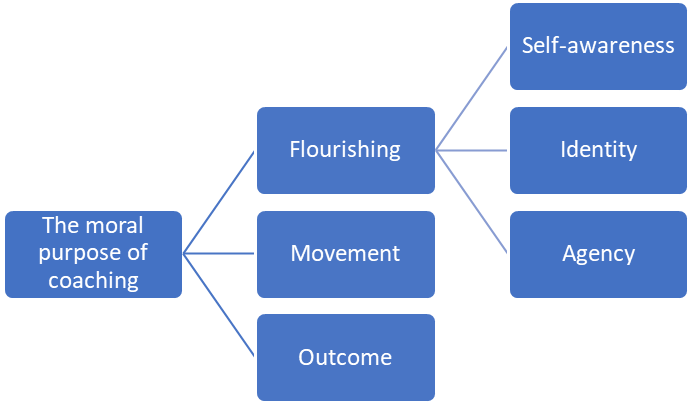
Themes identified that relate to the moral purpose of coaching
Flourishing
Coaches often expressed their ultimate purpose as allowing the client to be the best version of themselves, “To invite people to step into their best self, whatever they see that as being” [Nancy Co]. This does not involve changing the nature of who they are, but fulfilling their potential and “being even more alive” [Steve Co]. Some clients similarly described the impact of coaching as “It’s just made me a better person” [Rebecca Cl]. While interviewees did not use the term ‘flourishing’, this word, drawing from both classical philosophy and positive psychology, captures the essence of this theme.
Three interacting sub-themes were developed. One (Self-awareness) is centred around an awareness, acceptance and valuing by the clients of themselves. The second (Identity) describes clients finding or creating a better version of themselves, while the third (Agency) concerns empowerment.
Self-awareness
The central aspect of this sub-theme is to “help people to understand themselves, to understand who they are as people” [Brian Co] and to understand their values as well as their emotions. This is understood as something that is necessary to be “a contributing positive member of society” [Sally Co], and as illustrated in the extract below leading to wellbeing.
So, there's a sense of… wellbeing that comes from coaching because you learn about a part of your mind and a part of your sort of genetic makeup that … I don't think you'll ever find out unless you've got a coach. [Christian Cl]
Coaching was seen as providing the space and opportunity for reflection, which is necessary for self-awareness. The majority of clients, who often either don’t have the opportunity or are not naturally reflective, valued this aspect of coaching. The development of self-awareness is only a step in the process as outlined in the extract below:
…because an awful lot of the work you're doing with a client is growing self-awareness, and it's an internal piece of work around self-compassion, self-acceptance, self-esteem, emotional intelligence … As they progress, their voice is going back to them. And they're hearing themselves … and growing their self-awareness. [Penny Co]
This development of a positive sense of self can happen in the context of “a commitment to self” [Alice Co]. The consequence is not only that the client comes to appreciate that they are valued by others but that they value (and care for) themselves.
… my sister … used to laugh that … I am a person who would give you the last shirt because you don't have it and have to walk without one. And now she says she's noticed I still would do everything for someone but then I see that this is important to look after myself. [Claudia Cl]
Self-awareness and self-acceptance provide the basis for change and action. The extract below describes how, by being centred and self-aware, a person can take action:
… there is force, there is motion, there is energy. Whereas the other … feels stiller. Feels calmer and not necessarily in motion ... Whereas forces, obviously can be positive things but driving pushing things forward. ... that the stillness, sense that Buddhist sense … that slots in to the other, to enable you to do things with it, achieve with it. [Steve Co]
The development of positive self-awareness is seen as a key purpose of coaching. It is the foundation for change and for action, and closely meshes with the other sub-themes.
Identity
A closely related sub-theme was developed around identity. This was variously described as bringing something that is blurred into focus, or, as in the extract below, finding or connecting with an identity that had been lost, buried or put to one side:
[W]e talked about a sense of identity … she recognised … that she had lost the sense of who she was before her marriage. … ‘When I got married, I took on this name and I was no longer the person I was.’ … I was encouraging her to think about … what is it about you that you want to reconnect with, and there was this moment where … she lit up and she said, ‘I need to change my name back’. [Alice Co]
This development of identity is not about creating a new identity, though it may involve tapping into the whole self to find an unrecognised aspect of self. It was also seen, particularly by clients, as leading to self-acceptance “give me permission to be me” [Clare Cl].
The development of identity also involves integration and connection. This is in part an internal process, one metaphor described Russian dolls and how if they are stacked together they become more solid and stable even if they look the same as when empty. However, people also exist in a community, and identity needs those social connections. “… an ineffective person would be quite isolated and … would be an island and an ineffective person would lack any contribution to the community” [Sally Co].
Integration makes people more centred and stable; the stacked Russian dolls are harder to push over even though they look the same as an empty doll. This centredness gives a solidity and robustness to the individual.
Agency
A key element of the coaching process is the development of agency. Agency involves people not only deciding what is important and having control, but also that they take responsibility for their own actions. Coaches also described clients developing the belief that they could change things, which is part of self-efficacy (distinct from, but a foundation for, agency). Thus, clients described themselves as gaining in confidence and being empowered. Coaching is also important in “giving people a voice” [Penny Co].
Coaching enables this in several ways. Environments, including workplaces, can hamper peoples’ belief that they can change things. Coaches can help people “create an environment in which they feel comfortable to try new things” [Nick Co].
When coaches were asked what the good of giving people agency is, many could not identify any higher purpose than this: “it may or may not be good for them. It's probably good for them if they want to” [Emma Co]. This suggests that for them, the creation of agency is an ultimate purpose in and of itself. However, it is also an important enabling purpose, as the empowerment can drive change and action. Clients saw having choice as being important, even if they chose not to act; “I might choose to just lie on the sofa and cry. And that's okay, too. But I have a choice” [Muna Cl].
Movement
One of the purposes of coaching is to enable people to change and move forward. Many coaches assumed that change and development is normally a good thing in and of itself, and derive personal satisfaction and pleasure out of it:
...my immediate reaction ... was probably not the right one. But it was an interesting one. And that was it's because I like it. It gives me a buzz. That's a bit selfish isn't it. ... It's important for me to see change. [Peter Co]
Some clients saw change as necessary, either linked to a particular need (such as changing job, or dealing with new roles) or, as in the extract below, without a particular objective in mind.
But I didn't necessarily know going into what it was, or why I wanted it. But I knew that I wanted to develop personally and professionally and I knew I needed some space in which to do that. And I knew I needed somebody to help me. [John Cl]
There was a clearer sense of moral purpose in discussing clients being stuck or stagnated. Clients saw themselves as stuck, in some cases by things that had happened in the past, but more often by situations or individuals or being ‘stuck in a rut’. These conditions are seen as undesirable (though sometimes people might be temporarily or voluntarily ‘trapped’ by positive circumstances such as the birth of a child). There was general agreement that a purpose of coaching was to unstick people:
I hate feeling stuck. And I hate to see people feeling stuck. … it motivates me to be able to facilitate a conversation that will help them feel able to move forward. [Edith Co]
Coaching also allows people to move past things that are blocking or frustrating them. People can be damaged and scarred by their situation, or feel frustration in their work. Interestingly, when discussing this, coaches often reflected on times that they were personally stuck or trapped by work or other situations.
Clients also saw coaches as people that helped them in the journey, by being a guide who is alongside the client, a thinking partner, a person that helps the client maintain focus.
Outcome
The outcome is an instrumental purpose of coaching, that relates to what is different as a result of the coaching. There were three areas that were identified where coaching makes a difference; change to the individual, improved functioning (for example at work) and the impact of the coaching on third parties.
For the individual the benefits of coaching included elements such as happiness, fulfilment, calmness, resilience and being a contributing member of society. This was not only a good thing, but also would lead to better functioning at work; “I think workplaces that have a coaching culture might well be happier, more productive workplaces [Emma Co]
The outcome of coaching was seen in a number of practical ways, including better understanding of situations, the acquisition of tools or skills and the development of strategies for improving the situation (including working better with individuals).
Some interviewees (coaches and clients) saw the purpose of the business as primary, while others were more focussed on improving the work environment and would put the business purpose second. A third way was to align the business purpose and the need to support the individual (and their team). A happier and more content workforce would enable people to focus on doing things that would make the business more successful; “So I think it's a good thing for the bottom line, it's a good thing for the workforce. Full stop.” [Nick Co].
As described in the extract below, a lack of alignment of purpose can be destructive for the individual and, by extension, the organisation. Coaching helps achieve such an alignment:
…at its worst it's almost crippling. … So, if I remember back to early days in my career in one particular role … [in] ethics and morals and everything else, it was a long way away from where I wanted to be… and I remember cowering in a toilet ahead of having to make a presentation about something I did not believe in, that was not aligned to whom I was … I felt shocking. … it can be completely crippling. [Steve Co]
Coaching also causes change through a ripple out effect on the people and wider community around the client. Both coaches and clients were divided on this topic; some believed that the purpose of coaching included the wider impact, others were reluctant to claim this:
I'm not coaching just that person, I'm coaching every single person that they then come into contact with. [Julie Co]
Why is the world a better place? … No, I can't speak for the world. I don't feel I'm changing the world. … I'm not as ambitious as that. [Emma Co]
Coaching is … individual to individual, feels very atomized in a way to imagine all that effort rolls up into the world a better place. … maybe if world leaders were coached … It just feels too big… [Megan Cl]
This ambiguity about whether coaching makes the world a better place appears contradictory, but may stem from coaching’s focus on the client. Many coaches are unwilling to claim any ‘higher purpose’ than the benefit for their client, and will see any wider impact as almost incidental. In addition, some were reluctant to comment on the impact for people that they had no contact with. Many clients thought that there was a ‘ripple out’ from their coaching to people they worked with and their families, in part because of their changed behaviour but also, as this doctor in the quotation below indicates, because of changes in the client’s internal state.
…from the point of view of the patients … it's made a difference. Because I think if you're happier within yourself, patients get that vibe from you. … it's something that's probably very hard to prove…but I think patients will respond better when you're more relaxed. [Hamad Cl]
Some coaches appeared to be agnostic about the outcome of coaching for any third party; their concern was solely for their client. One coach gave the analogy of their clients being a piece in a jigsaw puzzle. The impact of coaching is that the piece changes shape, and the consequence for the rest of the puzzle is that they have to adapt to the new shape or, in extreme cases, the client might decide that “this jigsaw isn’t one I want to be in” [Alice Co]. The other pieces in the puzzle had little say in this. However, as discussed in ‘outcome’ there was an understanding that the coaching had to be relevant to the business objectives of the sponsoring organisation.
Differences between clients’ and coaches’ reflections
The themes described above developed from the interviews with both coaches and clients. However, while the responses were congruent, there were differences in emphasis between the two groups of respondents. Clients tended to emphasis the purpose of coaching being practical (‘movement’ and ‘outcome’) while coaches were more focussed on the themes embraced by ‘flourishing’. Clients tended not to talk about the moral purpose of coaching, but saw it as having instrumental goals that contributed to higher constitutive goals. This is perhaps not surprising. For clients coaching was not an end in itself, but a means to an end (their personal or professional moral purpose). This is different from coaches, whose professional moral purpose is that of coaching. In addition, for clients coaching is a small part of their working life, and they may not have thought deeply about the nature of coaching; coaches on the other hand will have reflected on this both in their training and practice.
Discussion
The central theme of the moral purpose of coaching that developed during these interviews was ‘flourishing’. This was made up of three subthemes; self-awareness, identity and agency, that interacted in a dynamic manner. Thus, identity both leads to, and is promoted by, agency and self-awareness; all three of these subthemes feed each other.
There is a considerable literature on the nature of flourishing. Hedonic (positive affect or happiness), evaluative (life satisfaction) and eudaimonic (self-determination, personal growth and autonomy) approaches can be used to measure flourishing (Ryff, 1989; National Research Council, 2013; OECD, 2013; VanderWeele, 2017). These factors have also been combined to measure individual wellbeing (VanderWeele et al., 2020).
Five domains that contribute to flourishing have been identified: happiness and life satisfaction, physical and mental health, meaning and purpose, character and virtue and close social relationships (VanderWeele, 2017). The flourishing that is the moral purpose of coaching can impact on all the 5 domains of flourishing proposed by Vanderweele (2017). While some of these domains were not identified as important by coaches or clients, for example ‘physical and mental health’, this study was done in the context of largely workplace coaching where such issues are less to the fore. Other coaches would see health, and its contribution to wellbeing, as a key objective (Anstiss & Moore, 2019).
The concept of flourishing is also found in positive psychology (Seligman, 2011). Coaching that uses positive psychology approaches has been described as having the objectives of improving short term and long term wellbeing (Passmore & Oades, 2014). Other studies have used outcome measures that include psychological and work-place well-being (O’Connor & Cavanagh, 2013; Grant, 2014), agency and self-acceptance (Green, Oades, & Grant, 2006) and self-insight (Bozer, Sarros, & Santora, 2014; Grant, 2014; Bozer, Joo, & Santora, 2015; Yu, Collins, Cavanagh, White, & Fairbrother, 2020). Using the data, we have obtained, we propose that flourishing is more than an instrumental purpose, but also provides the ultimate end, or moral purpose, to coaching.
Two other themes were discussed. One was ‘movement’, helping the client become unstuck and move forward. The other was ‘outcome’, which described what was different as a result of coaching. Both themes that were emphasised by many of the interviewees, however, while they are the reason why people seek coaching, and can be a strong motivator for coaches, they cannot be described as an ultimate purpose as they are not an end in themselves. They are instrumental purposes that can lead to the ultimate end.
A conceptual model
This research, in the context of a virtues framework, indicates that the moral purpose of coaching is the flourishing of the client. This has resulted in a conceptual model shown in Figure 2 which proposes three interacting factors (self-awareness, agency and identity) that comprise flourishing and form the moral purpose of coaching. It is proposed that these factors are ends in themselves for the coach, but also enable each other (self-awareness is needed for both identity and agency). These factors are therefore shown as interacting with each other to result in flourishing. The development of flourishing in clients is proposed to be the moral purpose of coaching. This is a conceptual model relating to coaching; other factors will be important to flourishing in other settings.
This research suggests that there are instrumental purposes that are connected to the moral purpose: movement and outcome. As discussed above, instrumental purposes are subsidiary to the ultimate end or moral purpose of a profession. It is proposed that there is a two-way relationship between the instrumental and moral purposes; movement happens because of changes in self-awareness, agency and identity. Movement also contributes to the changes in these factors that constitute flourishing. The same relationship holds for outcome. Further investigation would be needed to determine if there is a direct connection between movement and outcome, or whether it is entirely mediated though flourishing.
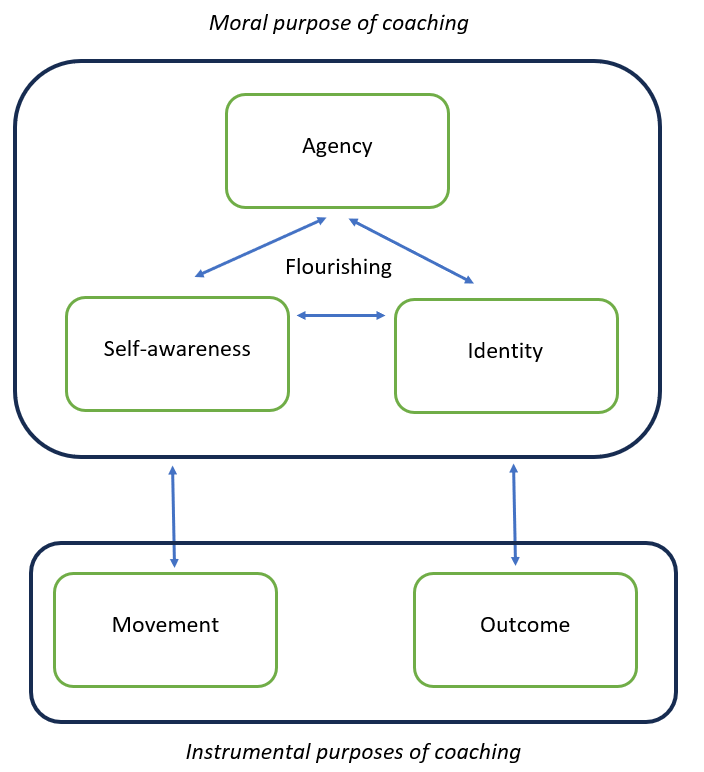
A conceptual model of the moral purpose of coaching.
It is important to note that the coach and their client may have a different perspective, and consider whose purpose is being served (Brockbank, 2008). While for the coach the moral purpose is to enable the flourishing of the client, the client may see that within a wider context. For example, a coach who has a doctor as a client may see their purpose to enable the flourishing of the doctor. The doctor will have their own moral purpose and for them coaching is not an end in itself but a means for them to achieve that. In a similar manner that doctor may achieve their moral purpose by contributing to the flourishing of a patient, but that patient will have their own purpose which the medical interventions may support.
Limitations of the study
The clients who participated in this study were, in general, senior members of their organisations. Most of the coaching that was being discussed was focused on the workplace. Future studies could look at wider coaching contexts where there may be other important components of flourishing.
The study also used convenience sampling followed by snowball sampling. Given the risk of homophilic selection (Chan, 2020), it would be important to assess whether these findings resonate with a wider, more diverse, selection of coaches and clients.
Contribution to Research and Practice
The contribution to research of this paper is the development of a conceptual model for further testing (Figure 2). This extends current understanding of the moral or ultimate purpose of coaching and its articulation in coaching practice.
The study produces a statement of the moral purpose (telos) of coaching, which is to enable the flourishing of people through development of agency, self-awareness and identity. This can act as the basis for future discussion and development.
The contribution to practice is to the development of the professional status of coaching. One important aspect of established professions is a shared understanding of moral purpose (Oakley & Cocking, 2001; MacIntyre, 2007). This allows a profession to articulate, both implicitly and explicitly, why it exists and what benefit it brings to society. An understanding of the moral purpose of a profession, and the virtues needed to achieve that, can be used both to navigate difficult situations and to provide a direction for the profession. This has clear consequences for teaching and education, and virtues frameworks are used in training of established professions (Pennock & O’Rourke, 2017; Koehler et al., 2020; Newstead, Dawkins, Macklin, & Martin, 2020).
Understanding the moral purpose is a useful ethical tool, especially when combined with consideration of the virtues needed to achieve it. Applied in a virtues framework for ethical reasoning it complements the approach currently used in coaching ethical codes of practice. Therefore, a coach could consider whether what they are doing is helping them achieve their moral purpose, and whether they are deploying their virtues appropriately. The model supports self, or peer, reflective practice which encourages excellence, rather than just competency (George et al., 2023), in coaching practice.
Finally, identification of the moral purpose of coaching provides a new dimension to measuring the success of coaching. Client goals are very heterogeneous, making assessment of coaching success problematic. There are approaches to evaluating flourishing (Seligman, 2011; VanderWeele, 2017; VanderWeele et al., 2020), which could be adapted for the evaluation of coaching (Grant, 2012).