




Abstract
The stream of advances in neuroscience have driven increasing levels of excitement in many applied disciplines with the promise of a better understanding of human brain function. This encourages those working with the complexities of human psychology since it appears ‘hard’ science grounds their interventions. In organisational coaching, many practitioners have begun to identify themselves as specialists in interpreting neuro-research studies for interpersonal interventions and claim an enhanced validity for such interventions. Whilst there are benefits for coaching theory development and the growing literacy of practitioners in this regard, any critical perspective of the neuroscience of coaching is minimal. In this paper we offer a conceptually framed analysis of the role of neuroscientific findings as applicable to organisational coaching. In doing so, we critically address some serious issues such as legitimacy of understanding of the brain as causal for behaviour and significant limitations of neuroscience in addressing what is crucial for coaching, i.e. action, change, context and ethics.
Introduction
The rapid development of research and technological advances achieved in neuroscience have generated considerable enthusiasm that real progress is being made in our attempts to understand what it is to be human. Applied disciplines aimed at developing this knowledge for enhancing interpersonal interventions in the educational and organizational contexts are no exception to this enthusiasm (Ashkanasy, 2013; Becker et al., 2011; Butler et al., 2017; Dias et al., 2015; Waldman et al, 2011). A good deal of such enthusiasm is generated by the idea that neuroscientific technology enables us to look at what is going on “under the bonnet”, to see inside the “…neural black box…” (Becker et al., 2011). As a result, the scope of current investment into neuroscientific studies and ‘neuroeducation’, in both financial and epistemological senses, has risen significantly (e.g., Jelle and Jelle, 2021; Lieberman, 2006; Waldman et al, 2011). Nevertheless, there are legitimate reasons for concern amidst this optimism, some of which have been addressed in other organisational disciplines (Bowers, 2016; Butler et al., 2017; Healey and Hodgkinson, 2014; Lindebaum and Zundel, 2013; Lindebaum and Jordan, 2014; Lindebaum, 2016; Lindebaum et al, 2018). However, in coaching dissenting voices appear to be in the minority (Grant, 2015; Myers and Kumar, 2024; Riaz, 2021) and the appeal of neuroscience is clearly overpowering a critical attitude.
There are specific factors that exacerbate this issue for the coaching field. First, coaching as a discipline is still in the early stages of development and in the process of establishing its academic credibility. Therefore, it is particularly vulnerable to the epistemic allure of grounding its raison d’etre on a platform of ‘hard’ scientific facts. At one level, recognizing the benefits of research in relation to any practice is clearly important, especially for the coaching field which is still prone to succumb to the authority of a few charismatic influencers. In such an environment, it is to the credit of coaching researchers and theorists that they are broad-minded and imaginative enough to effectively draw on resources from other related disciplines. At another level, it is disturbing to see how one discipline, neuroscience, has become so prevalent in the development of coaching without a more concerted effort to critically assess the consequences for everyone involved other than a few cautionary voices being raised (Grant, 2015; Myers and Kumar, 2024; Riaz, 2021).
Secondly, given the business models within which coaching practitioners typically operate, coaches are required to be highly entrepreneurial and inventive in how they offer their services to organizational clients. This entrepreneurial attitude leads to coaches not only having to develop the knowledge and interpersonal skills necessary for their practice but also to become adept in sales, marketing, and self-promotion; possibly more so than is the case in related applied disciplines such as, for example, counselling or psychotherapy. The demands of competing in the open market may promote something of a ‘magpie’ tendency – making use of ‘shiny new ideas’ that feature in the popular imagination, especially if they come with a veneer of scientific respectability (Bachkirova and Borrington, 2020). Utilising the potential links between something as ‘cutting edge’ as neuroscience and what is happening in coaching rooms is an attraction that is pretty irresistible for many practising coaches. It is no surprise that some coaching approaches now rebrand as ‘neurocoaching’ and offer clients the latest ‘science-based’ innovations (Valesi et al., 2023).
Concerns about the extensive growth of neuroscience-based organisational research and practice have been discussed in the wider context of learning and development agendas for organisations (Healey and Hodgkinson, 2014; Libenbaum and Zundel, 2013; Lindebaum and Jordan, 2014; Lindebaum, 2016; Lindebaum et al, 2018;), in which coaching is one of the interventions. This critique can be divided into three main areas: conceptual, ethical and methodological, of which the latter, important for consideration in research, has received most attention (Bowers, 2016; Butler et al., 2017; Healey and Hodgkinson, 2014; Lindebaum and Zundel, 2013; Lindebaum and Jordan, 2014; Lindebaum, 2016; Lindebaum et al, 2018). The discussion of ethical and conceptual issues with application of neuroscience to the practice of leader development is a more recent development. For example, Lindebaum et al (2018) recognise that conceptual issues in this practice in relation to leader development are “rife with pitfalls” (p. 106). Similar conceptual concerns have also been voiced by Grant (2015) and Riaz (2021) in relation to coaching. In this paper, our aim is to contribute to these debates by discussing some of the philosophical issues of applying research from one specific aspect of human physiology to practices that take place at the level of persons. Our intention is to add to these emerging debates by questioning how conceptually valid and ethically justified is the current emphasis on neuro-findings for organisational coaching as an applied discipline.
To meet this challenge, we first review the literature on the neuroscience of coaching as expressed in certain coaching discourses that mainly demonstrate an uncritical attitude (e.g., Boyatzis and Jack, 2018; Brown and Lanz, 2019; Dias at al., 2015; Jack, 2013; Valesi et al., 2023). Next, the main part of the paper highlights what we see as five major limitations of neuroscience as far as applications to organisational coaching are concerned. In this discussion we identify important questions for practice that we believe could never be answered by neuroscience. We argue that such analysis should mitigate excessive optimism for the power of neuroscience amongst practitioners and at the same time enhance our understanding of the nature of coaching and other interpersonal interventions. We finish with specific implications of this analysis for researchers and other various stakeholders of organisational coaching.
Expressions of faith in the neuroscience of organisational coaching
In this review we discuss that, unlike other applied disciplines which have seen robust discussion between the evangelical and the critical attitudes to neuroscience (Bowers, 2016; Butler et al., 2017; Healey and Hodgkinson, 2014; Lindebaum and Zundel, 2013; Lindebaum and Jordan, 2014; Lindebaum, 2016), coaching has been noticeably lacking in this regard. We start by highlighting the attitude or conceptual orientation towards neuroscience because in the coaching field it appears not so far removed from that of religious belief - an uncritical faith in unlimited power with the anticipation, if not of miracles, then of mind-blowing discoveries (Riaz, 2021). Driven by commercial interests, coaches and their training companies claim this science enables them to be experts in keeping clients engaged in new thoughts and behaviour. In terms of applications of these powers, a typical claim in the material on neurocoaching is that “coaches who work with an understanding of neuroplasticity, mirror neurons, the limbic system and the social brain are more likely to engage those regions of the client’s brain that are important for motivation and learning” (Ellington, 2024: 1). However, there is no evidence by which to ascertain the truth of such convictions. A science-based language is frequently used in this literature to justify claims that appear to border on the ridiculous, e.g., “the starting point for the leader is to understand his or her own brain; for it is that brain to which all other brains in the organization preferentially wish to tune” (Brown and Lanz, 2019: 228).
Even peer-reviewed publications do not escape this tendency (e.g. Boyatzis and Jack, 2018; Dias et al., 2015; Valesi et al., 2023). The strength of the belief in how neuroscience can change coaching, ranges from the fair to the highly questionable. For example, some researchers reasonably anticipate that inclusion of neuroscientific data in coaching research provides additional levels of access to the dynamics of coaching, methodologically “circumventing issues associated with self-report and subjective observational measures” (Passarelli et al., 2017: 613). On the other hand, some authors claim that by better understanding the functional arrangements of neural substrates we will be able to build a “physiologically based theory of effective coaching” (Jack et al., 2013: 381). Others go as far as to claim that neuroscience has the potential to explain when and why coaching approaches are effective (Bamber, 2018; Dias et al., 2015; Valesi et al., 2023). This attempt to associate the role of neurodata with effectiveness of coaching is, we suggest, a classic example of a category mistake (Ryle, 1986), which we address as part of our main argument in the following section on the ‘Limitations of the neuroscience of coaching’. Here we just highlight that such claims are expressed without any degree of doubt and do not appear to have been subjected to any critique.
We chose to focus on conceptual issues because even in the wider literature on application of neuroscience they have received less attention than issues concerning the methodological rigour of research (e.g., Farah et al., 2010), the interpretation of findings (e.g., Tallis, 2016), and the ethics of utilisation (Lindebaum et al., 2018). Many of the methodological concerns have emanated from within the research community itself (Button et al., 2013; Farah, 2005; Farah et al., 2010; Ilieva et al., 2015; Lindebaum and Jordan, 2014; Myers and Kumar, 2024). For example, a meta-analysis published in Nature Reviews Neuroscience (Button et al., 2013) expressed reasonable doubts about the valid interpretation of fMRI data. This analysis suggests that the estimated statistical power of fMRI studies using human subjects is weak because of small sample sizes and inconsistent analytical strategies (Button et al., 2013). Similar concerns are raised in other sources (e.g., Farah, 2005; Farah et al., 2010; Fuchs, 2006; Ilieva et al., 2015; Lindenbaum, 2016; Logothetis, 2008), which can be summarized as pointing out “…a confusion between, indeed a conflation of three quite different relations: correlation, causation and identity” (Tallis, 2016: 83) in a number of neuroscience studies. Nevertheless, recent contributions to the neuroscience of coaching continue to present questionable research designs and results as robust sources of evidence (Boyatzis and Jack, 2018; Jack et al., 2013; Novak and Radecki, 2018). Myers and Kumar (2024) are notable for having recently challenged this tendency.
Issues with interpretation of neuro findings in relation to interpersonal interventions have had some recognition - for example, the well-known neurological phenomenon of neuroplasticity (Doidge, 2007; Merzenich, 2013). This research has provided us with evidence that the possibility for developmental change as a function of neural connectivity is something we are capable of much later in life than was once thought to be the case. This is certainly valuable for coaching as a profession and for coaching clients inasmuch as it can play a useful motivational role in the pursuit of developmental objectives. Whilst the expanding knowledge of neuroplasticity rightly generates enthusiasm and has been popularly summarized as a ‘six syllable word for hope’ (commonly attributed to Dr Linda Page), it is worth noting a cautionary aside about seeing this in a too physiologically-reductionist context. We will come back to this point in the next section but here it is worth recognising that it is an individual who puts hard work into achieving developmental outcomes, thus the success of this effort should not be attributed “to a brain-directed plasticity of the brain but a person-directed plasticity of a person” (Tallis, 2016: 255).
Some limited literature (e.g., Lindebaum et al., 2018) discusses ethical concerns in conjunction with methodological issues about the legitimacy of the applications of data whose validity has been called into question by neuroscientists themselves. For example, Wastell and White (2017) identify that “contestable choices are being made about who to help, who needs to change and how money is spent on creating a better world” (p. 98).
Much stronger concerns are raised about organisational justice being compromised when priority is given to neurodata rather than actual behaviour, accomplishments or views of colleagues in establishing a person’s leadership capabilities. Lindebaum et al (2018) further question the ethics of access to a lucrative enhancement of cognitive abilities by those in power, which can lead to neuro-technology facilitating “a concentration of, and access to, power” (p. 98). As far as the ethics of neuro findings in coaching practice is concerned, in the next section we will argue for as strong a stance as these authors.
Limitations of the ‘neuroscience of coaching’
In this section we attend to five conceptual issues that, in our view, put in serious doubt the prospects of neuroscience to have a high level of significance for applied practices such as coaching. Amongst these issues we highlight: how we best characterize the relationship of the mind to the brain; the extent to which we understand the brain as causal for behaviour; the false belief that such information as provided by fMRI scans show us thinking in action (Crawford, 2008; Rose and Rose, 2016); and the reductionist commitment to the idea that looking at the bio-mechanisms of neural activity allow us to arrive at deeper reality of what it is to be a person (Riaz, 2021). Although all of these are important issues of great complexity and a subject area of philosophical investigations in their full extent, they allow us to highlight specific limitations of neuroscience findings in terms of their use in organisational coaching practice. We explore these limitations under the following headings:
The mismatch between the subject areas of neuroscience and coaching
Action is central for coaching, but cannot be explained sufficiently by neuroscience
Neuroscience has no means to address the meaning of ‘change’, ‘success’, or ‘progress’ as relevant to coaching
Neuroscience cannot address values and ethical concerns that permeate coaching work
Looking inside the brain for understanding what is happening on the outside
1. The mismatch between the subject areas of neuroscience and coaching
The structural analysis of organizational coaching, as set out in Cox et al., (2014), describes coaching practice as a contracted and focused interaction between at least two individuals (coach and client) with a purpose to achieve meaningful goals for the client in both an organizational and wider social context. There are three clearly defined sub-systems in this system: individual, interactional, and social. The individual sub-system can be characterized as consisting of multiple layers or levels of organisation as per Bachkirova’s “porous” model of human nature (2022: 97) in the context of coaching (Fig. 1). In this model, designed to account for the dynamic complexity of coaching interventions, the layers indicate what coaches can pay attention to in order to identify the core of the presented issue/goal and the potential to influence a course of the client’s action. Bachkirova (2022) calls this model ‘porous’ to depict that the boundaries between the layers are permeable and clearly interdependent. It is also porous in terms of the boundaries with the external world – all layers are in constant interaction with their extended environment and the contexts in which individuals are having to act.
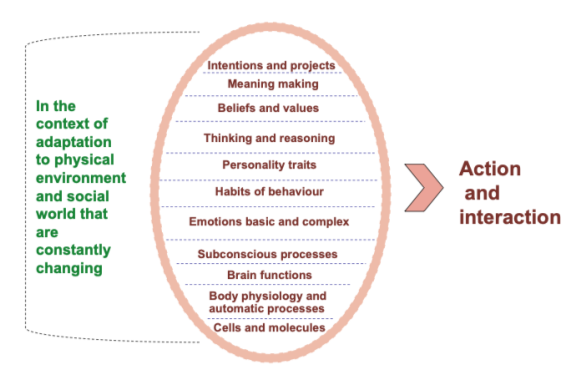
‘Porous egg’ model of human nature with relevance to coaching (Bachkirova, 2022, p. 97).
None of the layers in this ‘porous’ model is more or less salient than any other as they are all equally constitutive of the dynamic system that any individual is and all are equally important in what they contribute to the understanding of human nature. In terms of practice, however, it is also obvious that the means of coaching have limitations, as coaches do not have access to working with molecules or brain functions. Rather, it is the context and purpose of inquiry that determines which specific level one might be required to focus on. In coaching practice there are many approaches that focus initially on one or two of the individual layers. For example, ‘habits of behaviour’ and ‘thinking and reasoning’ feature strongly in cognitive-behavioural coaching (Williams et al, 2024). In more person-centred coaching greater initial attention would be given to emotions and beliefs (Joseph, 2024). The choices any coach makes as to where to focus the direction of the intervention will depend on their training, worldview, and/or the expectations of the sponsoring organisation, as well as what they identify that they can most effectively influence during coaching (Cox et al, 2014).
For research purposes of complex systems such as coaching, it is justified to study a single relevant layer even though such a narrow focus may be thought of as taking a reductionist stance in view of this holistic complexity. In this respect, it should be made clear that it is not the reductionist tendencies in neuroscience that are problematic per se. Analytically, focusing the attentions of a research programme onto the constitutive levels of any complex system can generate useful and informative insights providing the level being attended to is relevant for answering the questions being asked of the system being inquired into. What we question is the wide-spread assumption that taking a scientific approach demands that we understand the constitutive relations that occur at the level of the smaller units as being the most explanatory in understanding any complex phenomena and these smaller units are more real than the whole they comprise (Gazzaniga, 2018; Midgley, 2001; Putnam, 1975; Tallis, 2018;).
It appears to be more of a metaphysical dogma than an epistemological reality that dividing complexity into smaller bits will provide all the answers required for the most informative description of that complexity (Dennett, 1996; Nagel, 1998; Noble, 2006). Some authors (Ashkanasy, 2013; Passarelli et al., 2017) claim that the issue of reductionism in relation to neuroscience of coaching has been dealt with already and does not need to be revisited, quoting Marshall (2009), but we do not see it this way. It is important to challenge the epistemic optimism of neuro-enthusiasts that the most insightful explanation of what is happening in coaching will be forthcoming when we know everything about what is happening at the level of the brain (Myers and Kumar, 2024). Following this same logic, it would make sense to ask why the explanation at the level of the brain will be sufficient and would not require going further, e.g., to the molecular level.
A further philosophical question can be raised as to the nature of the relationship between the low-level processes in the brain and the higher-order phenomena important for coaching, e.g., learning, reflection, actions, decisions, strategies, plus interactional and social layers. Sharp and Miller identify this as the ‘philosophically unsophisticated assumption’ “…that more granular data (e.g., at the molecular level) are superior to more coarse-grained findings (e.g., at the behavioral level)” (2019: 18). Even physicists have now started to acknowledge that all the elements, events and processes in the world are more complex and interconnected than they previously thought them to be (e.g., Rovelli, 2021). The same is recognised in relation to our psychic life, e.g., Thompson (2010) arguing that the roots of the mental “lie not simply in the brain but ramify through the body and the environment” (2010: xi). This strongly suggests that the higher-order phenomena of conscious experience cannot be reduced to low-level processes in the brain and be explained solely as their product.
Neuroscientists themselves, e.g., Gazzaniga (2018: 230), ask questions of this nature: “Can a thought constrain the very brain that produced it? Does the whole constrain its parts?”. Using the analogy of relationship between the molecule and its inner atoms and electrons and seeing the molecule in many respects as their master, Gazzaniga asserts that “mental states, such as beliefs, thoughts, and desires represent a layer, and that layer arises from brain activity and, in turn, can and does influence our decisions to act one way or another” (2018: 229).
This pluralistic, non-reductionist worldview, we believe, establishes a suitable paradigm for understanding the individual in coaching as a psychological system. Every group of elements in this system are just different layers that interact, which means that upwards and downwards causal relations between these layers act in complementary ways. Of course, the behaviour habits, thinking and meaning making of all of us are affected by and reflected in the brain activity in which these processes are mediated, but they, in turn, bi-directionally affect these processes. Looking to grasp clear insights into these higher-order areas of interest for coaching by focusing on what is going on in their physiological implementation in the brain is not only ignoring the interdependency of these layers and the bi-directional causal relations under which they operate, but also depersonalising and directing the attention and efforts of practitioners away from those layers of emergent complexity that coaches have the means to impact upon.
2. Action is central for coaching, but cannot be explained sufficiently by neuroscience
Following the first limitation that focused on the nature of the individual in coaching, now we extend this focus to what is critical in coaching action (Bachkirova and Borrington, 2019; Cox et al., 2014; Grief, 2007;). It is our view that action, as a function of interpersonal behaviour, cannot be effectively understood by reference solely to what is happening at the level of neural activity.
Action is a primary focus of coaching because it brings to the fore a logical connection between the individual client as recipient of coaching and the systems they are part of (Bachkirova and Borrington, 2019; Lawrence, 2021). For coaches, this implies working with the clients’ acting in the world and recognizing the complexity arising from interactions with dynamic situations, which is, in essence, working systemically (Lawrence, 2021). The interplay between increasing self-knowledge of the client and enhanced action in their world is at the heart of coaching. By implication, this means that “the acting self is more ‘in-the-world’ than ‘in the brain’” (Gallagher and Daly, 2018: 3).
Similarly, Gazzaniga (2018: 231) argues that “setting a course of action is automatic, deterministic, modularized, and driven not only by one physical system at any one time but by hundreds, thousands, and perhaps millions of systems”. But the action of the person is something else as it lies at the interface between mental and physical processes and is also “made up of complementary components arising from within and without”. He further argues that analysing single brains in isolation cannot illuminate the capacity of individuals to act in the context of social exchange.
Bennett and Hacker (2003) add further complexity to understanding action by emphasizing the involvement of consciousness in its various expressions, arguing that action is not merely a collection of simple processual ingredients in the brain and movements of the body. In order to understand human action, we need to see it “as a person’s moves not their movements” (Bennett and Hacker, 2003: 365), as this is what distinguishes human behaviour from non-human. The actions of the person are highly circumstantial and context-dependent and are best understood by reference to intentions, goals, and purposes, affected by reasons and motives and implicated in habits, customs, and inclinations, all of which occur in the context of human social, moral and legal life, and all of which lay beyond the remit of neuroscience (Gronow, 2008; Holmwood, 2011; Kilpinen, 2009; Mead, 1934).
We do not dismiss the usefulness of neuroscience for understanding some forms of abnormal behaviours but agree with Bennett and Hacker (2003) who argue that to explain typical human behaviour we have to engage with the higher irreducible level of normal descriptions of human actions and their explanations in terms of reasons and motives, as well as causes. As they say, “neuroscientific explanation is not in competition (let alone in conflict) with these kinds of explanation; but neither does it reduce these forms of explanation to neuroscientific ones” (Bennett and Hacker, 2003: 366).
In terms of the difficulties in understanding the causes of action, Tallis (2016: 250) is more categorical, arguing that even “the simple notion of ‘a cause’ – cerebral or otherwise – loses its application, and even the more sophisticated notion of ‘motive’, understood as a force external to the agent, and certainly that of instinct, cannot easily be applied”. We agree that actions can be explained to some extent with reference to wishes, intentions and other propositional attitudes, but that makes them a subject area of psychology rather than neuroscience, and cannot be seen as simply caused, nor being simply causes.
In relation to influence of action in the context of leader development the data from neuroscience cannot help us to form subtle, complex and context-dependent judgments about clients’ actions (Lindebaum et al, 2020; Solymosi and Shook, 2013). Using the words of William James (1975: 3) we could say that such data are of low ‘cash value’ in the understanding of action. Moreover, the overemphasis of the neuro data downplays practical wisdom of not only leaders themselves (Lindebaum et al, 2018), but also practitioners who support leaders’ development.
3. Neuroscience has no means to address the meaning of change, success, progress as relevant to coaching
A simple view of a coaching engagement is that it is a series of conversations about what is important for a client. Neuroscience can add more understanding of internal individual processes that accompany such conversations (Passarelli et al., 2017). However, it cannot say anything about the content of conversations – what actually matters to clients and the meaning they make of things and events in order to act in the world (Bachkirova and Jackson, 2024). Hoping that this can happen is to ignore that meaning is a product of the conventions of language, which includes the normative expectations concerning moral attitudes, the appropriate use of humour and irony, etc. (Baert, 2016). All of these are inexplicable on the basis of their physical attributes, grammatical structures, or in terms of the behaviours of individuals alone (Holmwood, 2014; Nagel, 1998). The idea that one can objectively track such interpersonal nuances at the level of neuronal activity is both illusory and problematic (Baert, 2016; Riaz, 2021). The brain, whilst being the core mediatory centre from which these acts of interpersonal communication are implemented, is merely one factor in the more intricately interrelated pathways of communication that, together, account for human meaning making and behaviour (Gronow, 2008; Healey and Hodgkinson, 2014; Marshall, 2009; Miller and Keller, 2000).
Furthermore, meanings and intentions are the properties of people, and encompass the richness of individual qualities, ages, stages, and circumstances of life. Because of that they differ for different individuals (Baert, 2016). This is one of the reasons why coaching is useful - it offers an individualized approach to clients’ issues and goals with appreciation of what matters to them in their specific contexts and what they wish to accomplish (Bachkirova, 2022; Cox et al, 2014). It is a job of the coach to distil from their professional knowledge what might be applicable and useful for each individual client in discussing these matters. It appears there is nothing to suggest that knowledge about the brain processes can add any valuable information for understanding and influencing the specific intentions of the client and the themes of coaching conversations (Myers and Kumar, 2024; Riaz, 2021).
Unfortunately, neuro-inclined coaching literature is quick to make huge generalizations even when their research designs do not resemble anything that could be reasonably claimed as representative of an organisational coaching engagement (e.g., Boyatzis and Jack, 2018; Jack et al., 2013). Other authors build up expectations in a way that might be called irresponsible (Dias et al., 2015; McKay, 2019; O’Connor and Lages, 2019; Valesi et al., 2023). For example, Dias et al. (2015) acknowledge that “it is not yet possible to scan a coachee’s brain during a typical coaching session”. However, they seem very optimistic that “such an approach, made possible in the future, could enable the key brain areas mediating change in a given approach to be identified in real time so that a better understanding of how different coaching schools deliver results can be built, and for approaches to be compared at the brain level” (2015: 15).
There are too many issues in such a promise for us to address, but one of them is critical to the limitation concerned with the meaning of change. The above statement by Dias et al (2015) assumes that the concept of change is so simple that it can be pinpointed at a specific moment in time (by whom - the brain scanner, coach, client?), and even that it can be defined as a change in principle. The concept of change in the individual (e.g., changes in their thinking, feeling, action) in the process of coaching, or at all, is far from being understood (e.g., Bennett and Hacker, 2003; Grief, 2007). It has many different meanings in different disciplines and contexts as it is closely related to ideas of success and progress, the meaning of which are themselves not definitively clear and can be thought of as culturally variable (Kjellstrom and Stalne, 2017). The assumption that “the key brain areas mediating change” (Dias et al., 2015: 15) will capture this level of complexity in terms of meaning is at best extremely optimistic if not delusional.
Something similar can be said about promises that neuroscience will provide a definitive measure of the effectiveness of coaching (Bamber, 2019; Dias et al., 2015; Valesi et al., 2023). An example is captured by the following:
… research from neuroscience has demonstrated that having basic knowledge about the brain will enable a professional coach, whether working in private practice or employed in the corporate environment, to increase efficiency, results, and the overall effectiveness of the coaching engagement (Bamber, 2019: 13).
It should be clear to anyone reading this statement that ‘having basic knowledge about the brain’ (raising the question ‘how basic?’) has nothing to do with the ‘overall effectiveness of coaching’, as this is not what ‘research from neuroscience’ investigates. More importantly, it will not be possible to say what coaching processes or interventions are effective based on the studies of neural activity and functionality, as convincingly argued by Bowers (2009: 609) in the context of the role of neuroscience in the practice of educators and judging the effectiveness of their instructions. It might be a simple category mistake that can be illustrated by a false idea about advertising efficacy based on some areas of the brain being activated when subjects watched an advertisement. It is obvious that this efficacy can only be claimed if the subjects actually bought the item advertised. In the same way, the activation of certain areas of the client’s brain during a coaching intervention is irrelevant for judging the effectiveness of such intervention. The evidence for such effectiveness can only be arrived at if the change discussed during coaching is actually made by the client.
More serious than the above category mistake is a conceptual flaw on the matter of meaning, which is seeing changes in the brain as more indicative and valuable than changes in thinking, values, beliefs, and in what people do for reasons meaningful to them. This incorrect assumption has already been disputed in other disciplines (e.g., Coltheart and McArthur, 2012) but appear common in coaching literature on neuroscience (e.g., Bamber, 2019; Dias et al., 2015). We believe, however, that images of how a person’s neural architecture has changed in response to a coaching intervention have nothing of value to contribute in comparison to the evidence supplied by careful observations of their contextual behaviour and self-reporting on what has changed for them in relevant situations. Furthermore, considering the cost and practical obstacles to the use of such ‘dehumanising’ methodologies as MRI (Riaz, 2021: 119) in the natural coaching and organizational environment, we believe the value of generating neural data for understanding effectiveness of coaching will turn out to be practically negligible.
4. Neuroscience cannot address the values and ethical concerns that permeate coaching work
One of the biggest attractions that neuroscience seems to offer coaching is the hope of bringing greater certainty to a practice that is by nature highly uncertain, complex, and unpredictable (Dias et al., 2015). However, it is not at all clear how neuroscience actually can save us from uncertainty as far as coaching practice or any interpersonal interventions in organisations are concerned. Even if, by looking at the detailed structure of the brain and its functional activity, we were able to establish what interventions can be most helpful to a leader in a coaching session, and even if this help resulted, for example, in the leader being promoted to a higher level in the organization, no physiological analysis can tell us if this leader is a better leader (Kjellstrom and Stalne, 2017). The normative criteria for what are to be counted as ‘better’ are not only a matter of quantifiable effectiveness, an objectively definitive consensus for this being a tall order in its own right, they are also about what is valued within the particular organisation, and by the socio-cultural context in which the organisation is having to operate (Lawrence, 2021; Lindebaum et al, 2020; Rumens and Keleman, 2016). It is difficult to say even if more learned, more developed leaders are better leaders, let alone if they create better organisations (Kjellstrom and Stalne, 2017).
It is not at all clear in what way these kinds of questions could be answered by neuroscience or by any other science for that matter (Baert, 2016; Solymosi and Shook, 2013). Science cannot compare what is more important when it comes to large-scale matters of value, such as, for example, normative dilemmas as whether the preference should be for stability as opposed to change, or security as opposed to freedom (Baert, 2016; Gilbert, 2022; Lindebaum et al, 2020). At the smaller scale, science is of minimal help in attempts to establish success criteria for outcomes of coaching. It does not aid us in deciding what is more important: human dignity or progress; the wellbeing of the client or their professional ambitions that may require sacrifices being made; their autonomy or happiness (Bachkirova and Borrington, 2018; Solymosi and Shook, 2013). All of these cannot be compared and measured easily; they require conceptual analysis of higher moral values at the level of societies, the answers to which are not arrived at by the close-grained investigation of individual brains. As far as providing deeper understanding and knowledge of the purpose of development, this falls into the territory of philosophy and moral inquiry (Bachkirova, 2022; Baert, 2016; Gilbert, 2022; Solymosi and Shook, 2013), a territory in which neuroscience on its own is impotent.
When it comes to leader development and coaching practice, value-laden actions are often decisions that clients need to make in the face of difficult choices that affect organisations and individuals for whom they feel ethical responsibility. Coaching work is full of ethical questions (Iordanou and Williams, 2017) and it is very unlikely that coaches would, or even should, be turning to neuroscience for help at such moments.
5. Looking inside the brain for understanding what is happening on the outside
Our final critical point is about the conceptual confusion that is ignored amongst believers in neuroscience in the coaching field. We believe it is a logical misappropriation to apply understanding gained from one level of empirical investigation as being conceptually relevant to that which operates at a different level. One could characterize this in terms of a category error being made concerning the relevant ‘logical space’ (Ryle, 1986) in which the analysis or inquiry is to be framed. In an effort to clarify this argument for our purposes here, it is evident that a coaching engagement is an interpersonal exchange that does not take place inside the brain of a specific individual. It does take place as an interaction with the ‘external world’ as represented by the coach and the client intersubjectively operating in a wider environment that includes the interests of the relevant organisation and other pertinent external factors (Cox et al, 2014). Whilst all persons involved will be using their brains for the purposes of processing the relevant information and mediating their emotional and cognitive responses, the hope that all that needs to be understood about such a rich and dynamic activity can be structurally located in neural activity of a particular brain, so as to be objectively identifiable, seems plainly naive. This is well captured by Solymosi and Shook (2013) who argue that “both the phenomenology of lived human experience and the physicality of brains interacting with each other and the environment exist in natural spaces much larger than the confines of any cranium taken singly”( Solymosi and Shook, 2013:15).
Even if our questions are concerned only with the experiences of the client, locating the answers in that person’s neural mechanisms and excluding all other factors is clearly insufficient (see Bachkirova’s ‘porous egg’ model above). The complex feeling and thought processes involved in the coaching interaction cannot be solely reduced to the activity of firing neurons (Solymosi and Shook, 2013). Neuroscientists themselves recognize this challenge (Barrett 2017; Gazzaniga, 2018). When considering the nature of responsibility in human relationship, Gazzaniga (2018: 232), for example, concludes that “neuroscientists are looking at the concept of responsibility at the wrong organizational level” and suggests that responsibility is a property of social groups of many brains interacting. He supports this argument metaphorically: “Personal responsibility is not to be found in the brain; any more than traffic can be understood by knowing about everything inside the car” (2018: 233). It is easy to notice that both this argument and metaphor are particularly apt for making sense of what goes on in coaching.
Tallis (2016: 237) also makes this point in expressing his concerns about what he identifies as ‘neuromania’ challenging its intention “to pack what has grown out of, and beyond, so many brains over the many millennia back into the stand-alone brain examined in the laboratory”. He argues that “brains together create a space that cannot be stuffed back into the brain”, as the events and interactions in the community of minds are not the same as electrical discharges in the isolated brain. His metaphor about trying to capture the content of even the simplest of these in terms of brain activity is the same as “applying one’s ear to a seed and expecting to hear the rustling of the woods in a breeze”. Recognizing this level of challenge, researchers from applied disciplines such as coaching should follow the message that comes from other closely related fields, to not be “blinded by neuroscience" (Wastell and White, 2012: 339), particularly when important normative, ethical and practical questions arise.
Implications for research, practice and education of coaches
In this section we want to highlight some specific implications for those who are interested in the development of knowledge and practice of coaching: researchers of coaching, coaches, commissioners of coaching and coaching educators. We start with researchers of coaching, because they have an important role to play in how neuroscience is seen in the coaching field, even though they constitute the smallest group of the four indicated. There are a number of reasons for this, the primary one being that coaching is still only a developing discipline. As such, coaching researchers in academia probably face more challenges than others when it comes to accessing research funding and therefore are under greater pressure to be especially innovative in pursuing their research projects. The pull of the glossy allure of neuroscience-related topics as forming the substance of research proposals becomes a huge temptation in light of the popularity of neuroscience for academic publishers and funding bodies.
We are concerned, however, that this may be a case of history repeating itself returning us to the time when behaviourism rose to dominance “driving out other psychological enquiries by pretending to be scientific, by imitating physical science” (Midgley, 1999: 479). But whilst we can understand that neuro-based approaches appear to offer epistemic credibility in the sense of being ‘properly scientific’ for many purposes, we would argue that for coaching there are so many other methods of inquiry that are more applicable in getting to the heart of its complex nature, e.g. phenomenological or hermeneutic.
On a more practical level, there are clear reasons for why it should matter to researchers that neuroscience is not well suited for proposing new types of coaching interventions nor for assessing the effectiveness of coaching interventions. First of all, the suggestion by Bowers (2016: 605) to researchers developing training programmes is apposite for coaching research: “Rather than using (expensive) fMRI to look for a weak training effect that may or may not manifest itself in behaviour following further training, researchers should explore whether more extensive (cheaper) behavioural training does indeed result in useful changes in behaviour in a practical amount of time”. Second, similar concerns are expressed by Grant (2015) with regard to the application of neuroscience to coaching research where he questions the extent of the knowledge gained from neuroscience that cannot be learned from behavioural science. Third, our concern is that this is not only an issue of misdirected resources for expensive and time-consuming research projects – it also distracts a good deal of useful effort at a time when coaching discipline has an opportunity to grow in more useful and realistic directions.
We have discussed in the introduction why practitioners such as coaches are attracted to the excessive use of neuroscientific jargon as a means of gaining credibility and developing an aura of scientific respectability in order to sell their services. However, we would echo Grant’s concern (2015: 24) that this strategy may run “the very real risk of having [coaching’s] own professional standing diminished, as well as doing their clients and broader coaching industry a disservice”. We can see the value of coaches being engaged with findings and information that neuroscience increasingly supplies to the world of knowledge. However, we also see a problem if the use of this information “becomes the ballast of coaching” (Riaz, 2021: 121) and the attraction of it skews the attention of practitioners away from other real and serious concerns. For example, it would be problematic if coaching’s complexity were reductively quantified in ways that lead to the development of a false sense of certainty and exaggerated confidence which may encourage coaches who believe they ‘know best’ on the basis of their ability to employ neuro-jargon as a means of eliminating any healthy doubt concerning there being only one ‘right way to coach’.
We advocate the need for coaches to be discerning about the evidence they select for supporting their practice by developing greater criticality when taking advantage of what is offered by new technologies and ‘shiny new things’. What is needed is to see coaching practice as a nuanced process of engaging in meaningful relationships and joint inquiry in the context of an ever-changing flux and continue developing ourselves as instruments of this practice (Bachkirova, 2016). This notion of relationship is very different both in coaching and in leader development from how some neuroscience advocates argue for using science to manipulate others, e.g. considering trust as “a mechanism by which others’ energies will flow in the direction that the leader wishes them to flow” (Brown and Lanz, 2019: 236).
We hope that the above quote will also encourage commissioners of coaching in organisations to think twice when selecting coaches for their leaders and be careful with those who promise ‘neuroscientific miracles’. Although these sponsors might be responding to the desire of the coaching clients to work with well-educated and experienced coaches, they need to be better informed of what is meant by evidence-based practice. The mentioning of science in the title of a coaching approach does not guarantee that it is evidence-based. There are other criteria of quality in coaching approaches that have more rigorous research behind them and are conceptually solid.
Finally, the main implication for educators of coaches is the development of criticality and the ability to challenge ‘trends’ in the material they share, engaging with different levels of analysis for purposes of understanding coaching phenomena. We believe that being in the forefront of developing professional coaches requires an appreciation that the complexity of our thinking has to match the complexity of our practice. Offering simple explanations in the name of neuroscience will not help in this task.
Conclusion
Our intention has been to bring a philosophically grounded perspective to bear on the debates about the potential impact that neuroscience can have on the development and delivery of coaching. We support further development of studies with a potential to provide an additional level of explanation for how persons function in work related contexts. At the same time, we have argued that many strong claims about the power of ‘neurocoaching’ are either trivial or unwarranted. We highlighted five specific conceptual limitations of neuroscience-based research in terms of its capacity to influence coaching practice, thus arguing that in relation to practice we would be best served to be sceptical than naively optimistic. This paper contributes to a call for a higher level of criticality towards the intentions of researchers, the claims of the interpreters of neuroscientific studies and the blind faith of everyone in organisations who cares about coaching as an important professional service. Although the paper has been highly critical towards a specific approach to coaching, we hope that the discussion overall contributes to a deeper understanding of human nature and ways in which coaching can be of better service.