




Abstract
This article describes the use of the labyrinth for inquiry-based, hands-on activities suitable for a variety of psychology courses including learning, physiological psychology, clinical child psychology, and history of psychology. Two classroom examples that focus on psychology of learning and psychophysiology are presented. In general, students appeared to enjoy and learn from the labyrinth task. We see the labyrinth as a helpful base upon which instructors can build a set of activities to expenentially communicate psychological concepts to students.
This article demonstrates the various ways in which a toy labyrinth can be used as an inquiry-based, hands-on teaching demonstration in psychology courses. Surprisingly, the labyrinth has never been considered as a teaching tool although it is widely used as a popular toy. We discuss the suitability of its utilization in a classroom setting and its numerous advantages, such as versatility, ease of use, and its ability to demonstrate experimental concepts and other variables that influence learning. This continues the tradition of our laboratory for developing practical and inexpensive experiential activities for psychology courses. These activities include games (Abramson, Burke-Bergmann, Nolf, & Swift 2009), virtual visits to historical sites (Stevison, Biggs, & Abramson, 2010), official United States postage stamps commemorating significant people, events, and movements (Abramson & Long, 2012), the use of inexpensive animals such as invertebrates and fish (Abramson, Curb, Barber, & Sokolowski, 2011), and the use of “action figures” to demonstrate principles of comparative psychology (Abramson, Hilker, Becker, Barber, & Miskovsky, 2011). Of special interest is the development of an inexpensive laboratory microcontroller and associated programs that allow students for under $150.00 to train their animals in a variety of traditional operant, classical, and habituation laboratories (Varnon & Abramson 2013).
It is important to note that the terms ‘labyrinth’ and ‘maze’ are not synonymous. Mazes are composed of branches and choice points, labyrinths are composed of a single route leading from start to finish (Saward, 2008). Both labyrinths and mazes are found all over the world, offering insight into history and culture. Labyrinths are designed to be meditative and contemplative, yet easy to complete. In contrast, mazes are strategic challenges that are difficult to navigate (Saward, 2008).
The labyrinth has much to recommend it for the psychology classroom. Firstly, the labyrinth is widely available and inexpensive to purchase. There are a wide variety of labyrinths that can be purchased in stores and there are labyrinths “apps” for smart phones. Table 1 provides examples of applications for smart phones. Apple™ and Android™ smart phones or tablets come with an iTunes or Google Play application, respectively, upon purchase. One can access these labyrinth applications by opening iTunes or Google Play and typing in the name of the specific application in the search engine. Then, select the desired application and hit “Install.” 1 Table 2 lists a few examples of YouTube videos demonstrating the applications or teaching how to build a labyrinth.
Labyrinth Applications For Apple™ and Android™ Smart Phones.

YouTube Videos Demonstrating Different Types of Labyrinths

Secondly, the labyrinth is ideally suited to teach students concepts related to experimental design, such as operational definitions and independent and dependent variables. The importance of control groups, apparatus design, and the influence of training variables, subject variables, and environmental variables on performance are readily accommodated with the labyrinth. It also demands very little physical activity, which reduces the occurrence of fatigue, and it is a task that most individuals find interesting and are eager to master.
A third advantage of the labyrinth is that it is highly versatile and can be used for a number of psychology courses. For example, because the data are easily quantifiable in terms of number of errors and time to completion, the data can be used in any course that requires students to perform statistical calculations. Perhaps one of the less obvious uses of the labyrinth is in a history of psychology course. Labyrinths have been used and depicted from as early as 2,500 B.C.E. to the modern day (Saward, 2008). Many ancient cultures, such as the Greeks, Egyptians, Native Americans, and various Asian civilizations, have used the design or construction of labyrinths to depict symbolic pilgrimages or to protect themselves from evil spirits. Labyrinth constructions and symbols can be found all over the world and are also present in several different religions, including Christianity, Islam, Greek and Roman pantheism, and Celtic and Scandinavian pagan religions (Saward, 2008). The labyrinth can also be used in a history of psychology course to discuss the role emotion has played in the theories of both behaviorists and neobehaviorists (Abramson, 2013).
Table 3 provides a list of how the labyrinth can be incorporated in several different types of psychology courses. These are just a handful of the myriad of different experiments or demonstrations that can be performed using the labyrinth. Teachers can work with their students to develop new hypotheses and experiments to perform, thus encouraging creativity and critical thinking skills. Another benefit of the labyrinth is that it can improve and be used to assess fine motor skills because it requires the user to gently twist and turn two knobs that shift the balance of the labyrinth plane forward or backward and left or right to maneuver the ball along the pathway. It can also be used to encourage cooperative learning by allowing two different users to work together. This can be accomplished by assigning one user to each knob or by letting one user guide the other user, who operates the knobs while blindfolded. The labyrinth can also improve emotional intelligence, as students experience frustration and learn to cope with it.
Examples of Uses of Labyrinth Applications

Of all the uses for the labyrinth, we believe the most important is to provide students with an experiential exercise into how emotions influence behavior. While there are many demonstrations that teach students the importance of training variables and key concepts associated with classical and operant conditioning, no exercise focuses on the emotive. Consider, for example, the exercises available for operant conditioning in humans. In a typical exercise, students press a button on a keyboard to learn about schedules of reinforcement (Abramson & Satterfield, 1999). In such situations, the role of emotion in learning cannot easily be studied or directly experienced by the student. With the labyrinth, the student directly experiences the influence of emotion on learning because the task required to navigate a ball through a series of obstacles is inherently frustrating.
Example Study
The present study serves to examine the merits of the labyrinth as a teaching tool and to demonstrate a sample experiment. The experiment involves the manipulation of the training variable known as the intertrial interval. The data in this study were not statistically analyzed because this study in particular is merely an illustration. The primary focus is on the responses to a survey participants received. We also present the results of how a physiological monitoring system can be used in conjunction with the labyrinth.
Method
Participants
Participants were recruited using the Oklahoma State University SONA system and by word of mouth. The only requirement for participating in the study was that each person be 18 years of age or older. All but one of the 43 participants were students at Oklahoma State University ranging in age from 18 to 38 years (22 men, 21 women). All informed consent and confidentiality procedures were followed.
Measures
Participants attempted to master a wooden labyrinth by maneuvering a ball around 44 holes to reach the finish. The number of the hole that the ball fell in and the length of the trial (sec.) were recorded. The participants completed a background information questionnaire which ascertained information such as age, gender, the number of psychology courses completed, handedness, hand-eye coordination, experience with athletics or relaxation training, and prior knowledge of some experimental concepts. The participants also completed a questionnaire after using the labyrinth, which asked about strategies used on the labyrinth, the participants' thoughts during the experiment, and what they learned from the labyrinth. The form also included questions that retested the participants' knowledge of experimental concepts, how helpful the labyrinth was in learning those concepts, and about the use and effectiveness of teaching demonstrations in class.
Apparatus
The labyrinth used in this study is made of wood. It was purchased at http://www.starmagic.com/store.cgi?0+3C1C and cost $20.95. It has two knobs which are used to control front-to-back and left-to-right tilt of the plane of the labyrinth. It has 44 holes and a black line showing the route from beginning to end. Participants must maneuver a small pinball or ball bearing around the holes and obstacles to reach the end. Figure 1 shows the labyrinth used in the experiment.

The wooden labyrinth used in the experiments. The dimensions are 28 cm × 23.5 cm × 6.3 cm. To assist in visualizing the dimensions of the labyrinth, a scale is provided. Participants must use the two knobs on the side of the labyrinth to tilt the board and guide the ball along the path to the finish position without the ball falling into one of 44 numbered holes.
Procedure
Participants entered the laboratory and were randomly assigned to attempt to master the labyrinth with self-paced or fixed 30-sec. intertrial intervals. Twenty-three participants had self-paced intertrial intervals, with the remaining 22 receiving fixed intertrial intervals. Participants completed the background information form and were then shown how to operate the labyrinth. Five participants were randomly assigned to be video-recorded. Each participant had 20 trials to master the labyrinth, which was defined as reaching the finish in three consecutive errorless trials. After each trial, the number of the hole that the ball fell in and the length of the trial were recorded.
After the 20 trials, the investigator explained each of the psychological concepts and what each term (independent variable, dependent variable, introspection, subject variables, intertrial intervals, etc.) was in the context of the labyrinth experiment. Lastly, participants completed an interview script. The questions on the background information form assessed various subject variables, such as age, gender, hand-eye coordination, and previous experience in athletics and relaxation training. Participants were shown how each of these variables might have affected performance on the labyrinth. The interview script included introspective questions about strategies used or thoughts that occurred while attempting the labyrinth. These questions served as examples for using introspection as one assessment of the labyrinth experience.
Results
Definitions of Psychology Terms
Although 37 of the 43 participants had previous experience in at least one psychology course, only five correctly defined independent and dependent variables, intertrial interval, and introspection before the labyrinth experiment. Very few participants could provide an example of an independent or dependent variable in an experiment.
Performance on the Labyrinth
None of the participants were able to master the labyrinth in 20 trials. Figures 2 and 3 display the differences in the average performance of participants in self-paced and fixed intertrial intervals. It appears that fixed intertrial intervals slightly improved the learning on the labyrinth. However, looking at individual data, only a small number of participants actually improved at all during their trials.

Averaged performance time by trial number for fixed intertrial interval (Black Line) and self-paced intertrial interval (Gray Line) over the course of 20 training trials. Participants in the self-paced group fell into a hole approximately 3 seconds earlier than participants in the fixed-interval group. It is important to note that the performance in both groups was extremely poor, with no participant completing the task.
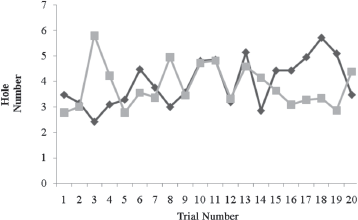
Averaged performance as measured by the hole in which the ball fell over the course of 20 training trials. No participant was able to negotiate the ball past hole number 6. The total number of holes is 44.
Although none of the participants were able to reach the criterion of mastery (three consecutive errorless runs) a number of interesting observations were recorded. These observations were obtained either by direct observation of the participants or discussions with them. Some participants tried to cheat by going off of the given pathway despite being told to stay on the path that clearly led to the finish. Comments to the experimenters from the participants revealed stark contrasts between those who blamed their own faculties for their lack of success and those that blamed the labyrinth for being poorly made, too difficult to complete, or having too many holes. Participants showed interesting behaviors between trials, such as turning the knobs, experimenting with how the planes of the labyrinth move, and heating the ball. Every participant asked how others had performed. Participants would also cheat. This would occur in situations where a hole was associated with two numbers: a higher and lower number, with the higher number representing greater progress along the path. For example, after leaving the starting position, the participant must successfully negotiate the ball past holes one, two, three, four, five, and six. In the version of the wooden labyrinth we use, hole two also serves as hole six. Every participant said they had fallen into hole six even though the ball fell immediately into hole two (i.e., they never reached hole three).
Participant Responses: What They Were Thinking
Several participants had similar responses when asked what they were thinking while they attempted to complete the labyrinth. Many were wondering about various aspects of the design of the labyrinth (knob placement, pathway drawn, fluidity of knob movements). Of participants assigned to the fixed intertrial interval, some felt it was helpful while others thought it was awkward or annoying. The majority of participants focused on getting around a specific point in the labyrinth that was giving them trouble. Many participants thought about controlling the ball, and a few worried that their performance was a poor reflection on them.
Participant Responses: Which Parts Were Most Stressful
The majority of participants listed falling into the same hole repeatedly as being very frustrating. Participants complained about the ball getting stuck or moving too quickly. Falling into the very first hole and turning corners also created much stress. Two of the participants noted that parts of the labyrinth did not have a corner for them to rest the ball and they considered this very stressful. Others were most frustrated when they would make considerable progress in one trial and then immediately regress in subsequent trials.
Participant Responses: Strategies
When asked about which strategies they used, some participants noted that they tried moving the ball faster while others thought that going slower would be best. Some of the participants switched back and forth, unable to determine which strategy they thought would work best. One participant tried to line up edges of the planes to minimize movement of the ball, which was a notably creative strategy. Many participants tried holding the labyrinth in different positions, switching from standing up to sitting down or holding the labyrinth in their laps. A few participants tried setting an easier goal before aspiring to reach the finish. Others tried keeping the ball close to the walls, and two participants had no strategy whatsoever.
Importance of Observations and Participant Responses
Examining the observations and responses of participants is a crucial aspect of using the labyrinth as a teaching tool. Students can explore the individual differences and similarities and ask themselves how people are similar or different in their behavior or performance, and what might be the causes of these similarities and differences. This allows students to formulate new hypotheses and design new experiments, thus teaching them how to ask questions and how to go about finding the answers.
As noted earlier, one of the more interesting findings was that some participants indicated that their poor performance was based on their own “faculties” while others suggested that their poor performance was the results of the labyrinth having “too many holes,” “poor construction,” and “too difficult.” These responses suggest that the labyrinth can be used by students to formulate hypotheses and design novel experiments in the area of Locus of Control (Rotter, 1954). In Locus of Control, the effect of reinforcement is enhanced if an individual perceives a causal relationship between his or her action and the receipt of reinforcement. The labyrinth appears particularly suited for such research, since it is perceived as difficult and the participants exhibit a range of responses that can be classified as representing the dimensions of internal (“I can control my performance”) and external (“my performance is the result of factors beyond my influence”) control. Students, for example, can be given a Locus of Control scale (Duttweiler, 1984) to predict their performance on the labyrinth and to test hypotheses they generate related, for example, to age, socioeconomic status, family dynamics, and competitiveness. One hypothesis easily tested in a classroom situation is that Locus of Control shifts from external to internal as “externals” master the labyrinth.
The labyrinth is also well suited for research in generalization of motor learning and “muscle memory.” Students can design a situation where they must master the labyrinth (i.e., negotiate the path without falling into any of the 44 holes), and once they have done so they must master the maze in reverse order (i.e., holes 44 through 1). Does performance improve? If so, what are the relevant variables that led to such improvement? Another variation is to have students design an experiment where they master the wooden labyrinth and then test themselves on another version of the labyrinth, such as those provided on the Internet (see Table 1 for some examples). A third variation is to make the knobs used to tilt the labyrinth more difficult to use. This can easily be done by placing some tissue paper between the knob and the body of the labyrinth. This will make the knob harder to turn. Once the student has learned to successfully negotiate the path with no errors remove the tissue, thereby making the knob more sensitive to manipulation.
Teaching Demonstrations
As shown in Fig. 4, every participant found the labyrinth at least somewhat helpful and 17 participants found it extremely helpful in understanding experimental terms. Fifteen participants rated teaching demonstrations as somewhat helpful and 27 participants rated them as extremely helpful. When considering hands-on teaching demonstrations, 31 participants rated them as extremely helpful and 12 rated them as somewhat helpful. Concerning the participants' experience with hands-on teaching demonstrations in college courses at Oklahoma State University, 22 participants had been involved in courses using hands-on demonstrations. The majority of these participants specified that these courses were in various scientific disciplines, such as chemistry, physics, biology, physiology, etc., or classes that included a laboratory session. No one mentioned any psychology courses.

Student perception of the helpfulness of the labyrinth, teaching demonstrations, and hands-on demonstrations in learning class material.
Participant Responses: Explanation of How the Labyrinth was Helpful
Several participants explained that the labyrinth experiment made the psychological terms and concepts easy to relate to. They appreciated the opportunity to see and assess variables first-hand. It provided participants with a visual and proprioceptive experience of terms that are usually presented orally in lectures. Many participants felt that using the labyrinth and having the variables explained to them in the context of the experiment clarified the terms and cemented them into memory. One participant explained that the labyrinth embodied the terms, unlike just reading about them in a book.
An Experimental Variation: Combining Physiological Measures with the Labyrinth
One often-overlooked area in the teaching of psychology is the direct observation of organismic variables that affect learning, clinical phenomena, and subjective states such as stress. Psychophysiology techniques can enhance laboratory learning and are useful for teaching students about the process of learning and human behavior. Here we use Furedy's definition (1983): “Psychophysiology is the study of psychological processes in the intact organism as a whole by means of unobtrusively measured physiological process.” (p. 13). The autonomic reactions to stress and mental load are sensitive to measurements of heart rate, rate of respiration, and heart rate variability (HRV). The Zephyr Bioharness 3.0™ (Annapolis, MD, Manufacturer number: BH3-INT-KIT) is an unobtrusive trunk worn body sensor that allows for the real-time measurement and logging of these (and other) variables. One of the advantages of this platform is the fact that up to 50 users can be monitored at a given time, allowing for both within-and between-person comparisons.
As an illustrative example, two of the current authors (C. I. A. and C. C. C.) used the Bioharness 3.0™ to demonstrate the physiological response of undergraduate students completing the labyrinth task in the context of a learning course. Students were given a brief lecture describing the average interbeat interval (IBI; also R-R interval) when a patient is in sinus rhythm. Students were instructed that the IBI commonly decreases under periods of stress, high emotionality, or mental workload (Henelius, Hirvonen, Holm, Korpela, & Muller, 2009).
In the first demonstration example, the student completed the labyrinth task while wearing the Bioharness 3.0™ (Figure 5). The student was blind to their psychophysiological data (Figure 6) while the remainder of the class was instructed to observe changes in heart rate, HRV, and respiration associated with the task. Students were able to note the decrease in HRV that is commonly associated with mental workload. In the second condition, the student was placed in a private office while the class monitored the psychophysiological data. During this period, the students were able to note the decrease in psychophysiologically measured stress associated with habituation to the task (i.e., decreases in heart rate and rates of respiration). Students were also able to use HRV to identify when the student was using the labyrinth and when he was at rest by observing the decreases in HRV. In this example, students were taught to infer the psychological experience of their classmate as he completed a mentally demanding task. In this example, only one student participated in the labyrinth task. However, multiple students could participate at a given time to allow for mean-level comparisons from data collected in a single classroom administration. Such an approach might be helpful for demonstrating the effect of fixed vs. self-paced intertrial intervals or relaxation strategies depending on the focus of the course. Alternatively, a single individual could be plotted over time to demonstrate the effect on physiology when task learning has occurred (i.e., physiological reactivity should decrease as the task is more well-learned).

Image of a student wearing the Bioharness 3.0™ over his clothes while completing the labyrinth. It should be noted that the Bioharness 3.0™ must be worn against the skin to record data.

Image of real-time data captured by the Bioharness 3.0™. The dashed lines represent heart rate while the solid line represents the R-R interval.
Discussion
Although none of the participants showed much improvement in performance over the trials, many participants improved in their ability to apply definitions of psychological terms and their understanding of them. Many participants who did not understand the experimental concepts in the background information form showed a greater understanding of them on the interview script after using the labyrinth and hearing an explanation of each term in the context of the labyrinth. Every participant found the labyrinth at least somewhat helpful and many explained that this was due to the fact that it embodied the terms and that they themselves were a part of the experiment, experiencing the effects of some of these terms personally.
Although every participant found hands-on teaching demonstrations somewhat or extremely helpful, only about half had experience in college courses with them. Many of the participants who had participated in courses that utilized hands-on demonstrations specified that these were science courses, such as anatomy, physiology, biology, chemistry, and physics. Very few participants correctly defined the simple experimental terms, which may be evident of the lack of hands-on teaching demonstrations and the need for them. Three participants commented that although the labyrinth was helpful, any hands-on experiment would be just as helpful.
To address this point, other hands-on demonstrations would probably be just as helpful as the labyrinth for explaining independent, dependent, and subject variables, and intertrial intervals. However, the labyrinth brings with it the possibility for several different experiments that investigate the role of emotions on performance. Many participants reflected on the stress or frustration of failures in each trial and saw how this influenced their learning. Others commented on the design and construction of the labyrinth, realizing that apparatus construction plays a major role in the process of learning.
The labyrinth can be used to demonstrate observational techniques and behavioral coding by video-recording participants. Because it invokes frustration and requires sustained mental effort, physiological monitoring can be used during the process of learning, for example, to examine differences between attempting the labyrinth in an isolated versus a group setting, e.g., to tap into the social demands of the group performance. The labyrinth can also be used to measure cooperative learning skills if two participants have to work together to master it. Teachers can discuss the rich history of labyrinths and mazes and their use in psychology. Moreover, the results are easily quantifiable, making the labyrinth ideal for generating real data for use in a statistics or quantitative methods course where students perform simple experiments illustrating various statistical methods associated with within, between, and mixed designs as well as experiencing new types of data analysis such as Observation Orientated Modeling (Grice, 2011; Grice, Barrett, Schlimgen, & Abramson, 2012).
The use of strategy, the evocation of frustration, and the thought process in using a labyrinth also create a possibility for the usefulness of introspection in the experiment. Additionally, as discussed earlier, the labyrinth could even be used in a personality course to correlate personality measures with performance or the amount of frustration or types of responses during participation. For example, some participants entirely blamed the labyrinth for their lack of success, while others attributed their lack of success on poor hand-eye coordination, lack of patience, or another personal trait. Perhaps the difference in internal and external blaming strategies correlates to some dimension of personality. The labyrinth could also be used therapeutically to teach patience or fine motor skills in children.
Overall, the labyrinth can be used in a number of different ways in various fields of psychology. Because most people find labyrinths interesting, students will be eager to participate in the demonstrations. Labyrinths are widely available and are relatively inexpensive apparatuses. In addition, there are several free applications for smart phones that emulate wooden labyrinths and even allow users to design their own (aTilt 3D Labyrinth, Labyrinth Lite, Rolling Ball, Wooden Labyrinth—see Table 1 for contact information). More college courses, especially psychology courses, need to incorporate hands-on teaching demonstrations to help students learn the procedures involved in performing an experiment.
Footnotes
1
For further clarification about downloading applications from Google Play, see this website: http://support.google.com/googleplay/bin/answer.py?hl=en&answer=113409. For more information on installing applications to an Apple device, see  .
.