




Abstract
Keywords
As an emerging interdisciplinary field, Cognitive Computational Neuroscience aims to bridge traditional disciplinary boundaries (Figure 1). Its core vision is to uncover the computational principles underlying complex cognitive processes and their neural implementation in the physical brain. This field lies at the deep intersection of cognitive science, psychology, computer science, and neurobiology. Although its recognition as an independent academic discipline [1]—together with dedicated conferences and scientific communities—has only emerged over the past decade [2], its foundational interdisciplinary ethos was established at the very dawn of artificial intelligence (AI) and cognitive science.
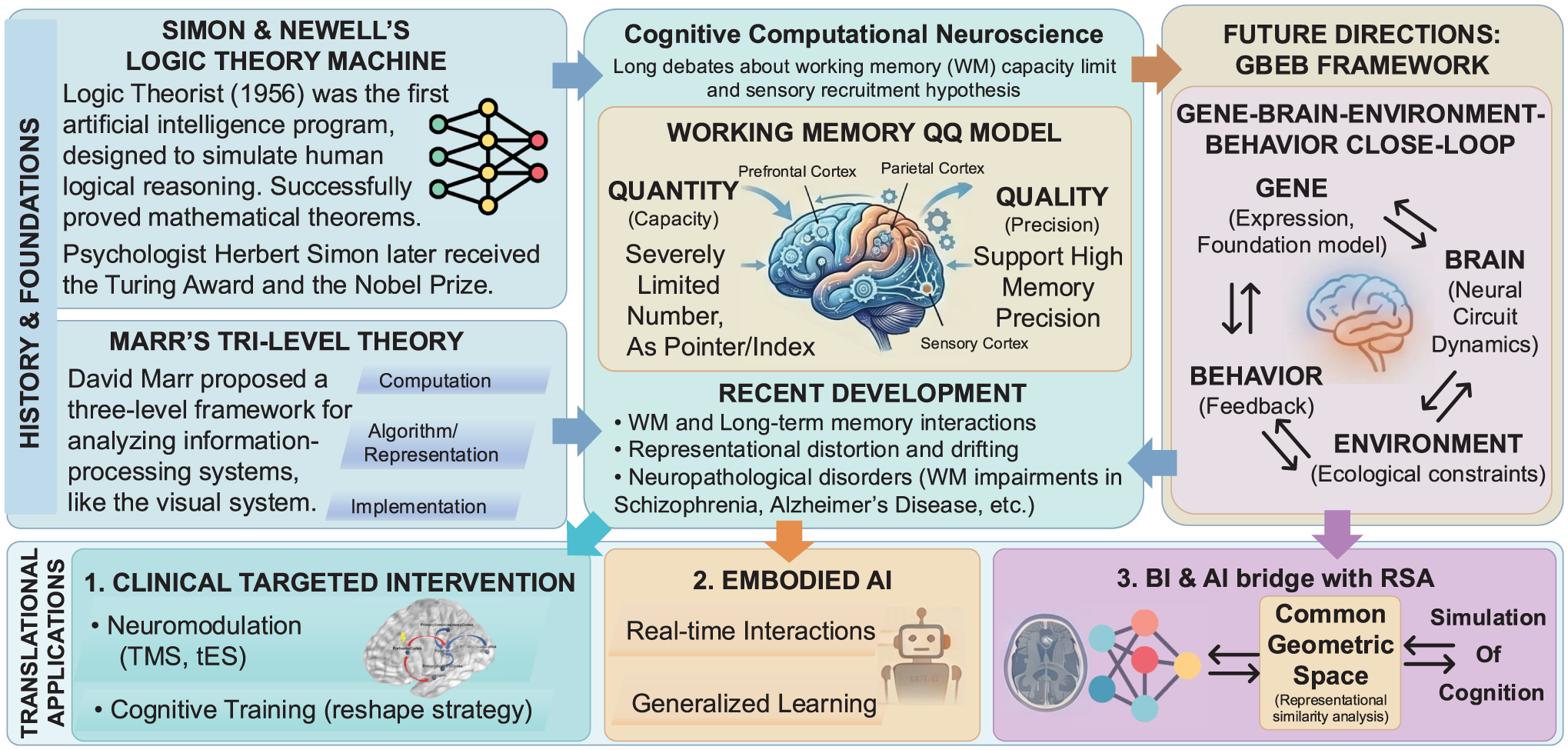
Framework of Cognitive Computational Neuroscience
Tracing back to the 1956 Dartmouth Workshop—widely recognized as the formal birthplace of AI—the profound historical ties between psychology and computer science are readily apparent. The early LOGIC THEORY MACHINE proposed by Herbert Simon and Allen Newell established the paradigm of simulating human thought through computational processes [3]. Simon, as a psychologist, renowned for his cross-disciplinary contributions, subsequently received both the Turing Award (1975) and the Nobel Prize in Economics (1978).
Similarly, AI “Godfather” Geoffrey Hinton was firmly rooted in experimental psychology as an undergraduate student at Cambridge University. He was awarded the Turing Award in 2018 and recently won the Nobel Prize in Physics in 2024. These iconic historical intersections repeatedly demonstrate that deciphering the operational mechanisms of the human brain and building true artificial intelligence are fundamentally two sides of the same coin. Although these disciplines evolved into highly specialized and separate domains over the subsequent decades, they are now experiencing a historic reconvergence, driven by complex system modeling and high- dimensional neural data.
David Marr proposed a computational theory that consists of three levels: computation, algorithm/representation, and implementation, for studying the visual system [4]. Over the past four decades, advances in technologies such as magnetic resonance imaging, large-scale electrophysiological recording, and brain- computer interfaces have enabled the accumulation of an unprecedented volume of data at the “implementational level.” However, seamlessly bridging neural activity with higher-order cognitive processes via robust “algorithms” remains a critical bottleneck.
In the exploration of the computational principles underlying cognitive modules, Bayesian models have achieved substantial success. This theoretical framework posits that the brain acts as an “optimal statistician”, flawlessly integrating prior knowledge about the world with current sensory evidence to guide decision-making. However, bounded by strict physical limitations such as metabolic energy consumption and tight temporal integration windows, the human brain rarely executes perfect, iterative Bayesian inference in real-world scenarios. Instead, individuals frequently turn to heuristic strategies [5]. While these strategies are statistically suboptimal, they achieve an elegant compromise between computational efficiency and evolutionary fitness, highlighting the highly context-dependent nature of cognitive algorithms.
Cognitive computational neuroscience has made substantive breakthroughs in deconstructing specific cognitive modules, for example working memory (WM). The mechanisms by which WM is maintained in the brain have long been a subject of intense debate [6]. We proposed a WM “Quantity-Quality” (QQ) model in 2015, provides a highly explanatory theoretical framework for resolving this issue [7]. The WM QQ model dissects working memory into two dissociable representational dimensions: capacity (Quantity) and precision (Quality). Specifically, the prefrontal- parietal network is responsible for executive control and the maintenance of the quantity of WM representations [8], whereas sensory cortices are involved in encoding the fine-grained precision of memory representations [9, 10]. Advances over the past decade have further expanded the boundaries of this model, for instance, by investigating how long-term memory (LTM) associations induce reconstruction during WM maintenance [11,12]. Such dynamic interactions between LTM and WM not only provide computational insights into representational drifts in memory, but also establish coordinates for elucidating the neuropathological mechanisms underlying various cognitive impairments in Schizophrenia or Alzheimer’s Disease [13–15 ].
Looking ahead to the next decade, cognitive computational neuroscience should transcend the isolated investigation of single cognitive module or individual brain region and turn toward cross-scale, systematic integration. The “Gene- Brain-Environment-Behavior” framework acts as a potential paradigm leading this transition. The framework posits that cognitive function is not an open-loop output restricted within the brain, but rather a closed-loop system defined by the continuous interactions among gene expression, brain circuit, behavioral feedback, and the broader ecological constraints. For example, in studies investigating the genetic and neural foundations of exceptional cognitive abilities such as absolute pitch, or in cross-species research on consciousness and affective transitions, it is only through the integration of dynamic data across these four dimensions that we can genuinely uncover the underlying regulations governing cognitive plasticity and brain development.
Currently, although we possess an unprecedented understanding of biological details ranging from synaptic transmitters to whole-brain networks, achieving a “seamless mapping” between higher- order cognitive computational modules and their underlying neurophysiological mechanisms remains challenging. Future breakthroughs may lie in these directions.
Clinical Targeted Intervention: Facing neuropsychiatric disorders, we should not only describe abnormalities in their cognitive computational metrics (e.g., deficits in working memory) [13–15 ] but also leverage these computational principles to implement precise interventions using neuromodulation techniques such as transcranial magnetic stimulation (TMS) [16] and transcranial electrical stimulation (tES) [17]. Furthermore, there is immense potential to reshape an individual’s neural computational strategies through targeted cognitive training [12].
The Progresses in Embodied AI: The genuine mind does not reside solely within the restrains of the cranium, but within its real-time interactions with the physical world. Incorporating the theories of cognitive computational neuroscience into embodied AI will not only provide AI agents with generalized learning capabilities in complex real-world environments but also inversely enrich our understanding of the fundamental principle of human intelligence [18].
Bridging Biological and Artificial Intelligence via representational similarity analysis (RSA): RSA has emerged as a transformative bridge to directly compare the information processing mechanisms of biological brains and artificial intelligence [19]. By abstracting both neural activity patterns—such as those measured via functional imaging—and the high-dimensional activations of hidden layers in deep neural networks into a common geometric space defined by representational dissimilarities, RSA effectively bypasses the need for a strict one-to-one mapping between biological neurons and artificial units. Ultimately, deploying RSA to evaluate these computational architectures allows researchers not only to rigorously adjudicate which AI systems best emulate true biological intelligence but also to iteratively refine artificial models into highly plausible, mechanistic simulations of human cognition.
Finally, to end the article in one sentence, in the coming decade, this interdisciplinary revolution of Cognitive Computational Neuroscience bridging carbon-based biology and silicon-based computation is only just beginning to unfold.
Footnotes
Acknowledgements
None.
Funding information
This work is supported by the National Natural Science Foundation of China (32471136).
Author Contribution
YK: conceptualization; investigation; writing-original draft; writing-review & editing.
Declaration of Conflicting interests
Professor Yixuan Ku is the member of the Brain Science Advances Editorial Board. To minimize bias, he was excluded from all editorial decision making related to the acceptance of this article for publication.
Data Availability Statement
Data sharing not applicable – no new data generated, or the article describes entirely theoretical research.
Ethics Statement
Not applicable.
Informed Consent
Not applicable.