



Abstract
By tackling illicit arms sales, the United States hopes to defuse the light arms campaign and protect the legal trade.
Afghanistan, November 10, 1995: An anti-Taliban government fighter mans a machine gun near a village south of Kabul.
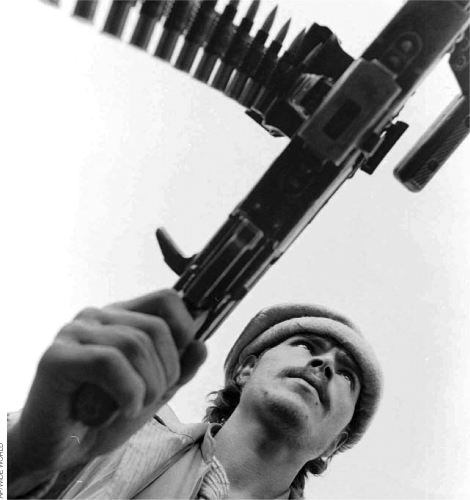
A global campaign to constrain or ban trade in small arms and light weapons is not the stuff of headlines, nor does it quicken pulses. But U.S. diplomats have been called off the bench and heavy hitters are stepping to the plate. But for what purpose?
While the rhetoric is promising, the Clinton administration's actual policy is merely to head off, defuse, and redirect the energies of activist organizations and vocal Western governments so the small arms-light weapons campaign does not too greatly inconvenience American interests.
Officially, the United States does “not believe that a single forum encompassing all efforts, or a single-issue campaign, will be effective.” Unofficially, however, Washington doesn't want much to come of this campaign-in-the-making.
American “equities,” the noun du jour inside the Beltway, are heavily weighted toward unrestricted legal transfers by governments and private sales to legitimate end-users. The United States provides immense quantities of arms on an overt or covert basis to friendly governments or other recipients–from which the United States thinks it gains either greater influence or prosperity, or both. Protecting such capabilities and options is the leitmotif of U.S. government policy on small arms and light weapons.
Deeply engaged in making the case for protecting these equities are powerful domestic lobbies, including the National Rifle Association and arms manufacturers with substantial economic roles in many U.S. states. The Clinton administration, as with every White House in recent memory, desperately wants to avoid antagonizing the gun lobby or further estranging industrialists and their Capitol Hill friends.
Thugs and drugs
Americans and guns seem bound together in life and death. The Second Amendment right to bear arms suggests to many the right to market, sell, or transfer weapons to friends.
At the same time, the White House has sent clear signals throughout the executive branch to steer clear of producing another diplomatic debacle like the anti-personnel land mines campaign. The land mines campaign is remembered painfully in the halls of U.S. government bureaucracies as an issue that involved bumbling policy-making and interagency squabbling, leading to the 1997 Ottawa Treaty to which the United States said “no,” putting it cozily in the company of a rogues' gallery of dictators and regimes known to sponsor state terrorism.
Between the jaws of the gun lobby and the tangled web of nongovernmental organizations engaged in the small arms-light weapons campaign, the Clinton administration steps gingerly. The strategy is to appear “activist” and show concern about the “cheap and deadly arms” in which the world is awash, while pushing the arms trade discourse decisively away from “the legitimate international trade in arms or the sale of individual weapons to sportsmen, collectors, businesspeople, and homeowners.”
“Guns don't kill people–people kill people.” This kind of bumper-sticker thinking now guides U.S. diplomacy. The bad guys are at fault, not the guns. According to Secretary of State Madeleine Albright, “It is a trade carried out by profiteers, abetted by corruption, creating a bottomless armory for rogue militias, criminal empires, and bands of thugs.” It is “the forces of extremism and hate… [who] get the weapons they need to carry out their destructive designs. … Terrorist groups, criminal syndicates, and narco-traffick[ers]” are too often in possession of dangerous weapons such as shoulder-fired missiles.
In short, the nasty, lying, thieving underworld corrupts an otherwise perfectly legitimate, licit, and even beneficial (for U.S. security) arms trade. Stop the bad guys and the problem goes away. The story of the U.S. diplomatic non-effort, then, focuses on thugs and drugs.
Bait and switch
A deputy assistant secretary of state whose brief is international narcotics and law enforcement is at the forefront of U.S. interagency discussion on small arms and light weapons. He consults with mid-ranking officials from the Defense, Treasury, and Commerce Departments, as well as the Arms Control and Disarmament Agency (ACDA). The integrity of these individuals ought not be impugned; they perform valued service and often seek far more latitude than they receive from the highest levels.
Yet, the subtext of U.S. diplomacy has been provided by military and civilian personnel at the Defense Department–sometimes joined by officials from other agencies–whose sidebar comments demean efforts by nongovernmental organizations and some allied governments on small arms-light weapons as “one more leftist campaign” or “another Axworthy step towards the Nobel Peace Prize.” (Lloyd Axworthy, Canada's foreign minister, has long been out front on the issue.)
U.S. diplomacy has faced up to the problem of devising an action plan that looks active but confines the discourse and action to the illicit trade. Madeleine Albright's speeches to the U.N. Security Council on September 24, 1998, and particularly her November 10, 1998 address at the International Rescue Committee in New York–see “U.S. Initiatives,” page 30–were meant to raise the profile of American efforts.
Indeed, the Clinton administration has proposed, inaugurated, or signed on to a substantial array of steps that sound caring, earnest, and forthright. But, if it isn't exactly smoke and mirrors it is certainly bait and switch. To promote an image of activism while ensuring that certain red lines are not crossed requires astute American diplomacy–motion, manipulation, and a long list of “proposals” devoid of much belief in the principles espoused by partisans of the small arms-light weapons campaign.
Transparency and reporting, and more transparency and more reporting–the confidence and security-building measures of the campaign–plus added attention to domestic enforcement in other countries constitute the menu of American initiatives.
The State Department says it is scrutinizing export licenses more closely to ensure that the end users are who the license says, while the Customs Service is trying to crack down on illegal shipments from American sources.
U.S. spokesmen advocate full and timely disclosure of arms shipments to conflict zones; a voluntary arms sales moratorium to “conflictual” regions (for example, Central Africa); greater information exchange among governments, international organizations, and NGOs; a U.N. clearinghouse for rapid exchange of data; conventions against illicit trafficking; and a new international center to collect and share information on small arms transfers.
But the United States resists efforts to actually lower the reservoir of rifles, light and heavy machine guns, mortars, grenade launchers, anti-tank projectiles, and other man- or team-portable weapons, especially via a global treaty to ban government shipments of particular kinds of weapons to certain groups of recipients.
European-led efforts to link human rights records to arms transfers via a universal Code of Conduct, and NGO suggestions to limit the lethality of small arms-light weapons exports also have met with little U.S. enthusiasm.
Likewise, the United States is loathe to engage in–although it applauds from afar–efforts to collect and destroy weapons after hostilities have ceased. Even where NATO forces were deployed in huge numbers to enforce the Dayton Accord for Bosnia, finding weapons, disarming criminals, and destroying arms caches were occasional and secondary efforts of the peacekeeping forces.
At the root of American intransigence lies a flat rejection of controls on production, a rigid focus on the illicit arms trade, and a geographic stress on the Southern Hemisphere. This “just say no” triumvirate amounts to saying that efforts directed against illicit distribution by criminals–operating in or from developing countries–are the key to handling this issue.
Illusory firewall
U.S. involvement in international discussions about small arms began with the U.N. Panel of Governmental Experts on Small Arms established by the General Assembly in December 1995. Its report, issued in August 1997, resulted in a series of recommendations that fell well short of control or limitations, and stressed information-sharing and cooperation, approaches favored by the Clinton administration.
Likewise falling within the comfort range of U.S. government policy has been U.S. participation in the U.N.'s Commission on Crime Prevention and Criminal Justice in Vienna, where the emphasis is on illegal firearms.
Mexico began an effort in 1996 to create an Organization of American States convention against illegal arms trafficking, in part as a response to U.S. apathy regarding the fact that many of the guns that make their way into Mexico or beyond come from the United States. The resulting convention was signed in November 1997. The United States signed on.
And, in the Group of Eight Industrialized Nations, the United States has been somewhat more active on small arms issues, particularly after it became clear that the OAS convention initiative posed no insurmountable problems while offering security benefits.
The G-8's Firearms Subcommittee, established in June 1997 and chaired by Japan, offered an OAS-type list of measures–all of which involve improving the identification and tracking of weapons and information exchange. Such measures are not very intrusive, require no legislative vehicles, and are largely non-enforcement, passive mechanisms.
In mid- to late 1998, the United States was represented at most forums at which small arms and light weapons were discussed. The increased pace of NGO and allied government-sponsored conferences and colloquia generated heightened attention in the Clinton administration, albeit attention to avoid losing an agenda-setting role, a lesson of the anti-personnel land mines disaster.
At a 21-nation meeting in Oslo in July, sponsored by Norway and Canada–the first truly international meeting among governments about small arms–the chief U.S. delegate was an able, experienced, but not high-ranking official from the Arms Control and Disarmament Agency.
In late September, coinciding with the U.N. General Assembly session, various NGOs convened an additional seminar in New York, to which the United States again sent a mid-level ACDA representative as well as an undersecretary from Treasury. Similarly, the October International Conference on Sustainable Disarmament for Sustainable Development in Brussels, co-sponsored by the Belgian government and Nobel Peace Prize winner Oscar Arias, led to a “Call for Action” that American representatives endorsed.
But a call for action is not quite the same as an actual plan of action. A proposed International Program of Action focused on small arms-light weapons stirred little U.S. government interest.
U.S. delegations are inclined to endorse various initiatives, not to offer new steps. Among U.S. delegates, the watchwords are “to ensure balance,” “to avoid surprises,” “to protect American equities,” and to “not lurch forward.”
In comparison, new varieties of American gunboat diplomacy carry far more weight. The Clinton administration has continued a long-standing policy of supplying weapons via “legitimate” transfers to regions in conflict–to allied governments of dubious democratic credentials like Turkey and Indonesia and many others, and to “non-state actors” who may be more amenable to perceived U.S. national interests. The resale, theft, or re-routing of such shipments enlarges by many times the weapons reservoir available for crime, terror, and abuse.
For principal American allies such as Israel, secondary transfers–that is, transfers of U.S. weapons and often sophisticated U.S. technologies to third parties–have long been reported. And on occasion, during the post-Yugoslav wars for instance, the United States has apparently turned a blind eye to violations of U.N. arms embargoes, presumably to ensure that well-armed and viable Croatian and Bosnian armies emerge to push back and “balance” Serb armies.
With each wink and every nod, America's credibility in controlling the arms trade weakens. Cumulatively, U.S. aid to brutal regimes–Indonesia, for instance, which has a government that kills people in East Timor as well as hundreds of pro-democracy demonstrators closer to home with “legally” transferred small arms and light weapons–denies to American diplomacy any moral high ground.
That Secretary Albright has focused major speeches on the topic of small arms and light weapons is significant. She evinces real concern about weapons that kill more people in more locales than any of the sophisticated weaponry deployed by large states.
But the purpose of U.S. attention must change. The firewall between so-called illicit and licit trade is illusory. Transfers presumed to be legitimate today become, over time, the reservoir for sales, thefts, and pilferage to dangerous end-users. More immediately, the ethos of U.S. diplomacy will frustrate efforts by many people whose noble goal is to reduce the legacy of death that arms transfers bequeath to generations ahead.