



Abstract

Russia's strategic forces are suffering from the same declining budgets and lack of resources that afflict the rest of the Russian military. In addition, the military's other deep-seated problems–draft dodging, suicide, alcoholism, criminality, resignations, and low morale–continued throughout 1998. Training has suffered and equipment is not being maintained. Most troubling is an increasing politicization of the military, which is manifested in more vocal criticism of the civilian leadership.
There has been a small decline since last year in the number of operational strategic warheads–to slightly below 6,000–mainly due to the removal of weapons once deployed in Kazakhstan, Ukraine, and Belarus.
Deactivation and retirement of ICBMs and their launchers proceed through at least four stages. In step one, an icbm is removed from alert status by electrical and mechanical procedures. Next, warheads are removed from the missile. In step three the missile is withdrawn from the silo. Finally, to comply with START I, the silo is blown up and eventually filled in. The number of missiles and warheads in the Russian arsenal will therefore vary depending on which step an analyst chooses to feature.
The Strategic Rocket Forces controls the ICBMs and continues to be the premier service of the Russian armed forces. The service is organized into four missile armies–headquartered at Vladimir, Omsk, Orenburg, and Chita–and 19 missile divisions, corresponding with the 19 main operating bases. The 12th Main Directorate is responsible for nuclear security and custody. At the end of 1998, a total of 756 missiles of five types were located at the 19 bases: 360 SS-18s, SS-19s, SS-24s, and SS-27s in underground silos; 36 SS-24s on railroad cars; and 360 road-mobile SS-25s.
If START II enters into force, all SS-18 and SS-24s, and all but 105 SS-19s, will be eliminated. The remaining SS-19s will be downloaded to one warhead each from their present six. As many as 90 SS-18 silos may be converted to take the SS-27 Topol-M.
An ambitious Topol M (SS-27) production schedule was announced by General Yakovlev. He stated that 20-30 SS-27s were scheduled to become operational each year for the next three years, and 30-40 a year for the three years after that. If this schedule is adhered to, by the end of 2001 there could be 70-100 SS-27s, and by the end of 2004, 160-220. A more realistic rate, given limited resources, is 10-15 missiles per year with perhaps some 60-80 fielded by 2005. The Topol M is produced at the Votkinsk Machine Building Plant.
On October 22, 1998 a Topol-M ICBM exploded after being launched from the Plesetsk test site. The fifth test launch, the missile was intended to fly across Russia to a target on the Kamchatka peninsula. The sixth test, on December 8, 1998, was successful.
Two silo-based SS-27s were put on “trial service” in December 1997 in southwestern Russia's Saratov region in Tatischevo. On December 27, 1998, according to the Russian government, the 104th Regiment, under the Taman Missile Division, had 10 missiles that were operational.
SS-25s were produced and deployed over a decade-long period beginning in 1985. Early versions are nearing the end of their service lives of approximately 15 years. A life extension program is likely, although exactly how many missiles will be involved and over what periods of time are unclear.
In an excellent report, The Evolution of Russia's Nuclear Force (Stanford University, 1998), Dean A. Wilkening develops a model based on the service lives of missiles, SSBNs, and heavy bombers over the past 40 years. Projecting the model forward to 2010-2015 results in an estimated force of 1,300-2,400 warheads, depending on the economic situation and arms treaties. Some argue these numbers are too optimistic and that the force will be closer to 1,000 or fewer.
Under the latest START data exchange of July 1, 1998, 42 subs of six types–Typhoon-class, Delta IV-class, Delta III-class, Delta II-class, Delta I-class, and Yankee I-class–are accountable. However, due to financial problems associated with dismantlement, the actual number of available and fully operational submarines is far fewer. The Russian Navy counts only some 25 SSBNs as operational, 16 in the Northern Fleet and nine in the Pacific–but even that number is probably too high. Fourteen Delta IIIs entered service between 1977 and 1982; two have been retired and a third may have been converted to a non-SSBN role. Three third-generation Typhoon submarines have been removed from service because of a technical problem. Without an infusion of funds, they are likely to be retired rather than overhauled. A more realistic number of operational submarines is 21.
The operational tempo of Russian SSBNs has been reduced significantly since the end of the Cold War. Reportedly, for a three-month period from May through July 1998, there were no SSBNs on patrol due to safety concerns. Patrols resumed in August with one sub in the Atlantic and one in the Pacific, with at least one other sub in each fleet on pier-side alert.
Russia has not announced future plans for its SSBN force, which is already below the START II warhead limit of 1,750. Depending on resources, Russia may have 10-15 operational SSBNs by the end of 2003 (seven Delta IVs and a combination of Typhoons and newer Delta IIIs). Reductions could lead to closing SSBN bases or even consolidating all SSBNs in the Northern Fleet.
The keel of the first ballistic missile submarine of a new type–the Borey-class–was laid in November 1996. Construction has been intermittent and was suspended altogether in 1998. Chief of the Navy Admiral Kuroyedov announced the submarine was being redesigned–not an auspicious sign. It is unlikely that any Borey-class SSBNs will join the fleet in the next five years. Despite rhetoric about maintaining a sea-based leg of the triad, the future of the Russian SSBN force remains very much in doubt.
Although Col. Gen. Anatoly Kornukov, commander-in-chief of the Russian Air Force, announced that a new aircraft to replace the Tu-95MS Bear H is expected to be introduced after 2010, this date is so far in the future as to have no practical significance for the air force's current dilemmas.
Of the six Tu-160 Blackjacks in the Russian inventory, only two are reportedly able to take off. The 1995 deal to purchase the Ukrainian Tu-160s fell through during the spring-summer of 1997 and the Ukrainians now plan to cut them up. Blackjack bomber production stopped in 1994, but in 1997 Gen. Eugene Habiger, then commander-in-chief of U.S. Strategic Command, said upon returning from Russia that some Tu-160 Blackjack bombers were still in production and should be “rolling out of a plant.” However, none appeared in 1998.
In the area of strategic defense, General Yakovlev announced that nuclear warheads would not be deployed on the SH-11 Galosh or SH-08 Gazelle missiles which make up the anti-ballistic missile system that encircles Moscow.
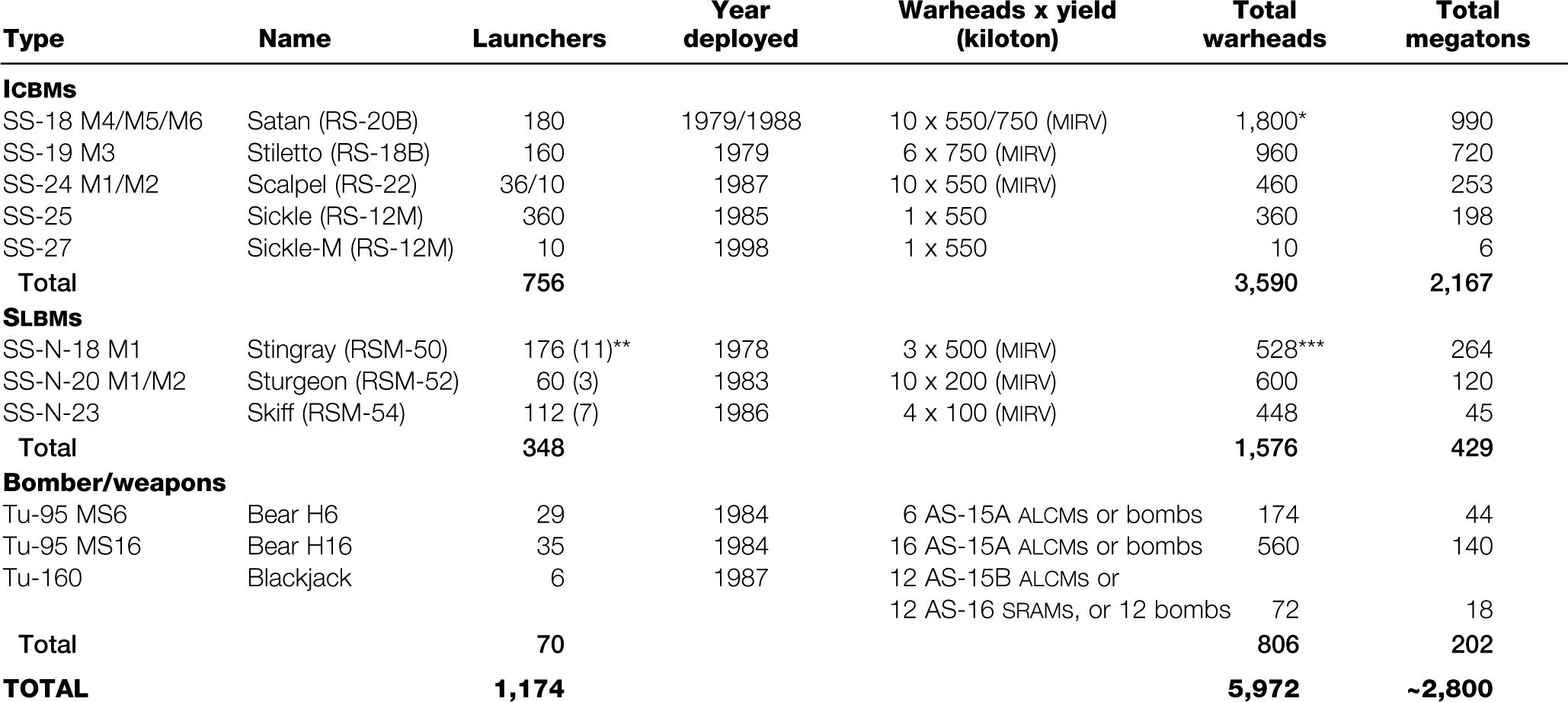
Some Mod 5 and/or Mod 6 SS-18s may carry a single warhead, although under START all are counted as carrying 10.
Numbers in parentheses refer to submarines.
Under START the number of warheads on the SS-N-18 is counted as three.