



Abstract
Stasi: The Untold Story of the East German Secret Police By John O. Koehler, Westview Press, 1999, 460 Pages; $ 28.00
It is more than mere linguistics to point out that in German the letters “sta” and “SI” stand for Staats (state) and Sicherheit (security), and that, in Russian, the initials “G” and “b” stand for Gosudarstvennyi (state) and Bezopasnost (security). Whether it was the KGB or the MGB, the Russian “Gb” was the master organ from which the Stasi was cloned. The terror practiced by both organs was justified in the name of state security.
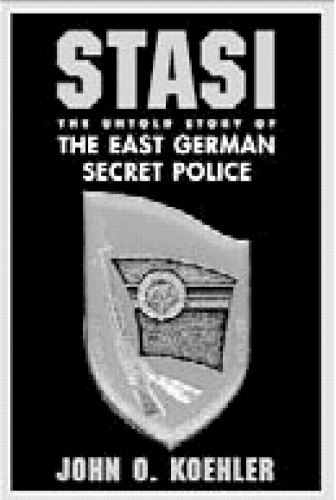
Jack Koehler, a former Berlin bureau chief for the Associated Press, describes in exhaustive detail how the concept of state security corrupted the entire society of East Germany, in some ways even more devastatingly than the Nazi system it replaced. He dedicates his book to “the victims of totalitarianism.” Readers learn–or re-learn–how and why there were no victors and only victims.
One mystery about the Russian and East German secret police is why they carefully preserved voluminous records of their misdeeds, as if they intended for posterity to know everything they did and how they did it. Koehler has waded through a massive cesspool and pulled out countless examples of the Stasis inhuman treatment of its own people.
Koehler's estimate of East Germany's oppressor-to-oppressed ratio is impressive: one secret policeman for every 166 citizens, or one in 66 when citizen-informers are counted. When part-time informers are added, the result is “one informer per 6.5 citizens.” The wounds inflicted upon the East German population crippled everybody. For many, the discovery that their best friends or their own family members were betraying them to the Stasi was worse, in its own way, than torture in an internment camp.
In his analysis of the lives and characters of the principal monsters, the author demonstrates how the state security apparatus was driven by the country's leaders. Just as the evil force in Russia was generated by Lenin, Stalin, and succeeding party tsars, in East Germany it was generated by party leaders, from Wilhelm Pieck to Walter Ulbricht and Willi Stoph, and finally to Erich Honecker, under whom East Germany finally fell apart.
The book includes numerous examples of Stasi intrigue. There are detailed reports, for example, that document how East Germany became a “playground for international terrorists.” When Libyan terrorists arrived in East Berlin with plans to bomb one of the cafés in West Berlin frequented by American servicemen, the Stasi knew all about it. They knew the names and locations of the individuals who would do the bombing, the exact type of explosive they would use, and the location of the bomb. When the Libyan plotters took the device in a suitcase from East to West Berlin, the Stasi tracked them. The Stasi even used some of its double agents working with American intelligence in West Berlin to try to warn the Americans and the West Berlin police of the impending attack–not because of any regard for Americans, but simply because they felt the bombing would hamper East Germany's chances of expanding trade with the West.
But the Libyans tricked the Stasi by pretending to abandon their plan. When the La Belle discotheque was bombed just after midnight on April 5, 1986, Stasi officers were furious. They drew up a list of the names and identities of the six Libyans who had carried out the bombing. Stasi officers knew they could have prevented the bombing–they also could have turned the murderers over to West Berlin authorities. Instead, they limited themselves to preventing the Libyan bombers from sending a message to West Berlin claiming responsibility for the bombing and bragging that they had done it “from [East] German soil.”
It was the Libyans' bravado–not the murders–that angered the East German leadership. The word came from on high–meaning party chief Honecker–that the Stasi had to “find a way out of” East Germany's “exposed position.” They settled on a disinformation campaign, planting the idea in the foreign press that the Americans had themselves done the bombing to create an excuse for reprisals against Libyan leader Muammar Qaddafi.
Koehler bases much of his account on information he gleaned from interviews with former Stasi officers. His most useful Stasi contact was Col. Rainer Wiegand, whose assignment had been counterintelligence. Colonel Wiegand defected just hours before the collapse of East Germany's communist regime. He would have been a star witness in the trial of the Libyans who bombed the La Belle café, but he died “under mysterious circumstances” during a holiday in Spain before he could testify.
A curiosity in Koehler's text concerns one of the more famous elements of the Cold War in East-West Berlin, the so-called UFJ–the Investigating Committee of Free Jurists. In their book Battleground Berlin, David Murphy, a former CIA chief in Berlin, and Sergei Kondrashev, a former Soviet Intelligence chief in Berlin, contend that “the Free Jurists grew out of the imagination of a single BOB [Berlin Operations Base] officer.” Koehler, however, writes that “the UFJ was the brainchild of Gen. Nikolai Melnikov of the Soviet MGB.”
In both versions, an American intelligence officer enlisted the help of Horst Erdmann, a defector from East Germany, to set up an organization that would advise East Germans on legal matters. The American officer saw the plan as a way of gaining access to valuable information about events in the Soviet zone. Koehler claims that Erdmann was in reality a mole sent by General Melnikov to West Berlin. His task was to set up a supposedly anti-communist organization that would give him access to Western intelligence agencies and enable him to pass valuable information about Western intelligence back to his Soviet/Stasi handlers.
Koehler's claim is based on an interview with “an unimpeachable U.S. intelligence source on condition of anonymity.” If Erdmann was a mole, one wonders why the former CIA chief in Berlin and the former head of the KGB's German department seem not to have been aware of his true identity. Whatever the explanation of that riddle, the fact is that the Free Jurists turned out to be a very large thorn in the side of the East German authorities. In 1952, Koehler reports, Moscow decided that the Free Jurists had to be eliminated.
Inevitably, the countless incidents of Stasi repression, terrorism, intelligence-gathering, and counterintelligence operations acquire, in their profusion, a certain sameness. At some point, they no longer make for light reading. But the very weight of their numbers underscores the enormity of the perversion that the Stasi represented and the degradation it produced in both the oppressors and the oppressed.
The book includes some memorable vignettes. On October 7, 1989, the fortieth anniversary of the East German regime, there was a “huge, pompous ceremony [with] tens of thousands of jeering citizens.” Soviet President Mikhail Gorbachev was East Germany's guest of honor that day. He saw and heard the crowd calling “Gorby, Help Us!” And he witnessed the arrival of Stasi chief Erich Mielke, who was screaming at the police to “club those pigs into submission.” Eleven days later, party chief Honecker was thrown out of power.
Later, when a warrant was issued for Honecker's arrest, Gorbachev arranged Honecker's escape to Moscow, and made Honecker his ward.
In the discussion of the Stasi's “invisible invasion” of not only West Germany's intelligence operations but its very highest governmental offices, there are wry descriptions of the use of East German “Romeos and Romiettes”–the agents who employed both heterosexual and homosexual talents to recruit gullible West Germans, from secretaries to cabinet ministers.
Koehler depicts Markus Wolf, the most debonair of the Stasi leaders and the long-time head of foreign intelligence, with a combination of admiration and contempt. He suggests that Wolf's “retirement” in 1986 was a smokescreen, and that Wolf remained in his post under a pseudonym. He also says that Wolf's autobiography is “full of distortions.” It became a bestseller in Germany, says Koehler, “but so was Hitler's Mein Kampf.”
The author uses Erich Mielke as a convenient thread to tie the Stasi narrative together. At 14, Mielke joined the communist youth organization in Germany. He went on to serve as a hit man for the party, murdering two German policemen in 1931. He worked for the Soviet secret police in Spain during that country's civil war, and rose in the Soviet-created Stasi after World War II. His activities during the war remain a mystery, even to Koehler, but his mastery of the art of survival is underscored by the fact that he became the longest-serving state security chief in the Eastern bloc–the Soviet Union included. In summarizing Mielke's lifelong devotion to the Soviet secret police, Koehler says, “He was an intimate of nearly every Soviet secret police chief.”
Koehler has multiple credentials: a German family background, three decades as a correspondent for the Associated Press, in Berlin and elsewhere, and service as a U.S. Army intelligence officer. In a recent conversation with me, Koehler hastened to point out that his work as a newsman and his stint with army intelligence occurred at distinctly separate periods of his life.
William Stearman, a former White House National Security Council staff member who is cited several times in the book, describes Stasi as “a real page-turner you cannot put down.” At 411 pages, it is a book that some readers will find they must put down, if only to catch their breath. Those who push themselves through to the end, however, will be glad they did. They will have been entertained by many truths that are stranger than fiction, and they will have acquired a huge amount of supplemental information to that long, painful episode of history about which many of us knew something, but not everything.