



Abstract

On July 9, during a radio interview in Germany with Deutsche Welle, President Lee Teng-hui of Taiwan characterized relations between China and Taiwan as a “special state-to-state relationship.”
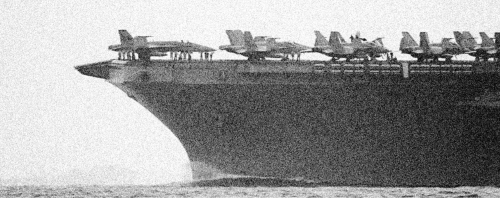
South China Sea, March 21, 1996: The U.S. aircraft carrier Nimitz monitors Chinese military exercises on the eve of Taiwan's first presidential election. Many in Congress—and on Taiwan—believe the United States must defend Taiwan if China attacks it.
Beijing interpreted that as a unilateral–if de facto–declaration of independence, a clearcut repudiation of the one China policy it claimed had long been accepted by the mainland, Taiwan, and the United States.
“The true colors of the Taiwan independence forces trying to split the country are now laid bare,” said the Politburo on August 1. “It is a declaration of war on the whole nation and the whole army.”
About two weeks later, the Liberation Army Daily added in a page one commentary: “We would rather lose a thousand soldiers than lose an inch of land.”
In the weeks and months following President Lee's state-to-state assertion, President Clinton and key members of his administration tried ineffectively to calm the roiling waters by telling each side what it wanted to hear. In one presidential press conference, for instance, a reporter asked if the United States was “obligated to defend Taiwan militarily if it abandons the one China policy.”
“A lot of those questions,” the president said, “are governed by the Taiwan Relations Act, which we intend to honor. Our policy is clear: We favor the one China policy; we favor the cross-strait dialogues. The understanding we have had all along with both China and Taiwan is that the differences between them would be resolved peacefully. If that were not the case, under the Taiwan Relations Act we would be required to view it with the gravest concern.”
The war of words escalated amid conflicting claims. The most inflammatory language appeared in the Hong Kong press, frequently in newspapers known to have close connections with the Chinese Communist party. Because what they said could not be regarded as official, the mainland may have been indulging in “psywar”–employing scare tactics in ways that could later be disclaimed.
It is conceivable that at some point the mainland will take concrete actions against Taiwan. Chinese president Jiang Zemin has domestic critics who will surely use any failure to act against Taiwan as a weapon to use against him. Jiang has pointedly said that the Chinese government will “not undertake to give up the use of force.”
On the other hand, the Chinese military has many combat deficiencies. To provoke a confrontation and be defeated could pose even more difficult problems for Jiang's continued ability to lead the People's Republic of China.
There is also a real possibility that the United States would intervene on Taiwan's behalf. Although Clinton's statements have been artfully ambiguous, the commanders of two carrier battle groups located in the area have said that Beijing must know that if it provokes a crisis, it will have to contend with the United States Navy.
Is there a crisis? If so, it has been decidedly low key. Taiwan's stock market has not collapsed, the economy still hums, and residents of Taiwan still visit relatives on the mainland. In turn, mainland officials have assured Taiwan business people that their investments are safe.
Scarcely anyone in the West believes that China will risk war with the United States by invading Taiwan. But it is possible that Beijing may take some kind of symbolic military action against Taiwan next year, perhaps during the runup to Taiwan's presidential elections in March.
If China acts militarily, what will the United States do? What would it be required to do? The Taiwan Relations Act, which would “govern” U.S. actions, is not a model of clarity. Indeed, it was designed to be ambiguous, to paper over an apparently intractable problem, which was how to ensure Taiwan's future security without violating the one China policy.
What it says
The Taiwan Relations Act is not a treaty; it is an act of Congress signed into law in April 1979, shortly after the United States officially recognized the Beijing government as representing China, while taking note that Beijing regarded Taiwan as a province of China. The act says, in part:
▪ The U.S. decision to establish diplomatic relations with the People's Republic of China rested on the expectation that the future of Taiwan would be determined by peaceful means.
▪ The United States would consider any effort to determine the island's future by other than peaceful means, including boycotts and embargoes, as a threat to the peace and security of the Western Pacific area and of grave concern to the United States.
▪ The United States would provide Taiwan with arms of a defensive character.
▪ The United States would maintain its capacity to resist any resort to force or other forms of coercion that would jeopardize the security of the social or economic system of the people on Taiwan.
▪ The president must inform the Congress promptly of any threat to the security or the social or economic system of the people on Taiwan, as well as any danger to the interests of the United States arising therefrom.
▪ The president and the Congress would determine appropriate action by the United States in response to such danger.
How it came about
For three decades before officially recognizing the People's Republic of China, Washington acquiesced to the claim of the Chinese Nationalist Party (or Kuomintang) that there was only one China, and that its government was the Kuomintang.
After being driven from the mainland in 1949 by a combination of communist forces and its own weaknesses, the Kuomintang set up a “temporary” capital in Taipei, denounced the communist government as bandit usurpers, and vowed that someday it would return to its rightful place on the mainland.
As the years passed, the Kuomintang's claim that it was the legitimate government of China seemed increasingly hollow. By the late 1960s, the Nixon administration was ready for a dramatic change of course.
The power of the Soviet Union was growing and both the United States and China feared it. A rapprochement between the United States and China could help offset that power. Nixon's national security adviser, Henry Kissinger, quietly began to seek better relations with Beijing. China's leaders were agreeable. But first, they made it clear that the Taiwan issue must be settled.
Secrecy surrounded the discussions–Kissinger even concealed the negotiations from the State Department, a bureaucracy he neither trusted nor respected. After lengthy and often tense meetings, the details of which are only now being made public, the “Shanghai Communiqué” was issued in February 1972.
At its core was the U.S. statement that “all Chinese on either side of the Taiwan Strait maintain that there is but one China and that Taiwan is a part of China. The United States does not challenge that position.”
While widely hailed in the West as a typically brilliant Kissingerian diplomatic move, the phraseology was patently false. Millions of native Taiwanese would not have agreed that Taiwan was part of China. Although most traced their ancestry to the mainland province nearest to the island, there was relatively little contact between them and a distinctive culture had developed. Taiwan had been a province of China for barely a decade. In 1895, it was annexed by Japan and remained a part of the empire for 50 years.
In 1972, however, the Taiwanese were not free to express their views. Today, after years of democratization, they are. And that, along with their booming economy, lies at the heart of today's crisis. According to a poll taken in late May, 89 percent of the people of Taiwan do not agree that Taiwan is a part of China. More than 84 percent replied that they regarded the Republic of China on Taiwan as a country.
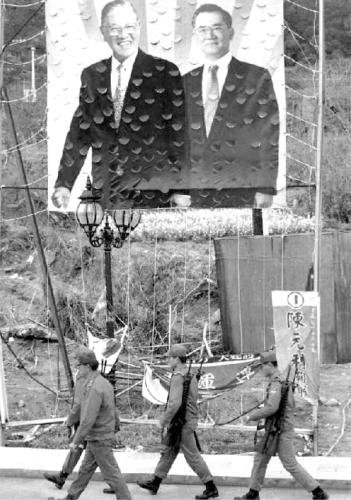
Matsu, 1996: Taiwanese soldiers march past an election poster for Lee Teng-hui.
In the Shanghai Communiqué, the People's Republic of China stated that “the liberation of Taiwan is China's internal affair in which no other country has the right to interfere. … The Chinese government firmly opposes any activities which aim at the creating of ‘one China, one Taiwan,’ ‘one China, two governments,’ ‘two Chinas,’ an ‘independent Taiwan,’ or advocate that ‘the status of Taiwan remains to be determined.’”
The United States took no position on that assertion. It did, however, declare its interest in a peaceful solution to the Taiwan question. Beijing, for its part, refused to rule out the use of force.
The nature of American protection for Taiwan became a crucial issue in Kissinger's post-communiqué discussions in Beijing. The United States had signed a Mutual Security Treaty with the Republic of China on Taiwan in 1954. This treaty, the People's Republic of China insisted, would have to be terminated before full diplomatic relations could be established.
Kissinger agreed. However, he argued that abruptly abandoning the treaty would incite strong resistance in the United States, which might undo the rapprochement. The American government needed a formula that would enable it to say that, at least for some period of time, there were assurances of peaceful integration.
It would not be until 1979, during the administration of Jimmy Carter, that full diplomatic recognition would be achieved.
Undue haste
Although candidate Jimmy Carter campaigned against secrecy in international relations, his China policy was as stealthy as Nixon's, while lacking the Nixon-Kissinger finesse. Carter announced on December 15, 1978–just after Congress left for its holiday recess–that diplomatic normalization would begin January 1. Diplomatic relations with the Republic of China would be terminated and the Mutual Security Treaty abrogated.
The administration failed to consult with Congress, and it acted with such haste that it made no arrangements regarding Taiwan's future. Further, the normalization announcement came little more than a week after Congress had passed a resolution that recognition of the People's Republic of China should not come at the expense of the Republic of China on Taiwan.
While normalization was widely considered desirable in Congress, the circumstances under which it was achieved were bitterly criticized by Republicans and Democrats alike. Taiwan's supporters also quickly mobilized, demanding redress.
Bipartisan congressional fury descended on Carter, resulting in the rapid passage of the Taiwan Relations Act. In turn, Beijing was furious. In China's view, the act contravened understandings it had with the United States leading up to and following the Shanghai Communiqué.
While that was undoubtedly true, the mainland's leadership had too many other concerns to press the issue. Mao's successor, Deng Xiaoping, had not yet consolidated his power, and China, having invaded Vietnam, was concerned about a possible Soviet counterstrike.
Deng's ambitious economic modernization program also claimed attention. Finally, breaking diplomatic relations with the United States over the Taiwan Relations Act would have played into the hands of American conservatives and hurt Carter. The Chinese bided their time.
In 1981, that time arrived. Deng had eclipsed Hua Guofeng, whom the dying Mao had allegedly designated as his heir. The economy was growing at an impressive rate. Relations with the Soviet Union had begun to improve. And across the Taiwan Strait, Beijing watched the rapid Taiwanization of the island's politics.
The old Chiang Kai-shek Nationalists had shared the dream of one China with Mao Zedong–except that the one China would be Nationalist instead of Communist. But Chiang was long dead, and it was likely that his son, Chiang Ching-kuo, would be the last mainlander to govern Taiwan. Unification would be much harder to achieve once native Taiwanese fully took charge of the island.
Meanwhile, Ronald Reagan, who had been critical of Carter's China policy, had been elected president. At one point in the campaign, he advocated re-recognition of the Republic of China on Taiwan, although an aide later said that Reagan had been misquoted. Conservatives, led by Barry Goldwater, generally pushed for a restoration of ties with the Republic of China.
Campaign rhetoric and conservative wishes notwithstanding, Reagan appointed Kissinger protegé Alexander Haig as secretary of state. Kissinger regarded the opening to China as the high point of his career, and he did not wish to see relations with China harmed. Haig agreed. Indeed, he was in favor of tipping the scales even more strongly toward the mainland. His main concern was with containing Soviet aggression, and a strategic partnership with China was essential to that.
China mounted a campaign that warned that the Taiwan Relations Act was a serious obstacle to improved Sino-U.S. relations. The act had to be rescinded; otherwise, it simply prepared the “so-called legal grounds for creating two Chinas.” A placatory agreement was signed in August 1982 and issued as another Beijing-Washington communiqué. It said, in part:
“The United States Government states that it does not seek to carry out a long-term policy of arms sales to Taiwan, that its arms sales to Taiwan will not exceed, either in qualitative or in quantitative terms, the level of those supplied in recent years since the establishment of diplomatic relations between the United States and China, and that it intends to reduce gradually its sales of arms to Taiwan, leading over a period of years, to a final resolution.”
Again Congress had not been consulted and irate legislators on both sides of the aisle pointed out, correctly, that the new agreement contradicted the Taiwan Relations Act, which put no limits on arms sales. Anguished Taiwan officials made the same point.
Subsequent developments compounded the confusion. When a State Department official defended the new agreement by saying that China had agreed not to use force against Taiwan, the Chinese angrily denied that. And after the State Department's legal counsel testified in Congress that the latest communiqué had no legal force, President Reagan dictated a secret memorandum stating that the United States would restrict arms sales to Taiwan “as long as the balance of military power between China and Taiwan was preserved.”
In addition, we now know that Taiwan had been assured before the communiqué was announced that the United States had not agreed to set a date for ending arms sales to Taiwan, and that it had not agreed to revise the Taiwan Relations Act.
Indeed, weapons continued to be sold to Taiwan but at progressively lower dollar amounts, as specified in the communiqué. However, because the levels were calculated by total price, the unit cost of weapons could be reduced and/or adjusted for inflation, allowing more to be sold for less cost. Sometimes more advanced weapons were sold, despite the promise not to do so, with the explanation that new copies of the original weapons were no longer available. Further, the communiqué had not mentioned restrictions on the transfer of technology, and the designs for weapons and systems were made available.
Tiananmen
As these developments were being played out, Taiwan was moving toward creating a civil society. Its hard authoritarianism became progressively softer. The pace of democratization picked up rapidly in the latter half of the 1980s, guided by Chiang Kai-shek's son and heir, President Chiang Ching-kuo. In 1988, Ching-kuo died and was succeeded by his vice-president, the Taiwan-born Lee Teng-hui.
Democratization inevitably meant growing political power for the Taiwanese majority. Generally well-educated and highly articulate, most Taiwanese did not consider Taiwan as part of China and they could not now be restrained from saying so.
The more optimistic China-watchers in the United States believed that the mainland would also move toward democracy. In their view, Deng Xiaoping presided over a benign, probusiness regime–a kind of “cuddly communism.” As the economy developed, so would pluralism, and the two sides would eventually work out their differences.
This comforting vision was shattered on June 4, 1989 by Deng's bloody suppression of demonstrations in and near Beijing's Tiananmen Square as well as elsewhere in China. Unarmed civilians were shot by their own army; in the following weeks, many others, bruised and beaten, were sentenced to long prison terms or–occasionally–to death.
Responding to popular revulsion, President George Bush announced the imposition of sanctions and a suspension of visits by high-ranking officials. Believing, however, that it was important to maintain a relationship with China despite the events of June 4, Bush secretly dispatched his national security adviser and deputy secretary of state to Beijing. They went again a few months later, in a visit that had not been publicized beforehand.
At that point news of the previous visit leaked. As domestic critics charged that this made a mockery of the sanctions, the Washington officials were photographed smiling and clinking champagne glasses with men the media regularly referred to as “the butchers of Beijing.”
Again members of Congress expressed outrage, as did Bill Clinton, Bush's opponent in the 1992 presidential election. Clinton accused Bush of “coddling dictators from Baghdad to Beijing.”
The hapless Bush managed to anger the Chinese as well. Running behind Clinton in the polls of two states with important aerospace industries that were crucial to his re-election, he announced that the United States would sell F-16 fighters to Taiwan. This clearly violated the 1982 communiqué–though not, of course, the Taiwan Relations Act.
The three no's
Bush's efforts notwithstanding, Clinton won the election. Despite his campaign rhetoric about Bush coddling dictators, Clinton's actions toward China were in accord with his predecessors. Although the Soviet Union had disintegrated, Clinton appeared to regard an alliance with China–a “strategic partnership,” as he called it–as an end in itself.
His administration, for reasons not stated, also stipulated that Taiwan's top leaders would not be permitted to visit the United States, although permission to transit the United States might be granted on a case-by-case basis.
In May 1994, when Lee Teng-hui was not allowed a transit stop in Honolulu, Taiwan's many supporters were upset. Their arguments found a receptive audience in Washington. To treat the democratically elected leader of a long-term ally so shabbily while Clinton regularly received others like Gerry Adams, the head of the terrorist-affiliated Sein Fein, for example, was galling.
Perceiving Clinton as cooperating with Beijing in tightening the noose around Taiwan, Taipei officials took counteraction, mounting an aggressive campaign in Washington to get Lee to the States. Poor handling by the State Department set in motion a series of events that culminated in a media extravaganza when Lee received a visa so he could accept an award from his alma mater, Cornell University, in June 1995.
Because the visa was granted after Secretary of State Warren Christopher had given Beijing his personal assurances that Lee would never receive it, the Chinese government was understandably enraged. Some feared that the series of missile tests and war games China initiated–which peaked in the early months of 1996–might portend a cross-strait invasion.
Clinton, upon hearing that certain members of Congress were discussing more drastic measures, cited the Taiwan Relations Act and sent two carrier battle groups to the area. The Chinese threatened to destroy the ships if they entered the strait. No such extreme action occurred. Beijing announced that it would end the war games early because of poor weather, which meant the carriers had no need to enter the strait. It is possible that the White House and Beijing quietly coordinated their moves so that neither side would be backed into a corner.
However, Clinton made secret promises to Beijing, which later became known as the “three no's”: no support for Taiwan independence; no support for one China, one Taiwan; and no support for Taiwan's membership in international bodies in which statehood is required.
During Clinton's visit to China in June 1998, he acquiesced to the desire of his hosts to publicly iterate the three no's. When the inevitable furor erupted, the administration argued that the statement did not represent a change in its–heretofore secret–policy.
However, Clinton had come closer than any previous administration to endorsing Beijing's definition of “one China.” His statement also undercut a 1992 agreement Taiwan had made with the mainland that, for the purpose of cross-strait negotiations, each side could use its own definition of “one China.”
Congress, already investigating contributions to the Democratic National Committee made by sources with ties to the highest levels of the Chinese government and military, responded to the three no's with bipartisan resolutions affirming U.S. commitments to Taiwan under the Taiwan Relations Act and urging the president to seek China's public renunciation of force against the island.
Undaunted, administration officials instead began to pressure Taipei to reach “interim agreements” with Beijing, in contravention of earlier promises–going back to the time of the 1982 communiqué–that the United States would not put pressure on the island to negotiate with the mainland, and that it would not seek to mediate between the two.
This caused even greater anxiety on Taiwan, leading Lee Teng-hui to describe cross-strait relations in July as “a special state-to-state relationship.” Lee later said that he had not repudiated the one-China policy, but merely Beijing's definition of it, which Clinton had apparently espoused. A new cross-strait crisis was precipitated.
Time to rethink
From Nixon to Clinton, American efforts to establish and maintain a relationship with the People's Republic of China have been characterized by an elitist brand of personal diplomacy and secrecy on the part of the executive branch.
For the past 30 years, there has been little effort to build a popular consensus for a coherent China policy; attempts to consult Congress before making important decisions have been minimal to nonexistent.
One of the consequences of this inept diplomacy was the Taiwan Relations Act, which freezes Taiwan in a status falling short of nationhood, even as the island exercises all the criteria of sovereignty.
Only in the sense of a vague cultural entity can it be said that “one China” has existed since 1949. Efforts to base policy on the one China myth have resulted in a welter of contradictory statements that anger both the mainland and Taiwan and prompt each to actions that test American resolve.
Shortly after President Nixon and Chairman Mao unveiled the Shanghai Communiqué, John Fairbank, then the dean of America's China scholars, contemptuously dismissed the communiqué's assertion that “there is but one China and Taiwan is part of China.”
That statement, he said, was “one of those hoary devices for manipulating the unsophisticated barbarian; any teenager can see that this is a nonfactual statement.” But once having acknowledged a patent untruth, Fairbank added, the United States would now have to find a way to work around it.
That has not been easy for the United States, or China, or Taiwan. What Fairbank did not say was that a policy built upon a foundation of untruth–most Western political scientists prefer the euphemism “a useful fiction”–may prove unstable in the long run. Current efforts to enshrine it may prove disastrous.
In August a prominent Taiwan opposition party figure responded to a New York Times editorial describing the one China policy as “sensible” by asking, “What could possibly be sensible about a policy that acknowledged two corrupt dictatorships' [the Chinese Communist Party and the Nationalists, as they existed in 1972] claim of sovereignty over the same nation,” while ignoring the basic will of the people?
Accepting the one China myth has caused problems for U.S.-China relations to this day, and never more dramatically than now. It is time to rethink the premises upon which the historically confused and ambiguous U.S. China policy is based before the United States and China blunder into a serious military confrontation over Taiwan, which neither they nor the Taiwanese want.