



Abstract

Congressional hawks have long demanded a national missile defense system, and the Clinton administration–as John Isaacs explains on page 22–may well comply with a decision to deploy one by 2005.
The administration is developing a system based on hit-to-kill interceptors, infrared sensors, radars, and the like. It would–in theory–intercept four or five “or a few tens” of warheads launched from a “rogue state.” It would also have, as always stated by the Pentagon, some capability against a small accidental or unauthorized launch of long-range missiles from Russia or China.
The administration is scheduled to make a deployment decision in July. The system specifications require extremely high confidence that not a single warhead penetrate to U.S. soil.
Unfortunately, the system–if deployed–would have zero effectiveness against even a few warheads. Any nation that can build an intercontinental ballistic missile can construct countermeasures that could easily defeat it.
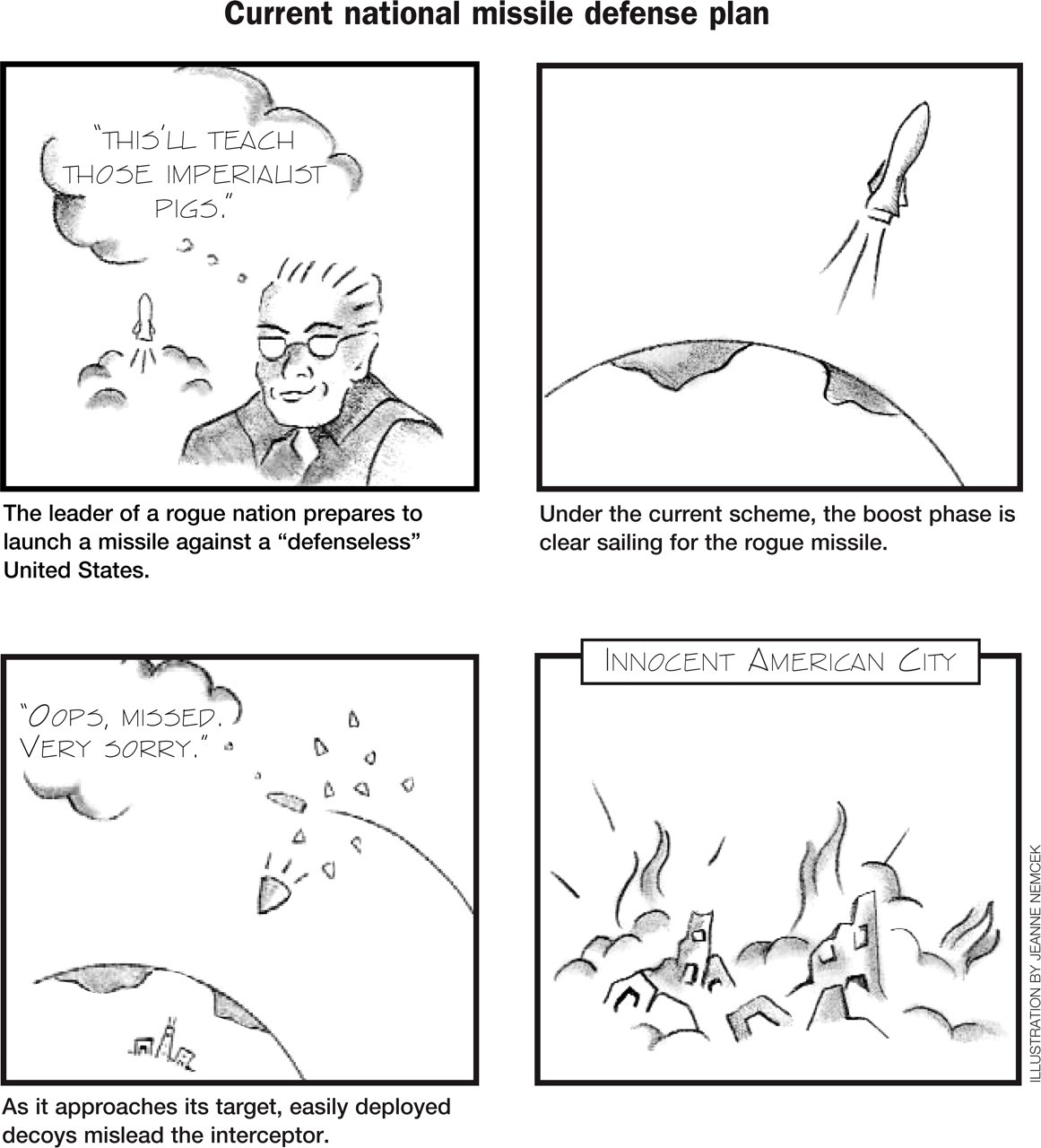
The fundamental problem is that the administration's system is designed to intercept missile warheads in mid-course as they arc through space, unpowered. The difficult task of “hitting a bullet with a bullet” at approach speeds of 10 kilometers per second will be compounded by the actions of an uncooperative adversary–actions particularly feasible in the vacuum of space when warheads are in free fall.
If the United States wishes to build defenses against an ICBM threat, it should try another approach–boost-phase interceptions while the rocket is still burning. A missile under power is a thousandfold more visible than the same missile after the “burn” has ended.
More to the point, countermeasures that are easy to deploy for a warhead in free fall are not feasible for a rocket still accelerating.
Further, the location and size of North Korea, Iraq, and Iran (the most likely threats) are such that a boost-phase intercept system is technically feasible–and it would be far less costly than the proposed national missile defense system.
Beyond that, the political payoff could be extraordinary. U.S.-Russian relations are poor and growing worse. Meanwhile, U.S. plans for a national missile defense system are poisoning the well even more. But a boost-phase national missile defense program could be best done with Russian cooperation–and that would be attractive to some elements in Russia.
In addition to boost-phase sites jointly operated, I propose that the same large interceptors be placed on a few U.S. military cargo ships operating in the Japan Basin, but with provisions that would keep them from being fired except in previously agreed areas.
Finally, it would not be difficult to write a protocol to the ABM Treaty to permit a joint boost-phase system. Boost-phase systems would violate neither the letter nor the spirit of the treaty because they would not be effective against even a single ICBM launched from the interior of Russia. Incidentally, they also would not be effective against Chinese ICBMs.
The threat
In July 1998, the nine-member Rumsfeld Commission (on which I served) reported that an elementary ICBM force could emerge in North Korea, Iran, or Iraq within five years of a decision to build such a capability. The missiles would be inaccurate and unreliable and few in number. And for several of those years, the report said, the United States might not be aware of the program.
However, the commission also noted (and I paraphrase) that the United States cannot assume that a nation would build ICBMs to American specifications–that is, that a rogue nation would construct weapons that the United States could easily destroy in flight.
First, there is the matter of warheads. The Pentagon's national missile defense program assumes that a rogue state would use a so-called “unitary” or single warhead containing a nuclear weapon, or biological or chemical agents. That assumption makes no sense in regard to biological or chemical weapons.
If North Korea, for instance, wished to maximize its capability to cause death or damage in the United States by the launch of a firstgeneration ICBM, it might choose biological weapons despite being a member of the Biological Weapons Convention. If so, it probably would not use a unitary payload, which would deliver tens or hundreds of kilograms of anthrax or other infectious or even contagious microbes on a city.
The result would be a narrow plume carried by the breeze, which would kill most of the people in its path while leaving those outside the plume untouched, except in the case of extremely contagious germs such as smallpox.
Rather, North Korea–or some other state–could make much better use of a limited payload capacity by packaging the biological agent in individual bomblets that would weigh a kilogram or so, and which would be released by the missile as soon as it had reached its full velocity on ascent.
The bomblets would travel separately along the trajectory to their targets. The planned national missile defense system would have no possibility of intercepting these tiny bomblets that, in any event, would be invisible to the “kill” vehicle's sensors.
While the Rumsfeld commission did not give any dates by which a rogue state might actually have an ICBM capability, North Korea launched the Taepo Dong I on August 31, 1998. To the surprise of the U.S. intelligence community, it was a three-stage rocket that attempted to insert a small satellite into orbit.
A boost phase system would have little in common with the national missile defense system as proposed.
Although the third stage failed before burning to completion, the test showed that North Korea was able to separate successive stages and to ignite the liquid-fueled second stage in space. The launch of a Taepo Dong II can be expected at some point, unless North Korea agrees to permanently abandon the launch. A three-stage Taepo Dong II could presumably strike U.S. territory.
Why the Pentagon plan won't work
A September 1999 National Intelligence Estimate (“Foreign Missile Developments and the Ballistic Missile Threat to the United States Through 2015”) noted: “We assess that countries developing ballistic missiles would also develop various responses to U.S. theater and national defenses. Russia and China each have developed numerous countermeasures and probably are willing to sell the requisite technologies.
“Many countries, such as North Korea, Iran, and Iraq probably would rely initially on readily available technology–including separating RVs [reentry vehicles], spin-stabilized RVs, RV reorientation, radar absorbing material (RAM), booster fragmentation, low-power jammers, chaff, and simple (balloon) decoys–to develop penetration aids and countermeasures.
“These countries could develop counter-measures based on these technologies by the time they flight test their missiles.”
Indeed, countermeasures are the Achilles' heel of the administration's national missile defense program. Simple countermeasures can defeat even a highly sophisticated system based on mid-course intercepts.
As already noted, a rogue state would likely choose biological weapons and package the agent in individual bomblets. That would definitively checkmate the system, a fact that no one involved with the program disputes.
But if the rogue nation goes the nuclear route, a single warhead–probably with a yield of 10 to 20 kilotons like the nuclear weapons that devastated Hiroshima and Nagasaki–would be the likely path. Nevertheless, the offense could still make use of low-tech counter-measures to make sure their weapons got through.
To be sure, the proposed national missile defense system would have a chance to observe the flight–Defense Support Program satellites, parked in high earth orbits, would see the booster flame almost immediately.
Upgraded early warning radars would track the warhead in mid-course, together with the spent final-stage fuel tank and whatever simple countermeasures might have been used. State-of-the-art X-band “imaging” radars might even help to discriminate the real warhead from decoys or junk.
Ground-based interceptors would be launched to hit and destroy the warhead. If the interceptors are based in Alaska, which seems to be the current plan, a launch from North Korea might provide time to fire again, if the first interceptor missed. That's the “shoot-look-shoot” scenario.
Nevertheless, the probabilities are that all the interceptors will miss their targets because of countermeasures. And there are many countermeasures to choose from.
One of the most effective countermeasures might be a large balloon surrounding the warhead. Immediately after achieving full velocity, the warhead would separate from the final stage of the missile and a simple gas generator containing a few grams of material (like that in automobile airbags) would gently inflate a metallized plastic balloon that had been crumpled down onto the warhead by a household vacuum cleaner, which would exhaust most of the air.
A warhead that might be five feet long could be enclosed in a balloon 30 feet in diameter. That would be nicely visible to the radars as well as to the sensors of the hit-to-kill homing vehicle on the ground-based interceptor.
But even if the the homing vehicle struck the balloon, it would probably not strike the warhead. A thin aluminum coat on the plastic would be opaque to the kill vehicle's sensors, thus effectively disguising where the warhead was within the balloon.
The collision might strip away the balloon, thus exposing the warhead to other interceptors. But the attacking state could anticipate that and shrink down several balloons, one over the other. Each could be independently expanded when the outermost balloon was blown away.
Other countermeasures could be used. More than 30 years ago, the Strategic Military Panel of the President's Science Advisory Committee, of which I was a member, observed that an adversary would no doubt use “anti-simulation.” That is, rather than making the decoys simulate the warhead, the warhead would be made to look like the decoys.
Thus, if the warhead were coasting “bare” through space, perhaps spinning in a stable fashion, decoys would need to be pretty much the same size and have the same spin. However, with anti-simulation, the warhead could be modified or “clothed” to simulate a cheap decoy.
The warhead could be put in a small, lumpy balloon. That would thoroughly confuse the tracking radars, which would have a hard time distinguishing between the lumpy balloon with the warhead and the lumpy decoy balloons accompanying it. For that matter, it might be better not to impart spin to the warhead, another measure that would help confound the radars.
(Spinning the warhead improves reentry accuracy, but the first-generation ICBMs will be so inaccurate that this will not be a significant impairment. In any case, a warhead can be spun up just as it begins reentry and after all possibility of interception has passed.)
One potential flaw with a balloon decoy is that its temperature could differ greatly from the temperature of the warhead, thus enabling heat-sensitive “seekers” to easily distinguish between the two. Because a warhead has substantial mass (perhaps 500-1,000 pounds), it does not cool much in its passage through space. Thin, empty decoy balloons, on the other hand, could change temperature rapidly, depending on their surface coating. They could either be warmer than a warhead in sunshine or cooler. At night, they would cool rapidly unless measures were taken to prevent this.
This problem, however, could be easily overcome. It takes less than a pound of lithium battery within a decoy balloon to supply as much heat to the interior of the balloon as the warhead itself would have–if the warhead were shrouded in commercially available multi-layer insulation, widely used in refrigerators, transport of liquid nitrogen, and in space applications.
Such countermeasures and others are credible. In fact, they would represent a minor effort compared with that of creating an ICBM force. The 1999 National Intelligence Estimate draws similar conclusions. To summarize:
• The national missile defense system would have no capability against bomblets carrying biological agents.
• The system would not be able to destroy a nuclear weapon within a large enclosing balloon.
• The system would not not be able to discriminate a warhead in a small balloon from perhaps 50 empty small balloons, if this coun-termeasure is properly done.
Boost-phase defense
It is possible to intercept ICBMs in boost-phase–while the rocket engines are still burning. That makes the task of a homing interceptor far simpler than that faced by an interceptor that must see a relatively cool warhead at great distances in space.
A boost-phase system would have little in common with the national missile defense system the administration has proposed. It would, however, use the existing Defense Support Program satellites to determine the time and rough direction for launch of a ground-or sea-based boost-phase interceptor.
The interceptors would carry a simple sensor to detect visible or near-infrared energy. That would immediately detect the bright flame of the rocket and autonomously home the interceptor against the flame.
The fundamental characteristic of the boost-phase interceptor is that it should reach ICBM velocity in about 100 seconds rather than the 250-400 seconds of a typical ICBM. Under these circumstances, there are vast geographical areas in which interceptors could be deployed and still make the intercept in boost phase.
“Countermeasures” are the Achilles' heel of national missile defense.
In the case of North Korea, interceptors could be deployed at a joint U.S.-Russian test range south of Vladivostok, if Russia wished to cooperate with the United States. Or they could be deployed on U.S. military cargo ships stationed near North Korea.
Intercepting an ICBM while it is in boost-phase would prevent bomblets from being dispensed or from reaching their intended targets. The third stage of an ICBM intercepted 10 seconds before burnout would fall about 5,000 kilometers short of its target–entirely outside the United States and Canada.
The only boost-phase intercept system currently under development is the airborne laser, which is funded by the air force. But it has always been discussed as a component of the theater missile defense program rather than as an adjunct to, or a component of, national missile defense.
The airborne laser is technically problematic because it involves exotic and mostly unproven hardware. In contrast, a ground-based or sea-based boost-phase interceptor system would involve mainly proven technology, and it would be available in a shorter time and with less technical risk than the airborne laser. It would also have the advantage of not requiring large aircraft to remain in the air at all times to provide continuous coverage, and it would have a greater interception range.

In my calculations, I assume that the interceptors must be launched from outside the territory of North Korea, Iraq, or Iran. And I also assume that interceptors now being designed for the national missile defense system would be used.
These three-stage interceptors are expected to achieve a velocity of some 8.5 kilometers per second, slightly faster than the 7.5 kilo-meters-per-second speed of an ICBM. However, the planned interceptor may need to be modified to reach its ultimate speed in no more than 100 seconds of powered flight.
The highly sophisticated four-band “seeker” currently planned for the interceptor would be replaced by a much simpler one with lower resolution and lower sensitivity, operating in the mid-infrared or near-infrared bands. A boost-phase interceptor would always “see” the ICBM rocket flame above the horizon, a relatively easy task.
The boost-phase interceptor would be self-guided as soon as its seeker acquired the still-burning rocket in the approximate region earlier designated by Defense Support Program satellites. It would home on the rocket flame, but as it came closer it would need to “lead” the flame in order to strike the body of the rocket. At about 10 kilometers, a different infrared im-ager could be used to see the rocket itself.
Fast burn and dummies
Countermeasures to a boost-phase interceptor system might include redesign of the ICBM to become a “fast-burn” missile. Or one-stage “dummy” missiles might be launched to provoke the launch of interceptors.
The former measure is highly unlikely. The United States is capable of producing fast-burn ICBMs that would have a burn of 100 seconds instead of the normal 250 seconds. But it is doubtful that North Korea, Iraq, or Iran could do the same.
Fast-burn missiles require engines two-and-a-half times as powerful as 250-second burn missiles. For countries such as North Korea, Iraq, and Iran, whose early ICBM designs feature heavy engines and structures, the payload would be reduced to zero.
As for the launch of dummy first stages (that is, first stages with ballast instead of fueled and loaded second and third stages), the nominal 30-second burn of an ICBM's first stage is short enough to allow a boost-phase interceptor launch to be cancelled. (In my calculations, I assume a 100-second firing delay.) A dummy missile would need to have both credible first and second stages to fool a boost-phase interception system.
Cooperation
The administration's planned national missile defense system would, if deployed, violate the 1972 ABM Treaty, which prohibits deployment of a national system. A boost-phase system is a different animal, because it would lack capability against Russian missiles.
Nevertheless, the United States would need Russian cooperation if it hopes to modify the ABM Treaty to permit even a boost-phase system. Russians engaged in ballistic missile defense work would probably be pleased to cooperate with the United States in building a ground-based system south of Vladivostok–using Russian hardware.
Russia has good interceptor technology and would have no difficulty in providing an effective Russian design for a mixed fleet of interceptors. Russian political leaders, however, might be less enthusiastic because North Korea, a former Soviet ally, would surely regard such a system as provocative.
Even if Russia does not agree to a ground-based site on Russian soil, it might not object to U.S. deployment of U.S.-designed interceptors on naval ships. Russia could easily match a U.S. deployment of a few dozen boost-phase interceptors on military cargo ships, even if they were somehow misused for mid-course intercepts, so this approach should not feed Russian fears of a natural U.S. advantage as the dominant sea power.
It would be a simple matter to agree on ocean areas from which these ships might fire, with cooperative and verifiable means to prevent them from doing so in other regions.
Don't scuttle the treaty
The proposed national missile defense system will not work against so-called rogue states with new ICBMs because they can deploy effective countermeasures, ranging from bomblets with biological agent to enclosing balloons.
Further, those same nations have far simpler means than ICBMs for attacking the United States with biological or nuclear weapons. They could fire short-range cruise missiles or short-range ballistic missiles from “freighters” near the West or East coasts of the United States, for instance. Meanwhile, Russia and China could readily penetrate the proposed system. Even an accidental or unauthorized launch would get through.
But against a potential rogue state ICBM threat–and with Russian cooperation–a limited national missile defense system based on boost-phase interceptors could be deployed cooperatively under the ABM Treaty, as amended with a suitable protocol.
The system would provide protection against bomblets containing biological agents released on ascent and nullify penetration aids such as enclosing balloons that would defeat the kind of mid-course national missile defense system the administration plans.
A joint ABM deployment site in Russia south of Vladivostok would be ideal for the system's self-guided interceptors. Alternative or additional capability would be provided by similar interceptors based on U.S. military cargo ships in the Japan Basin.
Rather than possibly making a decision in July to deploy an expensive and unworkable system, the Defense Department should be asked to contract–on an urgent basis–for studies of a boost-phase system using Defense Support Program sensing satellites and self-guided interceptors.
This could be done with a schedule that would permit a deployment decision that would meet the administration's desired operational date of 2005 for a national missile defense system.
Above all, bringing Russia into the loop is essential. Russia's 18,000 strategic nuclear warheads, tactical and strategic, pose a substantial threat to the existence of the United States–and to Russia and the entire world–if miscalculations get alarmingly out of hand during a time of crisis.
Russia, the United States, and the rest of the world would benefit if Russian and U.S. warheads were to be immediately reduced to 2,000 deployed strategic warheads. Instead, the trend is in the other direction.
A decision to deploy the kind of national missile defense system the administration envisions is likely to scuttle the ABM Treaty and encourage Russia to keep its nuclear weapons inventories high. That will benefit no one.