



Abstract

On the morning of september 30, three workers were nearly finished purifying the uranium oxide they were processing to make fuel rods for Japan's Joyo fast research reactor.
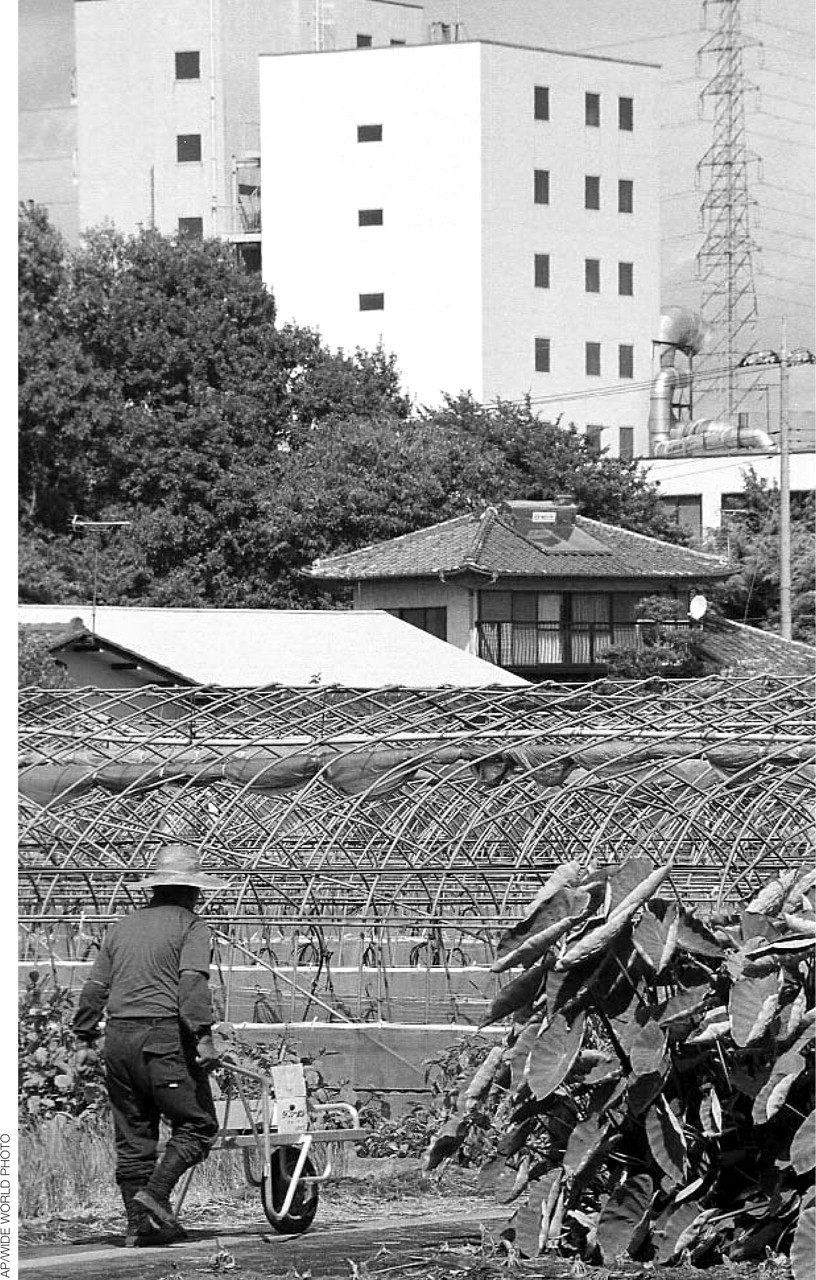
On October 4, 1999, four days after the nuclear accident in Tokaimura, a farmer continues his work in the shadow of the JCO uranium processing plant.
Ordinarily, the JCO fuel production plant at Tokaimura processed uranium oxide for commercial reactors, which usually contains less than 5 percent uranium 235. But Joyo required intermediate-enriched uranium–enriched to 18.8 percent uranium 235. So Hisashi Ouchi, Masato Shinohara, and Yutaka Yokokawa were working with this material in the Conversion Test Facility, a small building adjacent to the main production plant. The test facility was used only a couple of months a year, and two of the workers–Ouchi and Shinohara–had not worked there before, nor had they handled intermediate-enriched uranium oxide. Yokoka-wa, their supervisor, had not done so in three years.
The last remaining step in their processing task was to dissolve the purified uranium oxide in nitric acid. They were running behind schedule.
Jco, a company in trouble, could ill afford any delays. Unable to compete with foreign suppliers, its sales had plummeted 47 percent during the 1990s. In 1996, in an effort to speed things up and cut costs, plant managers had modified the procedure for dissolving uranium oxide, approving a plan that bypassed the use of a safety-designed dissolving vessel in favor of mixing the material in stainless steel buckets, which reportedly cut in half the time it took to dissolve the material. This truncated procedure was described in a secret manual that plant managers had chosen not to disclose to government regulators at the Science and Technology Agency.
at Tokaimura may be only the beginning of Japan's nuclear problems. The pressure on the utilities will be even greater once they start using MOX fuel.
After dissolution, the uranium-nitric acid mixture was supposed to be homogenized in criticality-safe storage tanks. But homogenizing the solution in these small, narrow storage tanks also took a long time.
The precipitation tank, ordinarily used at a different stage in the process, was larger, wider, and had a mechanical stirring device. The day before, Yokokawa had directed the two workers to use the precipitation tank rather than the storage tanks to homogenize the batches of solution they were preparing, a further violation of procedure. They poured four batches of solution–containing a total of 9.2 kilograms of uranium–into the tank. On this morning, they resumed mixing and pouring in additional batches.
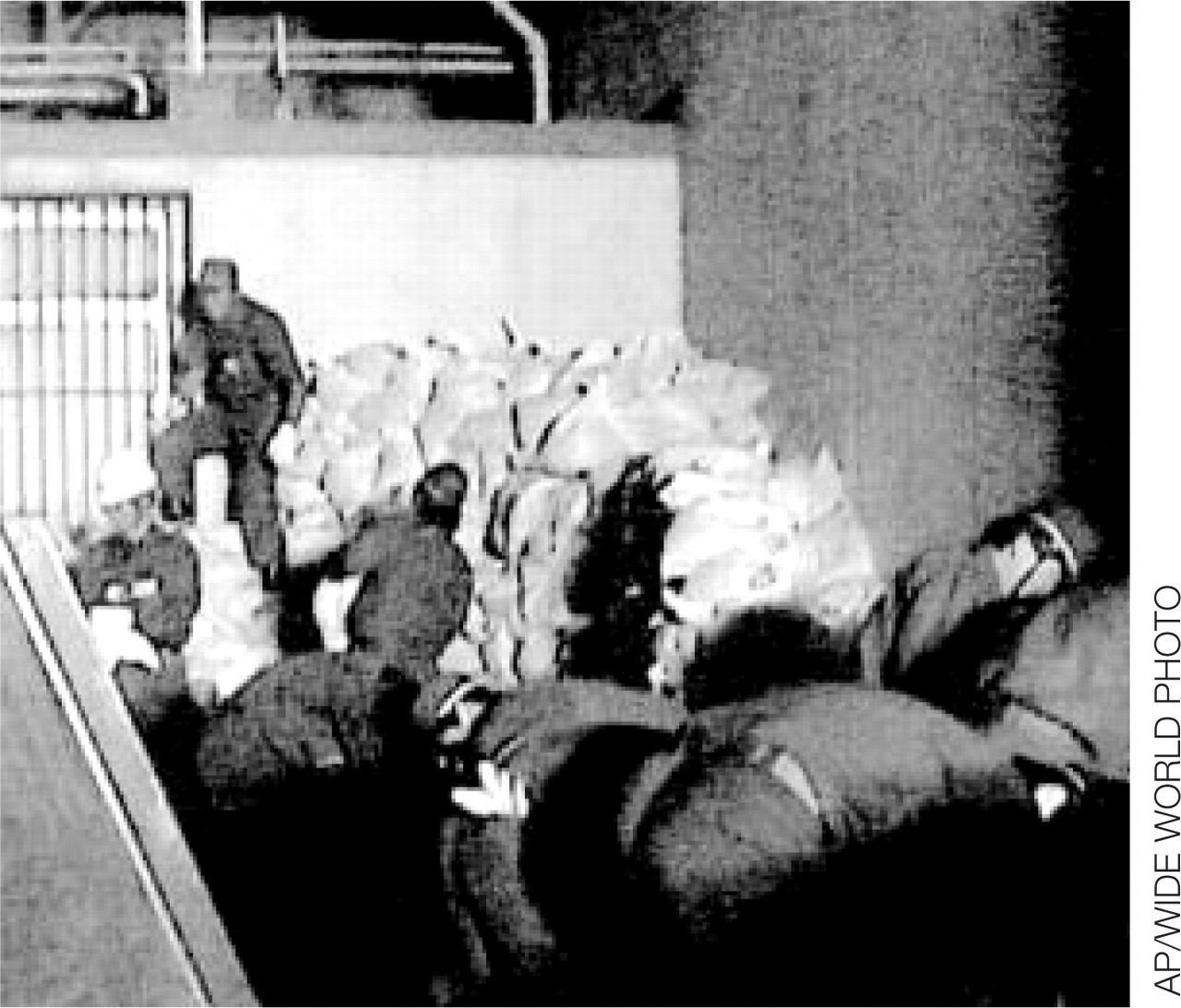
Unprotected workers pile sandbags outside the JCO facility.
Going critical
The storage tanks were small and narrow for a purpose–precisely to assure that the material remained sub-critical. Narrow cylindrical vessels have a high surface-to-volume ratio, which facilitates neutron leakage. The precipitation tank, in contrast, was large enough to hold a critical mass–enough material to initiate a self-sustaining chain reaction.
The amount of uranium allowed to enter the precipitation tank was usually controlled through the storage tank. However, Ouchi and Shinohara were transferring the solution in buckets, emptying them directly into the tank with a funnel. Bypassing the safety mechanism, they quickly exceeded the maximum amount of uranium authorized for the vessel.
Although it is difficult to believe, they apparently did not understand that the amount of intermediate-enriched uranium that could be safely poured into the vessel was smaller than the safe amount of low-enriched uranium, the material they were accustomed to working with. Yokokawa, the supervisor, told investigators later that he didn't even know what a “criticality” was.
The precipitation tank was encased in a jacket that circulated cooling water. This jacket both reflected neutrons back and facilitated heat removal. In effect, they were turning the precipitation tank into a low-power nuclear reactor.
The chain reaction began when the total amount of intermediate-enriched uranium in the tank reached 16.1 kilo-grams–nearly seven times the authorized amount (2.4 kilograms). At 10:35 an intense burst of neutrons and gamma rays was emitted.
Ouchi and Shinohara, who were working next to the tank, saw the telltale blue flash of Cerenkov radiation. They immediately fell ill with the classic symptoms of acute radiation poisoning. Yokokawa, in an adjacent room, was less severely affected.
Gamma radiation alarms sounded and the evacuation of the site began.
Emergency response
The village of Tokai has 15 nuclear facilities. In addition to the processing plant run by JCO, there are three plutonium fuel fabrication plants, a spent fuel reprocessing plant, and plutonium storage facilities–all within a few kilometers of the village center. The entire village is also within the 10-kilometer emergency evacuation zone of the Tokai II 1,100-megawatt nuclear power plant.
Nevertheless, Tokai was poorly prepared for a nuclear accident. The most serious deficiency may have been the absence of neutron detectors, which would have alerted emergency respon-ders to the fact that the chain reaction was continuing. Without this information, most officials incorrectly believed the reaction must have come to an end. After all, criticality accidents are usually self-limiting–typically, the heat generated by the intense fission rate causes the critical configuration to disassemble–as, for example, when the moderator solution boils away. What officials failed to realize was that the water jacket around the tank reflected neutrons back and provided the cooling that suppressed boiling.
Meanwhile, the three paramedics who responded within 15 minutes were unaware of the nature of the accident. They did not wear protective gear or dosimeters, and they had to be told to move the injured quickly rather than administer treatment on the spot. The paramedics received doses as high as 1.3 rem, as estimated from whole-body counts taken after the accident. 1
In addition, seven construction workers who were working close to the plant's boundary received estimated doses of as much as 1.5 rem; 145 others on the jco site were estimated to have received doses up to 4.7.
Because there were no facilities in Tokai or in the vicinity that were capable of treating the injured, they were ultimately transported to the National Institute of Radiological Sci-ences–62 miles away in Chiba–which also proved to be inadequately equipped. The two most severely injured workers, Ouchi and Shinohara, with estimated gamma-equivalent doses of 1,800 and 800 rads respectively, were later moved to Tokyo University Hospital.
In spite of heroic efforts, including the transplant of stem cells, Ouchi died of multiple organ failure on December 21. He had been in a coma since mid-October. Shinohara remains hospitalized in critical condition.
Meanwhile, confusion reigned at the various jurisdictions responsible for recommending or implementing countermeasures. Jco notified the Science and Technology Agency of the accident at 11:19 a.m., 45 minutes after it began, but the agency does not appear to have taken any meaningful action until 1:40 p.m., when it sent a radiological monitoring crew to the scene.
By law, all emergency planning decisions rested with local authorities, with national authorities serving only in an advisory role. Officials from the Science and Technology Agency did not believe there was much cause for concern and they advised officials from Ibaraki Prefecture at 1:55 p.m. that ordering the public to stay indoors would provide adequate protection. Based on JCO's recommendation, however, the mayor of Tokai ordered everyone within 350 meters of the plant (some 161 individuals) to evacuate. But the evacuation, ordered at 3:00 p.m., was not complete until 8:10, more than nine hours after the accident began.
Back at the plant, the chain reaction continued. The neutron dose within the evacuation zone was tens to hundreds of millirems per hour–although the level was not known until neutron detection equipment finally arrived at 5:00 p.m., more than six hours into the event.
The day after the accident, student protesters converged on the Science and Technology Agency in Tokyo.

Then, although the measurements indicated that radiation was above background level as far as seven kilometers away, Ibaraki officials waited until 10:30 p.m. before telling residents living within a 10-kilometer range (about 310,000 people) that they should stay indoors.
Because of these delays, many members of the public probably received radiation exposures, in spite of official statements to the contrary. By October 12, nearly 75,000 residents had been tested, but officials declared in January that only 207 were exposed. However, the half-life of sodium 24, the substance measured by the tests, is only 14 hours. Many exposures would have been undetectable after only a few days. (The company, which was insured for one billion yen, is already being sued for more than 15 billion, an amount that is expected to grow.)
Also likely to have received some exposure was a team of International Atomic Energy Agency inspectors who were visiting another plant about 800 meters from the JCO site, a fact not mentioned in that agency's own report of the accident.
Once authorities realized the chain reaction was continuing, they knew they had to cut off the supply of water on the utilities will be even greater to the precipitation tank's water jacket. Luckily, the pump and valves were outside the building. Still, it took four hours to break and drain the pipe.
The reaction finally came to an end at 6:30 a.m. on October 1. Boron was injected into the tank to guarantee subcriticality, and sandbags and walls were erected around the plant to block residual gamma radiation. Twenty-seven additional workers were exposed to doses as high as 12 rem during these operations.
The Science and Technology Agency estimates that a total of 439 people were exposed to radiation during and after the accident, including workers taking part in cleanup activities and village residents.
Who's to blame?
Accusations flew after the accident. The director of the plant, Kenzo Koshijima, blamed it on workers “trying to be creative,” but that statement was soon followed by the discovery of the secret manual outlining illegal operating procedures.
The Science and Technology Agency then pointed at company management, claiming on October 12 that “it's not the government's fault when companies fail to meet guidelines.” Police raided jco headquarters on October 6 and the offices of its parent company, Sumitomo, on December 16, collecting evidence for a criminal investigation.
Although the company's part in the accident is beyond dispute, the agency also deserves a share of the blame. Jco had been using illegal procedures since at least 1996. Since then, government regulators had performed a few spot checks (always announced in advance), but they had never inspected the plant while it was actually operating.
Japan's Nuclear Safety Commission criticized the Science and Technology Agency's failure to detect the illegal procedures. Ultimately, though, it was the commission's job, as the chief policy-making body on nuclear safety, to review the agency's effectiveness.
In any case, the law, which required periodic safety inspections at nuclear power plants, did not require inspections of fuel-cycle facilities like fuel fabrication plants, because they were regarded as low risk.
By mid-December, the government had passed two new bills aimed at correcting the most egregious deficiencies revealed by the accident. One requires periodic inspections at nuclear fuel-cycle facilities; the other is a revision of emergency planning procedures that delegates authority for emergency-response decisions to the central government. How useful these changes will be has been questioned: Although the mayor of Tokai complained that local authorities did not have the necessary expertise to deal with the accident, he actually made the right decision by ordering an evacuation, which national authorities erroneously believed was unnecessary.
However, the new laws do not even begin to address the systemic problems that are the root causes of the accident. One is Japan's bureaucracy-driven, plutonium-focused nuclear power program, which is veering farther and farther from economic viability, producing ever-increasing pressures to cut costs and minimize safety measures. The second is a pervasive belief among government and industry officials in Japan that severe nuclear accidents are essentially impossible, a belief that, incredibly, does not appear to have been shaken at all by the accident at Tokai.
Both of these problems are exacerbated by the fact that the Science and Technology Agency has dual but conflicting missions–that of regulating and promoting nuclear power–much as the U.S. Atomic Energy Commission had until it was abolished in 1974, when Congress gave its regulatory and promotional activities to separate agencies.
Until Japan's nuclear safety problems are dealt with in a fundamental way–and creating an independent regulatory agency would be a good start–the prospects for meaningful reform are dim.
A closed–or closing–cycle?
At a series of meetings with co-author Edwin Lyman and Nuclear Control Institute president, Paul Leventhal, utility and government officials made clear that the accident at JCO had not lessened their resolve to push ahead with Japan's ambitious nuclear energy program, which involves the construction of new power plants, the use of MOX (mixed oxide) fuel in light-water reactors, and the continued development of fuel reprocessing plants. A visit to the recently completed–and palatial–headquarters of Ibaraki Prefecture suggests that it may be difficult for this largely rural prefecture to say no to the increased revenues that nuclear installations bring.
One illustration of this attitude was the shocking announcement by jco president Hiroharu Kitani on January 5 that he hoped to receive permission to restart the plant “to protect employment.” Another is the fate of the Tokai spent-fuel reprocessing plant, operated by the Japan Nuclear Cycle Development Institute (jnc), which had been shut since a March 1997 explosion in a low-level waste processing plant. Jnc had finally received the last authorization to restart the plant and was planning to make an announcement on October 1, when the jco accident intervened. The political cost of trying to restart a facility responsible for the second-to-worst nuclear accident in Japan suddenly appeared to be too great.
Then, the ever-resourceful Science and Technology Agency announced on December 4 that 77 liters of contaminated uranium solution remaining in the jco Conversion Test Building would be purified at the jnc reprocessing plant. This ploy may defuse political opposition to restarting the jnc plant–who could object to cleaning up JCO's mess? But in fact, processing the contaminated solution is unnecessary–it could have been transferred directly to the reprocessing plant's high-level waste tanks and vitrified.
The accident has stiffened public opposition to other plans, however, including the siting of new nuclear power plants as well as a potential nuclear waste repository in Hokkaido.
The use of mox was the next major step in the implementation of Japan's closed fuel cycle, with the first loading of mox fuel scheduled for late fall. But the Japanese government is also encountering difficulties in its move to burn mox in commercial nuclear reactors.
Mox is not commercially viable–it costs several times as much as low-enriched uranium fuel, and costly modifications of the reactors may be needed. Nonetheless, it is being forced on the utilities as part of the country's energy strategy. The pressure on the utilities to cut costs will be even greater once they start using mox.
The use of mox fuel in nuclear power plants also increases the risk in the case of a loss-of-containment accident because the core contains a greater inventory of highly radiotoxic americium and curium, as well as plutonium. A 1999 report by the Nuclear Control Institute estimated that if a nuclear plant with a 25 percent loading of mox suffered a loss-of-containment accident, the number of resulting cancer fatalities would double. In densely populated Japan, such an accident could entail tens of thousands of additional cancer deaths. 2
One might think that Japanese officials would be planning to take additional safety measures at plants where mox is used and that they would impose more stringent emergency guidelines. However, the Nuclear Safety Commission has allowed utilities to sidestep the issue by exempting them from having to evaluate the safety consequences of an accidental off-site release of plutonium. Their reasoning was that accidents severe enough to cause such a release are virtually im-possible–precisely what they thought about a criticality accident at jco.
Renewed public skepticism about official safety assurances is not the only thing putting the brakes on the mox program. In the weeks before the accident, the British newspaper The Independent disclosed that workers at the British Nuclear Fuel (bnfl) mox fuel plant at Sellafield had falsified quality control data for 22 lots of mox pellets destined for the Takahama 3 reactor. This revelation was bad news, especially in light of the fact that a shipment of eight mox fuel assemblies manufactured at the same plant was already on its way to the Takahama 4 reactor. If they were defective, the pellets might cause a number of problems.
Bnfl quickly insisted that only pellets that had not been shipped were affected, and Takahama's owner, the Kansai Electric Power Company (kepco), appeared to concur. However, members of the public were no longer in any mood to accept mere assertions of safety. Citizens' groups, led by Green Action in Kyoto, challenged kepco's defense of bnfl's quality control data, and, in November sued to block the loading of the fuel. Kepco was forced to admit that British safety authorities had told it of irregularities concerning the Takahama 4 fuel in mid-October, a fact it had kept secret. BNFL's defense–that the fuel was safe anyway–was skeptically received.
Kepco finally announced that it would not use mox fuel manufactured by bnfl and that it was postponing its mox program. Another utility, the Tokyo Electric Power Company, quickly followed suit, even though it had acquired mox from a different manufacturer. However, Japan's mox ambitions may well survive the scandal. Neither utility said it was withdrawing from the program completely. Also, on January 17, the Takahama town assembly voted not to allow a referendum on mox fuel to proceed, even though nearly 20 percent of the town's citizens signed a petition in favor of the referendum.
It remains to be seen whether Japan will seize the opportunity to undertake a truly effective reform of its nuclear regulatory system, including the adoption of a meaningful mechanism for public input, or whether it will merely make a few cosmetic changes while carrying on with business as usual. The former approach could provide greater assurance that accidents as bad as the one at Tokaimura will not happen again. The latter course will increase the risk of a more serious accident that could well herald the end of nuclear energy in Japan.
Footnotes
1.
Radiation dose estimates are from the Science and Technology Agency's final report on the JCO accident investigation, December 1999.
