



Abstract

There's no easy way to say it. Outrage, or even concern, about nuclear weapons may be at an all-time low. Yet there are thousands of weapons in the United States and Russia still on hair-trigger alert. The Comprehensive Test Ban Treaty (ctbt) failed last fall in the Senate, and this year the Anti-Ballistic Missile Treaty, the foundation for nuclear arms reduction treaties, faces collapse. There are nuclear weapons in India and Pakistan, and potential “loose nukes” in the former Soviet Union could put these weapons in who-knows-what unstable part of the globe. Now could be precisely the moment when more activism and awareness are needed to mop up after the Cold Wa r. But it's not happening.

Numbers don't tell the whole tale, but they do reveal the decline in peace activism over the past decade. When sane and freeze merged in the late 1980s, their combined numbers totaled about 170,000 “paid up” members and nearly 500,000 supporters, according to organizing director Van Gosse. The organization, renamed Peace Action in 1993, today claims about 55,000 members–a figure that some believe to be an exaggeration.
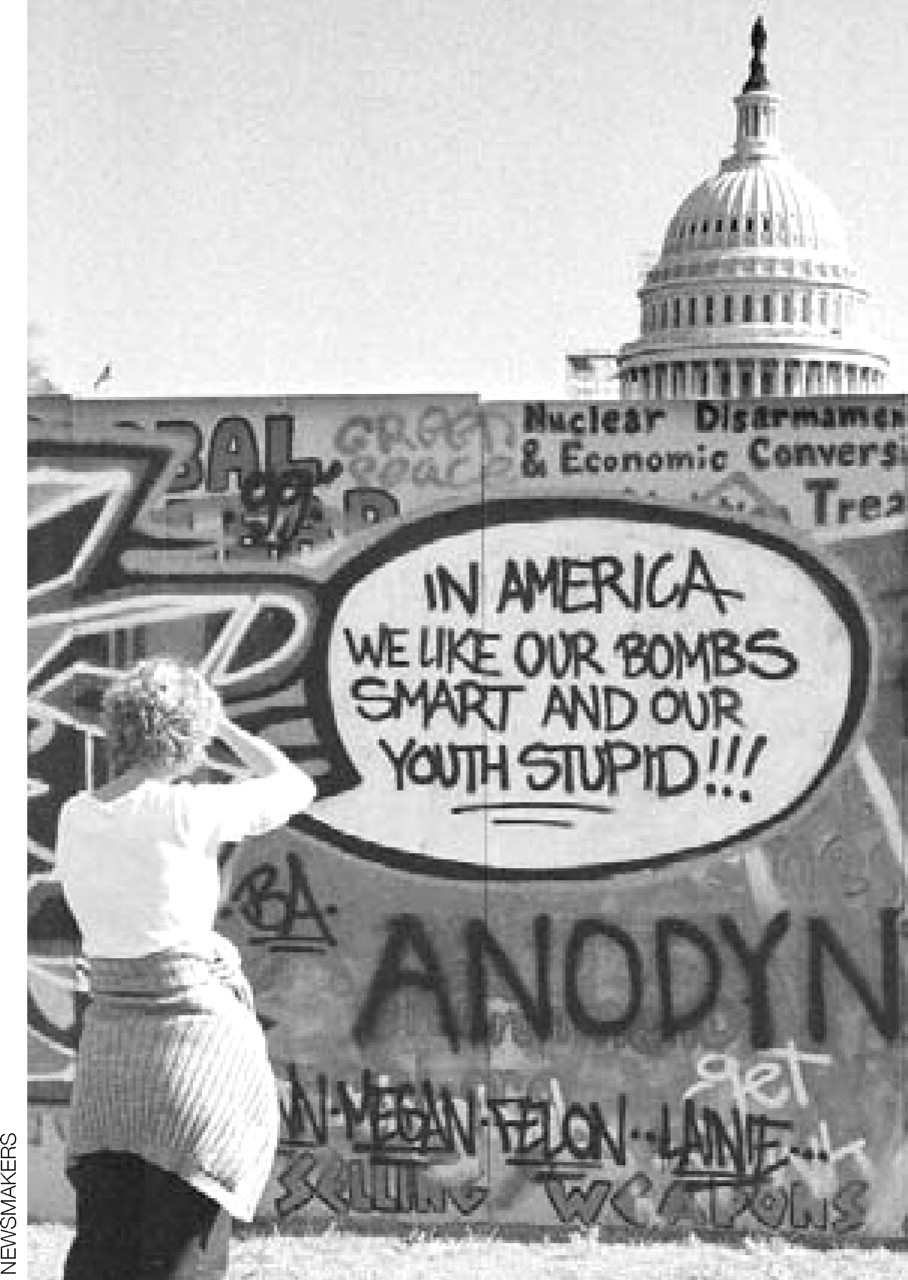
On June 12, 1982, more than 700,000 anti-nuclear activists marched in New York City to protest the deployment of intermediate-range missiles in Europe. How did the public express its “rage” in 1999? There was last summer's protest at Los Alamos National Laboratory marking the anniversary of the Nagasaki bombing. Approximately 400 protesters showed up. In November, Project Abolition constructed a “Wall of Denial” on the Washington D.C. National Mall to remind the public that the most dangerous relics of the Cold War–thousands of nuclear weapons–still exist. Over the course of a week, the group estimates around 3,000 visitors and tourists participated. Finally, there was the Nevada Desert Experience's “Millennium 2000” anti-nuclear event. It attracted 450 participants. While organizers were mostly pleased with these turnouts, and the sustained efforts of such groups is certainly commendable, the numbers illustrate how difficult it is to mobilize the masses on this issue.
“Well-honed” or atrophied? Today's peace activists march, but in much fewer numbers.
And while one might claim that this state of affairs simply reflects a general apathy toward global issues, other protests held last year–against the World Trade Organization, where more than 35,000 people took to the Seattle streets, and against the School of Americas, where 10,000 faith, labor, and student protesters converged at the gates of Fort Benning, Georgia–tell a different tale.
With all the issues still facing the anti-nuke movement, where have all the anti-war dissidents gone?
Beyond the bomb
David Cortright, president of the Fourth Freedom Forum in Goshen, Indiana, and executive director of SANE from 1977 to 1987, said activists have either moved to other issues or they've changed their tactics from public to political protest.
“Everything has changed since the end of the Cold War,” he told me. “Social movements always go in waves and cycles, and they all have what you might call the dilemma of success–when there's positive achievements, such as the nuclear reductions at the end of the Cold War, then you have a reduction in the amount of interest in the movement. Members fade away, money dries up, and activism diminishes.”
It's an inevitable trend, he added. As nuclear fear diminishes it becomes harder to mobilize people. But while those who follow peace issues are aware of the continuing dangers of nuclear weapons–some say, for example, that the likelihood of a nuclear weapon being detonated somewhere has never been greater–it could be worse. “The American people realize,” Cor-tright said, “that the chance of being ‘nuked’ in a competition with Russia is much less than it was, and they've moved to other issues.”
“There's been a proliferation of groups and causes,” agreed Jim Bridgman, research and resource coordinator for Peace Action. “People pick their one or two issues, and that's it.” He noted that even though some polls show more than 80 percent of the American public support the abolition of nuclear weapons, there are just too many issues–and the environment is usually the one people grab onto because it has a greater impact on their daily lives.
September 14, 1999: Peace Action director Gordon Clark leads a demonstration on the east steps of the capitol.
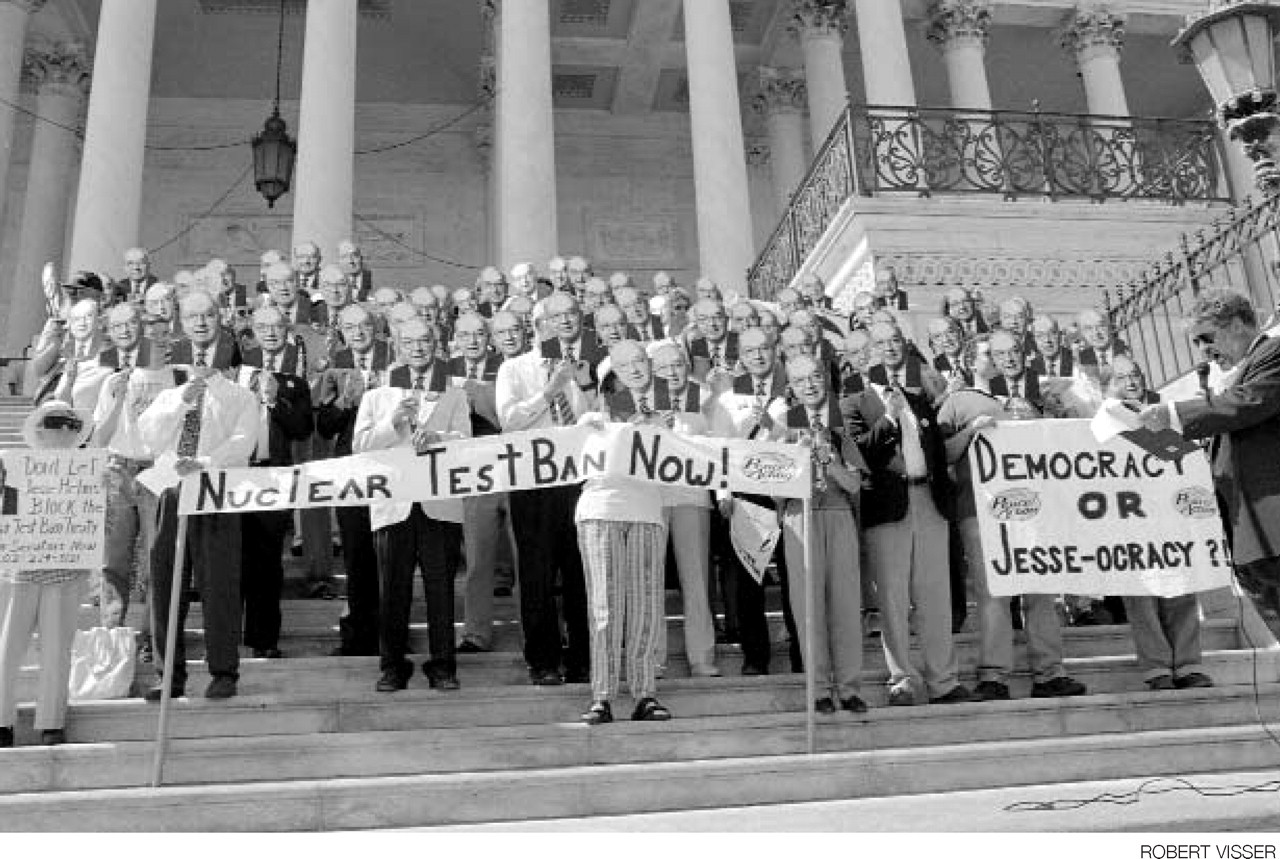
He also blames the media, which doesn't “play up” nuclear or foreign policy issues. “We saw more on defense and foreign policy [when the CTBT was being debated] than we've seen probably in the last two or three years combined, so without it hitting them over the head in their nightly news, other things are going to come up and take priority.”
“It's our job as a grassroots organization to reverse that trend, but the odds are against us,” he said.
Adam Eidinger, media consultant for Project Abolition, agreed that the media are partly to blame. In covering his group's “Wall of Denial” protest, the media never made the connection between nuclear weapons and the end of the Cold War–the reason for the demonstration. Instead, the coverage focused on democracy and human rights (“the Western triumphs” of the Cold War) rather than the difficulties ahead.
“I thought we had some momentum,” Ei-dinger said, “and in Europe and Germany the connection was made–but in the United States that didn't happen.”
Getting people's attention
John Isaacs, executive director of the Council for a Livable World, said, “We're clearly in a down time, but then, there are events that reactivate and reenergize the movement. If you go back to before Reagan, when Jimmy Carter was president in the late 1970s, it was also a down time, in particular when SALT II faltered and then was shelved.” Ronald Reagan turned things around for the movement by raising the military budget, proposing Star Wars, and breaking off arms control negotiations with Russia. Voilà. Suddenly some people were scared–and interested in nuclear weapons again.
Since the end of the Cold War and the dissolution of the Soviet Union, said Isaacs, the public has turned away from issues of global security to those in their own backyard, like education, crime, health care, social security, or the movement of nuclear materials through their communities (the so-called “mobile Chernobyl” issue), making it harder to recruit members into organizations like the Council for a Livable World:
“They may not realize that the Russians still have thousands and thousands of nuclear weapons, and the United States has 12,000 weapons, 6,000 of which are on alert.”
Isaacs also noted that the media and Congress have turned away in the last decade from foreign policy issues in general and nuclear issues in particular. “We're at a low point now, but it could be that fear and anger over the defeat of the test ban treaty–and perhaps the upcoming decision on the deployment of a national ballistic missile defense–may again energize and arouse the supporters of groups like ours. We'll have to see.”
“We got through that”
While parents may be occupied with school reform, and senior citizens fight for Social Security reform, and social activists promote the rights of the homeless, where are today's college students? In the past, student anti-war sentiment and protest were catalysts for the movement, or at the very least, sources for media coverage. But according to Paul Boyer, professor of history at the University of Wisconsin-Madison, and author of Fallout: A Historian Reflects on America's Half-Century Encounter with Nuclear Weapons, the big student issues currently focus more on humanitarian or environmental issues.
“On college campuses today, the big issue is sweatshop labor, which has that strong humanitarian appeal and is easy to grasp,” he said. “Compared to that, issues of nonproliferation and the CTBT are pretty arcane and require a lot of study. I get the sense that most people today, and certainly most undergraduates, tend to be drawn to issues that are more immediately accessible.”
It is also difficult to predict what will capture student attention on college campuses where the undergraduate population turns over every four years. “Each new wave of students wants to find its own issues rather than just take over the issues of the past,” he said.
The fear factor is also missing. “In the nuclear arms race, the fear of global thermonuclear war was the ultimate fear, so when the race ended in its classic form, people heaved a sigh of relief, thought ‘Well, we got through that,’ and never moved on to other pressing issues.”
Even during the Cold War, Boyer noted, there was not enough attention on other nuclear issues that were, and are, extremely urgent, because they didn't rise to the threshold of nuclear annihilation: “Apocalyptic books like Fate of the Earth, powerful as that was, contributed to the process of obscuring issues related to nuclear weapons, power, waste disposal, that also deserved a lot of attention but have gotten put on the back burner.”
“Take out the nose ring”
Linda Gunter, communications director for the Safe Energy Communication Council in Washington, D.C., is determined to capture as much media attention as possible for the movement. She holds media training workshops focused on getting both experienced activists–whom she often encourages “to not look so scruffy” when approaching the media–as well as newcomers to the movement to be more media savvy. For her, it's one of the keys to taking the movement to the next level.
While she often tells student activists to “take out the nose ring” so they don't fulfill the “establishment media's stereotype of the wacko extremist,” she also acknowledges that the movement needs young people to revitalize it.
“They've got all this energy and zeal,” she said, but “they're not seeing [the issue of nuclear weapons] as their issue.
“The young people want to know if there are fences to be climbed and lines to be crossed. They want it sexy and exciting and eventful, but if there are a thousand flyers that need to be passed out, it doesn't capture their attention.”
This is why, for example, the issue of genetically modified (GM) foods has captured so much attention on college campuses. “With GM they get to trash a corn field. We asked ourselves why GM captured their attention and I think it's just a microcosm of what's happening everywhere,” she said. “The whole process of winning a battle has gone away. They're not in it for the long haul.”
Gunter also acknowledged that there's not an understanding that nuclear weapons are still out there. “There's probably a greater danger now than there was during the Cold War,” she said, “but there's the impression that it's gone away … that it's been fixed. The kids think it's been dealt with–that it was their parents' issue. They just don't see it as their issue.”
And unlike the period after the Vietnam War, when there was a natural segue from the anti-war movement to the challenge of abolishing nuclear weapons, there isn't that clear connection between issues today. Today's kids are “phenomenally well educated on the green issues,” Gunter concluded. “It's the long-term issues such as global warming that seem to have grabbed them, while we see the short-term problem of nuclear weapons needing to be solved first.”
No apathy here: Protest organizers do get support—if it's the right issue. In Seattle last year, police used tear gas and rubber bullets to disperse thousands protesting a meeting of the World Trade Organization.

More than licking stamps
On the other hand, Dave Kraft, director of the Nuclear Energy Information Service in Chicago, thinks the peace movement could take some cues from student activists working on environmental and nuclear power issues. He said his wake-up call came last September–just after he had returned from the Nuclear Free Great Lakes Action Camp that he had helped organize–at the student-run E-Conference in Philadelphia.
The conference focused on the environment but encompassed a variety of related issues, including peace, and was attended by more than 3,000 student activists from around the country. Kraft said it hit him how readily middle-aged activists accept the legislative culture in which lobbying for peace takes place, instead of being moved to action by the necessity of the moment. At the conference, students wanted change, and they wanted it now. “Then there were those of us in our middle ages, and beyond, who have just gotten used to the legislative cycle and the horse trading. I realized it may not be enough to go to meetings on this treaty or that treaty. Perhaps the movement needs to take a cue from these students and say ‘the time is now.’”
When major prizes, such as the CTBT, fall victim to partisan politics, “Someone has to pay a price, especially when a movement puts 10 or 20 years into a project and then has it reversed in a matter of days. Our issues just can't tolerate this kind of setback.
“In the future it's not going to be enough to nod our heads and walk through the legislative process with our demands. We've thought we can do it from our side of the computer screen and it doesn't work. There's going to have to be a ticking time bomb on each issue. We've strayed too far from our roots.”
Kraft also believes that peace activists need to do a better job of inviting youth into the movement. “They want to be part of something that has meaning and value. They're eager and we need to invite them in; otherwise, they're just going to move onto their next field project.”
“Any movement that doesn't meaningfully incorporate the student movement is doomed,” he continued. “I get scared when I'm at a meeting and there's more and more gray hair. We need to invite the students in to give them a context and history to work from. Not just to lick stamps.”
Peeling back the wallpaper
It's not all gloom and doom. Fourth Freedom Forum's Cortright points to the Los Alamos Nagasaki demonstrations last summer as a positive sign. “It was the first time that I'm aware of where a major demonstration took place at the heart of the beast where nuclear weapons are being maintained and where there are plans to start producing new plutonium pits in the near future.”
Still, the media doesn't know how to cover such events, and while the summer demonstrations at Los Alamos got substantial regional coverage, the national media didn't pick it up as a major event. Part of the problem lies in the lack of identifiable players in the movement. “Greenpeace is not a player in the United States anymore and they've traditionally been an organization the press has gone to for commentary or action. The groups that are around–such as Peace Action and PSR [Physicians for Social Responsibility] are not known by the press as significant players,” he said.
But more than anything, Cortright noted that since the end of the Cold War, “nuclear consciousness” has receded even further.
During the Cold War he called it the denial phenomenon–even though the press reported on nuclear and foreign policy issues night after night, people chose to deny the danger. It was too scary.
Now that the perceived threats have diminished and are not in the news as much, “It's receded further and further so it's like an old layer of wallpaper. We've papered over the previous layer and we don't even see it anymore,” he said.
What it's going to take
The way out, according to Cortright, is to move the issue away from politics, making it a moral, and therefore a technical, issue. “If we could accept the need to reduce down to zero as public policy, then the issue could move beyond politics and we could address the technical matters, such as how we do it, not if,” he said.
A culture of insecurity holds the process up, he noted, as well as a leadership that still believes that nuclear weapons provide security and that the Cold War was won by nuclear weapons. The Soviet Union “really collapsed under the weight of its own inefficiencies,” he said.
Cortright added that the next step is to make the argument that security in the post-Cold War era does not depend on nuclear weapons and that you just can't effectively deter terrorism with weapons of mass destruction. “We need to tap the underlying moral and cultural sense … that it's wrong to base your defense on the threat to annihilate millions of innocent people.
“We need to spark a sense of hope and vision of a better tomorrow if we want to get rid of these weapons. It's a different kind of movement that doesn't just protest what's wrong but creates a vision and sense of hope for a better, safer, and more secure world. Then we can get on to the urgent needs of this planet. This is the most glaring unfinished business and the greatest challenge to address in the new millennium so we can get on with the business of evolving as a human family.”