



Abstract
After a decade of tension and instability, a spirit of cooperation would come as a great relief to most Russians.
For the first time since the painful but peaceful dissolution of the Soviet Union in December 1991, a Russian leader is likely to receive nationwide, consensus-type support. It seems most likely that when Russia's presidential elections take place on March 26, Acting President Vladimir Putin will be able to drop the first word of his title.
Most observers believe that Acting President Vladimir Putin will become Russia's next president.

It is also likely to be the first time that the parliament–the Federal Assembly, whose new members of the lower house, the State Duma, were elected on December 19–will be willing to join in a truly cooperative effort with the executive branch.
About time
After a decade of tension and instability–which in 1993 turned into direct confrontation between the two branches, with tanks firing at the parliament building–a spirit of cooperation would come as a great relief to most Russians. It would also encourage a new generation of Russian policy-makers who back Putin because they believe he will act decisively and energetically to achieve a market economy and democracy.
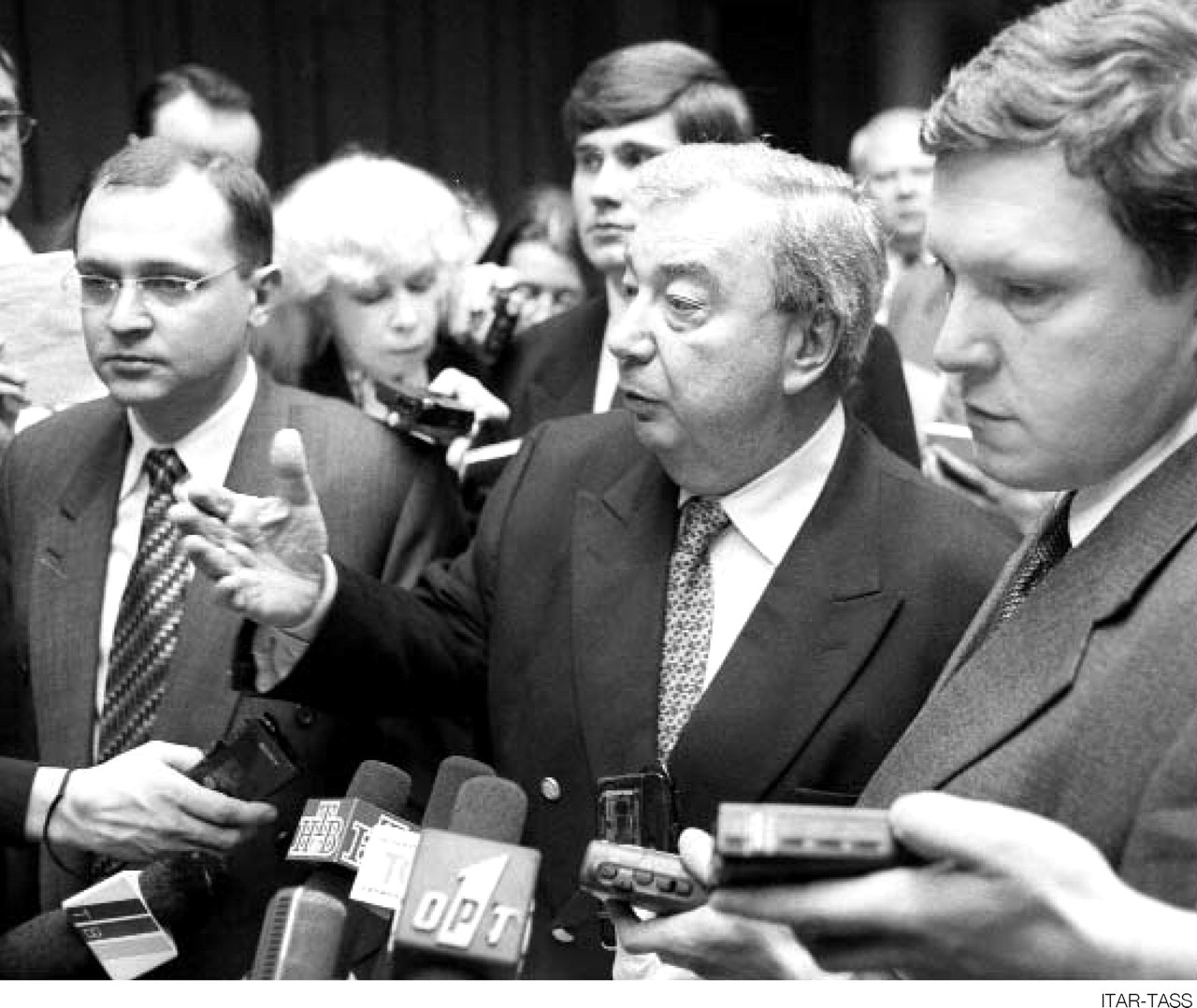
January 19, 2000: Segei Kirienko, Yvgeny Primakov, and Grigory Yavlinsky (left to right) answer questions after a meeting of the Russian Coordinating Committee, a group formed by their parties to protest the election of Gennady Seleznyov as the Duma speaker
If Putin is elected, it will at least offer Russia a chance to enter into an era of predictable de-velopment–in sharp contrast with the “Russian bear” behavior of the last three or four years, which has included a number of declarations about “Russian national interests” but few attempts to identify what those interests are or how to defend them.
Although the domestic agenda–the economy, social issues, and Chechnya–has dominated the run up to the presidential race, issues related to national security and international politics have attracted more public attention than they did during the elections to the Duma.
The new State Duma is already a part of the Russian political landscape, and a brief tour of the composition and intentions of its major political factions should make it possible to better understand the views held by key political figures in the various parties concerning national security policy.
The interactions of the major factions in the newly elected parliament will probably be similar to those of the Duma elected in late 1993, after the previous parliament was disbanded by Yeltsin. None of the parties had a sustainable majority in that period, and from 1993 to 1995 the legislative body's decisions were usually compromises that involved complicated combinations of interests and concessions.
This year, the various factions and groups within the parliament will likely reach agreement on matters about which there is public consensus, including environmental and nuclear safety and security issues and the implementation of agreements eliminating chemical weapons, primarily the Chemical Weapons Convention.
Start II also has a better chance of ratification, although its implementation may be impeded if the United States goes forward with national missile defense deployment.
Putin's faction in the Duma–Unity–has formed a tactical alliance with the Communist Party. These two major voting blocs may be able to adopt some legislation without having to seek the support of the smaller parties. The alliance is more likely to help than hinder the ratification of arms control agreements.
Last December, the parties ran on simplistic platforms when it came to national security and foreign policy issues in general and nuclear weapons in particular. They knew that most voters were much more interested in domestic policy.
Some movements (especially the Union of Rightist Forces–the most liberal and democracy-oriented group in the new parliament) managed to complement their internal policy agenda with a national security agenda, but the majority of parties (including the Communist Party of the Russian Federation and the Fatherland-All Russia party) preferred to avoid these issues. Most political parties and movements said little about the national security agenda.
The parties
In the 1999 elections, the
At the same time, the group recognized that “protracted armed conflicts along our borders make increased demands,” and that a Russian military presence was important “to maintain national security, including in the form of U.N. and C.I.S peacekeeping operations.” The nuclear deterrent was also key (and should become more Eastern-oriented). At the same time, party leaders were more articulate than others on the need to cooperate with the West on threat reduction-related programs.
The party's program states that “arms control issues remain the only area of international affairs where Russia's role is not only large, but indispensable.” Yabloko concludes that in the near future Russia faces no threat of large-scale military aggression. Yabloko also argues that, because of the nuclear deterrent, Russia need not maintain parity in conventional arms with NATO.
According to Yabloko, in both the mid-and long term, Russia needs to be alert to a possible Asian challenge. The party believes that even in times of economic crisis, a reliable nuclear deterrent should be maintained, and that sub-strategic nuclear forces can compensate for smaller conventional armed forces and deter large-scale, non-nuclear aggression. Yabloko assumes that in the future more resources should be allocated to the least vulnerable units of the nuclear forces (mobile land-based systems and missile submarines on active duty) and to early warning systems and command and control. The latter should be given more priority than the weapons, since its importance will continue to grow as nuclear arms reductions continue.
Yabloko favors START II ratification. Under current economic circumstances, it argues, Russia cannot maintain parity with the United States under the conditions of START II; therefore it proposes that negotiations on START III begin at the earliest possible date.
Communist leader Gennady Zyuganov, an early Putin challenger, pictured here in the Federation Council, Russia's upper house of parliament.
In early 1999, Yabloko leader Grigory Yavlinsky proposed the development of a “non-strategic missile defense” for both the European part of Russia and the East (engaging Japan in the process).
Although the
Nonetheless, the movement maintains that “Russia's national security interests cannot be realized without nuclear weapons. Nuclear arms serve as the means to deter external aggression and are required to ensure global stability.” At the same time, “nuclear weapons cannot provide Russia with a sufficient range of power resources to accomplish the national security tasks. This is why it is necessary to keep a reasonable balance between nuclear deterrence and conventional armed forces.”
Like many other parties and movements, this party believes that “Russia should oppose the proliferation of weapons of mass destruction and missile technologies and should develop its export control system for that purpose.”
Although the
In its condemnations of the air raids on Iraq in December 1998 and the NATO air campaign against Yugoslavia last spring, the Communist Party ruled out the possibility of START II ratification. The party also supported Belarus's proposal to deploy Russian nuclear weapons on its territory. The Communist deputies also set forth amendments to the federal bill “On the START II Tr eaty Ratification” delineating the financial conditions of the treaty and requiring stronger assurances from the United States concerning its commitment to both START II and the ABM Treaty.
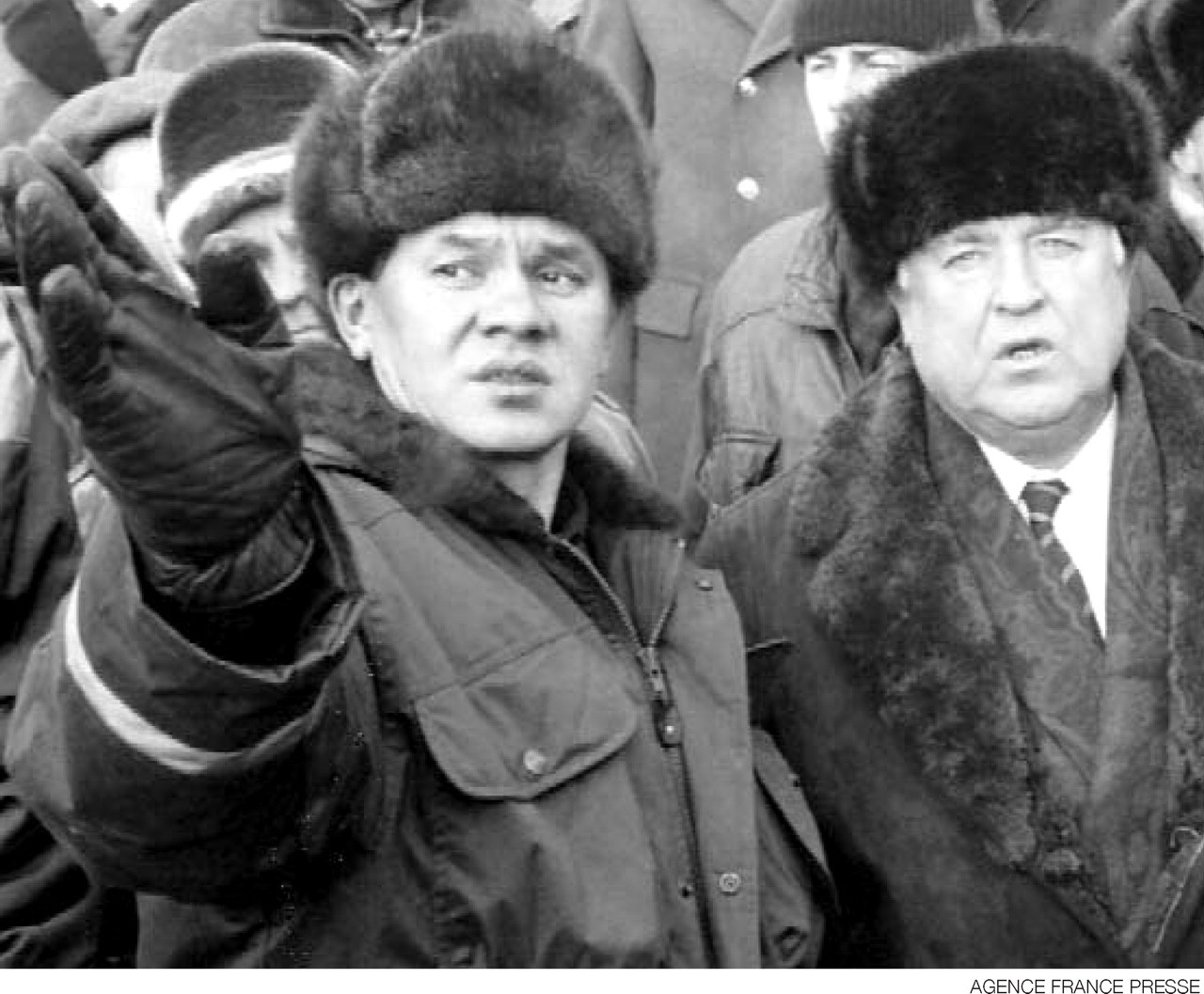
December 1997: Former Prime Minister Victor Chernomyrdin (right) and Emergency Minister and Unity Party leader Sergey Shoygu at the site of an aircrash in Irkutsk.
During the Duma elections, the
In general, however, the party's program and its leaders' statements on nuclear weapons often resemble simple slogans and are subject to considerable variation. For instance, Deputy Chairman of the Duma's Defense Committee Mikhail Musatov argued at the party congress that the party “will never back START II and will always oppose its ratification.” Yet on March 3, 1999, Vladimir Zhirinovsky argued that his party was “the only party that has used today the Duma's rostrum to support the realization of this proposal on strategic arms limitation–to facilitate the START II ratification.” At the following press conference, Zhirinovsky, considered an extremist and foreign policy hard-liner, confounded observers by suddenly appealing to President Yeltsin to urge other world leaders to take measures for general and complete disarmament.
In the Duma elections,
It had no particular program concerning nuclear weapons, and its leader, Minister of Emergencies Sergei Shoygu, refrained from expressing his opinion on nuclear issues. However, in the course of his campaign tours and his statements to the mass media, Shoygu did stress the need to strengthen defense.
If Unity manages to preserve its organizational coherence, this bloc will no doubt formulate a full-fledged program that includes its leaders' views on foreign policy issues and the future of nuclear weapons.
The principal player
The leaders of the major political movements–Evgeny Primakov of Fatherland, Gennady Zyuganov of the Communist Party, Vladimir Zhirinovsky of the Liberal Democrats, and Grigory Yavlinsky of Yabloko–are likely to act within a relatively narrow framework that reflects the public consensus on national security issues. That consensus includes the belief that:
• Russia can preserve its Great Power status only by a strict effort to maintain unity;
• The maintenance of nuclear weapons is critical if Russia is to maintain its influence on world affairs and resist the pressure of an expanding NATO;
• Russia's partnership with the West has weakened its position in the world and has borne no substantive fruit to the state or to the people;
• Despite all its difficulties in its relations with the West, nothing is to be gained by confrontation;
• Given its national interests and international commitments, Russia should develop and strengthen a weapons-of-mass-destruction nonproliferation regime.
Although the men mentioned above will remain principal players in Russian national politics, Vladimir Putin will almost certainly be elected president, barring a disaster in Chechnya.
Putin has been called a “black horse,” a “gray KGB person,” the “strong man of the Chechen war,” and an “anti-Western politician.” But how accurate are these labels?
On occasions during his rapid rise to power he has taken a hard-line policy toward the West. But as head of the Federal Security Service (FSB), and later, as secretary of the Russian Security Council, he demonstrated impressive diplomacy in dealing with Americans on arms control matters and with Israelis on export controls. His public image has always been more anti-Western then his actions.
In fact, Putin began his public career dealing with nuclear issues. In April 1999, after a meeting of the Russian Security Council, Putin briefed the press. He said the council had dealt with three major problems: nuclear deterrence policy, the security of the Russian nuclear program, and the benefits due employees of the nuclear weapons complex. Putin also said the participants had discussed the issue of nuclear tests, which he described as “a complicated issue.” He pointed out that Russia had been the first to declare a ban on testing and had the longest history of not conducting tests. But, he said, this caused certain difficulties for Russian nuclear weapons experts. He stressed that Russia would observe all of its international commitments.
On August 4, 1999, Putin talked by telephone with U.S. National Security Adviser Samuel Berger. He emphasized the importance of increasing the level of U.S.-Russian cooperation on nonproliferation and export controls, and expressed Russia's commitment to strengthening those controls. Although Russia had accepted U.S. concerns about the issue, he said, U.S. sanctions against a number of Russian enterprises remained in place. He expressed the hope that the matter would be resolved in the near future.
On August 30, 1999, Putin participated in the celebration of the fiftieth anniversary of the first Soviet nuclear test. In his speech on the occasion he mentioned the following issues:
• Efforts must be made in the next five to seven years to preserve the Russian nuclear weapons complex.
• Since its first nuclear test, the Soviet Union stood for a ban on nuclear weapons. The measures it took to modernize and improve the nuclear arsenal were always a response to external challenges.
• Russia continues to support the idea of complete nuclear disarmament.
• In September 1996, Russia signed the Comprehensive Test Ban Treaty. Russia was now preparing to ratify the treaty, which is in the nation's vital interest.
It was a real surprise to the analysts that Putin, surrounded by a large crowd of pro-nuclear officials from the military-industrial complex, did not hesitate to mention more than once that Russia was in favor of nuclear disarmament.
The public was also not aware that Putin was a longtime member of the democratically minded, liberally oriented wing of the Yeltsin government, or that he had sometimes served as mediator between young liberal reformers and conservative military and intelligence officers. His behavior has been characterized as pragmatic.
Putin has been widely viewed, both outside and inside Russia, as a leader of the anti-Western movement–or, at least, as the leader of a movement aimed at restoring Russia's Great Power status.
Vladimir Zhirinovsky displays his new Duma deputy identification card, received at a January 11 Central Election Commission ceremony.

Any deviation from this image would result in his losing the support of a considerable number of voters, which is why Putin will continue his polemics with the West (at least in the form of political statements and declarations), especially on issues concerning territorial integrity, which is particularly popular with the voters. Putin's first significant decision as acting president was to sign Decree No. 24 of January 10, 2000, approving the “Concept of National Security of the Russian Federation” which delineates a policy of greater reliance on nuclear weapons and confirms the earlier renunciation of a no-first-use policy.
Nonetheless, the acting president can afford to be more flexible when it comes to issues like nuclear security, nuclear nonproliferation, and export controls. Putin is sure to promote the ratification of START II. It is not by chance that in the first hours after Yeltsin resigned, Putin issued a statement emphasizing the importance of the arms control dialogue with the United States, stressing that ratification is in Russia's national interest.
And it is likely that the new Duma will follow Putin on the START II matter. Even those members of parliament who have expressed their opposition to the treaty now say, unofficially, that they will vote for it–not because Putin supports it, but because they do not believe the treaty will enter into force any time soon: The U.S. Senate has not yet ratified the New York Primakov-Albright protocols, and it is now a common belief in the Russian corridors of power that the Senate will not do so, at least not in the foreseeable future.
Although many analysts say it is unrealistic to expect any major changes in the Russian-U.S. relation, it is realistic to expect the new president to rebuild the Russian-U.S. security dialogue, which has been so damaged and devalued in recent years. It is likely that Putin will spend considerable effort in the year 2000 to improve the bilateral relationship. His policy on national missile defense and the ABM Tr eaty is not yet clear, but at a minimum he will want to sign a START III treaty while Clinton is still president.
The arrangement with the Communists will be convenient: If Putin decides to promote the ratification of arms control agreements, with the help of the Communists he will easily attain a majority and will be able to take credit for a major foreign policy success. On the other hand, if for some reason he decides to delay the ratification of START II, he can blame the Communists for the delay.
This good cop-bad cop scenario is already playing out. Even as Russian and U.S. teams were meeting in Geneva in January to discuss strategic arms reductions and an ABM/NMD-re-lated agenda, Duma Speaker Gennady Se-leznev declared that “Russia's State Duma has no immediate plans to ratify the START II nuclear disarmament treaty.”
Very little is known about Putin's personal life. But Russians regard that as a good sign–they are tired of Yeltsin's scandals, as well as scandals concerning his family and their Swiss or Grand Cayman bank accounts. Also, little is known about Putin's team–but then people are also tired of the scandals concerning the corruption of Yeltsin's “inner circle.” Most Russians would prefer a leader to be strong enough to ignore attempts by his supporters to establish a new “inner circle” in the Kremlin. As Putin closes in on full presidential powers, however, it looks as if his chief of staff, Dmitry Kozak, may form the nucleus of a group of “Putin's St. Petersburg friends.”
In any case, the election of Putin in March will usher in a new era in Russian-U.S. strategic relations, one based on a more solid political and economic foundation. As Eugene Rumer, formerly with the U.S. State Department, wrote in early January about the Yeltsin-era relationship (“Getting Real About Russia,” IntellectualCapital.com), “The partnership [between the two states] was hollow. It was built on promises and personal preferences … not accomplishments…. The partnership of summit declarations had neither the political nor economic foundation, nor the commonality of strategic purpose, required for a true partnership between nations.”
Being vitally interested in renewing the Rus-sian-U.S. relationship and extending the START process, Putin as president will start one step ahead of the Americans whose presidential races occur later in the year. As some analysts, like Nikolay Sokov from the Center for Non-proliferation Studies in Monterey, now predict, “Russia [under Putin] will continue negotiations [on ABM/NMD], but will not agree to just any deal, contrary to the expectations of many in this country. The burden of choosing between compromise and withdrawal from the ABM Tr eaty will fall to the United States.”
One cannot yet judge what the Putin style in foreign policy will be. But he will be a reliable and predictable, though tough, negotiator. It is very unlikely that he will play the part of an arms control and nonproliferation terminator. He is more likely to try to agree on changing the rules of the game or ignoring the game altogether, rather than violating the rules or pretending that he does not know that the rules have been established.