



Abstract

“Dr. Lee, I tell you with great sadness that I feel I was led astray last December by the Executive Branch of our government through its Department of Justice, by its Federal Bureau of Investigation, and by its United States Attorney for the District of New Mexico…. Although, as I indicated, I have no authority to speak on behalf of the Executive Branch, the president, the vice president, the attorney general, or the secretary of energy, as a member of the third branch of the United States government, the judiciary, the United States courts, I sincerely apologize to you, Dr. Lee, for the unfair manner in which you were held in custody by the Executive Branch.” 1
Lee outside his home the morning after his release from solitary confinement.
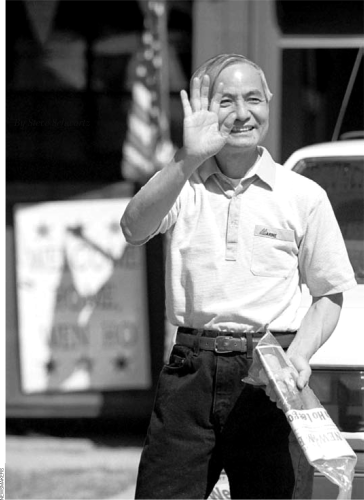
With that extraordinary statement on September 13, Judge James A. Parker ended the latest chapter in the saga of United States of America v. Wen Ho Lee. After 278 days in solitary confinement in the Santa Fe County Detention Center, Lee, the soft-spoken 60-year-old scientist from Los Alamos National Laboratory, was finally free to go home.
Outside the courtroom, Lee told reporters, “I'm very happy to go home with my wife and my children today. And I want to say thank you to all the people who support me. I really appreciate very, very much. And for the next few days, I'm going fishing.”
On December 10, 1999, Lee was indicted on 59 felony counts of mishandling national security information. Under the Atomic Energy Act, 39 of those counts—which charged Lee “with the intent to injure the United States, and with the intent to secure an advantage to a foreign nation”— carried a sentence of life in prison. On September 13, however, Lee pled guilty to just one count, and was sentenced to time served.
Assistant U.S. Attorney and lead prosecutor George Stamboulidis attempted to explain to Judge Parker how a man the government had previously argued was so dangerous that he could not be released on bail even under close supervision and electronic monitoring could now be sent home without any monitoring at all. He argued that what was of paramount importance was that Lee had agreed to cooperate with government investigators, to explain in detail why he transferred 806 megabytes (about 430,000 pages) of complex computer codes used to simulate the behavior of nuclear weapons from a secure to an unse-cure section of the Los Alamos computer network and then downloaded the data onto portable computer tapes known as IBM 6150s, each of which can hold 150 megabytes of data.
“The plea and cooperation agreement gives us the best chance to find out with confidence precisely what happened to the classified materials and data that the defendant down-partitioned and downloaded onto unsecured tapes. As it has been clear throughout this prosecution, for national security reasons, the location and fate of the tapes was always our transcending concern…. Had this case proceeded to trial and resulted in a conviction on all counts, the defendant might have faced many years in prison, but we might never have learned exactly what happened to those tapes.”
Stamboulidis further asserted that the plea agreement would serve as a deterrent to others “who are entrusted to work on our nuclear weapon design codes … not to violate that sacred oath and trust for any reason, as unfortunately happened here.” Finally, Stamboulidis stated that settling the case “avoids the public dissemination of certain nuclear secrets.”
Judge Parker remained unconvinced. “Throughout this case, the government has repeatedly questioned the veracity of Dr. Lee. You're saying now, simply because he has given a statement under oath, that the government no longer believes he is a threat to national security?”
“It's not simply that he's given a statement under oath,” replied Stam-boulidis. “It's that he has agreed to cooperate in ways that anyone who is intent on lying to the government would do so at great personal risk and would be far worse off than he was under the existing indictment.” 2
But as Judge Parker noted, and as Lee's lawyers remarked to the press after his release, Lee had been willing to cooperate with the government for months, even before he was indicted. The government, for reasons it has not yet divulged, shunned his repeated offers and refused to negotiate on the terms of his cooperation (which Lee's lawyers appear to have put forward as much for public relations purposes as for a genuine effort to resolve the case without a trial).
Much ado about not so much
The government never had much of a case against Lee. When I wrote about the case last year (“A Very Convenient Scandal,” May/June 1999), I quoted an unnamed official who told the New York Times in mid-March, “The guy violated some rules and was fired for doing that. But we really don't know what his motivations were…. We really don't know enough about what he did.”
But if Stamboulidis and his fellow prosecutors are sincere—that their primary objective was always to ascertain and contain the potential damage caused by Lee's actions—it's hard to understand why they did not do more to cooperate with Lee. After all, he volunteered many times to help clear up the mystery, including offering to take a polygraph test on the matter of the missing tapes.
In retrospect, the government's actions appear to have been aimed at “breaking” Lee in order to make an example of him and force him to cooperate. How else to explain a 59-count indictment, the first time anyone has ever been charged under the 1954 Atomic Energy Act?
The unusual conditions of his imprisonment seemed designed to intimidate him—or perhaps they were designed to convince the court that he was extremely dangerous.
In any case, they were harsh: solitary confinement; so little food that Lee (a colon cancer survivor) complained he was constantly hungry; leg and wrist shackles whenever he left his 13×7-foot cell (including when he was allowed to exercise one hour a day, five days a week); no more than a one-hour visit each week with his family while separated by a glass partition and under constant surveillance; a dim blue light left on continuously over his cell.
(Energy Secretary Bill Richardson, asked on NBC's Meet the Press if he agreed with Judge Parker that the government's treatment of Lee was a national embarrassment, said, “No, I disagree with that. Confinement, shackles, I wouldn't have done that.” But the Washington Post reported on the very same day that “Richardson … signed a directive for jail authorities to keep Lee in solitary confinement, segregated from other inmates through whom he might be able to communicate with the outside world…. ‘We pushed for solitary confinement to make life as difficult as possible, because if he were sent home, there would not be a lot of incentive for him to come clean,’ said one senior official, speaking on condition of anonymity.” The Justice Department, in turn, directed that Lee be placed in the jail's “administrative segregation unit,” which is usually reserved for “disruptive or dangerous detainees.” 3
Once Lee's lawyers began to methodically disassemble the prosecution's case, these tactics worked against the government. In the court of public opinion, they had the unintended effect of making Lee a martyr and a rallying point for both the Asian American and the scientific communities.
Lee initially became a suspect in 1995 in connection with the apparent theft by China of information pertaining to several U.S. nuclear warheads, including the W88. While investigating, officials inadvertently discovered that Lee had downloaded a large quantity of data onto portable tapes.
Information contained in a 1988 Chinese document that was brought to the attention of the United States by an agent working for China's intelligence service included very precise measurements of several U.S. nuclear weapons, including the W88. The data for the W88 included its yield, weight, and length, as well as descriptions of the warhead's atomic bomb trigger as aspherical or egg-shaped and of the hydrogen fuel components as spherical.
For reasons that have not been adequately explained, Energy Department investigators, led by Notra Tru-lock, focused only on the W88 data. (Ironically, Trulock resigned from his job at Energy last year, saying he was tired of attacks on his credibility and upset that an inspector general's report did not back up his charges that senior Clinton administration officials were to blame for failing to correct lax security at Los Alamos. Trulock is now under investigation by the FBI for possibly using classified information in an unpublished manuscript he was writing about the espionage investigation.)
Investigators at Energy and the FBI narrowed the field of suspects by looking only at Los Alamos and only at individuals who had traveled to China between 1984 and 1988, when China was presumed to have acquired the information.
But there were a number of problems with this approach. The President's Foreign Intelligence Advisory Board found last year that detailed information about the W88 was widely available inside the government and military as far back as 1983. 4 And a reinvestigation by the FBI last year found small but telltale errors in some of the measurements in the Chinese document that were traced to a document that did not originate at Los Alamos. 5
Robert Vrooman, head of counterin-telligence at Los Alamos from 1987 until 1998, discovered that one secret document describing the W88 had been sent to 548 addresses, including addresses at the Defense Department, the navy, Energy, Sandia National Laboratories, Lockheed Martin (which builds the Trident II/D-5 missiles that carry the W88), and even the National Guard. 6
Lee's lawyers produced evidence that a number of individuals at Los Alamos had had access to the same data Lee did and had also traveled to China, but were never considered suspects. Some of these people were Caucasian, raising the possibility that Lee was investigated because of his ethnicity (even though he was born in Taiwan, a longtime foe of China, and still has relatives there).
As Sen. (and Democratic vice presidential candidate) Joe Lieberman of Connecticut remarked on August 5, 1999, after the release of a detailed statement based on nearly 13 hours of closed door testimony from 20 witnesses before the Senate Governmental Affairs Committee, “The bottom line is that the U.S. government's investigation into the loss of the W88 nuclear warhead design information was not a comedy of errors, but a tragedy of errors. And unfortunately, it is a tragedy with very serious and continuing consequences. If … the failure to more competently investigate this case means that we have wrongly focused on Dr. Lee, then the person or persons who actually passed the W88 information to [China] are still out there—indeed probably still working for the U.S. government in jobs with access to the most highly classified information our government possesses.” 7
The final collapse of the case against Lee began this summer, as Judge Parker granted several motions by Lee's lawyers and as new evidence emerged over three days of hearings in August on whether to grant bail. In a defeat for the government, Parker ruled that Lee had the right to introduce a version of some or all of the codes he downloaded, as well as sanitized versions of other related classified information, in order to demonstrate that the codes themselves were not highly sensitive, that they were not blueprints of nuclear weapons, and that flaws in the codes rendered them something less than the “crown jewels,” as Richard Krajcik, deputy director of Los Alamos's X-division, had characterized them at Lee's first bail hearing in December 1999.
Parker also ruled that Lee was entitled to government documents that would support his contention that he was targeted primarily if not wholly because he is an Asian American. Finally, Parker ordered the government to reveal which country it suspected Lee of attempting to aid. In response, the government listed China and Taiwan, as well as France, Switzerland, Australia, and three others—countries where Lee was said to have considered seeking work when it appeared that his job at Los Alamos might be eliminated in the mid-1990s. 8
Some of the first serious cracks in the case had appeared in April, when the Albuquerque Journal reported that most if not all of the information Lee downloaded had not been reviewed and was not formally classified as secret restricted data. The information was instead categorized by the acronym pard: Protect As Restricted Data. (Pard is not a classification level per se but “a handling method for computer-generated numerical data or related information, which is not readily recognized as classified or unclassified because of the high volume of output and low density of potentially classified data,” and ranks between unclassified and confidential, the lowest level of classification.) Lee's lawyers argued that regulations permitted such information to be shipped by ordinary mail, raising doubts about just how sensitive it could be. Only after Lee was fired, and after investigators stumbled on three of the downloaded tapes in his office, was the information re-classified as secret restricted data. 9
The battle of the experts
In July, the defense submitted declarations to the court from Harold Agnew, director of Los Alamos from 1970 to 1979, and from Walter Goad, a Los Alamos emeritus fellow. 10 Agnew and Goad both disputed statements made by prosecution witnesses at Lee's first bail hearing in December concerning the value of the codes Lee had downloaded. Agnew wrote that China, Russia, and any other nuclear power would find the codes of very limited utility because they would have developed their own codes based on their own designs. “No nation would ever stockpile any device based on another nation's computer codes.” Agnew also noted that “most, if not all” of the codes in question had been modified after all of the weapons in the current U.S. nuclear stockpile were deployed. Thus, China “or other foreign powers should not assume that these codes were the exact codes used for existing nuclear weapons that have been tested.”
From Our Files
“A number of graduate science students, particularly physics students from China, are being deported back to China by the Immigration Office. We hear that the reason for this is their membership in organizations whose top leadership in America has allegedly been infiltrated by elements in sympathy with the communist regime. It is not asserted that either the local groups to which they belong, nor the students themselves are communist followers, and some of the deportees assert that their anti-communist associations will probably cause their arrest and persecution upon their return to China…. By this action the U.S. Office of Immigration presents the Chinese government with a valuable addition of exceptionally gifted and well-trained people to its meager scientific manpower and deprives the American scientific manpower of a small but potentially quite useful addition.”
—March 1951
Goad criticized the testimony of both Stephen Younger, associate director for nuclear weapons at Los Alamos, and Paul Robinson, president of Sandia National Laboratories, calling it “grossly misleading.” During Lee's initial December 1999 bail hearing, Robinson told the judge that the data downloaded by Lee was so valuable, and the likelihood that he might share it with another country so high, that granting him bail was a “you-bet-your-life decision.” Instead, said Goad, “The scientific knowledge and computational expertise required for nuclear weapons design is now widely dispersed. Therefore, any nation with a substantial scientific establishment is capable of designing nuclear weapons on its own…. At most, the U.S. codes and data could augment, not revolutionize their efforts.”
Testifying in person, John Richter, a senior weapons designer at Los Alamos until his retirement in 1997, pointed out that 99 percent of the downloaded data were available in the unclassified scientific literature. (In late September, Richter told the New York Times he was referring only to the software and physics that underlie the codes on Lee's tapes, not to other weapons-related data Lee also downloaded. Even so, he continued to maintain that the government's witnesses had grossly exaggerated the risks posed by Lee's actions.) 11
Such high-level disagreement took prosecutors by surprise. “We wouldn't have [sought an indictment] if we thought it would come down to a battle of experts,” a government official later told the Washington Post. “It always hinged on the value of the information.”
During the August bail hearing, the government's case suffered more blows when the defense demonstrated that the testimony of FBI agent Robert Messemer had been in error at the original bail hearing. Recanting his December 1999 testimony that had helped persuade Judge Parker to deny bail, Messemer admitted that Lee had not told the colleague whose computer he used beginning in 1993 to assemble the portable tapes that he wanted to download his resume, only that he wanted to download some files. Mes-semer had twice testified that Lee had misled his colleague about why he wanted to use the computer, an action Messemer characterized as deceptive and highly suspicious. 12
Lee's lawyers also demonstrated that far from acting furtively, Lee had done nothing to hide more than 40 hours of downloading over 70 days from the computer security monitors he knew were watching. He gave the downloaded files names that clearly indicated what they contained. The files stayed on the Los Alamos open network for as long as six years, where anyone could have found them. And when Lee started deleting some of the files in January 1999, he called the computer help office at Los Alamos to request assistance in wiping the files from the computer.
These facts, his lawyers argued, painted Lee as, at worst, a naïve and sloppy scientist, not a nefarious spy. His lawyers also elicited testimony that Lee seldom visited the vault in X-division where full-scale models of nuclear weapons are kept—something presumably of interest to a spy—and that by all accounts he focused on his work to the exclusion of almost everything else, including any interest in international politics. They also produced a report he submitted to officials at Los Alamos following his trip to China in 1986, flatly contradicting another claim in Messemer's earlier testimo-ny—that Lee had not told officials about his contacts with senior Chinese nuclear weapons officials. (Messemer admitted he had not read the report.) 13
By now, the government's case, never strong to begin with, was melting down. Rather than accusing Lee of intent to commit espionage, the government was now alleging that he made his tapes as part of a job search effort, perhaps as a way to impress prospective employers. But that justification evaporated when Lee's lawyers forced Messemer to admit that although the FBI had found letters from Lee to numerous overseas institutes and companies inquiring about employment opportunities, it had no evidence, even after searching overseas, that any of the letters were ever received. (However, just six days after Lee left jail, the San Jose Mercury News reported that “prosecutors have a copy of a letter Lee wrote to someone in Japan in 1994…. In the letter, Lee thanked the recipient and mentioned he had written to institutions in Taiwan, Germany, and Japan, and had heard back from two of them. ‘It confirms that the letters were sent,’ Stam-boulidis said.” Curiously, Japan was not on the government's list of countries Lee was accused of trying to help.) 14
Further damage was done by written declarations from Vrooman and Charles E. Washington, the former acting director of counterintelligence at Energy. Washington, who had worked with Notra Trulock, wrote that he believed Trulock “improperly targeted Dr. Lee due to Dr. Lee's race and national origin,” that Trulock never had strong evidence to identify Lee as a suspect, and that Trulock “acts vindictively and opportunistically, that he improperly uses security issues to punish and discredit others, and that he has racist views towards minority groups.” At one point, Washington himself had sued Energy over Trulock's behavior toward him (Trulock spit on him), a case settled in Washington's favor this year.
With regard to Lee, Washington wrote that he had personal knowledge of other “instances where DOE [Energy Department] employees compromised classified or other sensitive information, where computers were improperly used, and where files were inappropriately marked, but criminal investigations were not opened…. I am personally aware of a DOE employee who committed a most egregious case of espionage that cost our nation billions of dollars and drastically impacted our national defense. That DOE employee was not prosecuted.” Had he not been targeted based on ethnicity, or his name disclosed in the national media with an ensuing political firestorm, Washington said, Lee “may very well have been treated administratively like others who had allegedly mishandled classified information.” 15
Vrooman, amplifying on an earlier declaration, charged Messemer with being dishonest and with falsely informing the CIA that he (Vrooman) had criticized the CIA's handling of some aspect of the case against Lee. Vrooman also disputed the claim by Paul Moore, formerly the FBI's chief counterintelligence expert on China, that China exclusively targets ethnic Chinese as potential spies. “It was our experience,” wrote Vrooman, “that Chinese intelligence officials contacted everyone from the laboratories with a nuclear weapons background who visited China for information, regardless of their ethnicity. I am unaware of any empirical data that would support any inference that an American citizen born in Taiwan would be more likely than any other American citizen” to share information with China. Vroo-man also asserted that “dozens of individuals” had had access to the W88 data and traveled to China but “were not chosen for investigation.” 16
Have you seen my hard drive?
Between the December 1999 and August 2000 bail hearings, another event at Los Alamos indirectly aided Lee's defense. Following a wildfire that swept across the laboratory grounds in May, officials reported the disappearance of two laptop computer hard drives from a secure vault inside X-di-vision. The drives were used by the Nuclear Emergency Search Team (NEST), a sort of nuclear weapons SWAT team used to search for missing or terrorist nuclear weapons, verify their condition and potential for destruction, and, if necessary, disarm them. At the very least, many argued, this incident showed that security problems at Los Alamos were not limited to anything Wen Ho Lee may have done.
Given the significantly increased concern over all security matters at the laboratory in the wake of Lee's arrest and indictment, news of the missing hard drives—containing actual schematics and other detailed information about how to disarm U.S. weapons, potential terrorist devices and, reportedly, Russian, Chinese, and French weapons— sent lawmakers from both parties scurrying to microphones to condemn the incident as yet another indication of the Clinton administration's lax attitude toward national security matters. Cong. Bart Stupak, a Michigan Democrat, claimed that the “Menominee public library has a more sophisticated tracking system for Winnie the Pooh than Los Alamos has for highly classified nuclear weapons data.” 17
(A month or so after Cong. Stupak spoke at a House hearing, Energy security czar Gen. Eugene E. Habiger told the Institute of Nuclear Materials Management that despite the perception that easily available technology can keep documents from going missing, the reality is more complicated. “What I wanted to say was: ‘Congressman Stupak, I'll go into your library in Michigan with a roll of aluminum foil and I'll wrap books in the aluminum foil because there's a magnetic strip in the spine of every one of those books [so] that as you walk through a portal, the magnetic field sets off an alarm, but if you wrap that book in aluminum foil or put it in a metal briefcase you just defeated the system.’”) 18
Officials later testified that requirements to continuously track and inventory data like that found on the hard drives were eliminated during the Bush administration. Still, Energy Secretary Bill Richardson, who in 1999 promised Congress that no further security breaches would happen on his watch, was accused of incompetence and worse. Republicans and some Democrats renewed calls for his resignation and for the abolition of the Energy Department.
When the missing hard drives turned up a couple of weeks later behind a photocopier in a room that was previously searched by the FBI, the FBI suspected that someone had planted them there and the focus shifted from theft or espionage to coverup. Seeking to contain the damage, Richardson removed responsibility for security at the weapons laboratories from their operating contractor, the University of California, and set in motion plans to give another contractor that responsibility.
As of this writing in late September, the mystery of the missing hard drives remains unresolved. A half dozen senior managers have been disciplined and many other employees connected with NEST (considered by the FBI to be the prime suspects) have been interviewed and polygraphed.
On September 29, the New York Times reported that additional disciplinary actions are imminent. John Browne, director of Los Alamos, and Stephen Younger could face reprimands or suspensions, and Bradley Clark, the head of NEST, could be fined. Many of these employees view the investigation as a witch-hunt and are furious about being scapegoated. At one point in July, things got so bad that one nuclear weapons designer, seeing an FBI agent approaching him in a hallway, reportedly stuck out his arm in a Nazi-like salute. (The FBI agent, deeply offended at this behavior, reported the incident to a senior official at the laboratory.) 19
Some politicians, sensing that the atmosphere is neither conducive to resolving security problems nor helpful in retaining qualified personnel at the lab, have started calling on the FBI to wrap up its work.
“If you can't prove there is spying or espionage, pretty soon you ought to get off their backs,” Sen. Pete Domen-ici of New Mexico told his colleagues from the Senate floor on September 8, adding, “You ought to say to them: ‘we are going to fix this administratively.’” Domenici was particularly incensed because, he said, “Our most patriotic nuclear physicist, who is one of the greatest design people in all of nuclear history,” had been subpoenaed by a grand jury. “You are telling him,” said Domenici, “‘We are not quite sure about all this, but you may be the one, you could go to jail for 24 months or whatever number is used.” 20
From Our Files
Editor Eugene Rabinowitch complained about an article in the New York Times magazine that purported to explain how and why scientists were more likely than other citizens to be disloyal.
Rejecting the article's thesis, Rabinowitch wrote: “The affair of Alger Hiss has not provoked a discussion of reasons why lawyers are likely to lack moral and civic principles … [why not] attempt a psychological disquisition on the influence of legal training on man's faculty for finding alibis and excuses for any kind of antisocial conduct? The majority of representatives and senators in Congress are … lawyers.”
—December 1951
Unfinished business
The sudden and unexpected settlement of the government's case against Wen Ho Lee leaves many unanswered questions. Lee himself will answer some of them when he undergoes as many as 60 hours of debriefings over three weeks by the FBI that were scheduled to begin in late September. They include:
A SLOPPY SPYMASTER
Almost from the beginning, how Wen Ho Lee was treated was compared to the treatment of John Deutch, the former director of central intelligence.
In December 1996, just days after Deutch stepped down, a routine security check of his CIA-supplied Macintosh computers and related equipment by a cia security official at his Maryland home found numerous files containing classified information (including documents labeled “Secret” and “Top Secret,” and “Special Access Program”), some stored as unencrypted Microsoft Word files. Further investigation revealed that the 17,000 pages of data included extremely sensitive details of covert operations, budget information from the National Reconnaissance Office (which operates U.S. spy satellites), a memo to President Clinton, and a 1,000-page journal of Deutch's activities going back to his tenure as deputy secretary of defense before moving to the cia.
A cia inspector general report found that Deutch had knowingly violated cia and federal government regulations requiring that government-owned computers be used solely for government work. His computers containing classified information were connected to the Internet using America Online and Deutch's login name was a recognizable version of his own name. 1 (Someone in his family used one computer to access one or more pornography and “high risk” web sites where hackers could have planted “cookies” or other files on his hard drive to monitor his online activities and possibly access or steal his files.) Deutch had also given a resident alien employed as a housekeeper (who later became a U.S. citizen) the code to his house alarm system and unmonitored access to his Maryland residence. Deutch had refused the CIA's standard offer to place a security official at his house around the clock, citing concerns about privacy.
When initially confronted by his own security officials, Deutch denied he had done anything wrong. (He had made special and highly unusual arrangements to retain his government-issued computers by arguing that they contained personal information.) A few days later, when he attempted to delete the files from the hard drives, Deutch, like Lee, had trouble and ended up calling technical support for assistance.
He refused to explain his actions to agency officials and only with great reluctance did he finally agree to testify behind closed doors to the Senate Select Committee on Intelligence on February 22. After testifying, he told reporters, “The director of central intelligence is not above the rules. I very much regret my errors.” 2
In an unprecedented move, cia director George Tenet suspended Deutch's security clearance on August 20, 1999, after concluding that Deutch had mishandled national security information on computers at his residences in Maryland and Massachusetts during his 18 months as cia director. 3
Because of a reciprocal interagency arrangement, Deutch's clearance from the Defense Intelligence Agency was also suspended. However, he retained his industrial security clearance at the Defense Department, which allowed him to continue serving as a paid consultant to Raytheon Corp. and SAIC Corp. while teaching at the Massachusetts Institute of Technology. The Defense Department did not take action because it declined the CIA's offer in June 1998 to provide documents relevant to the CIA investigation. On February 8, 2000, after the press broke the story, Deutch volunteered to surrender his clearance and Defense accepted his offer. 4
Three months later, the New York Times reported that the Justice Department had begun a criminal investigation of Deutch's actions. The Times also reported that the President's Foreign Intelligence Advisory Board had recently presented President Clinton with a report on the matter. That report sharply criticized current and former CIA officials for failing to follow through on the evidence collected against Deutch. In late August, the Washington Post reported that Attorney General Janet Reno was considering a recommendation to bring criminal charges against Deutch. On September 16, the Post reported that he was under investigation for similar security transgressions while at the Defense Department, and that he routinely carried computer disks and portable memory cards in his shirt pocket to and from his home. 5
Displaying the disdain with which Deutch is regarded on Capitol Hill, Sen. Charles Grassley, an Iowa Republican and a member of the Judiciary Committee, commented, “Evidently, Mr. Deutch is a congenital downloader of classified information…. It appears that Mr. Deutch not only left his fingerprints at the CIA but he also left his droppings at the Defense Department. This is a troubling pattern and begs a thorough investigation.” 6
—S. I. S.
Why did Lee assemble so meticulously the codes on portable computer tapes? And why did he then make copies of those tapes (for a total of 20)? This latter fact only came to light when Lee presented his proffer to the government as the plea agreement was being negotiated in early September, a disclosure that nearly derailed the agreement. It had been thought that Lee had made just 10 tapes, seven of which were unaccounted for. 21
When, why, and how did Lee destroy the tapes?
Did anyone else have access to the contents of the tapes? The Washington Post reported that while on a trip to Taiwan in late 1998, Lee accessed his Los Alamos computer account and viewed a file or files in the directory where he stored the code files. 22
The government must answer other questions. The plea agreement ended the requirement that the government produce documents requested by Lee pertaining to the defense theory that he was selectively prosecuted. But according to lawyer Brian Sun, Lee plans to press on with a civil suit against the government for leaking personal information about him and his wife Sylvia to the media months before he was indicted. Hearings before the Senate Judiciary Committee, which began on September 26, as well as other congressional committees, could force the release of documents that may answer these questions:
Why did the government in 1995 focus on Lee as the prime suspect in the apparent loss of data pertaining to the W88 warhead?
Why was he held under such draconian conditions for so long?
Why didn't the government, as it has in many other cases, use administrative avenues to ensure Lee's cooperation in its investigation, and why did it choose to prosecute him under the Atomic Energy Act?
What role did political pressure play in the decision to bring the case in the first place and then to settle it? Michael Bromwich, the Justice Department's inspector general from 1994 to 1999, told Time shortly after Lee was freed that there had been “a tremendous amount of pressure on the Executive Branch to deal with what appeared to be very substantial security breaches.” 23
Whatever the answers to these questions, the impact of United States of America v. Wen Ho Lee will have an impact on politics and science for years to come. The heightened security measures imposed at Los Alamos and other weapons laboratories in the wake of the Lee investigation and prosecution have already led a sizable number of laboratory employees to leave for less restrictive workplaces. As for new hires, efforts to recruit younger scientists, especially Asian Americans, are suffering as prospective candidates heed calls to boycott the laboratories or simply choose to shun places where it appears that racial prejudice limits their opportunities. 24
What is certain is that Wen Ho Lee violated Energy Department regulations governing the handling of classified information. By pleading guilty to count 57 of the indictment against him, he became a convicted felon and lost the right to vote, to hold public office, to serve on a jury, and to possess a gun. It will be difficult if not impossible for him to ever again obtain a security clearance or work for the federal government on classified matters.
Wen Ho Lee was not indicted or prosecuted because of where he was born or what he looks like. But the process by which the government discovered his computer downloads, by which he became a suspect in the first place, does appear to have been pred-icated—at least in part—on those two conditions.
Footnotes
1.
“Statement by Judge in Los Alamos Case, With Apology for Abuse of Power,” New York Times, September 14, 2000, p. A21 (national edition).

3.
Transcript, Meet the Press, September 24, 2000; Walter Pincus and David A. Vise, “U.S. Blunders Undermined Lee Case,” Washington Post, September 24, 2000, p. A1.
5.
Vernon Loeb and Walter Pincus, “New Leads Found in Spy Probe, Washington Post, November 19, 1999, p. A1
6.
Vernon Loeb, “Ex-Official: Bomb Lab Case Lacks Evidence, Washington Post, August 17, 1999, p. A1.
8.
Vernon Loeb and Walter Pincus, “Lee May Have Shared Copied Data with 8 Nations, U.S. Says,” Washington Post, July 7, 2000, p. A5.
9.
Ian Hoffman, “Lee Data Constraints Unclear,” Albuquerque Journal, April 10, 2000, p. A1; William J. Broad, “Files in Question in Los Alamos Case Were Reclassified,” New York Times, April 15, 2000, p. A1.
11.
Vernon Loeb, “Nuclear Weapons Expert Urges Bail for Lee,” Washington Post, August 17, 2000, p. A4; Ian Hoffman, “Noted Scientist Testifies Lee Secrets Unclassified,” Albuquerque Journal, August 17, 2000, p. 3; David Johnston, “Reno and Freeh Still Call Acts of Scientist a Serious Crime,” New York Times, September 27, 2000, p. A1.
12.
James Sterngold, “Fbi Agent Gave Faulty Testimony in Weapons Case,” New York Times, August 18, 2000, p. A1.
13.
Dan Stober, “Hearings Erode Case Against Scientist,” San Jose Mercury News, August 19, 2000, A1.
14.
Dan Stober, “Lee Admits Copying More Tapes,” San Jose Mercury News, September 19, 2000, p. 1.
17.
James Risen, “Los Alamos Workers Waited 3 Weeks to Report Data Loss, New York Times, June 14, 2000, p. A1.
18.
Al Kamen, “Remove Foil to Let Steam Escape,” Washington Post, September 25, 2000, p. A19.
19.
Ian Hoffman, “Lab Staffer Gave Agent Nazi Salute,” Albuquerque Journal (North edition), August 2, 2000, p. A1.
20.
Ellen Nakashima and Walter Pincus, “Washington in Brief: FBI's Los Alamos Probe Assailed,” Washington Post, September 9, 2000, p. A11.
21.
Walter Pincus and Vernon Loeb, “U.S. is Probing Lee's Multiple Copying of Data,” Washington Post, September 20, 2000, p. A3.
22.
Walter Pincus, “Lee's Links to Taiwan Scrutinized,” Washington Post, December 31, 1999, p. A1.
23.
Michael Duffy, “The Long Way Home,” Time, September 25, 2000, p. 37.
2.
Vernon Loeb, “Deutch Apologizes for Mishandling Secrets on Home Computers,” Washington Post, February 23, 2000, p. A11.
3.
Steven Lee Myers, “Former Chief of CIA Is Stripped Of Right to Classified Information,” New York Times, August 21, 1999, p. A1.
4.
Walter Pincus, “Deutch Kept Clearance at Pentagon,” Washington Post, February 5, 2000, p. A1; Vernon Loeb and Walter Pincus, “Deutch Offers to Surrender Clearance,” Washington Post, February 9, 2000, p. A2; Larry Margasak, “Pentagon Confirms Access in Deutch Case,” Philadelphia Inquirer, September 21, 2000, p. A22.
5.
James Risen, “U.S., In a Reversal, Begins An Inquiry Into Ex-CIA Head,” New York Times, May 6, 2000, p. A1.
6.
David A. Vise and Vernon Loeb, “U.S. Probe of Former CIA Chief Expands,” Washington Post, September 16, 2000, p. A1; Neil A. Lewis, “Investigation Of Ex-Chief of the CIA Is Broadened,” New York Times, September 17, 2000, p. 25.