Abstract
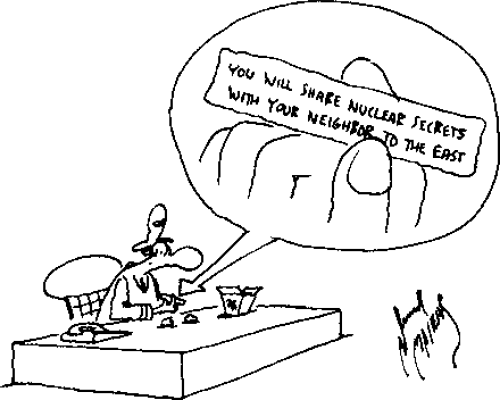
Jaffar dhia jaffar, the former and suspected current leader of Iraq's nuclear weapons program, surprised members of an International Atomic Energy Agency (IAEA) Action Team in 1996 by asking us about a particular classified method for more efficiently producing highly enriched uranium, a nuclear explosive material. Although the existence of this method is unclassified, details are classified. In addition to revealing that Jaffar had a good understanding of the open literature, his question also implied that Iraq, a country that is forbidden by the U.N. Security Council from having nuclear-weapons-usable materials and has had no nuclear power program, had a continuing interest in uranium enrichment.
Jaffar was asking about a technique developed in the United States for starting with raw natural uranium in the “electromagnetic isotope separation,” or “EMIS,” process. The method eliminates the traditional first step of the separation process—the production of natural uranium feed stock in a separate facility and its transportation to the separators. If Iraq were able to bypass the need for an industrial facility to make feed material, it would be harder for U.N inspectors and intelligence agencies to detect any clandestine EMIS program before it had actually produced highly enriched uranium.
After the inspection, I told a senior Energy Department official about the episode. He responded that although Energy had long ago declassified most EMIS information, it had not declassified key “tricks of the trade” needed to enable EMIS to work. He said that Jaffar's interest in this shortcut was worrisome, particularly after I mentioned that Jaffar had also said Iraq had unsuccessfully tried to master the technique. We agreed that little would be gained commercially or scientifically by the declassification of such additional information; yet its release could make it easier for Iraq to make nuclear weapons. So Energy has protected the information along with remaining tricks of the trade, overruling some officials who wanted to declassify more details.
One of many public web sites that collect nuclear bomb information.

At the time, the Energy Department was undergoing a long overdue transformation to make more information available to the public while continuing to protect U.S. national security. Soon after taking office, President Bill Clinton said that openness in government is essential to accountability, requiring that citizens have more information. He called on all federal agencies to renew their commitment to the underlying principles of government openness.
Hazel O'Leary, then secretary of Energy, launched a review of the department's classification and information policies to ensure that they were in step with the new national and international environment.
A major priority following the end of the Cold War was ensuring that any information that might help would-be pro-liferators or terrorists to obtain nuclear weapons was adequately protected. Proliferators or terrorist groups may not need access to classified information to construct a simple nuclear device. But access to that information could significantly ease the task of building a crude fission weapon, allow for more efficient or deliverable weapons, and enable the bypassing of export controls and international safeguards.
Senior Energy Department officials were also aware of the benefits of de-classification. They recognized that the release of more information was essential to restore public confidence in the department's environmental, safety, and health practices; critics had consistently attacked their releases as inadequate, charging that the department's practices were shrouded in secrecy to conceal imprudent or illegal acts. In addition, the release of information about past nuclear weapons activities, such as plutonium production or testing activities, might bolster arms control and international non-proliferation efforts that the United States was pursuing.
However, these two goals—being open and protecting information ade-quately—are often in conflict. At a minimum, a decision to classify information requires a balancing that demonstrates that the damage to national security outweighs the benefit of public disclosure. Because of the ingrained culture of secrecy at Energy, balancing had usually been done in a way that excluded the declassification of information. Today, with the current overemphasis on security within the Executive Branch and Congress, many of Energy's initiatives to be more open have come to a standstill.
Preventing the spread of information can
Yes, secrets matter
The history of the spread of nuclear weapons includes many cases where countries gained access to secret information enabling them to accomplish the goal of making nuclear explosive materials or the weapons themselves. Given this experience, what responsible state would voluntarily declassify information that could give a state or a terrorist group its first nuclear weapon?
Pakistan launched elaborate efforts in the 1970s and 1980s to obtain classified information about gas centrifuges for enriching uranium from individuals and from German, Dutch, and Swiss companies that were directly involved in enriching uranium for nuclear fuel or were key suppliers of equipment to enrichment plants. Without access to this classified information, Pakistan would not have progressed very far in producing highly enriched uranium.
Iraq's detailed declarations to the (IAEA) Action Team about its foreign procurement efforts confirm the immense value it placed on obtaining sensitive information about nuclear weaponization and fissile material production. For example, Iraq obtained vast amounts of classified information about the design and manufacture of both early and modern gas centrifuges.
The manufacture of reliable, deliverable fission nuclear weapons is not as simple as some in the public have claimed. Although the basic scientific and technical principles of making nuclear weapons are relatively well known, details and “tricks” can be very hard to duplicate in practice. Both the Iraqi and South African nuclear weapons programs spent significant resources trying to develop sufficient knowledge to design and manufacture crude, deliverable fission weapons. In both programs, success was measured in years rather than months.
Access to classified blueprints, design books, manufacturing specifications, and tricks of the trade can determine the success or failure of a clandestine nuclear weapons program in a developing country. As a result, governments have a special responsibility to protect dangerous nuclear weapons or nuclear weapons-related information. Protecting certain types of information—such as detailed designs of crude nuclear weapons or early thermonuclear weapons—is as vital now as 50 years ago. Although the end of the Cold War brought an end to the risk of global nuclear annihilation, one should never become callous about the tremendous destructive potential of “simple” nuclear weapons like the ones that destroyed Hiroshima and Nagasaki.
At the least, preventing the spread of information slows down programs aimed at getting the bomb, allowing time for other remedies to work. As such, secrecy is an important nonpro-liferation tool—complementing international safeguards and national and international export controls.
For 50 years the strategy of restricting access to certain types of information has been a success. Roughly 30 countries have sought nuclear weapons, but only about 10 have succeeded. Faced with delays and difficulties in building the bomb, many of which were caused by a lack of access to classified information, many countries made the political decision to abandon their nuclear weapons ambitions or were successfully pressured to end their programs.
If Pakistan had not obtained extensive classified information about gas centrifuges, it would likely have failed in its efforts to produce highly enriched uranium by the mid-1980s, the date typically given for the acquisition of its first nuclear explosive device. Consider Pakistan's efforts in developing nuclear reactors: Despite the wide availability of information, Pakistan needed about 20 years to build its first indigenous nuclear reactor, which was commissioned in 1998. International export controls—combined with the reluctance to supply Pakistan with technology and components—delayed the reactor's completion. If Pakistan had not already acquired the knowledge to build a gas centrifuge plant from others, it might have been dissuaded from acquiring nuclear weapons in the intervening years.
Success in denying proliferant states sensitive nuclear information does not mean that classification policies are without weaknesses or contradictions in their application. In some cases, countries lacking classified information have dramatically increased their domestic capabilities to develop expertise. Other countries have accelerated their efforts to illicitly obtain classified information, searching for weak links in international and national control regimes. Secrecy alone cannot prevent proliferation.
There is no doubt that the amount of once-classified nuclear weapons information in the public domain is increasing. Espionage and mistaken de-classifications will inevitably lead to more nuclear weapons information becoming publicly available. Some web sites even collect and organize open information related to nuclear weapons. Fortunately, surveys by the Institute for Science and International Se-curity—and according to a senior Energy Department official, surveys by the Energy Department as well—have not found any web sites that provide enough information to make nuclear explosives or weapons. But information on these sites is growing and information is being added from throughout the world. There is also a tendency at some of these sites to correct mistakes. Although no site appears to be a nuclear weapon “cookbook,” they do provide an efficient starting point for a would-be bomb maker.
Despite their shortcomings, classification rules can help buy time for other remedies to work. In combination with export controls, safeguards, and other nonproliferation tools, classification of information can slow down nuclear proliferation. Overall, security has been increased by the classification of critical nuclear weapons information.

Agreeing on what's secret and what's not
Because proliferant states routinely seek open or declassified information throughout the world, there is a need for the international community to ensure that sensitive information is not inadvertently declassified.
Classification rules vary enormously from country to country. Some countries do not protect the same information or protect it to the same degree as others do. There are growing concerns that one country may undercut another as it declassifies or releases information to the public. In addition, research results may be published openly in one country even if the results are considered classified in another.
Once information is declassified and released, it spreads faster than ever. Public collections are better identified and indexed. As everyone knows, the Internet accelerates dissemination.
Although information relevant to nuclear weapons production will continue to enter the public domain, more needs to be done internationally to prevent inadvertent or misguided declassi-fication. One initiative that has been under consideration within the United States to address this problem is the creation of international information guidelines. Such guidelines would list, in an unclassified manner, which information should be protected.
These guidelines would help prevent governments from inadvertently releasing sensitive information by creating a uniform list of protected information. Guidelines would also bolster the norm against the spreading of proliferation-sensitive information, reinforcing efforts by the Nuclear Suppliers Group to control certain types of technology or technical assistance. The effort to achieve such guidelines has so far focused on the nuclear weapon states.
A changing view
On the other side of the balance, de-classification of information has great public benefit. But throughout its history the Energy Department has classified far too much information, erring on the side of caution and giving the benefit of the doubt to those wanting to keep information classified. Under the Atomic Energy Act, there is a presumption that certain information is “born secret”—classified until a decision is taken to declassify it.
This “risk avoidance” approach to secret nuclear information and declas-sification has gradually been shown to be counterproductive or impossible to maintain effectively. Underlying the department's shift in approach was the end of the Cold War and the recognition that public trust could best be obtained by releasing more complete and accurate information and ensuring that only information requiring protection remained classified. Although this new view had been developing for years, the shift in emphasis was formalized and accelerated in Secretary O'Leary's 1993 “Openness Initiative.”
The National Research Council (NRC) endorsed this newer approach in its 1995 report, A Review of the Department of Energy Classification Policy and Practice. The report said Energy “should seek to maintain stringent security around sharply defined and narrowly circumscribed areas, but … reduce or eliminate classification around areas of less sensitivity.” The report also emphasized secrecy's costs as well as its benefits, and it pointed out that secrecy can be inimical to scientific and technical progress and that it undermines public confidence in government by reducing the ability of citizens to scrutinize their government's actions or be fully informed on public issues. More generally, the report concluded, democracy requires an informed citizenry, and secrecy undermines this goal.
In 1997, the Energy Department's Fundamental Classification Policy Review Group, chaired by Al Narath, then president of Sandia National Laboratories, expanded on the NRC's recommendations. In its December 1997 unclassified final report, the group recommended moving to a system in which classification is “based on explainable judgements of identifiable risk to national security and no other reason.” Under the approach endorsed by the NRC and the Narath group, an identified benefit is not required to justify declassification and release to the public. The burden of proof would shift to those who argue for classification, not be placed on those who request declassification.
In addition to recommending a significant narrowing of the scope of protected information, the Fundamental Classification Policy Review Group emphasized that some information should be more stringently protected. This initiative would attempt to protect nearly 140 types of information with “higher fences.” For example, a stock of detailed blueprints for the Little Boy nuclear weapon dropped on Hiroshima is proposed to be top secret because the information is valuable to proliferants and terrorists.
According to the 1997 report of the Energy Department's Openness Advisory Panel: “The narrowing of the information to be protected enables the focusing of resources—time, money, effort—thereby providing greater assurance that core information is truly safeguarded. Diluting resources by sweeping too much under guard may lessen the protection of the ‘crown jewels.’ Indeed, staff and contractors may underestimate the importance of stringent adherence to classification rules if they perceive that the system encompasses information of trivial national security significance.”
Under this new approach, decisions about classification are supposed to depend on a thorough analysis of the current international security situation. Toward this end, the department, and in particular the office in charge of de-classification, needed to enlarge their own in-house, technical analysis of trends in proliferation.
They need to continually ask themselves critical questions: What information is being sought? What information is targeted for illicit acquisition? What are the threats that classification must address? Armed with this type of assessment, officials can better determine the effectiveness of their classification and openness policies.
But developing this expertise has been more complicated than expected. Until relatively recently, those in charge of declassification did not receive intelligence briefings about clandestine nuclear weapons programs that might benefit from the careless declassification of information. Thus, declassification decisions were often made with little understanding of the types of information proliferant states were seeking.
Moving forward
The mid-1990s saw rapid progress on many of the recommendations by these expert groups. Large amounts of information have been declassified, much of which has been posted on the the Energy Department's “OpenNet” web site. These declassifications have increased public confidence in government, promoted scientific and commercial ventures, and strengthened arms control and nonproliferation efforts with no risk to national or international security.
The Energy Department's willingness to reveal information concerning the size of its plutonium stocks and its past nuclear tests encouraged similar openness by the Russians and other countries. Such transparency helped create greater confidence in the arms control process.
The Openness Initiative perhaps had its greatest impact on communities near Energy facilities. The department systematically revealed past abuses at nuclear weapons sites in an attempt to candidly acknowledge and confront its past. Information was revealed about unsafe practices, cover-ups of past accidents, human radiation experiments, excessive exposures to workers and the public, and past environmental contamination by radioactive and toxic materials. Much of this material had been kept secret despite weak or nonexistent legal justification for not releasing it to the public.
The revelations were overdue. Energy Department critics had long maintained that secrecy prevented the public from learning things it should have been told. The result of secrecy was widespread mistrust and suspicion of the department.
In the 1980s and early 1990s, some weapon production sites were shut down because the public and state governments had lost faith that they could be operated safely. The Rocky Flats Plant near Denver, which was the only U.S. site making plutonium components for nuclear weapons, was shut down in 1989 because of intense state and local opposition. Suspecting that the plant was wantonly violating environmental laws, the FBI raided the plant the same year.
I served as a member of the Health Advisory Panel appointed by the governor of Colorado to oversee technical state-sponsored studies of the health impact of the Rocky Flats Plant. Following a few frustrating years of trying without success to obtain sufficient information, our study was an early beneficiary of the department's 1993 commitment to openness.
More generally, the report concluded,
The Openness Initiative was critical to the ability to estimate historical releases of plutonium, other radioactive materials, and toxic chemicals to the area surrounding Rocky Flats. Without the release of information, the study would have been unable to estimate in a scientifically credible manner the health risks to people living near the plant.
Although the studies showed that the historical operation of the plant had caused few health problems to the surrounding population, they also revealed that at least two radiological catastrophes had been narrowly averted. Secrecy had kept the public ignorant about the true risk.
Following a major fire at the plant in 1957, neither the public nor the government of Colorado were informed that a major plutonium release had occurred. At the time, the federal government wouldn't even publicly confirm that Rocky Flats handled plutonium. Lessons about preventing and fighting plutonium fires that could have been learned as a result of the 1957 fire were simply ignored in the climate of secrecy and overemphasis on maintaining production levels. As described by Len Ackland in “The Day They Almost Lost Denver” (July/August 1999 Bulletin), the result was an even worse fire in 1969 that came close to contaminating the entire Denver area.
On October 1, 1970, the then-Atomic Energy Commission's director of military applications told the House Subcommittee on Public Works that if the 1969 fire “had been a little bigger, it is questionable whether it could have been contained.” If the fire had not been contained by the heroic actions of the firemen, “hundreds of square miles could be involved in radiation exposure and cleanup at an astronomical cost as well as creating a very intense reaction by the general public exposed to this.” The information declassified as part of the Colorado studies on Rocky Flats did not harm U.S. national security. Openness, accountability, and national security were successfully balanced. But a critical lesson of these health studies is that secrecy is deeply ingrained in the Energy Department. Sometimes progress was made possible only by the direct intervention of the Secretary of Energy's office or another senior official at department headquarters in Washington at the request of the Health Advisory Panel. Institutionalizing openness and changing the culture of secrecy at Energy are unfinished tasks.
As the Energy Department and Congress continue to wrestle with classification and openness issues, they should remember that the Openness Initiative was launched to restore public confidence in the department. The practice of using secrecy to hide safety, health, and environmental problems from the public had almost entirely eliminated Energy's credibility with the public. Ironically, excessive secrecy within the department contributed more to halting nuclear weapons production in the United States than any nuclear disarmament organization could have ever done.
The latest impediment
Although the department has made great strides in becoming more open, much work remains. For example, the Atomic Energy Act has not been amended to establish that an affirmative action by government is necessary to classify information. Also, the “higher fences” approach has not been implemented, although the Energy and Defense Departments have initiated another policy study on the subject.
An excessive focus on security has
In the last year, openness and de-classification have been under siege. Congressional politics and almost paranoid concerns about Chinese spying have conspired to significantly reduce the flow of information.
Health studies are reportedly being hindered once again. According to a September 13, 2000 Associated Press report, after two classified computer hard drives disappeared at Los Alamos National Laboratory last spring, scientists working with the Centers for Disease Control were denied access to the classified vaults. They need access in order to look for information about the historic releases of nuclear and toxic materials from the laboratory as part of a $4.2 million, three-year investigation.
Long awaited declassifications of many types of information have been delayed or placed on hold. Following up on its declassification of U.S. military stocks of plutonium, the department decided in the mid-1990s to declassify information about military stocks of highly enriched uranium. The Defense Department, however, has only recently allowed Energy to proceed with plans to release the information about this highly enriched uranium next year.
Although adequate security is vital, the overemphasis on security within the department may actually undermine security efforts. An excessive focus on security has demoralized the national laboratories and diminished the laboratories' ability to perform their duties. Under the current Energy Department policy of “zero tolerance” for security violations, personnel are under the threat of federal prosecution for minor security infractions. In an “us versus them” climate, workers feel less vested in making security a key part of their mission. There are concerns that Energy's security activities may get stiffer yet. The new chief of security was promoted from Energy's naval reactor security, which is well known for its draconian measures that violate employee privacy with midnight searches of lockers, desks, and vehicles.
Lost in the current preoccupation with security is a hard-learned lesson. Openness is an essential precondition for the success of Energy's activities. The department needs to return to emphasizing responsible openness. As recommended in the Openness Advisory Panel's 1997 report, Energy needs to focus on improving the classification system, achieving greater public accessibility to records and information, and changing the culture of the department. This is the way to ensure that dangerous information is adequately protected.
“Can you keep a top secret?”