



Abstract
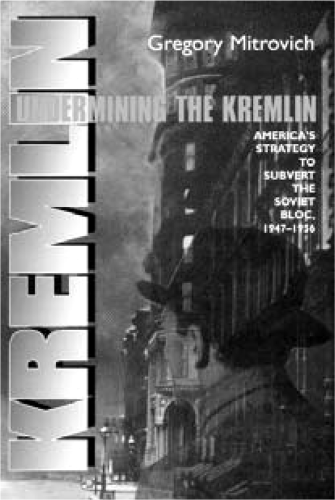
Although critical details about U.S. policy toward the Soviet Union during the early Cold War remain classified, the debates and deliberations that drove U.S. decision-making are largely available in the U.S. archives. In Undermining the Kremlin, Gregory Mitrovich, a research fellow at Harvard's Olin Institute for Strategic Studies, uses this wealth of information to demonstrate that the Truman administration secretly sanctioned a policy aimed at overturning the Soviet regime several years before President Eisenhower publicly campaigned to roll back communism. He also explains why Soviet advances in nuclear weapons prompted the United States to abandon this policy by 1955.
According to Mitrovich, before the Soviets tested their first atomic bomb on August 29, 1949, U.S. policymakers hoped to exploit their country's temporary strategic advantage to liberate Eastern Europe and undermine Kremlin rule. Although better known as the father of “containment,” George Kennan, who headed the State Department's policy planning staff under Truman, was also an initial author of the rollback policy. Kennan believed that the combination of Soviet strategic vulnerabilities and U.S. covert operations could lead to the Kremlin's collapse without a risk of war.
Mitrovich argues, however, that Kennan failed to construct an effective short-term policy. His early enthusiasm about the effects of the Stalin-Tito split over Eastern Europe proved misplaced. Stalin, together with his secret services and East European minions, brutally rooted out any opposition— real or imaginary—and consolidated the Soviet bloc. More important, Ken-nan's strategy failed to factor in Soviet nuclear power. By the end of 1949, U.S. planners—particularly in the military—calculated that the Soviet atomic program made irrelevant their assumption that in a protracted war the United States would prevail over the Soviet Union. The Soviet's nuclear arsenal made a surprise attack possible and—provided the Soviet Union could accumulate 200 or so atomic devices and develop adequate delivery systems—threatened the security of the United States.
All this made the prospect of a peaceful breakaway of Eastern Europe from the Soviet Union—under an American nuclear shield—highly improbable. Yet the book shows that U.S. strategies toward the Soviets became ever more aggressive and, by 1953, the emphasis on covert operations and the rollback of communism in Eastern Europe reached its peak. Mitrovich writes that Paul Nitze, architect of the NSC 68 policy paper that advocated a more militarized version of containment, sought “more, more, and more money” to build up forces and further contain Soviet expansion. The outbreak of the Korean War in 1950 gave an added sense of urgency.
Although the details of the covert operations remain hidden in classified documents, the book reveals the scope of U.S. strategists' imagination and the readiness of policy-makers to develop radical strategies. There were plans to complicate and undermine the functions of the Soviet regime, to instigate revolutions in Eastern Europe, and to provoke political tensions in the Kremlin.
For instance, the Psychological Strategy Board developed a program called “Packet”—a collection of operations “designed to defeat Soviet power worldwide.” Optimism, even hubris, was rampant in the board's ranks. Echoing Joseph Goebbels, one board official defined the Soviet regime as “a colossus with feet of clay” that was vulnerable to a decisive psychological warfare offensive. Yet, by 1952, all operations had come to premature ends and, when Stalin died the following year, the United States failed to use this long-awaited opportunity to disrupt the regime. With so much about the operations still classified, Mitrovich is cautious in his judgment. But everything in the book implies that covert operations behind the Iron Curtain did not seriously affect the course of the Cold War.
Mitrovich puts much of the blame for the failure of the rollback strategy on bureaucratic shortcomings and unforeseen circumstances—”lack of coordination,” inter-departmental rivalries, and betrayal by Soviet spies. However, the book is more convincing in its discussion of the impact of the Soviet nuclear program, which transformed the Cold War and had a sobering effect on U.S. planners. By August 1952, even Nitze had begun to back away from the predictions of “victory” contained in NSC 68. Mitrovich highlights the role of Charles Bohlen, a principal architect of the “doctrine of reasonable hope,” which eventually replaced the Kennan-Nitze strategy. This doctrine argued that rollback could be achieved only through the overthrow of the Kremlin or through war and revolution. The first option, according to Bohlen, was dangerous in the nuclear age, and the second was unrealistic. Instead, he advocated a policy of containment of and coexistence with the Soviet Union. He envisaged the eventual collapse of the Soviet Union resulting from internal decay and the impact of a prosperous liberal Western bloc.
“Big Brother is off tonight, so Little Brother is watching you.”

The book dwells heavily on the disagreements that arose among U.S. planners over the nature of the Soviet nuclear threat. Some, like Bohlen, believed that there was no risk of a nuclear war and that the United States could patiently wait for Soviet transformation. The military, however, thought that time was working against the United States, and throughout the 1950s military planners warned about the so-called moment of “maximum danger” when the Kremlin might be tempted to deliver a surprise attack.
The Eisenhower administration, which initially criticized the policies of its predecessors toward the Soviets, ended up repeating their arguments and disagreements. Although previous works have covered much of this ground (see, for example, Marc Trachtenberg or Richard Immerman), Mit-rovich's account of the agonizing vacillations of Eisenhower and John Foster Dulles makes for interesting reading. The Soviets' test of a boosted fission bomb in August 1953 and the prospect of a multi-megaton “super” in the Kremlin's hands horrified both of them. Contrary to their respective public images, smiling Ike at one point considered a preemptive nuclear attack on the Soviet Union as being “our duty to future generations,” while stern Dulles argued that a negotiated settlement with the Soviets was the only appropriate course of action.
By and large the book stays within the strict confines of its subject matter, as if Mitrovich deliberately decided to overlook the larger Cold War context. Although this strategy results in a tightly crafted narrative, it goes against the general trend among Cold War historians to take a broader look at their topics. Scholars are increasingly interested in exploring the impact of ideologies, beliefs, and experiences on the planning and behavior of Cold War actors. They complement the traditional emphasis on charismatic and influential individuals with reflections on ideological beliefs and “strategic culture,” the interaction between domestic politics and international priorities, and the impact of forces and actors other than the great powers. And many scholars seek to expand their frame of reference and get new angles from reading “new” Cold War history works that are based on archives outside the United States—particularly the archives of former Soviet-bloc countries.
Unfortunately, little—if any—of this made it into this book. Like today's historians, U.S. planners of the 1940s and 1950s had to grapple with a “context” that Mitrovich chose to overlook. The book does not even mention Mc-Carthyism, the vitriolic right-wing attacks on Bohlen, or many other important contextual facts of the time. But these facts explain why the Eisenhower administration continued to adhere publicly to the rollback doctrine and why John Foster Dulles, despite his doubts, refrained from talks with the Soviets and continued to employ aggressive and intimidating rhetoric.
Mitrovich's failure to include recent Cold War historiography also hampers his analysis of the nuclear arms race and Soviet nuclear capabilities. For instance, we now know that Stalin and his successors shared the same fears as their U.S. counterparts regarding a possible preemptive nuclear strike by their Cold War adversary. Mitrovich does not even mention recent authoritative studies on the Soviet atomic project, including David Holloway's masterly monograph, Stalin and the Bomb.
The only point where Mitrovich covers new historiography is in concluding that not only the Soviet Union but also the United States acted aggressively during the early stages of the Cold War. The book validates the argument that the Soviet hydrogen bomb helped to stabilize the Cold War, a view shared by every Kremlin leader since 1953—including President Vladimir Putin. But many questions remain: Did the demise of the rollback and “liberation” strategies really give way to a new strategy of patiently waiting for the collapse of the Soviet Union? Or did the United States simply vacillate between the old strategy and no strategy, fumbling along for decades until the obvious prosperity of the liberal international order—and a bit of luck with Mikhail Gorbachev—broke the vicious circle of confrontation and arms buildup? If various U.S. strategies were not responsible for the outcome of the Cold War, what was?
Readers interested in the strategic implications of nuclear weapons during the early Cold War will find Undermining the Kremlin instructive. But those curious to know the relationship between U.S. strategies and policy-making in the real world—and the impact of American ideology and culture on policy—will have to wait for other, more comprehensive studies.