



Abstract

Behind the bits
Sometimes there'S more to Internet pornography than meets the eye—much more, if U.S. and foreign officials are right. Embedded within explicit photos on some pornographic web sites lurk the dirty little secrets of terrorists associated with Saudi exile Osama bin Laden, these unnamed sources say (usa Today, February 5). The cloaked information posted on a variety of highly trafficked web sites has allegedly included maps, targets, and instructions related to terrorist activities.
Steganography, the ancient practice of concealing information, is a shadowy cousin to the more obvious and well-known practice of encrypting secret messages.
When a message is encrypted, its contents are more or less jumbled in order to baffle anyone who might intercept it. But if something is “ste-goed,” it is secreted out of sight, like invisible ink. No one but the sender and recipient know it's there, making its discovery much less likely. When used together, the two techniques, encryption and steganography, pose a double whammy for code-breakers.
With the Internet, steganography has come of age. Stego-tools—free and easily downloadable software programs—take advantage of the unused space in audio, text, image, or video files and create a secret hiding place for embedding data. Take an image of Osama bin Laden, for example. Then take a map. A stego-tool can be used to hide the map file under the “cover image” (stego-speak for the original file). You have the digital age equivalent of invisible ink.
Actually, there isn't much to see. Most stego-media are indistinguishable from unaltered files— which is, in fact, the whole point. An Internet surfer could be looking at a photo of a blonde bombshell and not realize he's also looking at… well, hidden data involving another kind of bombshell.
Conceptual rendering of steganography. The map is hidden “beneath” an image of Osama bin Laden.

To recover a hidden message posted on the web, the sender must first tell the intended recipient where to find the stego-media; then the recipient can extract the information using the same software that created it.
Because intercepting stego-files is so difficult, and dissemination so simple, steganography has become a popular means of communication for those who prefer to fly below the radar, which includes everyone from privacy nuts who stego their regular e-mails, to the terrorists who want to stego-smuggle information around the globe.
According to usa Today, electronic steganography has become so vital to subversive groups that it is taught at Afghani and Sudanese extremist camps.
The idea of religious extremists concealing their plots against “the infidels” on sites trafficking in explicit sexual content is more than a little ironic. But it doesn't surprise Neil Johnson, a steganography researcher. “Any organization that has an intelligence group is going to [teach their operatives steganography],” says Johnson.
The hide-then-seek-and-extract approach was used by bin Laden's followers to communicate in at least three different terrorist acts, including the 1998 embassy bombings in Kenya and Tanzania, according to U.S. officials.
Not only do terrorists have high-tech know-how, they've also got the leg up on the United States, at least according to the director of the National Security Agency, Michael Hayden.
“Osama bin Laden has at his disposal the wealth of a $3 trillion-a-year telecommunications industry he can rely on. He has better technology available to him,” said Hayden in a 60 Minutes II interview.
But now U.S. agents are going to be better prepared. Along with their badges and guns, FBI graduates are receiving laptop computers and permission to surf for porn.
Precisely off target
The U.S. Defense Department seems to have a very elastic idea of the meaning of “precision-guided weapon.”
On February 16, British and U.S. aircraft bombed five Iragi air defense installations. Unlike the dozens of previous coalition air strikes over the past two years, most of which had gone almost unnoticed by the U.S. press, this strike made news because many of the targets were located outside Irag's no-fly zone. It was also the first military operation authorized by President George W. Bush.
During a Pentagon press conference a few hours after the attack, Lt. Gen. Greg Newbold, the director of operations for the Joint Chiefs, described the strike as a “self-defense measure” undertaken in response to the increasing sophistication and fre-guency of Iragi attacks on coalition planes.
“We struck five command-and-control nodes… using standoff precision munitions,” New-bold explained. “All indications we have are that the munitions and the strikes were conducted efficiently and effectively.”
As it turns out, however, one of the weapons used in the attack—the navy's Joint Standoff Weapon, or JSOW—was neither effective nor precise.
At a February 22 press conference, Adm. Craig Quigley, the Pentagon spokesperson, revealed that almost all of the JSOWs had failed to hit their so-called aimpoints. But because the JSOW is an “area munition”— Pentagon-speak for cluster bomb—Quigley was certain that most of the targets had been damaged.
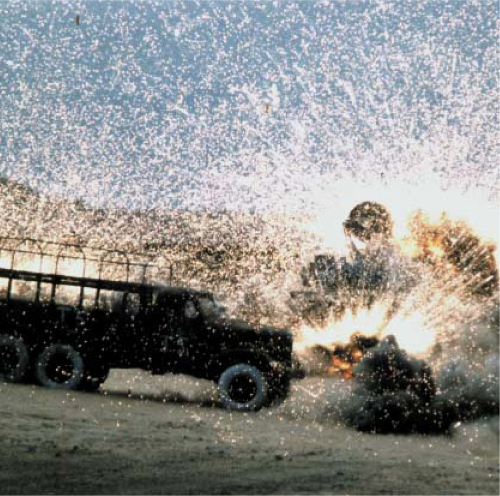
According to Bulletin columnist Bill Arkin, the JSOW, which scatters 145 incendiary bomblets over an area roughly the size of a football field, can hardly be described as a precise weapon.
In a February 26 article on Washingtonpost.com, Arkin wrote: “News media reports last week that 50 percent of the weapons fired [on Irag] missed their aimpoints obscures a more disturbing facet of the February 16 attack: The U.S. jets used cluster bombs that have no real aimpoint.” The bomblets, Arkin pointed out, often fail to explode and remain dangerous to civilians for years.
JSOW submunitions explode during a test.
Arkin thinks that many officials in the Pentagon did not even know that cluster bombs were used in the strike. On the day of the attack he asked an air force official if he was aware that JSOWs used cluster munitions. The official responded, “You're full of shit.”
“In a world in which ‘precision weapon’ has real meaning, to call the JSOW precise is ridiculous,” says Arkin. “The United States has invested tens of millions of dollars to give every plane in the armed forces precision weapons. There is no reason for us to use cluster bombs.”
Unidentified flying doughnut
Maybe the United States can build a flying saucer after all. Despite last issue's “Bulletins” item (“It Came From Ohio”) describing unfulfilled military plans to build a flying disk in the 1950s and 1960s, Sikorsky Aircraft Corporation has gone and made one. And it works.
“Cypher” is about 6.5 feet in diameter, weighs 250 pounds on takeoff, and can carry 50-pound payloads—so even the smallest humans would have trouble hitching a ride on this ufo. Instead, Cypher is operated remotely through a fly-by-wire system similar to that found on Comanche helicopters. It also shares the Comanche's automatic target detection system and ability to take off or land vertically. A camera mounted on top provides feedback to a pilot sitting in a control van.
Cypher struts its stuff during an army demonstration
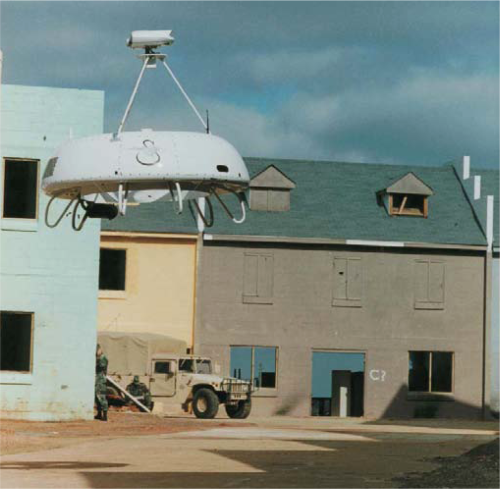
The doughnut-shaped aircraft, with a top speed of 80 miles per hour and ceiling of 8,000 feet, obtains lift from two sets of rotating blades mounted in the aircraft's center.
Looking like something from War of the Worlds, the unmanned aerial vehicle is being developed for military surveillance, communications, and counter-measure missions, as well as civilian applications such as law enforcement, drug interception, forestry, and search-and-rescue. After 400 flight hours buzzing around Sikorsky's Florida development center, Cypher went on the road, touting its features to potential customers.
For the army, Cypher flew down streets, landed on a building, and deposited various loads. At later demonstrations it tracked man-sized targets without operator input, detected unexploded ordinance, and participated in a drug interdiction exercise. For the Energy Department, the aircraft located underground tunnels in Nevada with an onboard magnetometer. (Its ability to decode underground structures gave the craft its name.)
Sikorsky is already planning to build the aircraft in different sizes, so if anyone buys into the project, Cyphers could range in size from cargo-hauling workhorses to 40-pound backpack models.
Another aerospace firm, Tennessee-based Micro Craft, has miniaturized a saucer-shaped drone of its own. Last October it tested its hovering spy craft. About the diameter of a pizza (9 inches), it can fly inside buildings or behind enemy lines for about an hour on 200 grams of fuel. The company says the craft can be outfitted with video cameras for surveillance work or with lasers to guide missiles to their targets.
Hi-tech cattle prod?
Millions of dollars and many years have been devoted to the idea of directed-energy weapons, and we apparently have a winner.
But it is not the missile-busting, outer-space giant killer we were promised in the 1980s. According to the Marine Corps Times, which broke the story, this hi-tech weapon turns out to be the “Vehicle-Mounted Active Denial System.” The March 5 Times describes the vmads as both a non-lethal weapon and “the biggest breakthrough in weapons technology since the atomic bomb.”
Imagine being in a microwave oven—anyone attacked by the beam quickly feels a burning sensation as moisture in the skin moves toward the boiling point. (Whether the beam can kill and how long it would take became the subject of press speculation, but details of the beam's potential are classified.)
Because the “people zapper,” as the Times dubbed it, is not the most portable of weapons, the current prototype is sitting on a large packing crate at Kirtland Air Force Base in New Mexico, although a Humvee-mounted system is expected soon.
An artist's conception of a Humvee-mounted “people zapper.”

Despite its limited portability, Marine Col. George Fenton, director of the Joint Non-Lethal Weapons Directorate, insists the vmads will be ideal for crowd control.
In Brief
Don't tell Europe
Responding to worries that members of their armed forces might have been exposed, technicians who examined urine samples from 69 Canadian soldiers who had served in areas where depleted uranium may have been used found so little uranium that they decided to ask for hair samples instead (Edmonton Sun, August 10, 2000). Researchers reported that the average amount of uranium in the soldiers' tissues (under 10 parts per trillion) was lower than the average level found in members of Canada's civilian, stay-at-home population.
Better living through chemistry
The British army is seriously considering ordering a plastic tank—the Advanced Composite Armoured Vehicle Platform—which has already passed field trials (Sunday Times of London, January 28). The vehicle is nearly invisible to radar, is lighter, faster, easier to transport by helicopter, and uses less fuel. The manufacturer, British defense company Vickers, claims that the plastic body is as shell-resistant as a metal tank.
Oops, we did it again?
After more than a decade, the SY-101 nuclear waste storage tank at the Hanford Reservation in Washington State has been taken off the “watch list” (Seattle Post-Intelligencer, February 9). The SY-101, which held 54 million gallons of highly radioactive waste, gained notoriety because it “burped” periodically to vent the explosive gases building up under a thick crust that had formed on top of the liquid waste. For two years Hanford crews fought the formation of gas bubbles (and the consequent rise in the level of material in the tank to near overflowing). They installed a pump to stir it, removed 520,000 gallons of waste, and diluted the remainder with 434,000 gallons of water. Their solution even won an award from the Project Management Institute (Hanford News, March 14). Now that they've solved the problem, Hanford managers say they will start putting more waste in the tank.
Hey, we all have potential
Head of the Defense Intelligence Agency Adm. Tom Wilson told the Senate Intelligence Committee that the United States is in danger of a cyber attack from Cuba (WiredNews, February 9). Wilson admitted that Fidel Castro's conventional forces were lacking, but he claimed that Castro's intelligence operations were “substantial.” When asked by Oregon Democrat Ron Wyden if the threat was “real,” Wilson replied, “There's certainly the potential for them to employ those kind of tactics against our modern and superior military.”
Project half-century?
A Tucson, Arizona company (projectcentury.com) offers interested parties the opportunity to reserve space for their personal memorabilia in a time capsule fashioned from a Titan II missile silo 90 feet below the Arizona desert. “What could be more secure than a facility built by the U.S. government to withstand a nuclear attack?” Project Century asks. The “century” in Project Century seems less secure, though—the company plans to open the capsule in 2050.
Fore!
The Earlston Golf Club of Scotland is either forward-thinking or highly gullible. The 95-year-old club, which has not had a golf course of its own since 1945, purchased a site for a new club—on the moon—from an Internet company called “MoonEs-tates.com” (bbc News, February 23). MoonEstates, which offers one and 10-acre lots on the moon, Mars, and Venus, bases its right to sell property on a claim filed at the offices of San Francisco County in 1980 by Californian Dennis M. Hope. (Hope apparently claimed only the land on the moon he could see; the dark side is unavailable.)
Dig we must
The Energy Department just spent $49 million to build the Atlas Pulsed Power Experimental Facility, described as essential equipment needed to simulate energy bursts from nuclear weapons (Albuquerque Journal, March 20). But Energy apparently doesn't want to operate the machine at the Los Alamos National Laboratory in New Mexico, even though it's been successfully tested. The department's Inspector General's Office is miffed. According to its recent audit: “If Atlas was important enough to build, then it should have received enough priority ranking to allow it to operate.” The National Nuclear Security Administration, the semi-autonomous arm of Energy now overseeing the weapons labs, disagrees with the inspector general. It wants to spend another $12 million to move the machine to the Nevada Test Site.
Noted in passing
Nevada drivers will soon have the choice of a license plate adorned with a mushroom cloud (Tahoe.com, March 1)…. Sweden has chosen copper containers for nuclear waste disposal, claiming it has a guaranteed life span of 100,000 years (Reuters, February 21) (How do they know?)… According to A. L. Kennedy, writing in the February 21 Guardian, it was easy for tourists and protesters alike to drive onto the Faslane submarine base during a protest on the previous Monday.
Self-fulfilling prophecy?
In late January, the U.S. Air Force staged its first ever “space war game” (Washington Post, January 29). The exercise, which was held at the Space Warfare Center at Schriever Air Force Base, Colorado, involved some 250 participants from the military and the government. The game also included a “com-merical cell” of players from the space industry.
Although the details are classified, reporters were told that the exercise, set in 2017, involved a conflict with a large, “near space-peer” nation, “Red,” which threatens to attack “Brown,” a small neighboring country. The good guys—“Blue”—come to the rescue, launching “reusable space planes” and deploying missile defenses, anti-satellite lasers, and tiny attack satellites known as “microsatellites.”
Asked who the bad guys were, one air force official responded, “We don't like to talk about countries.” But according to the Post, several participants admitted the Red force was modeled on China.
Red turned out to be a formidable space-war opponent. Included in its arsenal were microsatellites, ground-based lasers, advanced surveillance and communication satellites, and “offensive information warfare capabilities.”
According to one participant, Red also employed savvy tactics that befuddled the Blue force, like rushing to buy commercial, high-resolution satellite imagery before the good guys could secure their own contracts.
Air force Gen. Thomas Moorman, the Blue team's political leader, said that new concepts of deterrence had emerged as a result of the war game. “Space surprised us a bit,” he said. “It turns out that space gives you a lot of [deterrence] options before you have to go to conflict.”
Artist's rendering of a space-based laser.

Not surprisingly, officials concluded that the United States would have to spend lots more money on lasers and missile defenses to be able to deter the Reds of the future. Robert Hegstron, the game's director, said that if current trends continue, the United States will have only a “thin” space presence by 2017, which might force a future president to launch preemptive strikes against enemy weapons during a crisis.
Although the U.S. military doesn't have all the space weapons it desires, it seems to be doing a good job of conjuring up a future space adversary. Two weeks after the war game, Chinese military officials announced they would begin preparing for a possible space conflict with the United States (SpaceDaily.com, February 13). Yao Yunzhu, an official at China's Academy of Military Science, told the state-run China Daily, “The recent U.S. war games, simulating confrontations in outer space, signal U.S. attempts to dominate space operations and the beginning of the militarization of space.”
Four clicks is a crater
Billed as a “new experiment in volunteer science,” the Mars Clickworkers study at NASA's Ames Research Center wants to see if regular folks, with no scientific training or background, can advance science by participating in online experiments by simply pointing and clicking.
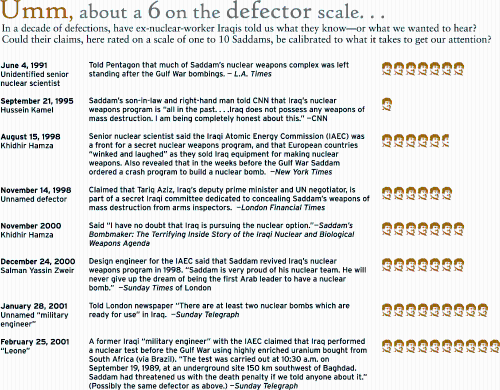
The clickworkers web site (clickworkers.arc.nasa.gov) gives interested visitors a short training session on how to identify and mark craters from black and white satellite images. Then visitors are given the opportunity to do some clicking that really counts.
“The idea is that a few clicks per person add up to real work,” said Bob Kanefsky, who thought up the project. After watching Mars Pathfinder scientists spend days on simple but time-consuming tasks, Kanefsky realized that the millions of people who were looking at satellite images of Mars on their personal computers might also be interested in lightening the scientists' load.
Kanefsky was right. People were interested in his interactive astronomy study. Since the project's debut on a science newsgroup last November, more than a million crater-marking entries have been made.
When the study began, clickworkers could work only on craters from old Viking Orbiter satellite images. Now volunteers can beat bona fide scientists to the punch and be the first to catalog craters in new images from the Mars Global Surveyor. And Kanefsky has added a feature allowing clickworkers to go a step further, classifying craters' age as fresh, degraded, or “ghost.” Many participants have written in to say that click-working is more satisfying than just donating machine time, as in the
It's too early to tell whether online volunteers might one day shoulder scientific research chores, either through the click-workers pilot project or other studies.
Judging from my own clickworking experience, this government work doesn't require a Ph.D. As the web site declares, “If you know a mountain from a hole in the ground, you can become a crater-marking clickworker.”
A page from the clickworker web site showing how clicks add up to craters.
Lovable leftie
Sam Day, a former edi-tor of the Bulletin, died January 26 of a stroke in his home in Madison, Wisconsin. His death was widely noted, locally and nationally—including a longish obituary in the New York Times.
Day would have been amused by the piece in the Times, the Queen of the Establishment. Although he was born to an upper-class family—his father was a diplomat and he attended Philips Exeter Academy and Swarth-more College—Day devoted his life to exposing what he regarded as establishment sins.
In the 1950s and 1960s, Day held a series of newspaper jobs, winding up as editor of the weekly Inter-mountain Observer in Boise, Idaho. It was, Day said, “a radical and sometimes strident organ of social protest.”
In November 1971, Day—45, married, and a father of three—helped engineer a street-blocking protest in Boise against a planned nuclear test on the island of Amchitka, Alaska. There were no arrests, but the paper eventually folded. Advertisers disliked the editor's activism, which continued unabated. In January 1974, Day became editor of the Bulletin.
Day and the Bulletin were not a match made in heaven. “I favored total nuclear disarmament,” he later wrote, “over the more moderate ‘arms control’ approach of the Bulletin and its allies in the liberal scientific community.”
But the decisive disputes were over nuclear energy. Day began commissioning pieces that were skeptical of nuclear power, which many high-level members of the Bulletin community favored. The relationship between Day and nuclear power advocates turned rocky.
By the summer of 1975, Day said, he felt “hemmed in by the conservatism of the Bulletin's Board of Directors,” and he left at the end of 1977. His final editorial focused on the importance of the Bulletin's nuclear weapons work:
“It is my hope that the Bulletin of the Atomic Scientists will continue to play its part by finding imaginative, forceful, and persuasive ways of scaring the hell out of people.”
Day's next stop was the left-leaning, muckraking magazine, the Progressive. As managing editor, he came to know Howard Morland, a freelance writer who was investigating nuclear secrecy. Morland eventually produced, under Day's tireless direction and rewriting, “The H-Bomb Secret: How We Got It—Why We're Telling It.”
The article, said Day, was designed to explode “the secrecy mystique that intimidates the public, including the news media, from serious scrutiny of nuclear weapons policies and issues.”
Former Bulletin editor Sam Day, in 1982.
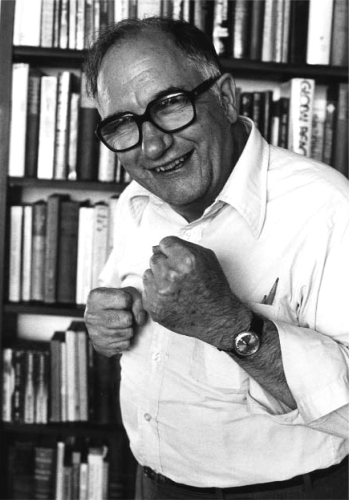
In a celebrated First Amendment case, the federal government enjoined publication of the article, claiming that it revealed classified information. The case, which played out in 1979 (and ended with the eventual publication of the article), makes compelling reading even today. Day told the story in his autobiography, Crossing the Line.
Two-and-a-half years after joining the Progressive, Day left on cordial terms. (In the following years, he often wrote for the magazine.) In Crossing the Line, he said he chose to become an independent peace activist to do direct battle “against the demon of nuclear secrecy.”
That was, finally, to be Day's calling. Until his death, he engaged in peaceful direct action and “resistance” in an effort to call attention to the nuclear weapons enterprise.
He was arrested often for acts of civil disobedience, serving increasingly longer sentences in local jails and federal prisons. In one early protest, he cut through the fence surrounding a Minuteman launch site near Kansas City. He was dressed in clown suit. That said something about his style.
While some activists seem chronically angry, Day was usually genial and thoughtful. The best thing written about him after his death was by Matthew Rothschild, editor of the Progressive. “More than anything,” wrote Rothschild, Sam was “a lovable leftie.”
Objectivity and activism
Alice Kimball Smith, 93, died February 6 in Ellens-burg, Washington.
It is likely that you do not recognize her name. Her major work—teaching history at Roosevelt University in Chicago, working as an assistant editor of the Bulletin, and then becoming a high-level administrator at Radcliffe—belong to an earlier time. She was also an author and book editor of distinction.
Her 591-page A Peril and a Hope, published in 1965, is the definitive story of how the “scientists' movement” came to be. The founding of the Bulletin and the Federation of American Scientists were Smith's case studies as she focused on how post-war “atomic” scientists tried to balance the requirements of scientific objectivity with their newly found need to engage in political activism.
Objectivity and activism did not always blend easily or well, Smith said. Nevertheless, there was a “certain epic quality” about those early years, largely because of the “magnitude and global ramifications of the problem with which [the scientists] tried to grapple.”
A bottle of scotch
William Epstein died February 9 in New York, at 88. Epstein, whose essays and reports appeared now and then in the Bulletin, was a member—in 1945— of the preparatory commission that helped establish the United Nations.
Epstein, a Canadian, served the United Nations in a variety of capacities until his death. In the 1960s he directed the Disarmament Division. After retiring in 1972, he continued at the United Nations, advising secretaries-general, and later the non-aligned nations, on disarmament issues.
His proudest moment, he once told me, was representing the secretary-general in negotiating the 1967 Treaty of Tlatelolco, which barred nuclear weapons from Latin America and the Caribbean.
An obituary in the National Post quoted Epstein as saying that at one point, after long diplomatic preliminaries, he and a Mexican lawyer were asked to work out a draft. “They gave us a bottle of Scotch and plates full of lots of sandwiches. By five o'clock in the morning, we had the draft.”
The draft served as a template for later nuclear disarmament-related efforts, including the 1972 Nuclear Non-Proliferation Treaty.