



Abstract
To forestall potential terrorist actions, the Energy Department closed Web sites and removed documents from the Internet. In the process, the public got shut out.

Following the September 11 attacks on the World Trade Center and the Pentagon, the Energy Department not only enhanced physical security at its national laboratories and sites, it began questioning the information available on its Web sites. In October, Energy Department managers, concerned about the breadth and the ease of availability of information on the Internet, began pulling thousands of files to see if they contained anything that could be used by terrorists. The search extended to documents in public reading rooms. Citizens living near the Pantex Plant outside Amarillo, Texas, found the shelves of their public reading rooms cleared. Even documents on groundwater pollution and other environmental impacts of plant operations had been replaced by a sign expressing an apology for the inconvenience.
On October 26, Deputy Energy Secretary Frank Blake formalized the removals by issuing a department-wide directive to “review the operational information accessible to members of the public and remove or restrict access, as appropriate, to information that may be used to target the Department of Energy.” Blake identified a number of areas as potential threats to security, including emergency planning hazard assessments, safety analysis reports, environmental impact statements, detailed site and facility maps, photographs of facilities, and personal data on employees.
Once pulled, documents were put in line for security reviews, very much like reviews they passed years, or in some cases months, ago. Blake gave the Security and Emergency Operations Office some responsibility for coordinating the review plans, but the reviews themselves were assigned to managers responsible for discrete activities, such as a single Web site. By late January, while some documents had been returned to the public domain, hundreds were still being examined.
The Energy Department's home page and its directly linked pages show no obvious signs that anything has changed. Dig a little deeper, though, and the absence of documents becomes apparent.
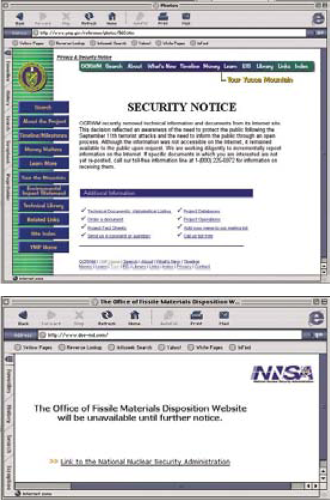
As of January 29, the link to the Security and Emergency Operations Web site in Energy's directory of office headquarters automatically redirected visitors back to the department's home page. Web sites for the offices of Defense Nuclear Nonpro-liferation, Fissile Materials Disposition, and Defense Programs had been taken off-line “until further notice.”
Although Web sites of other Energy offices still allowed access, they too displayed large holes where data used to be. The Office of Civilian Radioactive Waste Management is responsible for the controversial Yucca Mountain project in Nevada. Energy Secretary Spencer Abraham has recommended that President Bush give the project a green light, and both supporters and opponents are preparing for a tough legal and public opinion battle. But a number of Yucca Mountain documents were removed from the Web site, including the draft environmental impact statement; the site viability assessment; lists of once-available technical documents; online databases; elements of a virtual tour of the Yucca Mountain site and surrounding Nye County; a video showing a 360-degree view from the top of Yucca Mountain; and maps.
The Web site explained that, “The Office of Civilian Radioactive Waste Management promotes the open review of documents by the public during the Yucca Mountain site recommendation consideration process. However, following the attacks of September 11, 2001, we have removed certain content from our Internet site to minimize the risk of providing potentially sensitive information that could result in adverse impacts to national security.”
Parties interested in the information could still obtain it off-line by calling 1-800-225-6972. But the site noted, “A name and street address will be required.”
In some cases, a lucky or determined researcher might find documents that appear to have been removed in other areas. For example, reports on life-cycle costs and funding adequacy were no longer available from the technical documents section of the Yucca Mountain Web site but were obtainable at the Radioactive Waste office's publications page.
Where has all the data gone?

The Energy Department's Web site wasn't the only one purged of electronic documents after the September 11 attacks. At least a dozen other federal and state agencies reportedly pulled information off the Internet because they deemed it a potential security risk.
Some posted messages similar to the one at the Environmental Protection Agency's chemical accident prevention and risk management plan site. The site had contained information about emergency plans and chemicals used at 15,000 locations nationwide, but explained, “Risk management plan files that do not contain off-site consequence analysis information have been temporarily removed by EPA from its Web site in light of September 11. EPA is reviewing the information we make available over the Internet and assessing how best to make the information publicly available. We hope to complete that effort as soon as possible.”
Similar worst-case scenario (off-site consequence analysis) information about potential chemical accidents has been kept off-line in limited-access reading rooms since 1999 due to legislation promulgated after the Oklahoma City bombing.
The Federal Aviation Administration barred access to enforcement information due to “security concerns.” Transportation Department officials restricted pipeline mapping information, pipeline data, and data on unusually sensitive drinking water areas to approved pipeline operators and community officials. The Nuclear Regulatory Commission disabled a number of links, including those to the reactor oversight process, the nuclear reactor research program, regulatory initiatives for high-level waste disposal, and locations of reactors, whether operating or decommissioned. The Federal Energy Regulatory Commission barred online access to its records, including oversized maps detailing specifications of energy facilities. NASA's Glenn Research Center limited public access to technical data, such as instrumentation, control, and sensors information and ground and flight projects.
At the state level, the New York State Emergency Management Office removed driving directions to New York's two stockpiles of emergency supplies; New York's Public Service Commission removed a map of all existing and planned power plants in the state; and the State of New Jersey was withholding chemical information on 30,000 private sector facilities collected through its Community Right-to-Know program.
How quickly this information will be returned to the Internet, if at all, is unknown, and more may be removed before long. The National Infrastructure Protection Center, after receiving reports that U.S. infrastructure-related information was being accessed over the Internet from locations around the world, issued an advisory January 17 urging all content providers to review Web sites for “details on critical infrastructure, emergency response plans, and other data of potential use to persons with criminal intent.”
Paul Rogers is a freelance writer in Chicago, Illinois.
The Environmental Management office targeted any document with photographs or detailed maps of facilities, even though budget data, life-cycle cost estimates, and information about waste, pollutants, and program activities made up the bulk of each document. The office offered no explanation of what had been removed or why.
Among the missing documents: five reports on long-term stewardship (Energy's name for efforts to manage environmental hazards that will persist for generations); and historical documents, including the popular “Closing the Circle on Splitting the Atom” and “Linking Legacies.” Slated for removal but still available at the end of January were summaries of environmental science and technology activities at seven Energy sites and case studies describing the successful use of new technologies to deal with environmental hazards.
“It is frustrating that certain documents with no possible security value have been swept up in this dragnet,” said Jim Werner, an Energy official during the Clinton administration who was responsible for the preparation of many of the recently removed Environmental Management documents. “Broad, timely, and detailed environmental management information made the program more efficient, more effective, and more reliable and is a core reason for the program improvements during the 1990s. For example, if states and the public had not been given broad access to waste shipment and budget information, it is likely that the mixed waste and foreign spent fuel programs would have failed.”
The Office of Environment, Safety, and Health develops policies for and provides semi-independent oversight of the department's efforts to protect workers, the public, and the environment. The office restricted public access to reports of its oversight and accident investigations, with the explanation, “In support of our mission to protect national security, and the health and safety of our workers, the public, and the environment, [the Energy Department] is performing a review of information on our Web sites. Some information may be temporarily removed during this review. We appreciate your patience and understanding as we perform our critical work.”
The same explanation appeared on a non-functional search page for the Environment, Safety, and Health Web site and on the index page for the office's online document collection.
Environment, Safety, and Health is also responsible for Energy's compliance with the National Environmental Policy Act (NEPA)–the law requiring preparation of environmental impact statements and environmental assessments. Over the past five years, the department made most of its NEPA documents available without restrictions through a central Web site, along with guidance for implementing the law. After September 11, everything was briefly removed. Then the guidance was made available, but the NEPA documents remained unavailable. In January, internal access for department employees and some contractors was restored, but public access was still denied.
Meanwhile in New Mexico, as of January 29, people living near the Los Alamos National Laboratory were still waiting for access to hundreds of documents, including local NEPA guidance. The link to an electronic version of the “Environmental Justice Guide for LANL NEPA Analysis” produced only the message: “Electronic reports are unavailable. We regret the inconvenience.”
Requests for most Los Alamos publications in its online research library were denied. The Energy Department blocked access to documents on such wide-ranging subjects as the evaluation of habitat use by elk, environmental remediation technologies, pollution prevention, bat population studies, science education programs, physics, and the laboratory's history. What had been the only publicly available, complete copy of the Resource Conservation and Recovery Act permit for the lab, along with an index of supporting documents, was also gone.
Removal of the documents in the midst of the permit review process has especially frustrated activists.
“Our ability to ensure that the permitting process for [Los Alamos] adequately addresses and prioritizes the environmental management requirements at [the lab] for past, current, and future operations has been put to a halt for the time being,” said Colin King, research director for Nuclear Watch of New Mexico in Santa Fe.
Across the country in South Carolina, managers at the Savannah River Site pulled their entire Web site on October 25 and returned a greatly slimmed down version nearly a month later.
“Information had been rigorously reviewed prior to September 11, and the re-review has validated the strength of the original review,” explained Kevin Hall, director of the Safeguards, Security, and Cyberspace Office for the Savannah River Site. “Not all content has been restored as the additional review process, while not necessarily identifying information of concern, is time consuming.”
By January 29, none of the site's publications, environmental information, records about tritium operations, or information about science and technology activities had been restored. And while the shelves of the local public reading room remained full, the database allowing searches of available documents was taken off-line while the documents themselves were reviewed.
At the rest of Energy's facilities, the degree of change varied widely. The Hanford Site barely revised its Web content at all. Substantive documents, including many environmental impact statements and environmental assessments, remained publicly available. And the Fernald Environmental Management Project Web site continued to provide information about waste and contamination that was denied elsewhere.
The Energy Department is far from having resolved how it will control information access, especially via the Web, in light of September 11. Deputy Secretary Blake's directive reflected the desire of many within the department to act quickly, and that in itself limits options.
“The system works not with a scalpel, but with dull, blunt instruments,” said former Energy official Werner. Since many people examining security are unfamiliar with the details of the thousands of documents available on the Web, they had little choice but to pull them and undertake a detailed review, he said.
To ensure that the public at least knows what material was pulled by Energy, the Natural Resources Defense Council (NRDC) filed a request in January under the Freedom of Information Act to find out which documents were recalled. Energy's response came quickly but did not include a list of documents. Instead, it challenged the council's request for a fee waiver.
“Since the advent of the Bush administration, various federal agencies have initially challenged appropriate requests for fee waivers then granted the waiver before the situation escalated,” said NRDC attorney Geoffrey Fettus. The council has since addressed the Energy challenge and expects the department to begin cataloguing the missing documents.
“So far, [the Energy Department] has indicated that the information is being removed pending review. I would like to take them at their word, and I suspect that we will eventually get back to more or less where we were with document availability, though there will be a struggle to get there, with a lot of gnashing of teeth,” said Werner. “Legitimate security concerns will ultimately get sifted out, assuming there is a continuing public demand and interest.”
Missing links
Many government agencies pulled documents off-line or shut down Web sites for document review. As of January 29, the URLs listed below either redirected viewers to other sites, contained disabled links, led to shuttered sites, or offered some rationale for removing data.
Environment, Safety, and Health Office of Oversight:
Los Alamos National Laboratory Research Library:
lib-www.lanl.gov/pubs/la-pubs.htm
Civilian Radioactive Waste Management Office:
Defense Programs Office: www.dp.doe.gov
Environmental Management Office: www.em.doe.gov
Fissile Materials Disposition Office: www.doe-md.com
Defense Nuclear Nonproliferation: www.nn.doe.gov
Security and Emergency Operations Office:
Savannah River Site: www.srs.gov
Yucca Mountain Project: www.ymp.gov
Department of Transportation Office of Pipeline Safety:
www.npms.rspa.dot.gov/data/npms_data_down.htm
Environmental Protection Agency:
www.epa.gov/ceppo/review.htm#rmpreview
Federal Aviation Administration:
av-info.faa.gov/dd_sublevel.asp?Folder=%5Ceis
Federal Energy Regulatory Commission:
cips.ferc.fed.us/Q/CIPS/MISC/PL/PL02-1.000.TXT
NASA Glenn Research Center:
www.grc.nasa.gov/Doc/grcweb.htm
New Jersey Department of Environmental Protection:
www.state.nj.us/NASApp/pCRTK/jsp/ecrtkview.jsp
Nuclear Regulatory Commission: