



Abstract

The size and composition of India's nuclear arsenal is difficult to determine. From various sources, we estimate that India has a stockpile of approximately 30-35 nuclear warheads (fewer than Pakistan), which it is thought to be expanding. The Indian Atomic Energy Commission (AEC) stated that the series of five nuclear test explosions in May 1998 involved both fission and fusion designs.
On May 11, New Delhi claimed that the first three tests achieved yields of 43 kilotons (a “thermonuclear” device), 12 kilotons (a fission device), and 200 tons (a low-yield device). If the devices actually produced the yields claimed by Indian weapon scientists, we would expect to observe a seismic signal strength corresponding to 55 kilotons, or magnitude 5.76 on the Richter scale. Instead, the average recorded magnitude was 5.0, which indicates a probable yield of 12 kilotons, with the range possibly as low as 5 kilotons and as high as 25 kilotons. A mid-point of 12 kilotons is less than one-quarter of what Indian weapon scientists claimed, calling into question whether the thermonuclear milestone was achieved and whether the tests were “completely successful,” as India's AEC chairman claimed (see Nuclear Notebook, November/December 1998 Bulletin).
Construction at Kalpakkam of a new 500-megawatt sodium-cooled fast breeder reactor, which will produce plutonium, is scheduled to begin soon.
India established the National Security Council in April 1999 to implement nuclear policy, but its progress in setting up a nuclear command and control system is unknown. On August 17, 1999, a widely publicized draft document on nuclear doctrine (prepared by the 27-member National Security Advisory Board) called for the creation of a “credible minimum deterrent” to be based “on a triad of aircraft, mobile land-based missiles, and sea-based assets,” but the board's recommendations had no official standing.
While the army and the air force fine-tune their respective nuclear strategies, the Indian government has been considering a proposal to create a strategic nuclear force. The proposal followed a Group of Ministers' report that recommended the creation of a chief of defense, who would act as a military adviser to the prime minister on the management and control of nuclear weapons and strategic forces. The chief would “exercise administrative control, as distinct from operational military control, over these strategic forces.”
During 2001, a year that ended in heightened tensions with Pakistan, Indian government officials reaffirmed India's commitment to a nuclear no-first-use policy. But an Indian foreign ministry official told Defense News in 2000 that a “‘no-first-strike’ policy does not mean India will not have a first-strike capability.”
On May 31, 2001, the Indian Defence Ministry released a report detailing its plans to modernize its forces. The report also assessed security concerns. Not surprisingly, Pakistan's support of terrorist groups topped the list. After a terrorist attack on the Indian Parliament last December 13, both nations mobilized their armed forces, and India reportedly positioned Prithvi missiles near the Pakistani border.
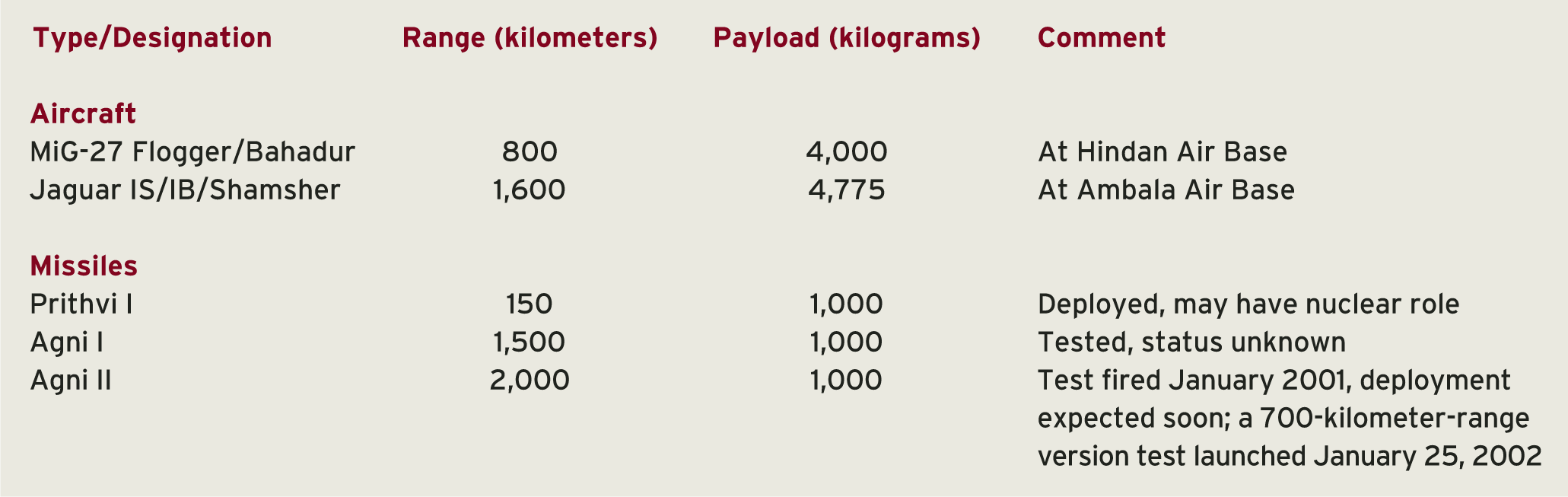
The MiG-27 Flogger is a nuclear-capable Soviet aircraft produced in the 1970s and 1980s. Hindustan Aeronautics assembled, under license, 165 aircraft, which India calls the Bahadur (meaning “valiant” or “brave”). The single-seat aircraft weighs almost 18,000 kilograms when fully equipped and has a range of approximately 800 kilometers. It can carry up to 4,000 kilograms of bombs on external hard points. There are nine operational squadrons. Which of India's bases may host nuclear-capable aircraft is unknown, but one likely candidate is Hindan, north of New Delhi. Some 50 MiG-27MLs are deployed there–fewer than 640 kilometers from Lahore, Pakistan. A few aircraft from Squadrons 2, 9, or 18 may be specially modified to carry one or more nuclear bombs.
The Jaguar IS/IB, known as the Shamsher (“sword”), was nuclear-capable with the British Royal Air Force from 1975-1985 and with the French Air Force from 1974-1991. Originally a joint Anglo-French aircraft, the first 40 were supplied by British Aerospace, with the remaining 91 assembled or manufactured by Hindustan Aeronautics. The Jaguar has a gross weight of 15,450 kilograms and a range of 1,600 kilometers with a maximum external load of 4,775 kilograms. There are four operational squadrons. Which bases may host nuclear-capable aircraft is unknown, but one likely place is Ambala, 525 kilometers from Islamabad. A few aircraft from Squadrons 5 or 14 may be specially modified to carry one or more nuclear bombs. In the Indian Air Force infrastructure, Hindan and Ambala are part of Western Air Command, located at Palam and reporting to headquarters in New Delhi.
Other aircraft, like the Su-30K and Mirage 2000H, could be equipped to deliver nuclear bombs but are more likely to be used for air defense missions. A Mirage 2000H may have been used in May 1994 to test-drop a dummy nuclear bomb, but this has not been officially confirmed. In late 1999, India was reported to have initiated talks with France about a possible purchase of as many as 18 Mirage 2000Ds to form part of its nuclear strike force; 10 Mirage 2000s were ordered in September 2000. In December 2000, India signed a $3 billion contract with Russia for the licensed production of 140 Su-30MKI aircraft at Hindustan Aeronautics over a period of 17 years. Forty Su-30K fighters procured in 1996 may also be upgraded to the MKI standard. Air Chief Marshal A. Y. Tipnis said before the deal that the indigenous Su-30MKI will “enable the Air Force to finalize its vision-2020 long-term perspective planning,” which involves acquiring up to 20 squadrons of multi-role aircraft over the next 15-20 years. The first Su-30MKI is scheduled to roll out in 2004. India may also lease a small number of Russian Tu-22 Backfire bombers, and France has offered to supply its new Rafale aircraft.
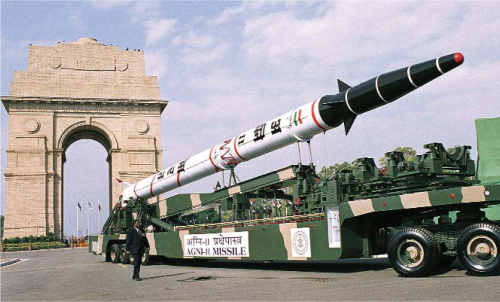
January 26, 2002: An Agni II missile in the India Republic Day parade, New Delhi.
The two-stage Agni (“fire”) intermediate-range ballistic missile is also under development and has been tested to a range of 1,500 kilometers, but its status remains unclear. Its first stage uses solid propellant taken from a satellite launch vehicle based on the U.S. Scout missile, and the liquid-fueled second stage is a shortened version of the Prithvi. The warhead section separates from the second stage during flight. The Agni was flight tested three times from 1989 to early 1994.
India is developing the Agni II, an improved version of the Agni, with a range greater than 2,000 kilometers. The missile is 20 meters long, about 16 tons, and carries a 1,000-kilogram payload. It was first test launched in April 1999, flying 2,000 kilometers in 11 minutes, and possibly carrying a nuclear warhead assembly without the plutonium core. Its second flight test was on January 17, 2001, from a mobile launcher at the Chadipur-on-Sea missile test range in the eastern state of Orissa. The missile, which was reportedly in “operational configuration,” flew 2,200 kilometers, and according to Indian officials landed less than 100 meters from its intended target. After the test, which took place shortly after a state visit by Li Peng, chairman of China's National People's Congress, Indian defense minister Jaswant Singh reportedly informed the Indian Parliament that “Agni II is planned to be inducted into the armed forces during 2001-02.” Both road- and rail-mobile versions are under development.
A short-range version (about 700 kilometers) of the Agni II was test launched from Wheeler's Island on India's east coast on January 25, 2002. The test, which had been postponed twice, occurred a week after Chinese Premier Zhu Rongji's first official visit to India.
The development of a longer-range Agni III, with a range of up to 3,500 kilometers, has not been confirmed.
Rumors persist concerning Indian plans for an intercontinental ballistic missile (ICBM) program, referred to as the Surya. Most components needed for an ICBM are available from India's indigenous space program. Conversion of its polar space launch vehicle (PSLV) to an ICBM would take a year or two after a decision to do so. The latest model, the four-stage PSLV-C3, is capable of launching satellites weighing up to 1,200 kilograms into polar sun-synchronous orbit (570 kilometers) or 3,500-kilogram satellites into low earth orbit (400 kilometers). The first successful flight was conducted in October 1994. An attempt to develop a geo-synchronous satellite launch vehicle (GSLV) suffered a setback in March 2001, when one of four liquid-fueled strap-on boosters caught fire, causing the launch to be aborted. GSLV capability would allow India to place permanent command and control satellites in geosynchronous equatorial orbit.
The Dhanush sea-launched ballistic missile has been under development since 1983 and could be completed next year. A test firing on April 11, 2000, was only a “partial success” and may delay the program. It was launched from the reinforced helicopter deck of the INS Subhadra, a modified patrol vessel anchored 20 kilometers offshore in the Bay of Bengal. The 8.56-meter missile, the navy's version of the army's Prithvi, can carry a 1,000-kilogram payload up to 250 kilometers. Neither the Dhanush nor the Sagarika has been declared nuclear-capable by Indian authorities.
During the tense standoff between India and Pakistan in January 2002, new naval chief Adm. Madhvendera Singh made some ambiguous comments about naval nuclear weapons in his initial news conference. “We have a triad of weapons for a second strike and one of the triad is at sea,” he said. “The most powerful leg of the triad is in the navy and is hidden underwater and moving.”
New Delhi, 1999: Painting a Prithvi missile.

A launch platform for a navy nuclear weapon may be the Advanced Technology Vessel (ATV), a nuclear-powered submarine project that has been underway since at least 1985. Design and operational experience was gained from operating a Charlie I-class cruise missile submarine (named INS Chakra) that India leased from the Soviet Union from 1988 to 1991. Full-scale work on the ATV began in 1991 shortly after the Chakra was returned, and construction started in 1997. A launch date may be scheduled for 2007 at the Mazagon Dockyard in Bombay (design has taken place in Vishakapat-nam on the east coast), but technical challenges are likely to delay the project further. Indian efforts to lease one or more Russian nuclear submarines continue. The ATV is thought to be based in part on the design of the Chakra, but the reactor is reported to be of Indian design. A land-based prototype reactor has been built and installed at the Indira Gandhi Centre for Atomic Research at Kalpakkam in southern India. Vice Adm. R.N. Ganesh, who commanded the Chakra, was appointed director general of the ATV project in 2000 in an apparent attempt to jumpstart the much delayed project.