



Abstract

Hot properties
COLLECTING RADIOACtive items may sound more hazardous than a hobby ought to be. But to a handful of aficionados, the click of a Geiger-Mueller counter at a flea market or rock show is as welcome as cold lemonade on a hot summer day.
The universe of radioactive items available for sale is surprisingly large. It includes everything from minerals like autunite, carnotite, and tobernite to decorative objects–uranium-glass salt shakers and red Fiestaware plates, for instance. Even quack cures, based on the alleged healing power of radiation, show up with some regularity.
Collectors usually specialize in a single category. Maurice de Graaf, a computer engineer in the Netherlands, has 84 radioactive specimens in a collection of more than 1,200 minerals.
“Once you decide you want to collect all the minerals there are, you have to make a decision if you want to take up the radioactive ones,” de Graaf explains. He decided to include them in his collection because “When you collect small samples and live by some rules, the risk is minimal.” And secondary uranium minerals “are very beautiful,” he adds.
Frank Kimbler sells specimens through his company, AtomicRocks.com, and on eBay. His customers include employees of the Nuclear Regulatory Commission, science teachers, nuclear power plant workers, people in radiation control, and even a few interested millionaires, including a Sony Music Corp. executive. Kimbler estimates that a third of the purchases are work-related–for demonstrating radioactivity, or for calibrating equipment. The rest are strictly for pleasure.
“A rock that emanates mysterious rays” is what attracts collectors, says Kimbler. “It makes a Geiger counter click.”
Other times the attraction is purely aesthetic. Uranium glass is called Vaseline glass these days because it fluoresces a bright yellow-green under ultraviolet light. It was popular in the late 1800s and can often be spied in flea markets and antique stores, according to Living With Radiation: The First Hundred Years, by William Kolb and Paul Frame.
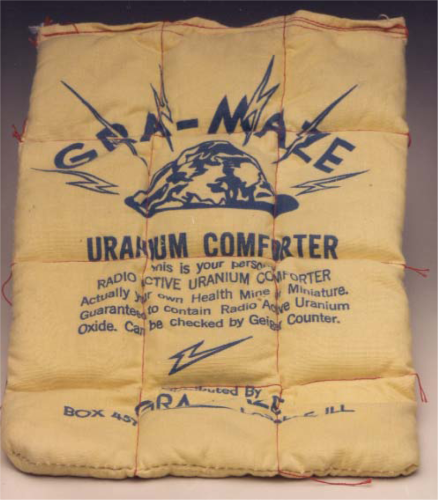
The uranium comforter, one of many radioactive quack cures.
Kimbler says his mother picks up Vaseline glass collectibles at yard sales, for example. “She doesn't use a Geiger counter, she just knows what it looks like. She didn't even know the stuff was radioactive–most people don't.” Since Vaseline glass is all slightly radioactive, “it glows like crazy under black light. Absolutely gorgeous!”
Most collectors own radioactive pieces not for their “heat” but because they belong to a particular category of collectible. Reddish-orange Fiestaware is probably the best-known example of a flea-market find that happens to be radioactive. “I generally don't even think about the uranium content of the glaze,” says Steven Beals, a Long Beach, California nurse-anesthetist who has collected Fiestaware for about seven years. He doesn't eat off the plates, but if he did, Beals says, he wouldn't put acidic foods on them or use them in the microwave.
The oddest strain of radioactive collectibles are quack cures from the 1920s, 1930s, and 1940s. The public was entranced at the time by the reputed healing power of radium, and inventors found myriad ways to bring its “benefits” to the public, including the “Radium Water Jar,” the “Gra-Maze Uranium Comforter,” the “Radium-chema Radioactive Compress,” and even “Vita Radium Suppositories.”
The Health Physics Historical Instrumentation Museum Collection in Oak Ridge, Tennessee, cu-rated by Paul Frame, features radioactive quack cures and more–almost 1,000 items in all.
Then there are the few folks who hunt down radioactive specimens of every kind. The two-and-a-half-year-old CDV700 Club, a YahoolGroup named for an old Geiger counter, has 127 members who gather to chat about all things radioactive.
Some work for the government in various radioactive areas, some are scientists or doctors, some are professors, most are radioactive mineral collectors, and some are just ordinary people who have an interest in radioactives and Geiger counters.
A radium water jar.

Is it a dangerous hobby? “Dangerous is a loaded word,” Frame says. “I don't know that anyone has been harmed by possessing these types of objects. What worries me a little bit is that they might end up in the hands of someone who doesn't know what they are and be used in an inappropriate fashion.”
It's not an irrational concern. Almost seven years ago, an unsuspecting Tennessee man picked up more than he bargained for at a local yard sale, according to reports in the Knoxville News-Sentinel. He brought home some old medical equipment, including a lead box about the size of a shaving kit. By the time he noticed the word “radium” on his new treasure, it had leaked radioactive contamination throughout his home. It took weeks for professionals to take care of the hot spots.
Knowledgeable retailers try to keep a watchful eye out for ignorant or irresponsible use of their wares. “One lady wanted to buy five chunks of car-notite to put in the water that her horse drinks,” says AtomicRocks.com's Kimbler. He refused to sell them.
Frame, however, does not encourage people to collect radioactive oddities or minerals. “In many cases, the activity of these things is so low that I don't see a big problem with someone having them,” he says. “I'm just concerned that the public has no good way to distinguish those that could be a problem from those that aren't.”
And they want to import 20,000 tons of spent nuclear fuel?
Duma Deputy Sergei Mitrokhin, a member of the Yabloko party, described the Odyssey–presented as a special report on NTV on February 15:
“We entered through two-by-two-meter holes in the barbed wire and walked on well-trampled paths, probably made by local citizens…. The guards drove past us several times, and we passed by their sentry boxes, but we pretended to be locals and nobody stopped us” (St. Petersburg Times, February 19).
Duma Deputy Sergei Mitrokhin at the plant at Krasnoyarsk.

150 solutions, one fun contest
You are not a Lilliputian in the land of the Brobdingnagians; you are viewing a selection of entries from the Bulletin's Plutonium Memorial Design Contest. One-hundred-fifty artists, architects, students, and conscientious citizens from 20 countries submitted entries ranging from the tongue-in-cheek (a mushroom cloud-shaped building topped by a four-star restaurant and located in Orlando, Florida, with a connecting tram to Disney World, of course) to the funereal (an underground tar pit in Kamchatka, Russia, marked by a jagged-branched dead tree made of metal).
Michael Collins's entry included this illustration along with a detailed notebook on nuclear history and monument construction.
All sought to offer solutions to the plutonium disposal problem more creative than the government's choice of either burying or burning it.
Entries were judged on the basis of artistry, novelty, sense of humor, elegance of solution, and practicality. On the judging panel were an artist, an architect, a Nobel laureate, a member of the Bulletin's board, and one Bulletin editor. Winners were announced March 14 at Chicago's Mars Gallery, where more than 40 of the most creative designs were put on display. Minneapolis songwriter Howie Kestell lent his original song, “Plutonium,” as a sound track for the event.
Entries had to take into account the inherent handling constraints of plutonium, most notably that it has to be stored in small quantities kept separate from each other, and needs to be kept in airtight containers to prevent inhalation or contact with the environment. And, of course, the system needed to be secure for the 240,000 years plutonium remains radioactive.
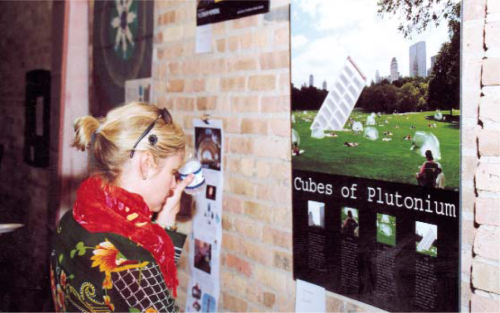
Photographer Alyce Henson studies one of the entries exhibited at the March 14 reception.

In devising a means to safely store plutonium, entrants also memorialized the folly of world governments creating so much of the volatile element. Between the humor and the scale of the projects, like the oversized ice cubes, bones, and “Pile of Pu” as the dubious mound was called, the entries served to educate, and in many cases entertain, while accomplishing the goal of any memorial: preserving a remembrance–in this case, the memory of the excesses of the nuclear enterprise.
J. Brantley Hightower, a Chicago-based architect who nabbed one of two $750 runner-up prizes, plotted his sprawling “National Plutonium Memorial” along Interstate 55 between Chicago and St. Louis. His memorial, which melds agrarian field planning with a geometry inspired by nuclear detonation, includes a learning center sited amid a series of 300 ominous, dark towers where plutonium would be stored.
Hightower sought to contrast a “familiar traditional, pastoral order with one that is foreign and potentially disturbing.” Segregated plots of farmland–differing in size–radiate out from the round learning-center core. The towers line the rounded outer edge of each plot. The entire development is 8,000 feet in diameter at its widest–matching the radius of destruction at Hiroshima.
“We don't ever experience in any real ways the destruction that can be caused by nuclear weapons. We know they are destructive, but it's an abstract thing we only read about in history books,” says Hightower, who was surprised at the scale of a nuclear blast when he started drawing the memorial site to match the dimensions of Hiroshima. “Our generation wasn't there to put [Hiroshima] into a physical context. The intent is to show what this technology, what these weapons systems, are capable of doing on a real and palpable scale,” says the 25-year-old.
The interstate intersects the complex, so people are reminded of plutonium and its potential on every drive through. To spread the message to the largest group possible, Hightower envisions a series of such memorials along U.S. thoroughfares between major metropolitan areas.
Michael Collins, an architect based in Chino Hills, California, and the other runner-up, echoed Hightower's call to educate. “We often hear the words ‘nuclear’ and ‘plutonium,’ but yet we really don't know what that means,” he says.
In Brief
Ever hear of the “paradigm clock,” which imitates a somewhat more famous iconic clock by periodically moving its hands closer to or farther from midnight? As explained on the Paradigm Research Group's Web site (www.paradigmclock.com), their clock represents “the proximity to formal disclosure by world governments of the ongoing presence of extraterrestrial life forms in our world now.”
A French team that will race in the next America's Cup yacht race is supported in large part by a consortium of French nuclear companies and the French government. But nuclear industry backing of the ship–nicknamed the “Atomic Warrior”–has been strongly criticized by activist groups–particularly Sortir de Nucléaire (New Zealand Herald, February 4). Another organization that is unhappy with the new ship is Greenpeace, which is still sore about the 1985 sinking by French agents of the Rainbow Warrior, a Greenpeace vessel used to protest French nuclear testing in the South Pacific.
According to This Week in Germany (germany-info.org), the unwort of the year 2001 was Gotteskrieger, which is translated into English as “holy warrior.” A jury of German linguists and journalists declared the term an entirely unacceptable euphemism to use when the word “terrorist” is a more accurate choice. (Since 1991, the German media has selected an “unword of the year” to compete with the German Language Association's annual “word of the year.”)
You may look at that little flashing light on your computer's hard drive as desktop entertainment, but scientists suspect it may be giving away, in a way akin to Morse code, the entire data stream it's processing. According to the March 9 New Scientist, a programmer at Lockheed Martin Space Systems in Denver and an Alabama professor have figured out how to convert the flashing light into readable data. Information may be retrieved from some modems and Internet routers in the same way.
In February, the British government released a series of once-classified documents from the 1960s, showing that Prime Minister Harold Wilson's government had an elaborate nuclear “war book,” but in 1965 realized it had omitted the question of who would take on the onerous duty of telling the queen that Britain was about to employ nuclear weapons (The Guardian, February 27).
The state government of California has decided to save money by sending items with low-level radioactive contamination to local landfills rather than to radioactive waste disposal sites–a plan similar to efforts over the years by the U.S. and British governments to deregulate the disposal of mildly radioactive materials (San Francisco Chronicle, March 20). As elsewhere, landfill operators and scrap recyclers have complained about the plan, but the angriest group appears to be the members of California's Integrated Waste Management Board. Although notice of the regulatory change was sent to a long list of state employees and agencies, the waste board was not on the list.
In early March, a number of congressional Democrats expressed surprise that the Bush administration had not bothered to tell them that a “shadow government” was in hiding in underground bunkers, ready to take over government functions in case of a catastrophic attack on Washington (Washington Post, March 2). Senate Majority Leader Tom Daschle and House Minority Leader Richard Gephardt complained that they had not been told and did not know that the “continuity of government” plan deployed on September 11 was continuing. Republican leaders, though, were apparently willing to jump through hoops to avoid criticizing the administration: According to their aides, both House Speaker Dennis Hastert and Senate Minority Leader Trent Lott said they were not sure whether they had known.
Hoping, one supposes, to confuse potential terrorist attackers and anti-nuclear demonstrators alike, Dominion, a Virginia-based energy company that took over the long-troubled Millstone nuclear reactor plant in Connecticut last year, decided to “shorten” the plant's name to “Millstone Power Station,” omitting the word “nuclear” (New York Times, February 27). David Lochbaum of the Union of Concerned Scientists somewhat facetiously described the name change as “a good safety move.” But Times reporter David Halbfinger asked, “Why cut loose the ‘nuclear’ when you've got ‘Millstone’ around your neck?”
Collins's futuristic-looking “Memorial to Plutonium” is a mostly open-air complex located in Orlando. A solar canopy tops a long walkway lined with half-submerged spheres of plutonium. Visitors are meant to proceed through the memorial to the main exhibit hall, explore and uncover a “layering of discoveries that attempt to reveal the idiosyncrasies of plutonium,” says Collins.
“Such a project has two primary objectives: to educate people about the history, science, and the personalities involved with plutonium; and to remind mankind that with actions, come consequences–often unanticipated,” he says.
Rather than asking people to come to a memorial, other entries brought plutonium to the masses. “P-239” is a line of plutonium laden silver balls suspended by titanium wires and looking much like the venerable perpetual-motion toy that tops many an executive desk. P-239 modules can be erected virtually anywhere, including, as the Austrian designer posits, along the Champs Ely-sees, through the Brandenburg Gate, and in the Poletown neighborhood of Detroit.
Leon Lederman signing Michael Collins's notebook.

“Instrument of Awareness” follows that same modular concept. Tinker-toy-like structures can be assembled into display walls about the size of a billboard or configured into walk-through halls. Rows of plutonium canisters are suspended at the center of subsections of each wall. They can be set up anywhere, including the designer's choices of Times Square, Wrigley Field, and Wilshire Boulevard in Los Angeles.
The U.S. capital of kitsch, Las Vegas, was the most common location for the proposed memorials. The “Atlas Shruggs Casino” (which looks like a giant roulette wheel) and the glitzy “Plutonium Park and Memorial,” which features the “Thrill of a Half-Life Rollercoast-er,” incorporated these same themes of getting the plutonium problem out in the public eye, while still meeting the country's penchant for tourism and titillation.
Designers also suggested such hallmarks of nuclear activity as Nagasaki, the Rocky Flats plutonium plant, the Sedan Crater, the Nevada test site, and Stagg Field at the University of Chicago, where scientists created the first controlled release of nuclear energy.
Brantley Hightower's plan for a memorial along Interstate 55.

San Francisco-based product designer Michael Simonian won the contest with his “24110” permanent plutonium waste repository (see p. 38), located in Washington, D.C., steps away from the Mall. “Most nuclear waste is swept away to parts of the earth that are either uninhabited by humans or inhabited by people who don't have the political power or resources to prevent the nuclear waste from ending up in their communities,” says Simonian, who was awarded $1,500 for his efforts. “For this reason, it is important that this memorial be situated in a high-profile location.”
The circular memorial is grass-topped and practically ground level, with a rise along one side, as if someone were lifting the edge of a rug to sweep under some dirt. The plutonium is stored in casks beneath the structure and can be seen in silhouette along the uplifted edge.
Says Simonian: “It represents a peeling away of what we try to forget is there, but is there.”
At least for 240,000 years.
Space, a tourist-friendly place
In February, the Boy Scouts' county council of Western Los Angeles presented businessman Dennis Tito with its prestigious Americanism Award, bestowed annually on one who personifies “the traditions of our country and the Boy Scouts of America.” Exactly what grand American tradition did Tito represent? The accumulation of wealth, one supposes.
Last May, Tito became the first space tourist when his $20 million ticket bought him a stay aboard the International Space Station.
California Republican Cong. Dana Rohrabacher, who chairs the House subcommittee for space and aeronautics, had this to say: “Because of Dennis Tito, space is no longer reserved for government employees and their invited guests.” That's right. Now the exceedingly rich have invitations, too.
And that might mean space will be getting some more “stars.” Lance Bass of the boy band ‘NSync was reportedly negotiating a seat on one of Russia's upcoming Soyuz flights to the space station. The 23-year-old pop singer might even be able to take his screaming fans along for the ride–if a Los Angeles production company has its way. Destiny Productions wants to sponsor Bass's journey and film his training for the trip for a new reality-TV show (working title “Celebrity Mission: Lance Bass”). The series would culminate with the space flight.
The Cosmopolis XXI.

Bass, who has already traveled to Moscow for preliminary health tests, might have some competition. In a recent interview, Tom Cruise told Barbara Walters of his wish to boldly go where no actor has gone before.
What's a poor person with dreams of space travel to do? Try the cut-rate sub-orbital space jaunt offered by Space Adventures, Ltd. The company unveiled the prototype for its first reusable spacecraft, the Cosmopolis XXI, on March 14 in Russia. Space Adventures wants to use the Cosmopolis for tourist trips, available at $98,000 a pop. The highlight of each voyage will be about three minutes of weightlessness. Although its first commercial flight won't happen until 2005, Space Adventures has already booked more than 100 reservations for the 30-90 minute, 62-mile-high lobs.
It's even possible to get into space by flying the old-fashioned way–on a regular commercial carrier. Rack up enough frequent flyer miles, and US Airways, in conjunction with Space Adventures, will let you redeem them for one of the sub-orbital trips. Just how many miles do you need to accrue? Ten million–equivalent to about 250 trips around the globe.
Some folks, including former astronaut Buzz Aldrin, have their sights set even farther into outer space. Aldrin is leading a team of researchers in designing spacecraft that would cruise non-stop between Earth and Mars–fittingly named “cyclers.” The outbound trip to Mars would take between six to eight months, but the cyclers themselves wouldn't take flight until 2018 at the earliest.
“These cyclers would be like space hotels,” said researcher and astronautics professor James Longuski (February 5, AScribe Newswire). “They would provide the usual creature comforts.” One assumes that doesn't include an outdoor pool and cable.