Abstract

Boiling the egg
Sixty years ago, shortly before 4 p.m. on December 2,1942, a bitterly cold day in Chicago, the first nuclear chain reactor went “critical” and the Atomic Age was born.
The chain reaction experiment was in a doubles sguash court under the west stands of Stagg Field, a football stadium at the University of Chicago. Many of the scientists involved seemed addicted to cute code words: They called the experiment “boiling the egg.”
In December 1938, German scientists had described an experiment in which uranium atoms had been split–“fissioned”–by neutron bombardment. It was the story of the decade in the global physics community.
Physicists in Europe, Britain, and the United States immediately began experimenting with uranium. In the United States two men took the point position: Enrico Fermi, who had fled Fascist Italy; and Leo Szilard, a Hungarian emigré who was certain that the Nazis were already working on a bomb.
Among the devices Fermi and Szilard built at Columbia University were machines consisting of stacks of graphite blocks that encapsulated cans of uranium oxide (later, pressed lumps of the material, and later still, lumps of metallic uranium). Szilard and Fermi called them piles because that's what they were–piles of graphite and natural uranium cunningly designed to slow “fast” neutrons produced by the highly fissionable isotope, uranium 235. The slow neutrons were likely to split additional nuclei, thus releasing additional neutrons–and to produce a sustained chain reaction. The uranium 235 isotope is scarce in natural uranium; the abundant isotope is uranium 238, which does not fission easily. But uranium 238 could capture neutrons. The result: highly fissionable plutonium 239.
Give that man a cigar
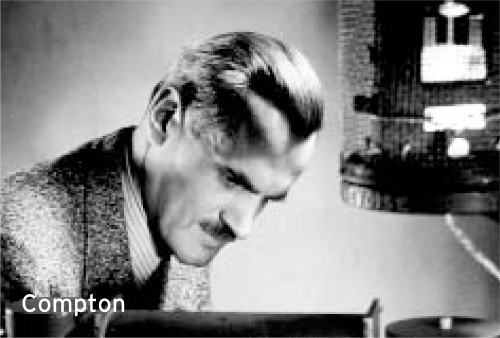
By December 6,1941, the University of Chicago's Arthur Holly Compton was a major honcho in America's atom bomb project. He strongly believed that there were two roads to making an atomic bomb. One was to separate uranium 235 from natural uranium and make a weapon from that. That seemed a near-impossible task. The second route was to create plutonium 239 by irradiating uranium 238 in a chain-reacting pile.
The uranium 235 work was assigned to other labs, and Compton consolidated widespread plutonium research in Chicago. Ernest Lawrence, then the leading American-born nuclear physicist, didn't think much of Compton's decision.
“You'll never get the chain reaction going here,” he told Compton on January 24,1942. “The whole tempo at the University of Chicago is too slow.”
“We'll have it going by the end of the year,” Compton said.
“I'll bet you a thousand dollars you won't,” Lawrence replied.
“I'll take that bet,” said Compton.
“I'll cut the stakes to a five-cent cigar,” said Lawrence.
Compton won, but he didn't smoke and he never got his cigar.
That good
Compton had a hard sell when he took his plutonium idea to Vannevar Bush and James Conant, men appointed by the president to determine wartime priorities for scientific research.
Even if a chain reactor could make plutonium, said Conant, extracting it might prove very difficult because of the lethal radioactivity.
Compton replied that a young chemist in California, Glenn Seaborg, had assured him “that within six months from the time the plutonium is formed he can have it available for use in the bomb.”
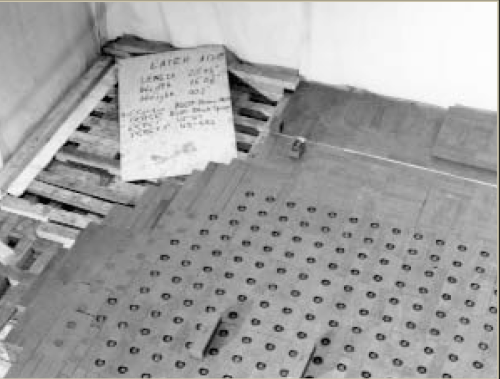
An experimental pile, part of the scale-up to building CP-1.
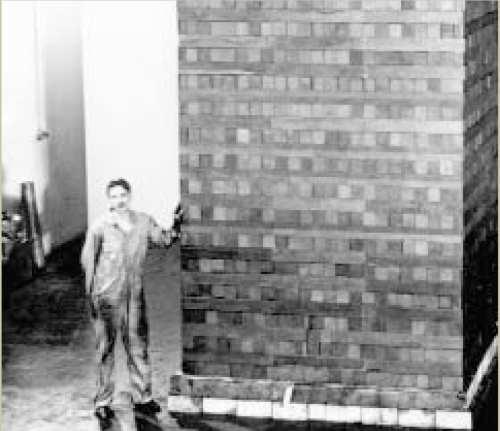
The pile's tenth layer (of an eventual 57), as seen in November 1942.
“Glenn Seaborg is very competent,” said Conant, himself a world-class chemist, “but he isn't that good.”
Conant was wrong. By 1945, it took Seaborg and his team just two months to extract bomb-grade plutonium from the first irradiated uranium slugs.
He was just kidding, wasn't he?
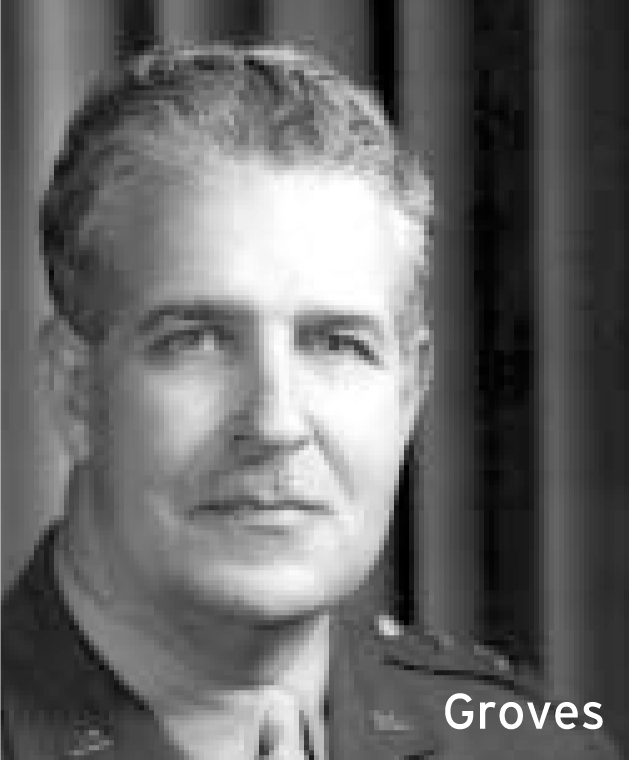
In the spring of 1942, scores of the world's brightest scientists began assembling in Chicago, including Szilard, Fermi, Eugene Wigner, and Seaborg, where they worked in the mysterious new “Metallurgical Laboratory.” By that summer, the Army Corps of Engineers was placed in charge of the bomb project and code named it the “Manhattan Engineer District.” In late September, Gen. Leslie R. Groves, a loose-lips-sink-ships guy, took over. Because he felt the Chicago scientists (while brilliant) were too talky and undisciplined, Groves compartmentalized the project, which sharply limited the ability of the scientists to communicate with one another. Szilard biographer William Lanouette wrote that after Groves's first meeting with the scientists, “Charles D. Coryell, a Met Lab chemist, was walking toward the door with Groves. Glancing back at the large window in the conference room, Coryell wondered aloud about their security.
“‘General, what would you think if someone threw a hand grenade through the window?’”
“‘It'd be a damned good thing,’ Groves snapped. ‘There's too much hot air in here.’”
Handcuffs, please
Szilard did not think well of Groves, who in turn despised Szilard. Insofar as Groves was concerned, Szilard was a potential German spy until proven innocent.
Just weeks before the successful December 2 experiment, Groves asked Secretary of War Henry Stimson to sign an order that would “dispense” with Szilard's services. It was essential for the “prosecution of the war that Mr. Szilard, who is an enemy alien, be interned for the duration,” the draft order said.
Stimson declined to sign.
What the boss doesn't know …
Fermi and his crew built 31 subcritical piles in the sguash court during the summer and fall of 1942. Unlike the earlier “exponential” piles, the final Chicago Pile-1 (CP-1) was not supposed to be built in the city. No one wanted a meltdown in Hyde Park, a stylish, densely populated middle- and upper-class neighborhood. The pile was to be built in a forest preserve 20 miles southwest of Chicago's Loop and to be completed by October 20.
But union workers at the site went on strike, and the building designed to house CP-1 would not take shape in time.
Fermi told Compton: “I believe we can make the chain reaction work safely right here in Chicago.”
And Fermi's calculations seemed to be in order. “We did not see,” Compton later recalled, “how a true nuclear explosion, such as that of an atomic bomb, could possibly occur. But the amount of potentially radioactive material present in the pile would be enormous.”
In a worst-case scenario, an uncontrolled chain reaction was conceivable; if it had taken place, it would have been good-bye Hyde Park.
As a university official, Compton felt obliged to run the decision by his superior, Robert M. Hutchins. But Hutchins, as president of the university, would have had to say “no.”
During war, one takes risks, Compton later said. Without consulting Hutchins, he gave Fermi a green light.
He got satisfaction
Compton phoned Conant to tell him the December 2 experiment had been a success. “Jim,” said Compton, “you'll be interested to know that the Italian navigator has just landed in the New World.”
“Is that so,” said Conant. “Were the natives friendly?”
“Everyone landed safe and happy.”
In contrast, Fermi simply noted in his December report: “The chain reacting structure has been completed on December 2 and has been in operation since then in a satisfactory way.”
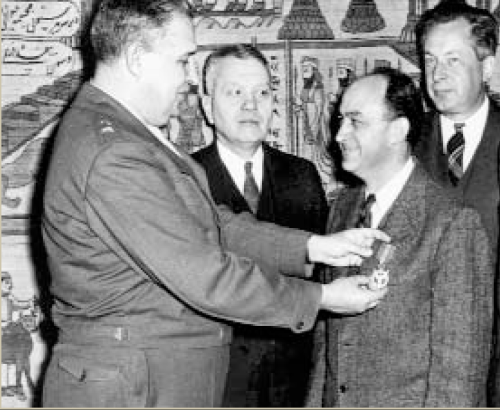
General Groves pins a medal on Enrico Fermi's lapel.
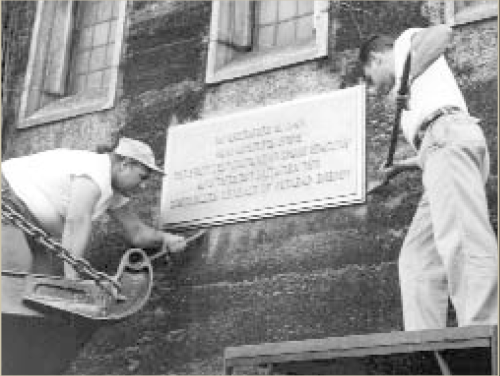
August 15, 1957: Workmen remove a commemorative plaque before the demolition of Stagg Field begins.