



Abstract

Advocates of a multilateral foreign policy and negotiated reductions of weapons of mass destruction suffered a devastating loss in the November elections, one that runs deeper than it first appears.
Republican election gains have left both the executive branch and Congress in the hands of President George W. Bush. It is the first time that Republicans have dominated Washington for more than a brief period since the early 1950s.
Even more distressing, the Republicans achieved their victory in major part due to their focus on the war on terrorism and other national security issues. President Bush and his key political adviser Karl Rove gambled by getting deeply involved in the congressional elections. The president persuaded some candidates to run and elbowed others out. He raised an estimated $180 million for Republican candidates, and then barnstormed across the nation, particularly in the last five days of the campaign. The president put his prestige on the line, and he won.
Most observers had expected Republicans to retain control of the House of Representatives, and they did, while surprising many by gaining about five seats (some races remained undecided at press time). In the Senate, Republicans won a net of at least two seats, winning control with 51 or 52 votes. The result was particularly surprising in that the party that controls the White House normally loses seats in a mid-term election, particularly with the economy languishing.
While it was a stunning defeat for the Democrats and a triumph for a president who had only narrowly secured the White House two years ago, the election should not be over-interpreted. In 1974, there was a Watergate landslide for Democrats with many seats changing hands. In 1980, a Ronald Reagan tidal wave brought in huge Republican gains.
This time, the trend toward Republicans was more of a gentle breeze than a tidal wave. The country remains divided roughly 50-50 between Republicans and Democrats–very similar to the 2000 election. A switch of fewer than 50,000 votes in Senate contests would have left the Senate in Democratic hands–and a similar switch in House votes would have given that body back to the Democrats.
Republicans won because of a late surge, particularly in the suburbs, fueled in part by the president's energetic campaigning. With that extra push, they won most of the close congressional contests. Heading into election day, there were 10 toss-up Senate contests; seven went to the Republicans. Two years ago, almost all close Senate races went to Democrats, fueling a four-seat Democratic pick-up, creating a 50-50 tie, which was later broken when Vermont's Sen. Jim Jeffords left the Republican Party.
While the shift may be narrow, the implications will be profound. The one major check on White House power over the past two years has been the Senate–even if some complained that the check had not been utilized vigorously enough. Majority Leader Tom Daschle set the Senate agenda. Chairs of important Senate committees were held by Democrats: Armed Services by Michigan's Carl Levin, Foreign Relations by Delaware's Joseph Biden, Budget by North Dakota's Kent Conrad, and so on. All those committees will pass to Republican control.
The consequences can be understood by looking at the Senate Armed Services Committee's consideration this past year of the $393 billion Defense Authorization bill.
Because Democrats narrowly controlled the committee, they were able to unite during the writing of the bill to produce a reduction in missile defense programs by $800 million, block the administration's request for a nuclear “bunker buster” weapon, and leave intact a ban on developing a new, smaller nuclear weapon.
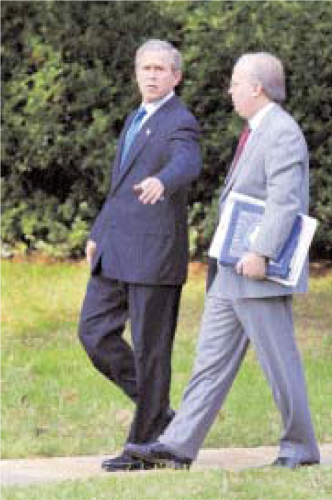
Bush and political adviser Karl Rove.
The onus was on Republicans to offer amendments in committee or on the Senate floor to overturn those decisions, and the Republicans, forced to choose where they would make a stand, concentrated on missile defense. Starting in 2003, it will be Republicans led by Virginia's John Warner who will produce the draft bill, and Democrats will have to pick and choose their best opportunities for amendments. The minority can stop egregious actions by resorting to a filibuster, but that weapon can only rarely be unsheathed. As a result, it will be even harder for proarms control positions to prevail.
As important as the election results themselves is the way that Republicans won. Democrats had expected to exploit their support for expanded health care, prescription drug benefits, and education. The president, on the other hand, put his chips on the battle against terrorism and his determination to deal with Saddam Hussein. After Labor Day, he transformed the national debate by demanding congressional approval of a resolution providing the president authority to conduct military operations in Iraq. Many congressional Democrats supported the president, hoping to get the issue “out of the way” so they could focus on the economy and domestic issues.
Their strategy failed. On election day, voters may have thought the economy and health care were more important issues, but they voted on national security.
A poll conducted for the Vietnam Veterans of America Foundation immediately after the election by Democratic and Republican analysts concluded: “Foreign affairs and security issues–particularly homeland security–played an unprecedented role in this year's mid-term elections.”
The survey by Greenberg, Quinlan, Rosner Research, Inc., a Democratic firm, and Public Opinion Strategies, a Republican company, found:
While the economy and jobs were top concerns, more voters chose candidates based on Bush's popularity and his war on terrorism.
Within concerns over the war on terrorism, the media focused on Iraq, but voters were most concerned about improving homeland security.
Voters felt that terrorism is just as much a domestic issue as it is an international issue.
Fox News and Opinion Dynamics conducted another series of polls on November 4 and 5 in 10 key states. Their polls found that other issues were more important than terrorism, but voters who cared most strongly about the terrorism issue voted overwhelmingly Republican.
For example, in Colorado, where incumbent Republican Sen. Wayne Allard was being challenged by Democrat Tom Strickland, the economy was the most important issue for 29 percent of the voters, while terrorism counted most for 14 percent. But among the 14 percent for whom terrorism was the key issue, 71 percent voted for Allard; only 28 percent voted for Strickland.
In Missouri, where Democratic incumbent Sen. Jean Carnahan embraced the Bush position on Iraq and other national security issues, those who voted primarily with the issue of terrorism in mind went for her Republican opponent, Jim Talent, 88 to 12 percent.
Republicans have long charged Democrats with being “weak on defense.” That issue faded after the demise of the Soviet Union, but Bush and Rove have resurrected it in light of the new terror threat.
Early in the campaign, Republican candidates tried to raise national security issues by running television ads lambasting Democratic candidates for taking money from a “radical” organization. After Labor Day, Republicans pivoted to new issues–the war in Iraq, delays in establishing the Department of Homeland Security, even flag-burning. Two Senate Democrats in particular, Carnahan in Missouri and Georgia's Max Cleland, were defeated at least in part because they were accused of undermining the war on terrorism by insisting on worker rights at the new department.
After the election, Democrats immediately began debating whether to move left to encourage base voters to turn out or to move toward the center, where independent voters tend to congregate. However, most observers felt that the major problem for Democrats in 2002 was not that they were ideologically off-base, but that they failed to stand for anything, either on domestic issues or national security. Voters who felt that Bush was mishandling the economy did not believe Democrats had a coherent alternative. Many Americans may have been uncomfortable with the drive toward eliminating Saddam Hussein and the unilateralist nature of the Bush foreign policy, but Democrats failed to provide a rational plan of their own.
Ruy Teixeira, a senior fellow at the Century Foundation, wrote for the November 8 issue of an e-mail newsletter, “Public Opinion Watch”: “Democrats need a national security policy that is a plausible alternative to the Republicans. Voters want to know what the Democrats are going to do to make them feel safer.”
Added Washington Post columnist E. J. Dionne on November 12, “The Democrats don't need to move left or right. They need to adjust to the new environment terrorism has created.”
Democrats may now try to take strong positions in opposition to the Bush administration. As a starting point, the party will have to work on reframing its national security message.