



Abstract
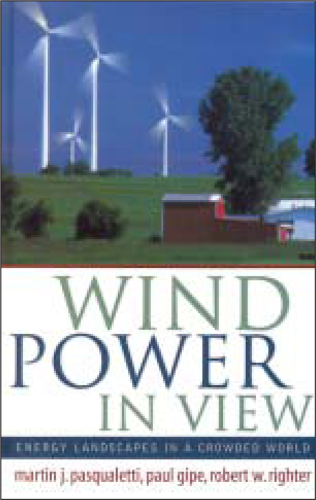
Wind Power in View: Energy Landscapes in a Crowded World Edited by Martin J. Pasqualetti, Paul Gipe, and Robert W. Righter, Academic Press, 2002, 248 pages; $59.95
Wind power is the fastest-growing energy source in the world and one of the most promising near-term clean electricity technologies. In suitable areas, wind turbines can produce electricity at costs per kilowatt-hour that are competitive with conventional sources. Unlike fossil fuels, wind does not produce harmful air pollutants or greenhouse gas emissions; unlike nuclear power, it does not generate radioactive waste or pose safety threats to nearby communities.
So, what's not to like about wind power? Plenty, according to its critics–a group that includes environmentalists and community advocates. In Massachusetts, for example, a proposal to build the first U.S. offshore wind project near Cape Cod and Martha's Vineyard has drawn heated opposition from a coalition of homeowners, boaters, fishermen, and prominent environmentalists like Robert F. Kennedy Jr. Other, lower-profile projects throughout the northeast also face resistance.
Wind Power in View puts this seeming paradox into context. The book's contributors–who include architects, geographers, historians, engineers, and landscape designers–examine the visual impact of wind turbines on landscapes. Drawing on the records of projects in Europe and California, the authors describe some wind power successes and outline many of the hurdles to its growth.
Denmark and Germany have some of the largest wind power sectors in the world: Wind provides about 15 percent of Denmark's electricity supply, and nearly 3.5 percent of Germany's. Both governments have given wind power significant economic and political support, and in both countries wind is widely viewed as preferable to nuclear power.
Other factors also help explain the relatively broad acceptance of wind facilities in places like metropolitan Copenhagen. Developers there are required to minimize noise, visibility, and bird strikes. And because aesthetics are a major consideration, designers blend wind installations into the landscape. Further, in Denmark and Germany, many wind installations are partly owned by local residents, who thus have an economic stake in their success.
Wind is less popular elsewhere. In Britain, only one in four proposed wind projects has been approved. Author Laurence Short argues that the wind industry has not recognized Britons' strong attachment to their landscape. Developers have offered “solutions that are packaged and parachuted onto each proposed site,” rather than proposals that mirror the character of individual locations. Additionally, the British wind industry has not given the public an opportunity to invest in wind projects, helping create the perception that it is an aggressive external force.
Early U.S. wind projects in California suffered from similar mistakes. According to Paul Gipe, developers followed an “extractive” growth model to concentrate wind turbines in large geometric arrays that were spaced closely together. Turbines of varying sizes and types were crammed into sites, making for a cluttered visual image. Broken turbines were often left standing next to working units, and highly visible “boneyards” of abandoned hardware began to grow. Also, access roads were cut around the turbines, causing erosion and flooding.
The wind industry has corrected some of these mistakes, but the authors' broader argument remains valid: Installing wind turbines industrializes natural landscapes, which can provoke strong opposition. Developers and supporters should not expect wind to be universally welcomed simply because it is a clean power source. But wind power will be of little use if it is only developed in remote areas that are far from power grids and transmission lines.
The authors offer a number of proposals for making wind projects more acceptable to the public, emphasizing three basic points:
First, wind projects must be designed so that they blend into the surrounding landscape and reflect the character of the site. Choices such as clusters versus curving or straight rows will help determine whether the visual impact of an installation is pleasing or jarring. Developers should think architecturally about site histories, available light, and local materials.
Second, local citizens should be given the opportunity to invest in wind projects as a way of generating pride in and support for the projects. At the very least, surrounding communities should be involved in all phases of planning.
Finally, while there is no universal definition of beauty, arguments against wind power almost always boil down to the belief that wind turbines will ruin an attractive landscape. Accordingly, aesthetics should be a central part of wind development, from turbine design to plans for wind power sites.
The authors fail to address a few important issues. For example, should some potential sites be declared too beautiful to develop? Who would choose those sites? And how should the quantifiable benefits of wind power–lower electricity prices and reduced damage to human health and the environment–be weighed against the aesthetic impact of wind installations? This last question is especially relevant to large wind installations because their negative visual impact is seen locally while their benefits tend to be felt in much larger areas.
Author Christoph Schwan alludes to another important point: Renewable energy in itself does not constitute a national energy strategy. Schwan writes, “Only by confronting our so-called need for electricity can we develop a more responsible policy for the use of energy.” He adds, “Cities such as Berlin … could contribute far more to an alternative energy system by reducing their consumption than by installing a few wind turbines inside the city.”
Despite its somewhat narrow focus, this book provides valuable perspective for renewable energy advocates–especially those involved in contentious initiatives like the Cape Wind project in Massachusetts. History shows that wind opponents are not just “environmental NIMBYs,” as they are often dubbed in the press. It is not enough for wind to be ecologically sounder than coal or nuclear power. Even energy technologies that are environmentally friendly in the abstract must win public acceptance site by site. The recommendations in this book will help wind power developers and proponents win the public over.