



Abstract

Who failed to live up to the Agreed Frame-work between the United States and the Democratic Peoples Republic of Korea? A better question might be, who didnt?
The agreement had three main points:
How terrible the Taepo?
Confusion over North Koreas Taepodong-2 missile and its supposedly U.S-threatening ranges has resurfaced yet again. (Previously, range estimates for Taepodongs figured into debate over national missile defense–the more a person wanted NMD, it seemed, the further the Taepodong could fly.) Russian experts reportedly call the unseen weapons paper missiles.
In the summer of 1998, North Korea tested a three-stage Taepodong-1 in a failed attempt to orbit a small satellite, wrote Joseph Cirincione, director of Carnegies Non-Proliferation Project, in a 2001 analysis of the ballistic missile threat. The missile flew only 1,320 kilometers [820 miles], but its international impact was enormous.
A short history of U.S. assessments of the yet-to-materialize (some would say non-existent) Taepo-dong-2:

–Emerging Missile Threats to North America During the Next 15 Years, Secret DCI National Intelligence Estimate, Presidents Summary
–Rumsfeld Report (Commission to Assess the Ballistic Missile Threat to the United States)
–Proliferation: Threat and Response, Defense Department
Connecting the dots
Judging by maps published in the mainstream media, North Korea is dotted with nondescript nuclear facilities, suggesting that the country is bursting with weapons-related plants and labs. But is uranium enrichment the same as uranium mining? Should proliferation-resistant light-water reactors being built with U.S. cooperation be ranked as part of a vast weapons program? Is a nuclear facility a nuclear facility a nuclear facility? Its time for a little definition.
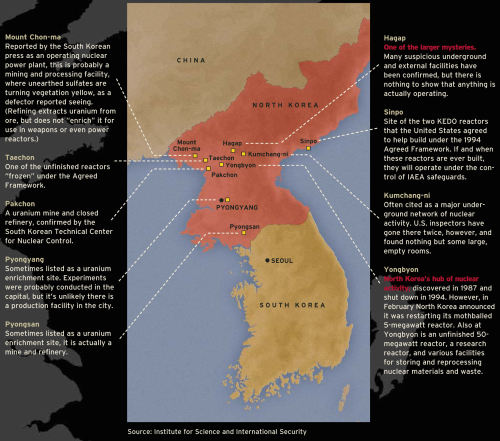
Reported by the South Korean press as an operating nuclear power plant, this is probably a mining and processing facility, where unearthed sulfates are turning vegetation yellow, as a defector reported seeing. (Refining extracts uranium from ore, but does not enrich it for use in weapons or even power reactors.)
One of the unfinished reactors frozen under the Agreed Framework.
A uranium mine and closed refinery, confirmed by the South Korean Technical Center for Nuclear Control.
Sometimes listed as a uranium enrichment site. Experiments were probably conducted in the capital, but its unlikely there is a production facility in the city.
Sometimes listed as a uranium enrichment site, it is actually a mine and refinery.
Many suspicious underground and external facilities have been confirmed, but there is nothing to show that anything is actually operating.
Site of the two KEDO reactors that the United States agreed to help build under the 1994 Agreed Framework. If and when these reactors are ever built, they will operate under the control of IAEA safeguards.
Often cited as a major underground network of nuclear activity. U.S. inspectors have gone there twice, however, and found nothing but some large, empty rooms.