



Abstract

The military often uses words like “surgical” and “precise” to describe modern bombing. The media, instead of questioning this dubious metaphor (what surgeon, after all, wouldn't find the term offensive if not obscene) too often repeat these misleading and inaccurate descriptions of modern aerial bombardment. In this way, civilian casualties, euphemistically referred to as collateral damage, are trivialized.
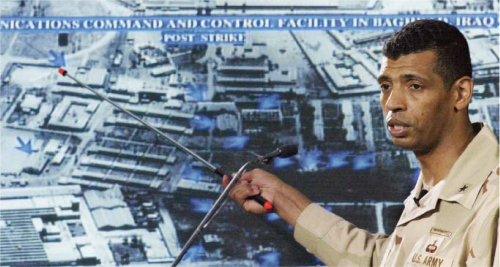
The military uses at least two public relations techniques to whitewash the bloodshed caused by its bombs. First, military briefers show the media slides and videos only of direct hits. These “before and after” displays are neat and easily comprehended by rookie reporters–but they're misleading. Second, briefings rely on obscure probability formulas to describe each bomb's accuracy, or inaccuracy. But if U.S. bombs are so precise, one might ask why the military's March 19 “S-hour decapitation strike” against the Iraqi leadership required more than 40 cruise missiles?
This answer might be found in the term “circular error probable” (CEP), a figure that describes how far 50 percent of bombs of a certain type will fall from their targets under ideal circumstances. In other words, if 100 unfatigued, un-drugged pilots flying in perfect weather with miles of visibility and no distractions deliver perfectly their Paveway III laser-guided bombs (which have CEPs of 8 meters), 50 percent of those Paveway IIIs will fall within 8 meters of their targets. The other half probably won't. In its “Intelligence Targeting Guide,” the air force says that potential errors may occur in target location, navigational systems, global positioning system (GPS), aircraft, and with the operator.
Based on calculations such as CEP, the U.S. military claims that its newer precision guided munitions (PGMs) produce less collateral damage than older “dumb” bombs. Describing the PGMs dropped from air force B-1 Lancers in the Iraq conflict, Lt. Col. Frank Swan said that with all the testing done on the 2,000-pound GPS-guided bombs, they would hit fewer than 40 feet from the target. “I've got, you know, 110 percent confidence in this weapon and weapon system…. [It is] going to minimize collateral damage. When you know a weapon is that accurate, you can put it where you want and you don't have to take chances with civilians and maybe damaging other structures that you don't want to,” Swan said in a March 28 Defense Department briefing.
A “direct hit” as shown by Brig. Gen. Vincent Brooks of Central Command
March 27: A direct hit as seen on the ground in Baghdad
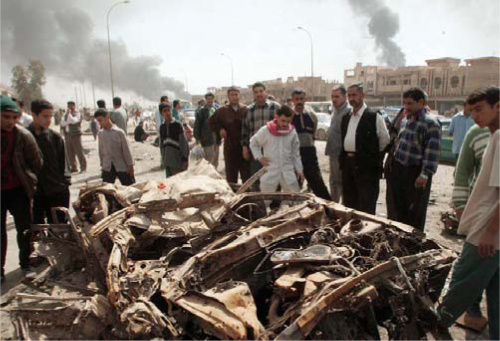
But using CEP–a single, simplified figure for bombing accuracy–is misleading because it doesn't account for the fact that fragmentation and blast extend well beyond the area of probable initial impact. For example, although the April 6 decapitation strike on the Al Mansour residential neighborhood of Baghdad was “on target,” the four bombs dropped in the strike ripped a crater 25–60 feet deep and destroyed four buildings adjacent to the target. It also took the lives of more than nine Iraqi civilians dining in the nearby Al Saa restaurant complex.
A new way of looking at bombing accuracy might be called cumulative collateral damage probability (CCDP), which would account not just for the damage done within the CEP, but all the potential damage that a bomb can inflict, including blast, heat, and fragmentation. Once a bomb hits its target, whether it was a “smart” weapon guided by GPS or a “dumb” bomb allowed to fall freely to its target, the munition explodes–sending shrapnel outward. According to the Federation of American Scientists, “Fragmentation is effective against troops, vehicles, aircraft, and other soft targets. The fragmentation effects generated from the detonation of a high-explosive bomb have greater effective range than blast, usually up to approximately 3,000 feet regardless of bomb size.”
For example, the CCDP for a 2,000-pound GPS bomb would include the CEP of 40 feet, a lethal blast and heat radius of 110 feet, and a shrapnel zone of as much as 3,000 feet. People more than half a mile away from the bomb's impact could be injured by a perfectly on-target “smart” bomb.
Given this context, a comment made by Rear Adm. John Stufflebeem after a December 2001 B-52 friendly fire incident in Afghanistan now makes sense. “As a pilot, when I would drop a 2,000-pound weapon, I wanted at least 4,000 feet of separation from that weapon when it went off,” he said. It is instructive to remember–as one hears numbers suggesting that “smart” bombs cause less collateral damage than old dumb ones–that all bombs blow up, sending shrapnel, heat, and blast beyond the small circle in which they are intended to land.
Gen. Tommy Franks of U.S. Central Command said the military “doesn't do body counts,” but a Los Angeles Times survey of 27 Baghdad hospitals found that at least 1,700 Iraqi civilians died and more than 8,000 were injured in the battle for the Iraqi capital. The Times count spanned five weeks beginning March 20 and included fatalities from unex-ploded ordinance during the first few weeks after the city fell on April 9.
More than 11,000 smart bombs were dropped in Gulf War II, mainly GPS satellite-guided weapons. With every smart bomb dropped, there was a significant chance that Iraqi civilians on the ground would be hurt or killed. How you interpret the odds could depend on whether you're in the air or not.