



Abstract
By Paul Shambroom
Johns Hopkins University Press, 2003
144 pages; $34.95
Paul Shambroom has invested a significant portion of his career photographically documenting hidden places of power. Certainly, his latest effort–demystifying nuclear weapons–does just that. Over a 10-year period, Shambroom obtained permission from the U.S. Air Force and Navy to capture images of some of their most secret weapons systems. His book contains 83 high-quality color photographs of missiles, warheads, bombers, submarines, and 15 command and control centers, in addition to several intercontinental ballistic missile silos.
Although not the first of its kind to be published, the book presents portraits of a substantial sampling of the nation's forward-deployed nuclear weapons and their supporting infrastructure during the period between the end of the Cold War and September 11, 2001, when the photo-journalist's “window of opportunity” slammed shut. Today, in spite of September 11, the war against Iraq, and the perceived threats from North Korea and Iran, few people spend much time worrying or wondering about nuclear weapons–and their indifference deeply concerns and motivates the author.
Shambroom reports that he thought a lot about atomic bombs when he was child, but began this project with “little understanding of [his] own motivations.” But he knew he wanted to help people believe that nuclear weapons were real and to “think about them in concrete terms … in an everyday, familiar, undeniable way.” So he negotiated access from the military (the Energy Department didn't even bother to return his calls). Shambroom traveled from one end of the country to the other. He climbed down into missile silos, submarines, and subterranean command centers; he drove to the tops of mountains and into lonely deserts and prairies to explore, learn about, and photograph the active weapons end of the nuclear weapons complex.
Considering the constraints that military escorts often imposed on him (“sanitizing” areas before he arrived, preventing him from fully setting up his hurried shots, denying him the ability to use his own equipment, and having aggressive soldiers armed with M-16s threaten to “jack him up” by cuffing him and slamming him to the ground), Sham-broom has captured a variety of exceptional images of unique hardware and of the people who have chosen to work with nuclear weapons.
His book categorizes the photographs according to the classic American nuclear triad: bombers, intercontinental ballistic missiles, and submarines. Additional sections document command, control, and communications, and twenty-first-century technologies. Endnotes provide a little background or explanation for each photograph, a necessary feature for the more obscure shots.
Face to Face with the Bomb begins with Shambroom's quick summary of his own journey through the military's nuclear weapons complex, followed by Richard Rhodes's rambling introduction to the photos that provides a backdrop focusing on Cold War fears, rationales for deterrence through mutually assured destruction, and efforts to bring transparency to the world.
Shambroom's contribution is an extension of the work of other Cold War photojournalists such as Robert Del Tredici (author and cofounder of the Atomic Photographers Guild), who occasionally peeked behind the cloak of national security to reveal to the public how nuclear weapons were made, where they were deployed, and who was harmed in the process.

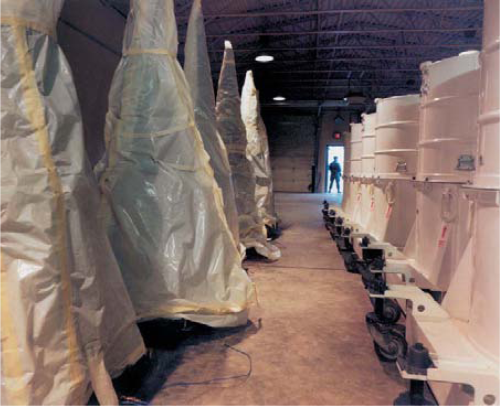
The most compelling of Sham-broom's photographs are not like those of the large, expensive delivery systems (a billion-dollar submarine or a B-2 bomber) frequently displayed to the public by CNN, or Aviation Week, or other military-themed magazines that use stock footage or official images. Rather, they are of relatively small warheads. Especially fascinating are photos showing war-heads being serviced by their caretakers: the armed soldier guarding the distant doorway in a warehouse filled with dozens of erect plastic-sheathed Peacekeeper warheads; the G.I. sweeping the floor along a row of 13 gleaming white 1-megaton B83 gravity bombs; two green-camouflaged technicians in a workshop maneuvering a rotary launcher loaded with disarmed air-launched cruise missiles, their silver W80 physics packages waiting on open racks in the background; and technicians adjusting multiple independently targeted reentry vehicles restrained on workbenches with simple canvas thongs. In one startling photograph, a half-dozen soldiers wrestle with a pair of B83 gravity bombs outside a concrete storage bunker–a scene reminiscent of cowboys dragging a wild stallion into a corral. What seems so discordant about many of these photographs is the impression of everyday routine they evoke–almost indifference toward objects that should, by their unimaginable capability to destroy, compel awe from their handlers. Apparently, to those who work with nuclear weapons on a daily basis, it's just a job.
In contrast, photographs of the forests of piping, wires, and switches within Poseidon and Trident nuclear submarines evoke a sense of passive confusion–how could anyone maintain control over such a beast? And Shambroom's photographs of “command and control” reveal the determination with which military leaders endeavor to project an aura of competence. Matched pairs of sharpened number-two pencils lie on both sides and perfectly parallel to fresh pads of paper at each place setting of a polished wooden conference table. Young soldiers guard Boeing 747s, standing constantly on alert, designated as the National Airborne Operation Centers. A row of empty chairs are tagged with the names of dignitaries soon to arrive at a formal presentation ceremony for a new B-2 bomber one late afternoon. The comfortable accoutrements and earth tones seem meant to reassure not the passing photojournalist, but rather the invisible military and civilian officials themselves, that they might better maintain their confident postures while deciding the fate of the world. Still, photographs can never show what it was really like, and viewers might have a hard time guessing what Shambroom often envisioned while he was creating them–“a giant waterfall, with a wide, endless river of dollar bills, cascading into a void.”
Peacekeeper missile reentry vehicles in storage at Warren Air Force Base, Cheyenne, Wyoming.
Shambroom was fascinated when touring the weapons facilities, but horrified whenever he slowed down long enough to realize what the weapons could do. Although he quickly acquired respect for the “bright, competent, normal people” who guard, maintain, and (if it ever became necessary) would use nuclear weapons, he also developed a much more distinct and real terror of the devices than he had had before.
For Shambroom, at least, there is a difference between just knowing about weapons and actually seeing them. He recognizes that his photographs “only show us the hardware, not the violence” of nuclear weapons.
American society's conflicted relationship with nuclear weapons continues to evolve. Works like Face to Face with the Bomb may help bring about the more open and transparent world that, according to physicist Niels Bohr, these doomsday devices were supposed to have created in the first place. Shambroom's book left us wanting more–more pictures of the weapons, more explanations of how they are maintained and managed, more details about the people who watch over them, and more depth to answering the question “Why?” But perhaps that was part of his motivation all along.