



Abstract

Tovah Feldshuh portrays Golda Meir, the prime minister of Israel during the Yom Kippur War in 1973.

A view from the balcony
By early October 1973, Israel's Prime Minister Golda Meir–Golda, as she was called by everyone in Israel–knew that the Egyptian and the Syrian armies were amassing on Israel's borders. King Hussein of Jordan had warned her personally that Israel was about to be attacked. But she was assured by her military chiefs that war was a “low probability,” and believing them, she took no action, leaving on a scheduled trip to Europe. At the same time, as she wrote in her 1975 autobiography My Life, she was beset by a premonition that something terrible was about to happen.
The attack came on Yom Kippur, October 6. By dawn, October 7, the Egyptian army had seized the entire Suez Canal and columns of Syrian tanks were penetrating deeply into the Golan Heights. Hundreds of Israeli soldiers died that night in heroic but hopeless efforts to save small and isolated strongholds along the frontier. According to some sources, faced with what seemed like certain ruin, Defense Minister Moshe Dayan asked the prime minister to ready Israel's nuclear weapons.
At an infamous meeting in the early hours of October 9, the war cabinet tried to digest the failure of the Israeli counterattack. Sources say it was at the end of that meeting that Dayan explicitly proposed using the nuclear option. To this day the details of Dayan's proposal are unknown, but it is known that Golda could not conceive authorizing the use of nuclear weapons. She refused to concede to Dayan's “last resort” thinking.
Her own idea was to fly to Washington incognito, to plead with President Richard Nixon for help, an idea rejected by Nixon adviser Henry Kissinger. At the same time, though, U.S. intelligence began picking up signs that Israel was placing its nuclear-tipped Jericho missiles on high alert. Less than three days later, the United States responded with a massive airlift of aid.
What was it like for Golda to be faced with deciding on the possible use of nuclear weapons? William Gibson's one-woman biographical play Golda's Balcony, which began its Broadway run last October, offers an answer through the use of a monologue that runs back and forth through time.
Most often based on Golda's autobiography, the play's building blocks include faded childhood memories of the Russia of pogroms, Golda's formative American Zionist experiences in Milwaukee and Denver, postcards from her life as a young idealist in Palestine, pictures from her failed marriage to Morris Myerson, feelings of guilt over her role as an inattentive mother, her rise as a star Zionist politician, and finally, her role presiding over Israel's war cabinet during the darkest hours of the Yom Kippur War.
This mechanism allows Gibson to create a literary space for Golda, his Golda, in which she reckons and explains her life.
Yet the central motif of the play is not mentioned even once in Golda's autobiography. That is the balcony, Golda's balcony. In fact, the world knew nothing about it until 1986, seven years after Golda died. Mordechai Vanunu, the nuclear technician turned whistle-blower, who provided the first insider account of the secret nuclear facility at Dimona, revealed its meaning. Vanunu noted that the VIP observation deck over the six-story-deep underground plutonium extraction plant where he worked was nicknamed “Golda's balcony.”
“There were two balconies in Golda's life,” Gibson writes in an author's note. The stark contrast between them is the primary motif of the play. One balcony was in Golda's old Tel Aviv apartment, from which, she says, “I had a view of the Mediterranean and the ships arriving with our exiles, the refugees and survivors coming home.” The second was her balcony at Dimona. “The view from this balcony was into hell. And I am seeing it, all night long, as our cabinet talks.”
While the real Golda said nothing in public about it, Gibson's Golda does. Following the version of events as Seymour Hersh recounted them in Samson's Option, Gibson tries to recreate what that hell meant to her. After all, Golda, like President John F. Kennedy during the Cuban Missile Crisis, was one of the very few world leaders who has had to make real-time decisions about the bomb.
In Brief
The U.S. General Accounting Office (GAO) has concluded that it will take at least 300 years for the Defense Department to decontaminate closed U.S. military facilities. GAO reports that Defense has yet to assess 60 percent of its 2,307 shuttered sites and that it has so far cleaned up only 1 percent (St. Louis Post-Dispatch, January 28).
Dounreay, the British government's 50-year-old reactor in Caithness, Scotland, has assembled an archive of 10 million pages weighing 230 metric tons. According to the January 20 Glasgow Herald, the files contain everything from bus schedules and invoices for vacuum cleaners to government papers on nuclear policy. However, reporter David Ross says critics suspect that the archive, which may eventually be posted online, does not include information about Dounreay's involvement in Britain's nuclear weapons program.
After a government report, published in Süddeutsche Zeitung, described Germany's 18 nuclear power plants as vulnerable to air attack, Germany's ministry of the environment released a statement describing a proposal to disguise the plants with “fog-making machines that are capable of hiding the installations in a few seconds.” In fog, “the probability that a plane could be aimed precisely at the reactor would be very efficiently reduced,” according to the statement. But the plan would only work if the winds were calm. Ben Eden, managing director of Pea Soup, a British company that makes fog machines, told NewScientist.com, “If it's really windy they would have lost already.”
Last December a Justice Department inspector general's report concluded that the FBI had become better about sharing information concerning potential terrorist threats with other agencies. But as Steven Aftergood reported on December 30 in Secrecy News, (vol. 2003, no. 112, fas.org) the report also revealed that the FBI is still unable to securely e-mail messages to the CIA and must instead send paper versions to the agency.
Prime Minister Tony Blair's 2003 Christmas message to British troops included the claim that “massive evidence” of Iraq's secret weapons laboratories had been found. Almost immediately after the message was aired, Jonathan Dimbleby of ITV asked Coalition Authority head L. Paul Bremer what he thought of the statement (London Daily Telegraph, December 29, 2003). As Dimbleby tried to interrupt Bremer to tell him who had made the claim, Bremer responded “I don't know where those words come from, but that is not what [chief investigator] David Kay has said…. It sounds like a bit of a red herring to me.”
Over the past decade, British towns have installed hundreds of closed-circuit cameras allowing police to monitor nighttime activity on public streets. Early data on the use of the cameras suggested that inordinate amounts of police attention were spent searching for attractive young women or viewing inappropriately public sexual behavior. But that was before a major four-year study examined the use of cameras in five randomly chosen communities (BBC, December 22, 2003). The authors of the latest study, who compared police and hospital data, concluded that although surveillance cameras did not reduce the number of violent offenses, they may have led to faster responses once violence did occur, reducing the severity of victims' injuries. The researchers also thought it might be a good idea to compare the relative merits of closed circuit surveillance and more and better streetlights.
In 1991 Presidents George H. W. Bush and Mikhail Gorbachev agreed to rein in one of the most dangerous practices their countries had engaged in during the Cold War–carting about easily used tactical nuclear weapons on surface ships and attack submarines. Both countries were eager to remove what many believed was the most likely of nuclear accidents waiting to happen. The U.S. Navy moved its Tomahawk cruise missiles to storage areas on land, where they have remained ever since. In recent years, the navy has wanted to dispose of these weapons, only to have the Office of the Secretary of Defense veto the plan–perhaps yet another sign of the administration's commitment to retaining and expanding its stockpile of “more usable” nukes. J. D. Crouch, who retired as assistant secretary of defense for international security policy last October, told the December 2, 2003 Inside the Navy that the Pentagon wants to hang onto the navy's sea-launched Tomahawks because they have a “unique set of capabilities.”
… that the European firm Siemens plans to sell a plutonium fuel-fabrication plant to China? (Union of Concerned Scientists press release, December 18, 2003). But will the sale turn out to be helpful or harmful? Why not ask Siemens's home country, Germany, which has specifically forbidden such a facility from operating on its own soil?
Gibson handles the issue in a most sympathetic manner, both for Golda personally and for Israel as a nation. Golda's Balcony is perhaps the strongest, and surely the most emotional, defense of Israel's nuclear option.
Gibson's Golda is reflective, even moralistic. She is fully aware of the meaning of crossing the nuclear threshold. “Military headquarters means Cairo and Damascus, an obliteration of the millions in those cities, killed, maimed, burned, bleeding–and might the Soviets then bomb in reprisal Tel Aviv? And the United States then bomb Moscow and Moscow bomb New York? Our little war isn't taking place in a bottle, it was a piece of the Cold War for world control.”
At the end, the dilemma causes Golda to question not only the bomb but also the meaning of her entire life as a servant of Zionism. “I started out to make this state ‘a model for the redemption of the human race,’ how did I come to be wiping up these cities full of good people I never met? … What happens when idealism becomes power? It kills. To save a world you create–and this is the terrible question–how many worlds you are entitled to destroy?”
This encounter with hell adds Golda's Balcony to the small list of plays, like Copenhagen, or Walk in the Woods, which are about humans encountering the meaning of the bomb. But it is only in the few minutes at the end that Golda's Balcony is elevated from biographical narrative to a powerful dramatic monologue about the nuclear abyss. Nonetheless, actress Tovah Feldshuh admirably meets the real challenge of holding an audience throughout a one-woman show.
The real Golda Meir.

Golda's Balcony is not the kind of play that could have been written by a present-day Israeli author. It is unlikely even to be translated and produced in Israel. To an Israeli audience, the text often sounds kitsch, something between Exodus and Fiddler on the Roof.
For many Israelis, there is something awkward–if not uncomfortable–about the sympathetic way the play presents the persona of Golda and the way it talks about the bomb. Both present real problems for most Israelis.
In Israel itself, Golda's overall legacy, but especially her war legacy, has remained controversial. In the Israeli psyche, Golda is the iron-willed fourth prime minister of Israel whose political inflexibility and refusal to recognize reality brought Israel to its greatest trauma. As to the war itself, to this day, all the material from the war cabinet is classified–not available to historical research. Consequently, there is still no authoritative historical study of how Golda functioned during the dark hours of the war.
This absence is closely related to the secrecy and mystery that surrounds anything nuclear in Israel. The nuclear issue remains Israel's ultimate taboo, politically and culturally. Israel still has not found a way to officially acknowledge the possession of the nuclear weapons that it has had since the 1967 Six-Day War. The very phrase “Golda's balcony” disconcerts many Israelis because it was first made public by Mordechai Vanunu, the man most Israelis consider their nation's most infamous traitor.
Avner Cohen, a senior fellow at the Center for International and Security Studies at the University of Maryland, is the author of Israel and the Bomb (1998).
True devotion to science
Last October, Popular Science ran its list of the 18 worst jobs in science. From isolation-chamber tester (think three months in a tin can) to flatus odor judge (no explanation necessary), its list detailed the most torturous ways to make a living in science. A few of our favorites:
In a protective suit at the Centers for Disease Control in Atlanta.

Currently, two scientists at the National Institute of Standards and Technology continue to go the extra kilometer, as it were, in trying to convince the U.S. public, so far unwilling to give an inch, to abandon its beloved Imperial units. On the other hand, a spokesperson for the program, when queried by Popular Science, couldn't give his own height in meters.
“Aside from the commute, this is a pretty good job.”
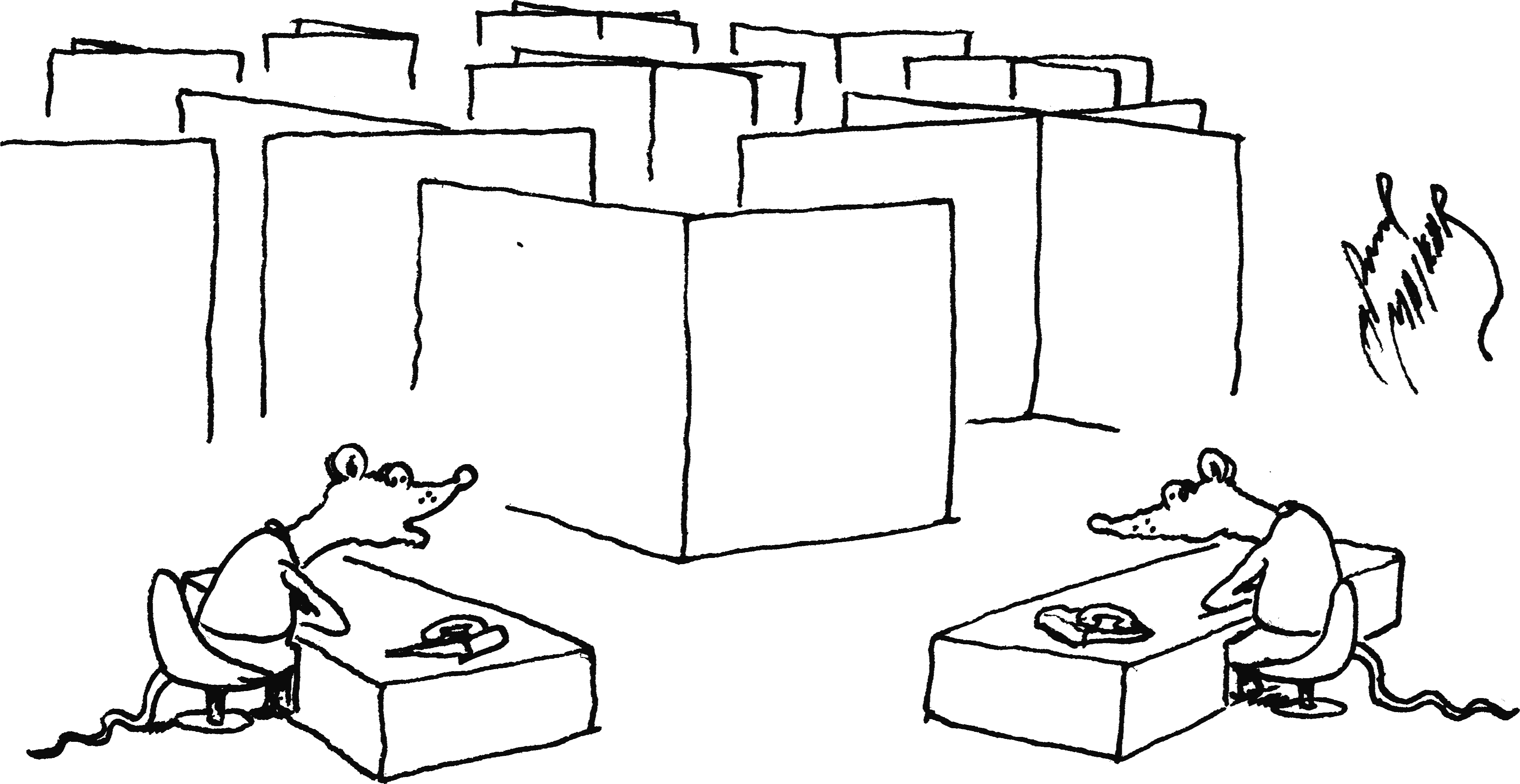
In 1996, however, when it was mathematically demonstrated that using the design of the latest fusion reactor, the proposed International Thermal Experimental Reactor (ITER), would make it impossible to produce energy, the United States withdrew from the multibillion-dollar project. But when the we-love-every-thing-nuclear Bush administration came to power, the United States rejoined the ITER consortium.
Weapons labs good to go
The Bush administration is eager to develop new low-yield nuclear weapons, eager to complete the continuum of weapons (from artillery shell to Peacekeeper missile) at its disposal, eager to reduce collateral damage, and eager to provide a more effective deterrent. Love for humanity is emanating from nuclear weapons labs across the country. Is there anything more exciting and worthwhile than researching the potential of low-yield nuclear weapons? Not to Linton Brooks, administrator of the National Nuclear Security Administration.
On November 24, 2003 President George W. Bush signed into law the defense bill that authorized research into the new low-yield weapons and reestablished “advanced concepts” teams at Sandia, Lawrence Livermore, and Los Alamos national laboratories. Research at the labs presumably shifted into high gear.
After enduring the “chilling effect” of a 10-year development ban, Brooks said he is ready to make up for lost time.
“We are now free to explore a range of technical options that could strengthen our ability to deter, or respond to new or emerging threats without any concern that some ideas could inadvertently violate a vague and arbitrary limitation,” Brooks wrote in a December 5 memo, thanking the heads of the three nuclear weapons laboratories for their support of the administrations' policies.
Linton Brooks thanked the heads of the three nuclear weapons laboratories for supporting the development of new nukes.

Brooks recently attempted to broaden the scope of his comments and portray more gentle motives.
“Research and development is about looking at a variety of things, including improving safety and security of existing designs, making existing designs more robust in the absence of testing,” he told the Baltimore Sun (January 14).
Despite the fact that many experts believe it is implausible to build low-yield nuclear weapons that won't spray radioactivity over large areas, Los Alamos scientists have shown their eagerness to take up Brooks's directive and explore the possibilities.
In the October/November 2003 Comparative Strategy, four Los Alamos nuclear scientists reiterated the rationale for pursuing several types of low-yield and “advanced” nuclear weapons–low-yield warheads aboard highly accurate, fast ballistic missiles; low-yield warheads aboard more accurate air-breathing systems; low-yield earth penetrating weapons; enhanced radiation warheads; and reduced fission yield warheads.
“By having [reduced-collateral-damage] weapons, the risk and the credibility of response to WMD attack would likely be assessed as viable by our adversaries–providing stronger dissuasion and deterrence, and hence, lowered likelihood of use,” wrote Bryan L. Fearey, Paul C. White, John St. Ledger, and John D. Immele.
If we build them we won't have to use them, the scientists said. Still, they undertook an analysis of collateral damage (radiation contamination, injury, and death) caused by low-yield weapons detonated at various distances from ground level and compared the results to those of higher-yield weapons.
If scientists haven't explicitly thought out the conditions that would lead to a nuclear strike using low-yield weapons, those directly involved in shaping the administration's policy, who have been pushing for the new nuclear weapons, have.
Stephen Younger, who directed the Pentagon's Defense Threat Reduction Agency (DTRA) since 2001, has continually argued that new, specialized weapons will reduce the U.S. reliance on high-yield nuclear weapons. Younger set out his views in Nuclear Weapons in the Twenty-First Century in 2000, when he was head of Los Alamos's nuclear weapons program.
Not to miss out on the action at Los Alamos–the fruit of his and the administration's efforts–Younger announced his resignation from DTRA in December and plans to return to the storied lab. According to a Los Alamos press release, Younger will be a senior fellow in the theoretical division and will continue pursuing his interests, including large-scale computer simulations. Perhaps he's hoping to persuade critics that significant reductions in collateral damage are possible.
Contractors behaving badly
In December 2003, Pentagon investigators revealed that they had found evidence that a Halliburton subsidiary overcharged the government more than $60 million on a contract to deliver gasoline to Iraq (New York Times, December 13, 2002). Auditors say the company also proposed a contract for cafeteria services in Iraq that inflated costs by $67 million. (The Pentagon said no thanks.) But despite these shady practices, Halliburton doesn't even make a Top 10 list of firms that abuse the government's contracting system.
The Project on Government Oversight (POGO), a watchdog group, looked at nearly 50 government contractors that together receive about half of all federal contract dollars. Their transgressions range from shareholder fraud to breaking export control laws, to wrongful death suits, and environmental irresponsibility. General Electric's 87 cases of proven or alleged misconduct earned it the dubious distinction of first place. Together, the Top 10 have paid out about $4 billion in fines, penalties, settlements, and cleanup costs stemming from misconduct cases.
Top 10 misbehaving contractors
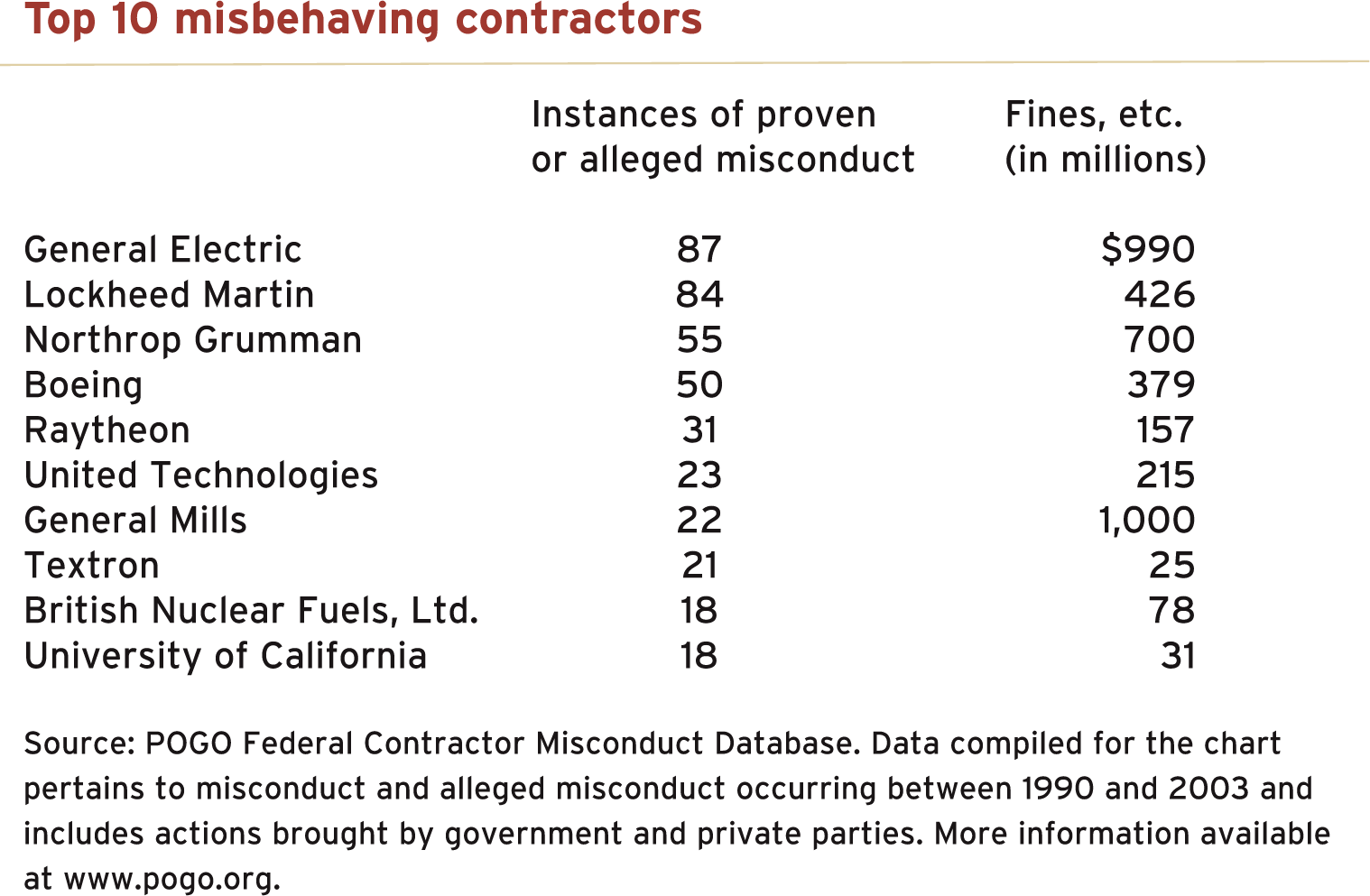
Source: POGO Federal Contractor Misconduct Database. Data compiled for the chart pertains to misconduct and alleged misconduct occurring between 1990 and 2003 and includes actions brought by government and private parties. More information available at www.pogo.org.