



Abstract
The Bush administration has terminated the consensus among democracies that had been uncontested since World War II.
The fortieth anniversary of John F. Kennedy's assassination garnered much attention worldwide. In Germany, Kennedy's famous declaration, “Ich bin ein Berliner” (“I am a Berliner”), expressing his solidarity with the half-city enclosed by the newly erected Berlin wall, is not forgotten. Its public repetition is a regular and welcome exercise. Most Germans are aware that our democracy, our constitution that respects human rights, and our integration into the international community after World War II were achieved with the help of other Western nations, foremost among them the United States. Because of this, transatlantic ties have been considered precious despite various disagreements over international policy issues, such as the German-Soviet gas trade that went against U.S. will, or certain aspects of Willy Brandt's “Ostpolitik”–reconciliation and détente with the East–at the end of the 1970s. These temporary differences of opinion were considered par for the course and not disruptive. In the past, being pro-American has been synonymous with being in favor of international collaboration and participation in international organizations and treaties.
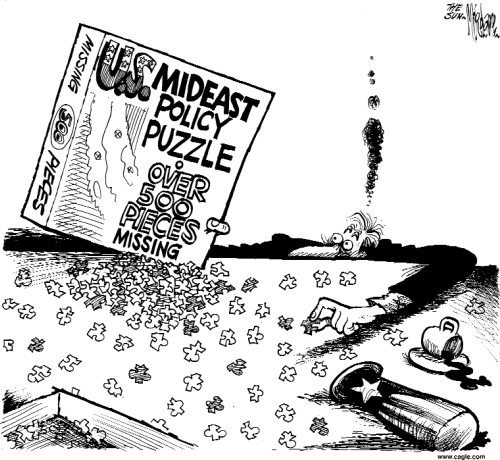
But now it seems that being pro-multilateral and pro-transatlantic may be contradictory. The Bush administration appears to fundamentally deviate from multilateralism and to disrespect international treaty regimes and laws. It has terminated the consensus among democracies that had been uncontested since World War II.
Bush's unilateralism became obvious when his administration disregarded several international agreements that had been negotiated at length. The Bush administration rejected the Kyoto Protocol; withdrew its signature from the International Criminal Court; opposed the Biodiversity Convention, the Comprehensive Test Ban Treaty, and the Convention on Maritime Law; boycotted the Action Program on Small Arms and the Biological Weapons Convention; and withdrew from the Anti-Ballistic Missile Treaty. One treaty Bush has signed, the Strategic Offensive Reductions Treaty (SORT), or the Moscow Treaty, is a sore disappointment for disarmament–it contains no provisions for verification and allows immediate rearmament after its termination.
For the Bush administration, international law has degenerated to an instrument of U.S. power policy that is used or not used according to inconsistent criteria. International agreements are seen as impediments because they require reciprocity; because of this, they are marginalized.
The new U.S. attitude toward international policy culminated in Bush's January 2002 State of the Union address and in his September 2002 National Security Strategy. Both describe the Bush administration's maxim: The threat to the United States is both tremendous and diffuse. Tremendous, because there is a perceived danger that weapons of mass destruction will be used on U.S. territory. And diffuse, because it is unclear who the enemy is. It is the “axis of evil,” a perceived alliance of “rogue states” and terrorists, possibly in the possession of weapons of mass destruction.
According to Bush administration thinking, the lack of information on the enemy and the magnitude of danger necessitate preemption. As soon as proliferation indicators emerge, such as technology transfer, action must be taken in order to prevent its success. Waiting for an international mandate would be too risky, too arduous, and is not guaranteed to be effective. So the United States claims the right to do what it sees fit, with or without international blessing. As it is clear that such a unilateralist doctrine will conflict with the interests of others, the National Security Strategy envisions absolute superiority. The administration wants the United States to be so powerful that any attempt to compete militarily would seem futile.
In Germany, the U.S. foreign policy shift is watched with irritation and worry. It comes at a time when Germany is seriously rethinking and changing its international role, especially its attitude toward military force.
During the Cold War, Germany restricted the use of military force exclusively to defense. Sending troops abroad for any other purpose was unthinkable, because “never again shall a war start from German soil.” This attitude was uncontested and unchallenged. The army was bound in NATO, and NATO war scenarios involved the Cold War. Because of this tradition, Germany did not participate in the first Gulf War. But a sense emerged that sometimes the use of force might be justified. The role of the army must be rethought, some cautiously claimed.
Heated and sometimes painful debates soon followed, intensified by the violent conflicts of the 1990s–Somalia in 1993 and Bosnia in 1995. Topics included the future of an international order: How should international law be enforced? How can one country abstain and let others do the hard work?
Gradually, the role of the German army shifted. As a result, Germany took part in the Afghanistan war, a move largely accepted by the public. At the same time, Germans clearly believed that any military action must take place only under a mandate from the United Nations or as part of participation in an international organization like NATO. Germans regarded the Afghanistan war as sanctioned by international law.
The war in Iraq was a very different case. Most Germans felt that the first Iraq war was morally justified; Saddam Hussein's regime was perceived as an evil dictatorship. And most Germans did not doubt that Saddam wanted to acquire weapons of mass destruction–the return of inspectors to Iraq was unanimously welcomed.
Last autumn, attempting to be conciliatory, Bush told Schröder that he understands that “Germans are pacifists.” But Bush has understood nothing.
But Bush's push into Iraq was seen as unprovoked. Germans did not perceive any immediate threat emanating from Iraq. The repeated U.S. claims about clandestine acquisition of weapons of mass destruction were received with great skepticism by both decision makers and the public. German intelligence, too, was skeptical about the alarmist warnings coming from the United States. Because Germany's repeated requests to substantiate the warnings went unanswered, the claims were regarded as not credible.
The notion of an “axis of evil” also got an unenthusiastic welcome from the German public. The predominant belief in Germany is that the world has not changed, for better or worse. It's not clear to Germans why Iran, North Korea, and Iraq were so prominently singled out as “rogues,” while other regimes with similar characteristics–absence of democracy, disregard of human rights, alleged support of terrorism–such as Syria or Libya, were treated differently. Some in Germany suspect that this treatment can be traced to specific U.S. grievances with the “axis” nations: U.S. humiliation over the taking of American hostages by Iran's ayatollahs; the failed U.S. attempt in 1953 to roll back communism in North Korea; and in Iraq, the unfinished business of 1991. In sum, the German public thought that U.S. rhetoric was a hypocritical foundation for war. It did not go unnoticed that the United States had made up its mind to proceed, whether or not there was a U.N. mandate. The majority of Germans rejected this stance, and German opposition to a new war in Iraq was clear.
But the policy of the German government was contradictory. Chancellor Gerhard Schröder exploited the public's anti-war sentiment during his re-election campaign in summer 2002, declaring a categorical “no” against war in Iraq under any circumstances. In this respect, the German position differed from that of France, which also rejected the war but not the option of militarily enforcing non-military solutions–as long as it was sanctioned by the U.N. In contrast, British Prime Minister Tony Blair adopted the U.S. line without consulting with his fellow Europeans, neglecting both international law and the will of his people, whose majority against an Iraq war was even larger than in Germany.
Last autumn, President Bush, in an effort to overcome the chill that had settled between the countries, told Schröder that he “understands the Germans are pacifists.” But Bush has understood nothing. Germans are no more pacifists than anyone else. Germans are prepared to take part in military operations, as the Afghanistan war has demonstrated. But Germans resent the United States–for not waiting until weapons inspections in Iraq were completed; for making a mockery of the United Nations by demanding that the Security Council either go along with U.S. policy or be irrelevant; for fabricating an immediate threat.
Bush's unilateralism threatens to do more damage than simply causing friction between old allies. Over several decades the international community, mostly under U.S. leadership, has developed international regimes supported by treaties, organizations, common norms, and beliefs. The most prominent and so far most successful is the nuclear nonproliferation regime. Based on the Nuclear Non-Proliferation Treaty (NPT), its goal is to enhance global security by outlawing proliferation and by promising in return the ultimate goal of abolishing nuclear weapons.
The United States could have taken a significant step toward this goal by ratifying the Comprehensive Test Ban Treaty. Instead, Congress rejected it during the Clinton administration–and the Bush administration has no plans to revive it. More and more members of the nonproliferation regime are starting to wonder whether it is in their best interests to comply. Why? They see current U.S. foreign policy as self-serving and uninterested in international regimes. The United States wants others to promise compliance, but does not want to subject itself to the same standards. Its interest is merely in U.S., not global, security. This is hardly a sympathetic position.
Germany and other Western allies are still deeply committed to international regimes and to international law. But in other nations, disappointment and frustration are rising, most notably in the Arab world and in developing countries. The compliance of these countries is key to the nonproliferation regime and to the success of other treaties.
If U.S. foreign policy does not change, treaties will collapse. That could fuel more resistance to U.S. policy.