



Abstract

The security vacuum created by the collapse of the Soviet Union, the changing nature of warfare, and the rise in globalization were all integral to the advent of what P. W. Singer calls “privatized military firms” (PMFs). In his book Corporate Warriors: The Rise of the Privatized Military Industry (reviewed on page 78), Singer examines how it came to be that companies now sell military services that most people assume their governments are responsible for. Singer tells how these firms have emerged as key actors in conflicts around the world.
Many roles that previously fell to governments–“from prisons to postal systems,” as Singer puts it–have been privatized. So privatization's entry into the military domain may not be a complete surprise, but the duties private firms are often tasked with might come as a shock.
The U.S. government engages private firms for everything from computing and communications at the U.S. nuclear response headquarters at Cheyenne Mountain, to protecting NASA launch facilities, to maintaining strategic weapons like the B-2 Stealth bomber, to building the detention camp at Guantánamo Bay, to running university ROTC programs. The U.S. military has used private help in places like Somalia, Haiti, the Balkans, Rwanda, Iraq, and Afghanistan. From 1994 to 2002, the Defense Department had more than 3,000 contracts worth more than $300 billion with U.S.-based PMFs alone.
It's not just the United States that buys these services. PMFs have customers across the globe–and “across the moral spectrum,” as Singer says. Clients that contract with these firms include many governments, as well as some of their adversaries, including rebels, insurgents, drug cartels, and militias.
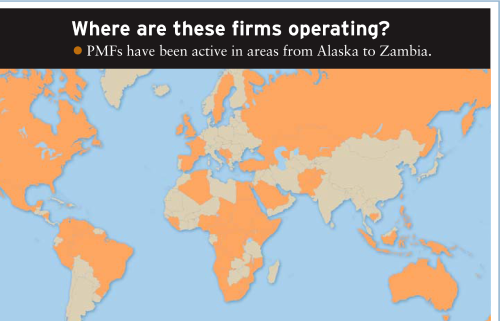
Source: P. W. Singer, Corporate Warriors (Ithaca: Cornell University Press, 2003).
Many corporate clients, like the Jose Cuervo distillery in Mexico, want protection that the government can't, or won't, give. The company employs a 125-person private “military-style unit” to keep its agave fields safe from raiders. For multinational corporations, PMFs act as what Singer calls “investment enablers”–they protect assets like mines, pipelines, and oil wells. Oil companies in Algeria, where terrorists are waging an anti-government campaign, spend about 9 percent of their operational budgets on protection; in Colombia, multinationals spend about 6 percent of their budgets fighting “leftist guerrillas, narco-terrorists, and paramilitaries.”
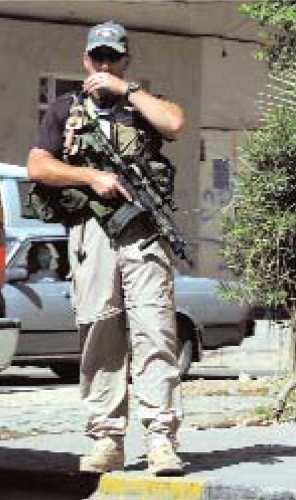
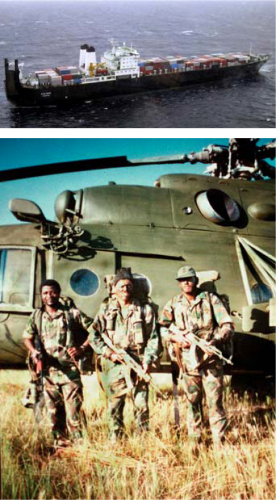
A civilian working for a U.S.-hired contractor in Iraq (top). Canadian soldiers and equipment were stuck aboard the GTS Katie during a contract dispute (top right); Executive Outcomes employees in Angola, later presumed killed in action (right).
Humanitarian agencies, like the International Committee of the Red Cross and the U.N. High Commission on Refugees, also use private military firms. The aid agencies get protection for their staff and facilities, and the PMFs get legitimacy from working for such clients. Demining operations run by PMFs are on the rise, and even the World Wildlife Fund received a bid from a company called Saracen to protect rhinos from poachers in game preserves in the Congo.
Problems? Affirmative
Naturally, outsourcing military work to private firms has its complications.
Brains and brawn?
Many firms have built their reputations on the power of “ex.” Many employees are “ex-U.S. Green Berets, French Foreign Legionnaires, South African paratroopers, Ukrainian pilots, and Gurkha fighters from Nepal.” Some believe that about 70 percent of ex-KGB turned to private military work.
In July 2000, a unit of Canadian soldiers and hundreds of Canadian tanks and military vehicles were aboard a privately contracted military transport ship, returning home from Bosnia. Before the ship reached the Canadian shore, a financial dispute between subcontractors arose, and the ship refused to dock until it was resolved. For nearly two weeks, the ship sailed in circles off the coast, “during which time this sizable chunk of the Canadian military's inventory was unavailable, solely because its leadership had privatized transportation to save a minimal amount.”
Risk to an individual's life and limb is inherent to military work, but there are larger things at stake when the stability and security of a whole region hangs in the balance. The firm Executive Outcomes is widely credited with stabilizing Sierra Leone in the mid- to late 1990s; the stability lasted until the company's contract was terminated. (When a commander from the private firm Gurkha Security Group was killed, emasculated, and eaten by rebels in Sierra Leone in February 1995, the firm broke its contract and left the country; Executive Outcomes was then hired.)
Contracts, as everyone knows, can be broken, but unlike a state or national military, profit-driven private firms have less reason to be loyal. And it doesn't help that the industry is basically unregulated.
There is little to prevent a company from “going rogue”–that is, selling its services to an illegal or illicit operation. An Israeli firm, Spearhead Ltd., is suspected of assisting Colombian drug lords and training paramilitary death squads linked to assassinations and an airline bombing; the British firm Sakina Security Ltd. taught would-be jihadists hand-to-hand combat and how to build improvised explosive devices. Like most businesses, these companies are “driven neither by goodwill nor honor, but rather by profit.”
The nature of warfare has changed; governments no longer have sole control over the best weaponry. “Machine guns, tanks, and even fighter jets can be purchased by any customer,” Singer writes. (In Uganda you can buy an AK-47 for a chicken.) Some PMFs can outgun state armies.
What are they up to?
handling all army recruitment for Australia (Manpower, a temp agency)
protecting Afghan president Hamid Karzai (Dyncorp)
operating the air force's unmanned aerial planes in Afghanistan
training Britain's Royal Navy to operate and maintain its newest nuclear-powered submarine
retrieval operations for Russia's Kursk nuclear sub
running Saudi Arabian armed forces
helping dismantle Russian intercontinental ballistic missiles
And there are the dangers of overreliance to consider. “In outsourcing personnel and services, the client always risks becoming too dependent on the private agent,” Singer writes. For instance, “as many as five different companies are often required to help just one U.S. military unit carry out its operations.”
The trend toward military outsourcing will continue, Singer predicts. In Britain, “the Blair government has even floated the idea of privatizing future troop donations to U.N. peacekeeping missions.” That's in line with another of Singer's guesses–that there will likely be a boom in contracts between PMFs and humanitarian agencies. The privatization of peacekeeping may be an attractive option both for international organizations, but also for PMFs looking for mainstream acceptance.