



Abstract
A stunning loss on November 2 means congressional Democrats must play defense on arms control–they had hoped to run the show.
The 2004 elections were a disaster for Democrats. Most Democrats expected Massachusetts Sen. John Kerry to win a narrow victory, but he lost the popular vote 51 to 48 percent. And because he lost Ohio by about 140,000 votes, he lost the electoral vote as well. A victorious George W. Bush is expected to retain many of the same disastrous national security policies.
These results mean more of the same for those working to prevent the production of new nuclear weapons, impede deployment of national missile defense, block resumption of nuclear weapons tests, reduce nuclear weapons stockpiles, promote a verification protocol to the Biological Weapons Convention, take nuclear weapons off hair-trigger alert, and other issues.
Indeed, the central story of the election is of opportunity lost: If Kerry had been elected president, the arms control community could have gone on the offensive. Kerry promised more aggressive nonproliferation policies, promoting diplomacy over preemption, and stopping new nuclear weapons and missile defense deployment. There would have been a search for ways to resurrect the Comprehensive Test Ban Treaty.
That opportunity has been lost for four years.
If Democrats had gained a majority of the Senate, Michigan's Carl Levin would have taken control of the Armed Services Committee and Delaware's Joe Biden would have chaired the Foreign Relations Committee. They, perhaps in conjunction with a new president, would have been in a position to set the agenda for their committees and Congress–to hold hearings, launch investigations, and write bills with positive legislation that Republicans would have been forced to try to overturn on the Senate floor.
That opportunity has been lost for two years.
The 109th Congress convening in January 2005 will not be that different from the 108th. For a number of years, Republicans have maintained absolute control of the House of Representatives, notwithstanding their small majority. That majority has expanded by about four seats (several races have not been decided at this writing). Democrats will remain powerless, shut out of decision making, committee control, and most conference committees that determine the final shape of legislation.
The outcome of key votes is likely to be similar. On May 20, 2004, an amendment offered by California Democrat Ellen Tauscher that would have eliminated funding for the nuclear bunker-buster and “advanced concepts” programs lost 204-214. The House is likely to vote in 2005 to fund these new weapons programs unless a substantial block of Republicans can be convinced that they would be detrimental.
For the past two years, however, Ohio Republican David Hobson, chairman of the Energy and Water Appropriations Subcommittee, has single-handedly cut funding for the same programs in the annual appropriations bill he manages. Hobson is expected to remain in that key position, able to take the same actions.
In the Senate, Democrats remain in the minority, with fewer seats than before. A net loss of four seats means Republican control, 55-44, with one independent (Vermont's Jim Jeffords). On June 15, 2004, an amendment offered by two Democrats, Massachusetts's Ted Kennedy and California's Dianne Feinstein, to bar funding for new nuclear weapons, lost 42-55. Two days later, an amendment offered by California's Barbara Boxer was defeated 42-57. These votes will be lost again in 2005, by slightly larger margins.
In the past two years, Senate Democrats have attained a significant degree of power through the filibuster, used particularly to block dangerous judicial nominees. With 45 seats, the Democrats continue to hold four seats more than the 41 needed to sustain a filibuster.
The great loss is in failing to gain control of key committees and the Senate floor. As Arizona Republican John McCain was quoted as saying in the November 16, 2004 Roll Call, “When you give up a chairmanship, you lose the ability to set the agenda.”
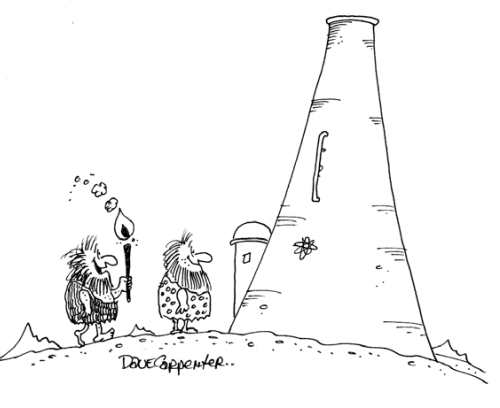
“Hey! I just discovered fire. What's that you came up with?”
The Republican gains in the Senate were the most surprising. Democrats had high hopes of regaining control lost in 2002. The defeats were particularly painful in the South, where five incumbent Democrats retired and were all replaced by Republicans. Seats in North Carolina, South Carolina, Florida, Georgia, and Louisiana all went Republican (the Bayou Senate seat for the first time since Reconstruction), despite some strong Democratic contenders. Oklahoma remained in Republican hands despite the nomination of a conservative Democrat, Cong. Brad Carson, who appeared to be a perfect fit for the state.
Democrats cannot hold only four Senate seats in the Deep South, get wiped out in the Mountain States, and have any hope of regaining a majority any time soon.
Particularly galling for Democrats was the defeat of Senate Minority Leader Tom Daschle of South Dakota, an aggressive and effective Democrat who had maintained a consistently excellent record on arms control issues. Daschle was the Republicans' number one Senate target, and they have been gloating over his loss.
The Democrats' new Senate leader, Nevada's Harry Reid, will be a quieter, but also an effective, champion for the Democrats. (Both Daschle and Reid received a very respectable 83 percent on the Council for a Livable World's most recent rating of Senate voting records.)
While the Bush vote gain from four years ago was not huge, it was consistent across the country and across population categories–men, women, whites, blacks, Hispanics, Asians, Protestants, Catholics, and Jews. While national security issues writ large–terrorism and the war in Iraq–played a key role in the election, the more narrowly defined arms control issues did not. There was little mention of the debate over new nuclear weapons. The anticipated formal launch of a new national missile defense never happened.
After the elections, Democrats largely avoided the normal circular firing squad, blaming Kerry, or squabbling over whether the party should move left or right. Rather, there has been a focus on finding a way to speak to a broad swath of individuals from the South to much of the Midwest, the Mountain States, and the Southwest. A Northeastern liberal may not speak a language that resonates with many of faith concerned about “God, gays, and guns.” Exit polling showed that moral values was the top issue for voters (22 percent), followed by the economy (20 percent), terrorism (19 percent), and Iraq (15 percent).
There are a meager few silver linings for the Democrats. Republicans control the entire government and have sole responsibility for the quagmire in Iraq and the burgeoning federal budget deficit. Both issues are intractable and will cost the administration time and focus–to say nothing of dollars–to solve. These issues, plus a narrowly divided Congress, would have bedeviled a Kerry administration but are now Bush's problems.
Another plus–during the first presidential debate, Bush stated: “I agree with my opponent that the biggest threat facing this country is weapons of mass destruction.” His verbal commitment could be good news for an effort to accelerate the Nunn-Lugar Cooperative Threat Reduction program and initiate the recently proposed program, the “Global Cleanout” of nuclear weapons materials.
In his first public foray after the election, President Bush appeared to promise an early focus on two enormous issues, Social Security privatization and tax simplification. Abroad, he pledged to work to ensure democracy in Iraq. These issues are likely to consume the second term.
One last glimmer of hope: the 2006 congressional elections. A November 4 Roll Call article reported: “In the five elections since World War II that featured a president in his sixth year–so called ‘six-year-itch’ cycles–the party out of the Oval Office has picked up an average of 29 House and six Senate seats.”
One election down, a new one to go.