



Abstract
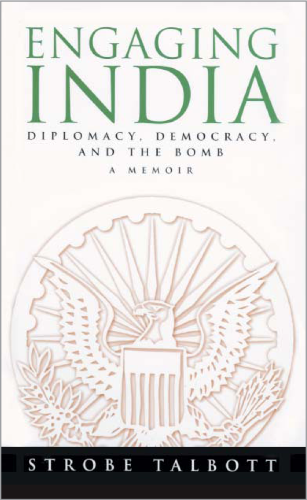
Days after India conducted atomic tests in May 1998, provoking the United States to impose sanctions and virtually freeze relations with India, New Delhi signaled its desire for a dialogue with Washington. The Clinton administration responded quickly, and a series of 14 meetings between Jaswant Singh, Indian Prime Minister Atal Bihari Vajpayee's emissary and later foreign minister, and U.S. Deputy Secretary of State Strobe Talbott followed. Talbott undertook a parallel series of talks with Pakistani officials; Engaging India is his account of this dialogue.
India and the United States started the talks with widely divergent goals. India sought nothing less than a total transformation of Indo-U.S. relations from a state of “cold peace” to a strategic alliance. U.S. aims were far narrower–a compromise between U.S. nonproliferation goals and India's aspiration to be accepted as a nuclear power on par with the officially recognized nuclear weapon states. The Indian tests had blown away the main plank of the Clinton administration's earlier South Asia policy, the goal of which was to “cap, eliminate, and roll back” the Indian and Pakistani nuclear capabilities. With rollback and elimination no longer feasible, the policy centered on “cap.” The United States “would limit the extent to which the Indian bomb was an obstacle to better relations if India would, by explicit agreement, limit the development and deployment of its nuclear arsenal,” Talbott writes.
Early in the talks, Talbott put forward U.S. “benchmarks” aimed at achieving a cap on India's nuclear capabilities. The United States wanted India to sign the Comprehensive Nuclear Test Ban Treaty (CTBT); to cooperate in capping India's production of fissile material; to create a “strategic restraint regime” under which India would limit its ballistic missiles to the existing Prithvi and Agni, refrain from arming them with nuclear warheads, and not deploy them close to Pakistan; to adopt strict export controls on nuclear and missile technologies and materials; and to resume the India-Pakistan dialogue on Kashmir.
Not much came of the U.S. goals. India appeared willing to sign the CTBT, but failed to muster enough domestic support to actually do so. The refusal of the U.S. Senate to ratify the treaty eventually ended any prospect of India signing it. On fissile material, some progress was made when India acceded to U.S. demands. Vajpayee made a landmark visit to Pakistan early in 1999 in an effort to peacefully resolve Indo-Pakistani disputes. But within weeks, Pakistani incursions in the Kargil sector of the Line of Control in Kashmir set off a major crisis and killed the dialogue between New Delhi and Islamabad for the rest of the Clinton administration. U.S. efforts to restrain India's nuclear and missile programs made no progress beyond technical talks. Less than six months after the tests, the U.S. Congress authorized waiving the sanctions, thus undercutting the administration's only bargaining chip. By late 1999, Clinton, with only one year left in office, decided to go ahead with his long-postponed South Asia visit, brushing aside Talbott's objections about “having let himself [Clinton] be stared down [by India] and thus having devalued American power.” The Talbott-Singh talks petered out in 2000.
The importance the Clinton administration gave this dialogue can be gauged from Talbott's assertion that, “From the American perspective, what was at stake was the stability of the global nuclear order.” If so, the efforts of those in charge of the U.S. South Asia policy were amazingly lopsided. Talbott gives very little indication that the Clinton administration lost much sleep as nuclear and missile technology and equipment flowed into and out of Pakistan in a steady stream throughout its tenure, giving Pakistan the ability to produce nuclear warheads and their delivery vehicles and spreading nuclear weapon technology to America's adversaries. He writes, “We suspected that… North Korea may have gotten Pakistani nuclear technology.” In a meeting with Pakistani Prime Minister Nawaz Sharif, Talbott insisted that all Pakistani contacts with North Korea had to stop. Pakistan's response? “Sharif shrugged and lapsed into silence.” That apparently ended U.S. nonproliferation efforts vis-à-vis Pakistan. The disparity between the high priority Washington gave to restraining India's nuclear and missile programs and the amazingly benign reaction to Pakistan's proliferation activities makes one wonder whether, for all the hype surrounding it, nonproliferation was the decisive consideration for Washington in India's case only. With India, there simply was no vital American interest that could override nonproliferation concerns.
Talbott claims that “Singh came closer to achieving his objective in the dialogue than I did to achieving mine.” But if Washington did not get what it wanted on its benchmarks, it was not because of any extraordinary Indian diplomacy. There is enough evidence of Indian naiveté in the book to establish that skillful Indian diplomacy is an oxymoron. Sanctions were a wasting asset and, even when they remained in place, did not hurt India enough to extract substantive concessions. All India had to do, as Talbott feared, was hang tight for a few months and wait for the flow of events to produce “a breakdown in sanctions without a breakthrough on nonproliferation.” Talbott's explanation for this failure to secure Indian concessions is revealing: “Indian democracy, for all its virtues in American eyes, was a complicating factor in accomplishing an important American goal.”
Contrary to Talbott's claim, India did not get more of what it wanted–a better relationship with Washington. He exaggerates when he asserts that his book “is the story of the turning point in U.S.-Indian relations.” At the outset of the dialogue, Clinton wanted South Asia to be “front and center” for the remaining years of his presidency, wanting his administration “to be bold and in the lead on this one.” Talbott seems to have interpreted this part of his mission rather elastically. His sole contribution was to rebuff Singh's every overture, as he relentlessly pursued a cap on India's nuclear capability. When Washington talked about better Indo-U.S. relations, it meant only slightly better relations than the low point reached after the tests, never the kind of improvement India sought. In return for Indian compliance with the benchmarks, all that the United States would offer was “easing sanctions and throttling back on the campaign of international criticism we were orchestrating”; Nuclear Non-Proliferation Treaty-related sanctions and restrictions on India imposed before the tests would have remained. Clinton's India visit was rich in atmospherics but devoid of substance.
Descriptions of melodramatic meetings in which Pakistani officials alternated between bluntly rejecting Talbott's approaches and pathetically pleading their helplessness make for entertaining reading. They do not mitigate for the book's failure to offer much by way of new information on substantive issues.
Engaging India is also marred by several factors that cast doubts on its credibility. Talbott refers to the Clinton administration's efforts to block Russian sales of what he calls “rocket engines and related technology to India for use in its missile program.” The rocket engines–cryogenic engines, for use as the last stage in rockets for placing geostationary satellites in orbit–in fact, had nothing to do with India's missile program. U.S. companies had also bid for the contract for their supply. Talbott offers a lengthy account of U.S. efforts in 1994, which he led, to get Pakistan to stop its fissile material production in return for the supply of arms stalled by the invocation of the Pressler Amendment by the previous Bush administration. Pakistan rejected the proposal. Nevertheless, the Clinton administration put its full weight behind the passage of the Brown Amendment, which authorized the supply of some of the arms. Talbott simply ignores this episode. Another of Talbott's “revelations,” which created quite a sensation in the Indian media, was that Indian Defense Minister George Fernandes was strip-searched at a U.S. airport. Fernandes himself clarified that all he was asked to do was to remove his coat, shoes, and socks and spread his arms wide.
Historians, who will eventually have access to the archives, are unlikely to give the Singh-Talbott dialogue the importance the contemporary Indian media gave it and that Talbott claims for it in his book. Both sides pursued unrealistic aims. While New Delhi completely failed to gauge American intentions, Washington's aims were far in excess of what it could leverage. The book is at best a flawed narrative of a flawed and not very consequential exercise in diplomacy, in pursuit of unachievable goals.