



Abstract
Why is the Defense Department pumping billions of dollars into a stealth satellite program that may not even enhance U.S. intelligence-gathering capabilities?
The public rarely learns of ongoing debates about the merits of a spy program whose existence is supposed to be secret. But in early December 2004, Sen. Jay Rockefeller, a West Virginia Democrat and the vice chairman of the Senate Select Committee on Intelligence, made known his “strenuous objection” to the funding of a major acquisition program that he labeled “totally unjustified and very wasteful and dangerous to national security.”
The senator could not say exactly what program he objected to, since all details remained classified. But he was not the lone dissenter. For two years, the Senate intelligence committee had voted to kill the program, only to be overruled in the appropriations conference. Three other Democrats on the committee–Carl Levin of Michigan, Ron Wyden of Oregon, and Richard J. Durbin of Illinois–echoed Rockefeller's objections in the conference report on the 2005 Intelligence Authorization Act. And some Republican lawmakers and members of the Senate Armed Services Committee reportedly shared their reservations. 1
Days after Rockefeller's statement, the Washington Post revealed that the budget item in question was a stealth imaging satellite program code-named “Misty.” 2 U.S. intelligence agencies launched the first Misty satellite in 1990 and have been working to launch what is thought to be the program's third-generation satellite within the next five years.
The senators' objections to the program were motivated by two factors: cost and benefit. Only a relatively small amount, several hundred million dollars, had been spent so far. But the projected cost for the complete successor program–including spacecraft, launchers, and transmission technology–had recently skyrocketed from $5 billion to an estimated $9.5 billion. That's a lot to spend on a satellite program, unless it significantly enhances U.S. intelligence capabilities. And, according to the senators, the program does not. So why build it? That's exactly what the senators were asking.
Scanning the Soviets
The Misty program can trace its intellectual origins back to the early days of the U.S. space reconnaissance effort. By mid-April 1963, the United States had conducted more than 25 successful satellite reconnaissance missions, almost all of which involved versions of the Corona satellite. The satellite's KH-4 camera system produced photographs with a resolution of between 10 and 25 feet and had successfully documented large portions of Soviet and other foreign territory. In July 1963, the United States launched the first Gambit program spacecraft, which carried a KH-7 camera with a much higher resolution–between 2 and 4 feet. 3
In order to evade antisatellite systems, analysts believed that engineers could build satellites with low radar cross sections, or incorporate other stealth technologies, like radar-absorbing materials, to mask them from sensors.
The two satellite systems gave the photointerpreters at the CIA-run National Photographic Interpretation Center (NPIC) the ability not only to examine wide segments of Soviet territory, but also individual targets such as airfields, radar installations, nuclear reactors, and missile sites. Yet, to the dismay of U.S. intelligence officials, the observers were themselves being observed. Although the United States did not acknowledge that it was launching reconnaissance satellites, it was no secret–to either the interested public or to the Soviet Union–that the mission of many of the spacecraft being blasted into orbit from Vandenberg Air Force Base, California, was to photograph other nations. The Soviets could detect these launches through various means, such as intelligence ships stationed off the California coast. By 1962, the United States had learned, probably through communications intelligence, that Soviet intercept stations and tracking facilities had been instructed to monitor certain U.S. satellites and track them for orbital data. 4
By tracking the satellites as they orbited the earth, the Soviets would know where and when the spacecraft would be passing overhead. Armed with such foreknowledge, the Soviet military and security personnel could place some sensitive equipment under cover, suspend various activities, or camouflage certain installations. Alternatively, it was feared, the Soviets might use the orbital data to take more violent action. In October 1962, a national intelligence estimate on Soviet bloc air and missile defenses reported that, “The Soviet leaders almost certainly intend to acquire an antisatellite capability.” 5
In response, James Cunningham, the deputy director of the Office of Special Activities (OSA), a component of the CIA's Deputy Directorate of Research, sent a memo, “A Covert Reconnaissance Satellite,” to John Parangosky, his deputy for technology. The April 1963 memo described how the reconnaissance systems under development “are difficult, if not impossible, to conceal.” The same could be said of the ones in operation. “Protection against a determined Soviet defense,” Cunningham wrote, “will certainly involve considerable loss or degradation of product, if, in fact, protection is at all possible for any extended period of time.”
Cunningham feared that if the United States relied solely on the heavy reconnaissance satellites under development, “An intense Soviet effort will seriously reduce our coverage and may deprive us of coverage completely.” That specter justified development of “a backup covert system which would rely, above all, on concealment” and “be kept on the shelf until needed.” The resolution of the images obtained by a covert system would be significantly inferior to those produced by more conventional systems because they would be operating in less than optimal orbits or with lighter and inferior cameras (thereby permitting the satellite to be launched on smaller launch vehicles). Nevertheless, Cunningham believed that “useful coverage” still could be obtained. 6
The OSA deputy chief identified six requirements for a covert system, beginning with “a separate and tight security system.” Additional requirements included a clandestine and portable launch and recovery system, silent launch capabilities, silent orbital operations, silent recovery plans, and simplified checkout and handling procedures that would employ a minimum number of personnel and make use of a covert prelaunch command channel.
Among those who investigated the feasibility of Cunningham's proposal was Leslie Dirks, who joined the agency in 1961 and went on to become deputy director for science and technology. Dirks and his colleagues quickly concluded that a secret satellite in low-Earth orbit was not feasible, because the Soviet space detection and tracking network would easily pick up the launch and orbit of the satellite. The United States could try to deceive the Soviets by placing the spacecraft in a much higher parking orbit and then bring it down only when needed. But this strategy also had a fatal flaw: As the film sat in space, unused, it would begin to degrade. By the time officials summoned the secret satellite into active duty, the entire film supply might have been worthless.
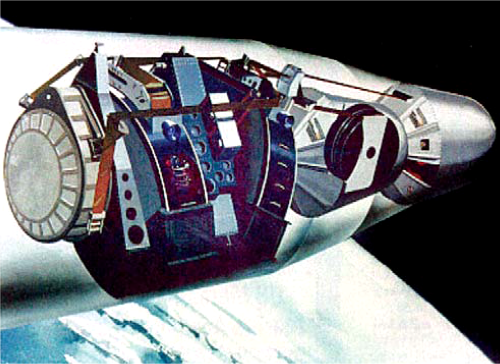
Peekaboo: Early U.S. reconnaissance satellites, like the KH-4B illustrated above, snapped photos from space and then returned the film to Earth via recovery vehicles.
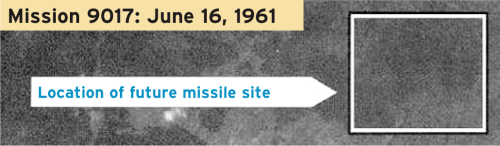
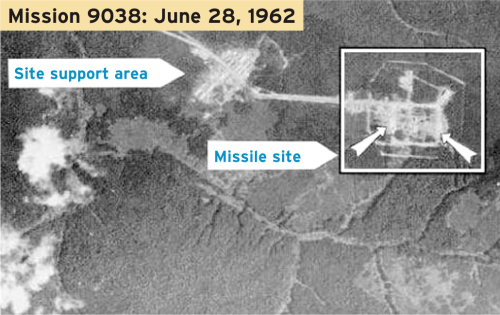
Two separate Corona satellite missions returned photos (right) that helped intelligence officials identify a new Russian missile launch site at the Yurya missile complex.
Making covert work
Not until Ronald Reagan occupied the Oval Office two decades later would both the technology and the political will exist to support a covert satellite program. Administration officials were increasingly concerned about the extent of Soviet denial and deception measures, which included camouflaging important targets, constructing decoys, and implementing other measures to prevent effective satellite coverage of its targets. 7 (Although, over the years, a variety of senior intelligence officials had challenged the extent to which Soviet denial and deception activities represented a serious problem. Dino Brugioni, a former senior official of NPIC, commented in 1983 that, “If the Soviets put up dummy aircraft, you never see them being serviced. If they put up rubber dummies and decoys you see them smashed as the weather and seasons change.” 8 )
Equally worrisome to Reagan-era officials was the assessment in the 1983 edition of the annual Defense Department report, Soviet Military Power, which stated that, “The [Soviet antisatellite] system, which is now operational, has the capability to seek and destroy U.S. space systems in near-Earth orbit.” That July, a national intelligence estimate on the Soviet space program reported that the Soviet Union was unlikely to employ an antisatellite weapon merely for warning or demonstration purposes, but chances were high that it would use one during a NATO-Warsaw Pact conflict. 9 In order to evade antisatellite systems, security analysts believed that engineers could build satellites with low radar cross sections, which would make them harder for ground-based radars to detect, or incorporate other stealth technologies, including radar-absorbing materials and paints, to mask them from targeting sensors. 10
Another impetus for the program might have been the success of the KH-11 satellite camera, the first of which was launched in December 1976. Unlike previous U.S. reconnaissance satellites, which returned capsules of film, the KH-11 was an electro-optical system. It relayed imagery in near-real time through another satellite and arrived at the KH-11 ground station at Fort Belvoir, Virginia, only seconds after the satellite passed over its target. At first, for reasons unknown, the Soviets apparently mistook the KH-11 for an electronic intelligence satellite and did not exercise the same security precautions when it was overhead as they did for the other U.S. imaging satellites. As a result, the KH-11 functioned as a stealth satellite and obtained imagery the other imaging satellites had not.
With the Reagan administration convinced of the potential benefits of a covert satellite program, the engineers of the CIA's development and engineering office sought out technical analyses in order to obtain funding. They turned to the Directorate of Intelligence's Office of Scientific and Weapons Research, which established a Threat Assessment Branch (later Center) in the office's Space Systems Division. Its personnel received special clearances, worked in ultra-secure offices, and had large sums of money available for their work. The branch produced an analysis that supported the idea that such a satellite could be successful–certainly what program advocates wanted to hear. It argued that Soviet radars and cameras were not very capable and were unlikely to track such a satellite. But because the program was so highly compartmented, the development and engineering office did not consult several agencies experienced in satellite tracking–including the Naval Research Laboratory, whose engineers might have provided a different assessment.
Special delivery: The space shuttle Atlantis lifts off on February 28, 1990, carrying the first Misty satellite.

In 1983, the director of central intelligence, William Casey, and presumably President Reagan, approved the program to develop a stealth imaging satellite, and the program was given the code name Misty. To protect the security of the new program, the National Reconnaissance Office (NRO) established a special compartment named “Zir-conic” to designate information related to stealth satellites. Zirconic became a separate element within the already highly secret Byeman Control System–the system used by the NRO to control information about satellite reconnaissance programs. Within Zirconic, yet another term, “Nebula,” designated stealth satellite technology.
Like the KH-11, the new satellite would carry an imagery system that operated in visible light conditions and not against targets obscured by cloud cover. It would lack the all-weather capability of the planned constellation of radar imaging satellites, whose first launch would take place in December 1988. The exact technology engineers developed in an attempt to make the satellite un-detectable to other nations is highly classified. But two publicly filed patents provide clues as to how a satellite might achieve stealthi-ness. In January 1971, two employees of spy satellite manufacturer TRW filed a patent application for a “crossed skirt antiradar screen structure for space vehicles.” 11 In their abstract, they described their invention as consisting of multiple radar screens with “electrically conductive skirts.” The screen, they wrote, had two applications. It could be employed for “controlling and suppressing” the satellite's radar cross section to hide it from “ground-based radar systems.” Or, it could be used to make the spacecraft resemble another space vehicle, “such as a decoy,” to radar systems.
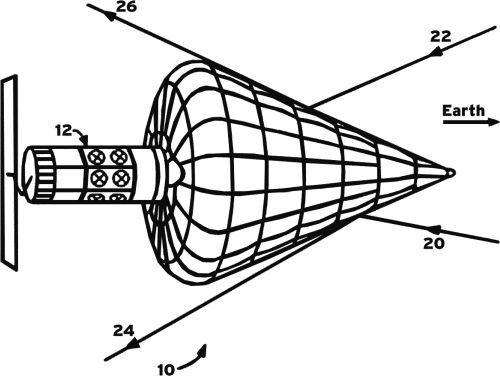
Nineteen years later, three employees of the Strategic Defense Initiative Organization, now the Missile Defense Agency, filed a patent application for a “satellite signature suppression shield”–an action that angered the NRO. 12 In contrast to the antiradar screen, the shield was intended to prevent detection by radar systems and other technologies. The application describes the shield as moveable, inflatable, and “conical-shaped.” Made from a “thin synthetic polymer film material coated with a radiation reflecting material, such as gold or aluminum,” the shield would be stored in a sealed canister attached to the satellite prior to inflation.
One of the invention's goals was to provide an effective shield against “active and passive detection” systems–radar and laser systems, as well as infrared and visible-light detection systems. To do this, the shield's reflective surfaces would deflect radiation away from the satellite and tracking sensors, rendering it effectively invisible to Earth-based monitors.
Not so stealthy
During the early morning hours of February 28, 1990, the space shuttle Atlantis lifted off from Cape Canaveral on the sixth shuttle mission devoted solely to military space operations. The following day, the shuttle released its primary cargo, publicly designated Air Force Project 731 (AFP-731) and reported to weigh 37,300 pounds. While the mission was officially secret, various newspapers and magazines printed stories describing what they believed to be the nature of the cargo. Aviation Week & Space Technology had reported in advance that the Atlantis would carry a “secret intelligence gathering satellite” capable of both imaging and signal interception. The day after the satellite's deployment a New York Times headline read “Satellite Is Deployed In Orbit to Observe Much of the U.S.S.R.”
Space observers generally believed that the intelligence satellite was the first of a new generation of electro-optical satellites–an advanced KH-11 often inaccurately referred to as the “KH-12.” Less than three weeks after the launch, the Soviet news agency Novosti reported that the new spy satellite had broken up on March 7 and that Soviet space specialists were tracking what were thought to be four large pieces from the $1 billion spacecraft. Both U.S. and Soviet sources also reported that the satellite had malfunctioned and would make a “fiery reentry …in the next 30 days.” And on March 17, the Washington Post quoted an anonymous U.S. intelligence official who described the events as a “serious setback.” The Defense Department's statement–that while the space shuttle mission had “achieved” its goal, “hardware elements” carried by Atlantis were expected to fall from orbit soon–appeared to give some credence to the Soviet and U.S. reports.
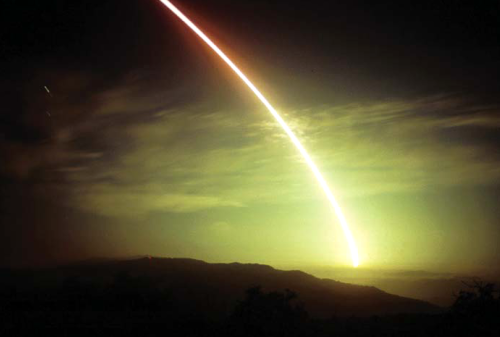
Flash of the Titan: A Titan IV-B rocket streaks through the sky with its secret payload—the Misty 2 satellite—on May 22, 1999.
The reports were wrong. The satellite was not an advanced KH-11; it was Misty. And it had not broken up or malfunctioned; the debris could have resulted from jettisoning shrouds or covers; or it could have been a purposeful attempt at deception. But the CIA quickly learned that the satellite failed one crucial element of its mission. Despite Misty's intended stealthiness, less than eight months after its launch, three civilian space observers spotted the satellite orbiting between 494 and 503 miles above the Earth, at a 65 degree angle to the equator. 13 (The CIA had similarly overestimated the difficulty the Soviet radars would have in detecting the first U-2 spy plane flights.) Ted Molczan, a Canadian computer programmer and amateur space observer, compiled the data of the three observers and traced the satellite's launch trajectory back to the Atlantis mission.
On May 22, 1999, nine years after Misty's launch, a Titan IV-B rocket blasted off from Vandenberg Air Force Base on what was acknowledged to be a mission to place an NRO spacecraft into orbit. About six weeks later, Aviation Week & Space Technology described it as an “unusual mission” with “parameters unlike any other current NRO satel-lite.” 14 The launch left nine objects in orbit, in addition to the primary payload, according to the trade magazine. Two days after the Titan's second stage placed the satellite in a low parking orbit, the satellite fired its own engine and placed itself into an intermediate 250-mile orbit. The magazine also claimed that six objects separated from the spacecraft in its initial parking orbit, two more in its intermediate orbit, and one additional piece as it maneuvered into its final orbit.
That final, unusual orbit, Aviation Week reported, took the satellite, which had the unclassified designation USA 144, to as far as 2,050 miles above the Earth and no closer than 1,675 miles. The satellite's angle in relation to the Earth's equator was standard for a variety of communication and signals intelligence satellites operated by the United States and the Soviet Union (and later Russia), but the lowest point and highest point of its orbit were too low for a signals intelligence satellite and too high for an imagery satellite. What function then did the satellite serve? The answer, according to space observer Molczan, may be that the object orbiting more than 1,600 miles above the earth was a decoy. Amateur space observers had detected an object in a much lower orbit–between 434 and 558 miles–that they associated with the May 22 launch, making it highly likely that they had found Misty 2.
Hawk eyes
To keep an eye on any threat, anytime, anywhere in the world, intelligence officials aim to develop a new constellation of surveillance and reconnaissance systems. The goal is “persistent surveillance,” according to Stephen Cambone, undersecretary of defense for intelligence. But officials have struggled to translate their expansive plans into reality.
Technical problems and a lack of funding have repeatedly delayed deployment of two satellite programs central to future surveillance plans: Future Imagery Architecture (FIA) and Space-Based Infrared System (SBIRS) High. A May 2003 Defense Science Board report labeled as “troubled” the SBIRS High program, whose infrared sensors, observers believe, would add the capability to stare continuously at a target to the intelligence-gathering repertoire. As of late 2004, the estimated bill for the complete SBIRS High program had risen to $9.9 billion.
The same report tagged the FIA program “significantly underfunded,” “technically flawed,” and “not executable.” Little is known about the FIA program, but it is believed to include a large number of small imagery satellites, which would allow intelligence agencies to view more targets at any given time and “revisit” targets more frequently. Estimates of the FIA program's cost range from $10 billion to $28 billion.
Looking for cheaper and more versatile alternatives to satellites, the Defense Department, in 1994, began developing the Global Hawk, an unmanned aerial vehicle that uses several different types of imaging sensors to spy on targets at an altitude of up to 60,000 feet. After only limited testing, air force officials deployed a few Global Hawks to Afghanistan in 2001. By all accounts the system performed well, although one of the craft crashed in late 2001. (The Pentagon fielded a single Global Hawk during the U.S. invasion of Iraq, and the U.S. Navy is currently testing whether Global Hawk can assist with naval surveillance.)
Remote control needed: The air force unveils the Global Hawk unmanned aerial vehicle in February 1997.

Eager to field more Global Hawks, Defense restructured the program in March 2002 and decided to build a second-generation model, called the RQ-4B, a bigger version with more advanced intelligence-gathering sensors. But the RQ-4B is a heavy bird as currently envisioned. It won't be able to stay aloft as long as the original model, possibly limiting how much it will be able to accomplish during each trip into the air, according to a November 2004 Government Accountability Office (GAO) report.
The Global Hawk was rushed into service, and now some Defense officials fear the same will happen with the RQ-4B. The GAO report shares that opinion: “A substantial lack of knowledge continues to add risk to the RQ-4B acquisition.” And that risk doesn't come cheaply. The GAO estimates a single Global Hawk now costs $123 million, a 40 percent increase since March 2001. The air force maintains that risk associated with the Global Hawk program is being adequately managed. Anything for an all-seeing eye in the sky.
Play Misty 3 for me
Questions about the value of a not-so-stealthy spacecraft, which can only produce imagery when a target is not obscured by cloud cover, underpinned the various dissenting senators' comments on the program last December–particularly considering that today's primary military targets include terrorist groups and rogue states with small, highly covert nuclear weapons programs.
When Misty was approved in March 1983 the primary target was the Soviet Union, whose military operations included the movement of mobile missiles, tests of new aircraft, and launches of military satellites. At the time, the United States only had three imaging spacecraft in orbit and no other Western nation possessed similar capabilities. As a result, the Soviets could be confident that they could hide certain activities or equipment by keeping them out of view when those satellites were overhead.
Today, a wide array of satellites is capable of producing high-resolution imagery. In addition to Misty, the United States operates three advanced KH-11 satellites and two Onyx radar-imagery satellites. Two U.S. commercial imagery satellites, operated by Space Imaging and DigitalGlobe, return spy satellite-quality images, not to mention the French Helios, Israeli Offeq, and Japanese IGS satellites. As one government official told the New York Times: “There's already so many satellites in orbit that our adversaries already assume that just about anything done in plain sight is watched, so it's hard to believe a new satellite, even a stealthy one, could make much of a difference.” 15
Indeed, the United States has operated Misty 2 since May 1999–during a time in which terrorist groups and covert nuclear weapons programs have emerged as key threats. Yet, U.S. satellites apparently failed to detect North Korean uranium enrichment efforts from overhead. (Intelligence gathered about the North's purchase of aluminum tubes led to this discovery.)
“Numerous independent reviews have concluded that the program does not fulfill a major intelligence gap or shortfall, and the original justification for developing this technology has eroded in importance due to the changed practices and capabilities of our adversaries,” Senator Wyden has said. He added: “There are a number of other programs in existence and in development whose capabilities can match those envisioned for this program at far less cost and technological risk.” Among those programs are unmanned aerial vehicles, including Global Hawk (see “Hawk Eyes,” opposite page) and its planned successors, which can conduct surveillance of targets for hours at a time, rather than for the brief spells to which orbiting spacecraft are limited. 16 But the limited publicly available information about the Misty program makes it difficult to reach an independent judgment concerning the program's value.
Stealth cone: The shield in this drawing, part of a 1990 patent application, could help a satellite evade detection.
The arguments of the dissenters and independent reviews–whose number, authors, and specific conclusions remain classified–did not convince the congressional appropriations committees or the House Permanent Select Committee on Intelligence and its chairman, current Director of Central Intelligence Porter Goss, to terminate the program. Perhaps they judged the value of the intelligence produced to be worth the cost. For the moment, at least, while Misty 2 continues its activities in outer space, back on Earth the follow-on program marches ahead. The public might not hear of the satellite again, until space observers spot another mysterious object in the sky.
Footnotes
1.
Dana Priest, “New Spy Satellite Debated on Hill,” Washington Post, December 11, 2004, pp. A1, A13.
2.
Ibid.
3.
National Imagery and Mapping Agency, America's Eyes: What We Were Seeing (Bethesda: NIMA, 2002), p. 3.
4.
Deputy director/intelligence, CIA, memorandum for director of central intelligence titled, “Soviet Knowledge of U.S. Reconnaissance Satellite Programs,” April 11, 1962.
5.
Director of central intelligence, National Intelligence Estimate 11-3-62, “Soviet Bloc Air and Missile Defense Capabilities Through Mid-1967,” October 31, 1962, p. 15.
6.
Cunningham was not the first to propose the development of such a system. Richard Bis-sell, the CIA's deputy director for plans from 1959 to 1962, who managed the Corona program, had suggested such a system.
7.
Yossef Bodansky, “Ogarkov Maps Soviets' Strategy for Winnable War,” Washington Times, July 23, 1985, pp. 1A, 10A; Viktor Su-vorov, “GUSM: The Soviet Service of Strategic Deception,” International Defense Review, no. 8, pp. 1235-40 (1985).
8.
Dino A. Brugioni, “Hiding the Aircraft Factories,” Air Force Magazine, March 1983, pp. 112-115.
9.
Director of central intelligence, National Intelligence Estimate 11-1-83, “The Soviet Space Program,” vol. 1, July 19, 1983, p. 6.
10.
Paul Stares, Space and National Security (Washington, D.C.: Brookings, 1987), p. 78.
11.
William C. Barker and Donald M. Slager. Crossed skirt antiradar screen for space vehicles. 1971. U.S. Patent 6,107,952, filed January 4, 1971 and issued August 22, 2000, pp. 1, 3.
12.
Morton T. Eldridge, Karl H. McKechnie, and Richard M. Hefley. Satellite signature suppression shield. 1990. U.S. Patent 5,345,238, filed March 14, 1990 and issued September 6, 1994, pp. 1, 3.
13.
“U.S. Spy Satellite Spotted by Europeans,” Washington Times, November 1, 1990, p. A6; Tony Allen-Mills, “Dad's Army Runs Rings Around CIA Stealth Satellites,” The Sunday Times, December 26, 2004.
14.
“NRO's Unusual Mission,” Aviation Week & Space Technology, July 5, 1999, p. 17.
15.
Douglas Jehl, “New Spy Plan Said to Involve Satellite System,” New York Times, December 12, 2004, pp. A1, A30.
16.
Douglas Jehl, “Debate on Secret Program Bursts Into Open,” New York Times, December 10, 2004, p. A29; Douglas Jehl, “It's Planes vs. Satellites in Debate on Spying,” New York Times, December 16, 2004, p. A30.