



Abstract
Biosecurity and Bioterrorism, no. 1, 2005, Center for Biosecurity of the University of Pittsburgh Medical Center.
What good is a biosurveillance system if the samples it collects can't be affordably and efficiently processed? In order to handle the enormous output of new government programs created to detect biological agents in the environment–the most notable of which is BioWatch–the Defense Department did what any good business would do, it attempted to increase productivity. More specifically, Defense invested in automation.
In principle, an automated system could avert the numerous bottlenecks that routinely occur during the time-intensive laboratory work necessary to identify the presence of bioagents in air, water, and soil samples. But, in a replay of the classic John Henry confrontation between man and machine, are robots up to the task of homeland security?
The short answer is yes, according to an article titled “Automated Screening for Biological Weapons in Homeland Defense,” published in the journal Biosecurity and Bioterrorism. The authors of the study, led by Peter A. Emanuel, the director of the Critical Reagents Program at the Joint Program Executive Office for Chemical and Biological Defense, found that screening machines held several advantages.
After evaluating the Defense Department's Automated Biological Agent Testing System (ABATS), a prototype designed to prescreen samples and “elevate” some for further testing, the researchers concluded that automation can “substantially decrease the time between a biological attack and the ability to respond.” And throughout the test, the accuracy of the system remained high. “The probability that the instrument would correctly determine if the sample was positive or negative was 98.66 percent,” they found.
ABATS also proved cheaper than more traditional screening methods, particularly in labor costs. Using three operators, the ABATS processed a single sample for $70.67. By comparison, it cost $320 per specimen when 10 doctoral-level scientists working for the U.S. Army Medical Research Institute of Infectious Diseases processed samples in a similar manner at the height of the anthrax incidents in late 2001.
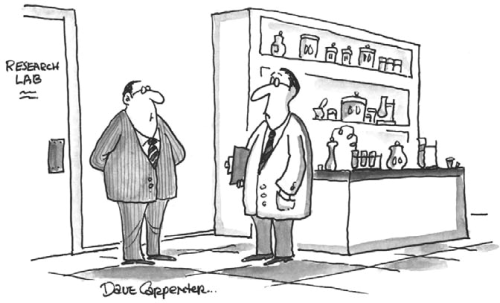
“I hate putting undo pressure on you, Crenshaw, but we urgently need something ‘cutting-edge’ enough to satisfy our investors.”
Despite their findings, the authors agreed that “full automation of the [screening] process was unnecessary to realize the major benefits of automation.” They believe that a semi-automated system, labeled Stations of Robotic Monitoring, promises the same reduced labor costs, but lower upfront costs and more flexibility.
And what about improving government management of biosurveillance systems in general? That's not addressed by the Biosecurity article, but in late March, the inspector general of the Environmental Protection Agency released a report criticizing the agency for its oversight of the BioWatch program, noting that the “failure” of the agency “raises uncertainty about the ability of the Bio-Watch program to detect a biological attack.”
If only the jobs of bureaucrats could be easily automated, too.