



Abstract

In a region of great powers, Mongolia is an exception. A sizable chunk of North Asia with a land area of more than 1.5 million square kilometers, Mongolia is home to 2.8 million people, half of whom live as nomadic herders; its global influence lags far behind neighboring world powers China and Russia, and even nearby North Korea. Yet recently Mongolia has begun quietly engaging the big boys in its turbulent neighborhood with a blend of pragmatism and moral suasion.
At the heart of Mongolia's initiatives is its 1992 decision to declare itself a nuclear-weapon-free state. “Traditionally, nuclear-weapon-free zones [NWZs] have been created in regions where the interests of nuclear powers have not been directly challenged,” says Jargalsaikhan Enkhsaikhan, Mongolia's former ambassador to the United Nations. “But there are over a dozen states like Mongolia that, due to their geographic location or some other geopolitical reason, cannot be part of a regional NWZ. That is why Mongolia is advocating the single-state approach and encouraging countries like Afghanistan, Nepal, Sri Lanka, and even North Korea and Japan to officially declare themselves nuclear-weapon-free states.”
One of the imperatives driving Ulaanbaatar is the environment. Wind patterns in the region are such that any nuclear test or accident in Russia, China, Central Asia, Pakistan, India, or even Europe would carry radiation directly across Mongolia's vast steppes. “China and Russia have 25 nuclear sites near Mongolia, but do not give us or each other any safety-related information,” Enkhsaikhan says. “Maybe we can't get them to close these [sites], but if we get them to comply with international standards [and] institutionalize some exchange, we can make the region safer.”
As a weak but strategically important nation, Mongolia's nuclear policy is also designed to keep the imposing million-man armies of Russia and China on their respective sides of the border. For centuries, both giants have jockeyed to control Mongolia–mostly for no other reason than to ensure the other did not. China reversed Genghis Khan's assault in 1691 and occupied Mongolia until 1921. “[China] has never abandoned its wild goal of recapturing Mongolia,” Wang Wei-fang, assistant professor at Taiwan's Lung-hwa University, recently wrote in the Jamestown Foundation's May 2005 China Brief. When China left, Russia immediately assumed control, running the country from 1921 until the end of the Cold War in 1990. The big bear to the north still looks down at Ulaanbaatar with a proprietary eye.
A neutral, non-nuclear Mongolia would reassure both Russia and China. To this end, Ulaanbaatar has suggested the creation of a trilateral nuclear agreement between the three countries. “We are trying to create predictability and transparency,” Enkhsaikhan says. “Russia and China have already declared that they would not use territories of adjacent third states against one another. By institutionalizing its nuclear-weapon-free status, Mongolia would be helping them realize that commitment with respect to one of the longest borders of their countries.”
Initially, diplomats were dismissive of such grand ideas emanating from a geopolitical afterthought. But the determination that once made Mongolia the world's largest land empire is still evident, even if its borders have shrunk. “The United States, along with the rest of the international community, has supported U.N. General Assembly resolutions in 1998, 2000, 2002, and 2004 that encourage cooperation with Mongolia in promoting its independence, sovereignty, territorial integrity, and economic security, as well as its nuclear-weapon-free status,” says Pamela J. Slutz, the U.S. ambassador to Mongolia.
“The Mongolians have surprised everyone,” adds Stephen Noerper, international relations specialist at the Nautilus Institute, about the efficacy with which Mongolia has promoted nuclear disarmament.
As such, Mongolia's nonaligned diplomats are playing an integral, if mostly private, role in denuclearizing North Korea. Even when Pyongyang briefly withdrew from the six-party talks earlier this year, Mongolia continued this low-profile dialogue. Neutrality is in short supply in North Asia, and Mongolia's non-nuclear status is a major reason why North Korea, riled by the great powers' attempts to disarm it, communicates with Mongolia. “Pyongyang sees non-nuclear Mongolia as non-threatening and even sympathetic–a kind of Asian Switzerland,” Noerper says.
Instead of focusing on North Korea's nuclear program, Mongolia's stiff-suited and usually foreign-educated diplomats are trying to draw Pyongyang toward reform by sharing the tales of its own transformation from a Stalinist state to a free-market democracy. Despite all of North Korea's fiery rhetoric, Mongolian officials involved in the talks say Pyongyang's leaders realize they need to make similar changes.
Some U.S. officials envisioned Mongolia serving as a transitional consultant to nations such as North Korea as far back as a decade ago. In the early 1990s, Mongolia's reforms made it the first–and still only–Soviet client state in the region to successfully become a free-market democracy. Its 1994 Bilateral Investment Treaty with the United States was one of the first that Washington signed with any Asian or former communist country, and then-Speaker of the House Newt Gingrich was convinced that Mongolia should serve as a model for all ex-Soviet republics. As secretary of state, James Baker visited Mongolia twice and is credited with the substantial economic and diplomatic assistance Washington extended to Ulaanbaatar–though local politicians joked that he was primarily interested in hunting in Mongolia's vast wilderness. Today, despite the Bush administration's stated goal of isolating North Korea, the United States is quietly supportive of Mongolia's diplomacy with Pyongyang. (Forging a continued friendship with the United States, Mongolia also sent troops to support missions in both Afghanistan and Iraq.)
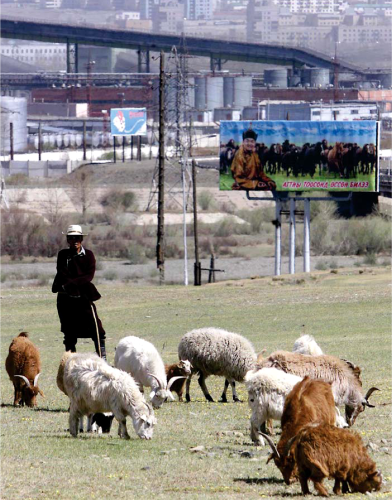
The Khan-do country: Although half of its people still live as nomadic herders, Mongolia has begun to assert itself on the world stage.
Unlike the rest of the players at the six-party talks, Mongolia shares ethnic similarities with North Korea. Mongolians, Koreans, and the Japanese all belong to the Altaic language family, and many Korean clans are believed to have come from the Buir Lake region in eastern Mongolia. This fraternity has become an essential thread in the web of ties that Mongolia is building with the two Koreas and Japan as it pursues what Baker dubbed the “third neighbor” policy. This pillar of Mongolian foreign policy is designed to overcome the disadvantage of being sandwiched between Russia and China by building close ties with the United States and regional allies such as Japan and South Korea.
It also fills Mongolian coffers. Half of Mongolia's budget comes from international donors, and Western, South Korean, and Japanese firms have invested $300 million in the country. That's a considerable amount for Mongolia, and the returns on these investments are starting to become apparent. In Ulaanbaatar, many of the staid Soviet structures built to proclaim the power of the workers' revolution are now adorned with the universal crown of capitalism: giant neon signs advertising cell phones and designer clothing. Additional aid might come from the Bush administration's Millennium Challenge Account, which will distribute more than $1 billion to 16 developing countries this year.
Naturally, Mongolia's efforts to achieve global and regional harmony are not purely altruistic. With a reformed North Korea, a continuous railway can be established between the two Koreas and Europe using the trans-Siberian railway. Such a project could generate $30 billion for Mongolia over the next decade alone. China, however, disapproves, wanting any transit route to use more Chinese territory; China also worries such financial independence might pull Mongolia further from its influence.
Following the West's lead, China, whose hunger for coal, copper, gold, iron, and other natural resources makes it Mongolia's largest trading partner, has learned how to buy friends, too. In July, Beijing gave Mongolia a $300 million soft loan, which Ulaanbaatar accepted after much soul-searching. Whether such economic assistance will pull Mongolia from the Western orbit and make it completely reliant on China once again is uncertain. Ulaanbaatar will politely listen to all its allies and neighbors, but inside the country there's a fierce resolve to find its own way in the world. “We're a small nation, but we have two things working for us–common sense and morality,” says Bat-Erdene Batbayar, a well-known Mongolian historian and political adviser. “Let's see how far that takes us.”