




Abstract

Since Britain withdrew its last WEI 77 gravity bomb from service in March 1998, it has relied on a single nuclear weapon system, its fleet of nuclear-powered ballistic missile submarines (SSBNs), and their accompanying Trident submarine-launched ballistic missiles (SLBMs). Though the fleet is expected to be in operation until 2020 or beyond, attention is now turning to the question of whether Britain requires a new generation of nuclear weapons. The debate is in its early stages, but it has already proved contentious.
Just before he died unexpectedly in early August, Robin Cook, the former foreign secretary, called upon Prime Minister Tony Blair to “break from the past” and make “the case that nuclear weapons now have no relevance to Britain's defenses in the modern world.” Some suspect Blair has already secretly decided to build a new generation of nuclear weapons to replace the Trident system. The debate is unfolding against the backdrop of global concerns about nonproliferation, especially in Iran and North Korea, and about Britain's long-standing nuclear “special relationship” with the United States.
Any new British nuclear warheads would be built by the Atomic Weapons Establishment (AWE). Since 1950, the AWE has been responsible for the full life cycle of British nuclear warheads, from research and development through disassembly and disposal. British warheads have been designed at Aldermaston, a 750-acre site in Berkshire. Final assembly and disassembly takes place at Burghfield, a 225-acre site 7 miles to the east. The Atomic Weapons Establishment Management Limited–a joint venture between Lockheed Martin, Serco Limited, and British Nuclear Fuels, Ltd.–has a 25-year contract with the Ministry of Defence to operate AWE that is due to expire in 2025.
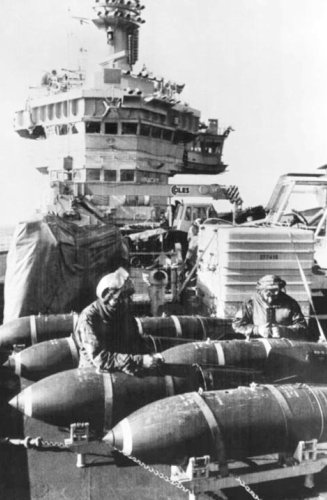
During the 1982 Falklands War, the British carrier Hermes (above) transported nuclear depth charges (not pictured).
Like its counterpart in the United States, AWE is responsible for guaranteeing the reliability and safety of the warheads in the stockpile and for maintaining the capability to design new weapons should the Blair government decide to do so. AWE also supports arms control treaties to which Britain is a party. For instance, its Forensic Seismology Centre at Brimpton, near Aldermaston, monitors earth movements around the world to detect underground nuclear explosions and advises the government on nuclear testing issues.
The Labour Party's 1998 Strategic Defence Review (SDR) determined that only one of Britain's four SSBNs would be on patrol at any given time, and it “will carry 48 warheads.” The British government reaffirmed this number to Parliament on July 21, 2005. The stockpile's remaining warheads are enough to arm the three other subs, each of which can carry as many as 16 missiles, with up to three warheads per missile. Only two of the three subs would be able to deploy on relatively short notice; one sub is scheduled to be in major overhaul at all times and would take considerably longer to deploy, if at all.
The submarine on patrol operates at reduced alert, with the capability to fire its missiles within days of receiving an authentic launch order (rather than within a few minutes, as during the Cold War). The missiles are held in a “detargeted” mode, meaning that target data would need to be loaded into the guidance system before launch, an operation that takes a few minutes. It could also take the sub some time to get into position to launch a missile. While on patrol, the submarine carries out secondary tasks, including hydrographic data collection and exercises with other vessels. During the past few years, a couple of British subs have visited French ports.
Though the government has described the number of “operationally available” warheads in its stockpile, estimating the size of the total stockpile remains difficult. There are, however, some hints. The 1998 SDR reduced the number of Trident II D5 missiles to be supplied by the United States from 65 to 58, meaning that there are not enough missiles to fully arm all four SSBNs. This suggests a Royal Navy decision to acquire only enough missiles to arm three boats (48 missiles), with the remaining 10 missiles to be used for spares and test-launches. If we assume that the navy arms each of the 48 missiles with an average of three warheads, then only 144 warheads are required. It is important to note that there is not a set of Trident IIs specifically dedicated to British use. Rather Britain draws on a pool of commingled missiles kept in the Strategic Weapons Facility Atlantic at Naval Submarine Base Kings Bay, Georgia. Britain has title to 58 missiles but does not own them; a missile that was deployed on a U.S. sub may later deploy on a British sub, or vice versa.
A second indicator of the size of the British arsenal is that Britain assigns its patrolling SSBN a “substrategic mission” to supplement its strategic role. Operationally this probably means that some of the sub's missiles have a single warhead aimed at targets once covered by WEI 77 gravity bombs. These warheads could be used to attack regional adversaries–so-called rogue states–that have weapons of mass destruction, a mission that would not require a substantial attack. The substrategic mission may also require smaller warhead yield options. This can be achieved by choosing to detonate a warhead's un-boosted primary, which would produce a yield of 1 kiloton or less, or by choosing to detonate the boosted primary, which would produce a yield of approximately a few kilotons.
The load-out of an SSBN on patrol with strategic and substrategic missions would likely be either 10, 12, or 14 SLBMs loaded with multiple warheads; the remaining missiles would be armed with one warhead each. U.S. Trident IIs can carry up to eight warheads; presumably those missiles on British submarines can do the same. Assuming a limited upload capability, a few spares, and a number of warheads always in maintenance (and therefore not “operationally available”), we conclude that a reasonable estimate of the total stockpile is approximately 200 warheads.
The tightness of the relationship means that, in part, as the U.S. nuclear arsenal goes, so too does Britain's. In April 2005, a former Los Alamos National Laboratory warhead designer and three colleagues claimed that there is a serious flaw in the W76 warhead that could cause it to explode with a reduced yield or possibly not at all. Officials from the National Nuclear Security Administration, Los Alamos, and other experts say there is no problem with the warhead and maintain that the W76 is reliable, but the issue is of obvious concern to the British.
The British government confirmed in 2002 that staff from the Defence Procurement Agency's Nuclear Weapons Integrated Project Team held discussions with their U.S. counterparts “on the U.S. W76 warhead, relevant to the safety and reliability of [Britain's] Trident warhead.” In July 2005, the government announced that it intends to spend more than £1 billion ($1.8 billion) during the next three years to ensure the “continued reliability and safety … of the existing Trident warhead stockpile.”
In the United States, such language has meant modifying the W76 warhead to incorporate new capabilities that significantly improve the weapon's effectiveness. The U.S. Navy has begun replacing the W76's airburst arming and firing fuzes with a new groundburst fuze. This modification significantly increases the lethality of the W76 warhead and broadens the range of targets that it can hold at risk to include some hard targets, such as reinforced missile silos. Whether Britain also plans to install groundburst fuzes in its warheads is unknown.
Some interesting historical documents about the secret understandings between U.S. presidents and British prime ministers on the use of nuclear weapons have been declassified and published on the internet. The documents, which span 1950-1974, reveal some tension in the “special relationship.” British leaders wanted assurances from each new U.S. administration that they would be consulted and have some say if nuclear weapons were about to be used. U.S. leaders wanted the freedom to act unilaterally and never agreed to a British veto on the use of U.S. forces; they always agreed to consult Britain, but only “if time permits.”
Britain has always had a special role supporting and collaborating with the deployment of U.S. nuclear weapons overseas. Since World War II, in fact, Britain has based four nuclear-capable U.S. weapons systems, the most numerous of which were various gravity bombs, some of which remain on British soil today. From 1958 to 1963, the United States deployed 60 Thor intermediate-range ballistic missiles and W49 warheads in Britain; from 1968 to 1991, it deployed depth bombs at British bases for use by U.S., British, and Dutch antisubmarine aircraft; and from 1961 to 1992, U.S. SSBNs used Holy Loch on the Firth of Clyde in Scotland as a refit facility.
“While en route, the weapons were transferred to the aircraft carriers Hermes and Invincible, which already carried 40 and 25 percent, respectively, of Britain's nuclear depth charges and were also traveling to the South Atlantic. Only in late June did the weapons return to Britain. Freedman stresses that there was never any intention to use the weapons against the Argentines but adds that the chief of the defense staff, Adm. Sir Terence Lewin, was inclined to bring them to the South Atlantic just in case Soviet submarines got involved in the conflict on the Argentine side.
In 2003, the British government released information identifying more than a dozen nuclear weapon accidents and incidents since 1960. The British define a nuclear weapon accident as “an unplanned occurrence involving the destruction of, or damage, or suspected damage to, a nuclear weapon which has resulted in actual or potential hazard to life or property, or which may have impaired nuclear safety.” There are two categories of accidents: Category 1, in which no release of radioactive material occurs, and Category 2, in which a release is detected. Between 1973 and 1987, there were seven Category 1 accidents and zero Category 2 accidents. None of them involved anything like the 32 acknowledged U.S. “broken arrows” (accidents), which include airplanes crashing and submarines sinking with nuclear weapons aboard. In one instance, an explosion inside a U.S. missile silo catapulted a nuclear warhead 600 feet into the adjacent woods. British accidents include a few minor traffic mishaps involving vehicles transporting nuclear weapons and instances in which weapons fell a few inches with no damage to the warheads.
Britain's arsenal
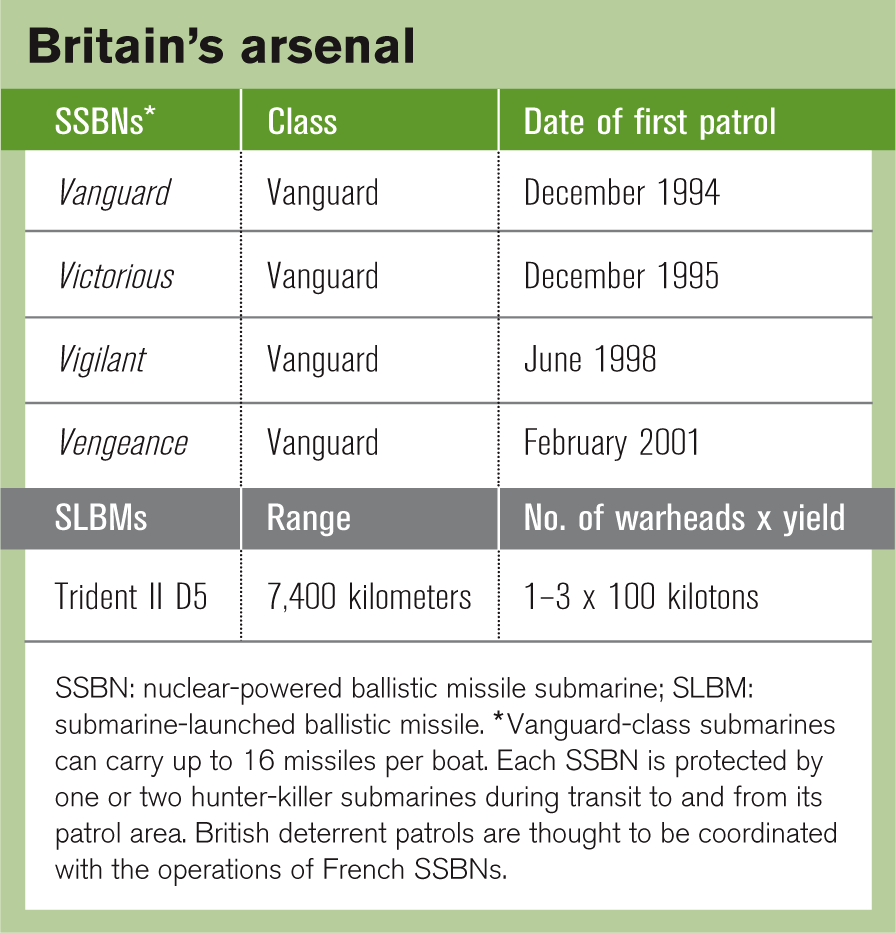
SSBN: nuclear-powered ballistic missile submarine; SLBM: submarine-launched ballistic missile.
Vanguard-class submarines can carry up to 16 missiles per boat. Each SSBN is protected by one or two hunter-killer submarines during transit to and from its patrol area. British deterrent patrols are thought to be coordinated with the operations of French SSBNs.
The British also track “incidents”–unplanned occurrences that “did not constitute an accident … but which [need] to be reported in the interests of safety, or because it was likely to attract the attention of the public or the media.” There were 12 such incidents between 1960 and 1991. One occurred during the transfer of containers carrying nuclear weapons between warships in the Falklands War. The container was damaged in the accident, but the nuclear weapon was not. Another occurred in August 1988 when a British warship carrying nuclear weapons collided with another ship while moored off Hong Kong. Though these ships are not identified in British reports, this incident may have involved either the carrier Ark Royal or the transport ship Fort Grange, both of which were on overseas cruises in the Pacific that included a visit to nuclear-free Australia in October.