




Abstract
The replacements
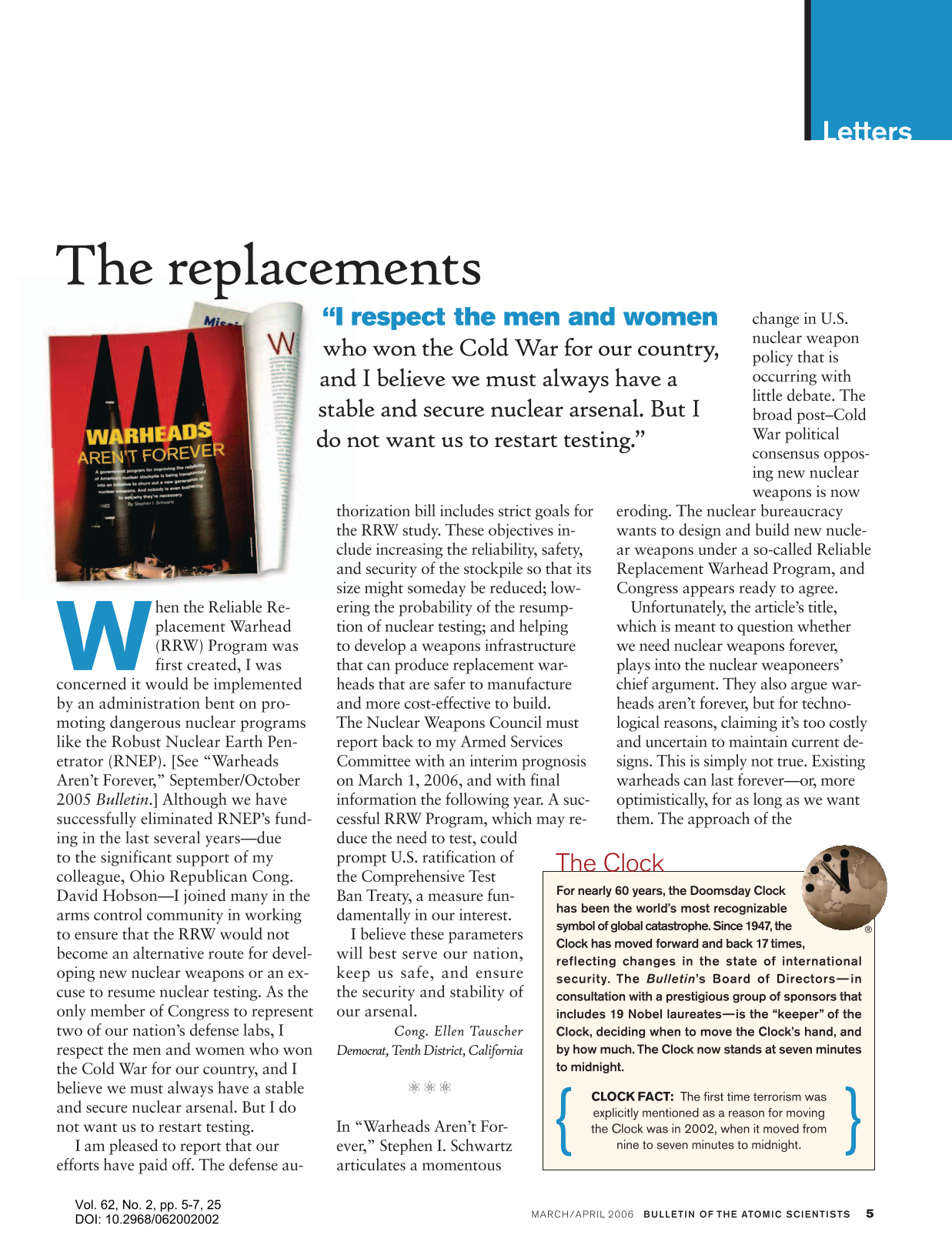
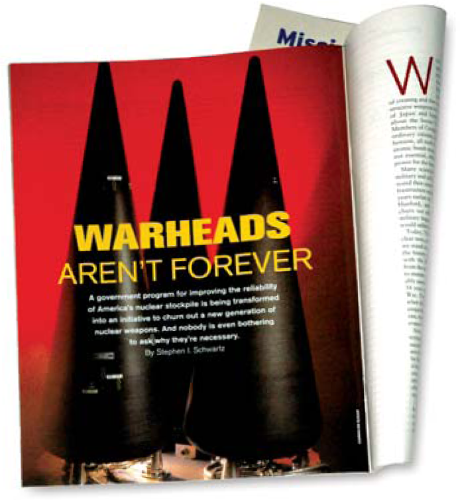
When the Reliable Replacement Warhead (RRW) Program was first created, I was concerned it would be implemented by an administration bent on promoting dangerous nuclear programs like the Robust Nuclear Earth Penetrator (RNEP). [See “Warheads Aren't Forever,” September/October 2005 Bulletin.] Although we have successfully eliminated RNEP's funding in the last several years–due to the significant support of my colleague, Ohio Republican Cong. David Hobson–I joined many in the arms control community in working to ensure that the RRW would not become an alternative route for developing new nuclear weapons or an excuse to resume nuclear testing. As the only member of Congress to represent two of our nation's defense labs, I respect the men and women who won the Cold War for our country, and I believe we must always have a stable and secure nuclear arsenal. But I do not want us to restart testing.
I am pleased to report that our efforts have paid off. The defense authorization bill includes strict goals for the RRW study. These objectives include increasing the reliability, safety, and security of the stockpile so that its size might someday be reduced; lowering the probability of the resumption of nuclear testing; and helping to develop a weapons infrastructure that can produce replacement warheads that are safer to manufacture and more cost-effective to build. The Nuclear Weapons Council must report back to my Armed Services Committee with an interim prognosis on March 1, 2006, and with final information the following year. A successful RRW Program, which may reduce the need to test, could prompt U.S. ratification of the Comprehensive Test Ban Treaty, a measure fundamentally in our interest.
I believe these parameters will best serve our nation, keep us safe, and ensure the security and stability of our arsenal.
Cong. Ellen Tauscher
Democrat, Tenth District, California
In “Warheads Aren't Forever,” Stephen I. Schwartz articulates a momentous change in U.S. nuclear weapon policy that is occurring with little debate. The broad post-Cold War political consensus opposing new nuclear weapons is now eroding. The nuclear bureaucracy wants to design and build new nuclear weapons under a so-called Reliable Replacement Warhead Program, and Congress appears ready to agree.
Unfortunately, the article's title, which is meant to question whether we need nuclear weapons forever, plays into the nuclear weaponeers' chief argument. They also argue warheads aren't forever, but for technological reasons, claiming it's too costly and uncertain to maintain current designs. This is simply not true. Existing warheads can last forever–or, more optimistically, for as long as we want them. The approach of the National Nuclear Security Administration (NNSA) to stockpile maintenance is costly and uncertain because it cannot refrain from modifying weapons. The NNSA spends substantial sums on upgrading its capabilities and executing plans. Under the fraudulently named Life Extension Program, NNSA has made weapons lighter, more tamperproof, and more resistant to radiation, while improving target flexibility and providing new tritium delivery systems.
The Clock
For nearly 60 years, the Doomsday Clock has been the world's most recognizable symbol of global catastrophe. Since 1947, the Clock has moved forward and back 17 times, reflecting changes in the state of international security. The Bulletin's Board of Directors–in consultation with a prestigious group of sponsors that includes 19 Nobel laureates–is the “keeper” of the Clock, deciding when to move the Clock's hand, and by how much. The Clock now stands at seven minutes to midnight.

UPDATES
Worried that satellite images provided by Google Earth could be used for nefarious purposes, some nations have expressed concern that details about sensitive sites in their countries might be merely a few keystrokes away. Russia's security services are upset, and India has sent Google a letter asking it to provide only low-resolution images of certain areas and buildings. Google reps have also met with officials from South Korea and Thailand to discuss the situation. Despite the anxiety abroad, U.S. experts and government officials continue to dismiss the possibility that adversaries could use images from the internet powerhouse for malevolent ends (see “A Google's-Eye View,” September/October 2005 Bulletin).

Coming soon to a theater near you–a documentary version of Chris Mooney's 2005 book The Republican War on Science, a portion of which Mooney adapted for the September/October 2005 Bulletin cover story about the demise of the Office of Technology Assessment (see “Requiem for an Office”). The film will be produced by documentarian Morgan Spurlock, the creative force behind the Oscar-nominated film Super Size Me. “I am excited and honored that Morgan Spurlock has optioned my book,” Mooney recently wrote on his blog. “I think that with his sensibility, he's the perfect filmmaker to capture the true essence of it.”
This is unnecessary. The arsenal is highly capable, extremely secure, and very reliable as it stands. As I discuss in a January 2006 report (“The Reliable Replacement Warhead Program: A Slippery Slope to New Nuclear Weapons”), the NNSA could save billions of dollars and maintain a portion of the stockpile indefinitely under a “curatorship” approach, in which it replaces only the components that present significant risks of failure. Those components would then be replaced with exact duplicates of the original design, rendering redesign unnecessary unless critical parts or materials are no longer available.
Robert Civiak
Physicist and consultant
Lebanon, New Hampshire
I applaud the Bulletin for focusing attention on the Reliable Replacement Warhead (RRW) Program. I want to underscore a few key points. At an April 2005 Senate Subcommittee on Energy and Water Appropriations hearing, National Nuclear Security Administration (NNSA) chief Linton Brooks disclosed an exceedingly ambitious, open-ended nuclear weapons design enterprise. When California Democratic Sen. Dianne Feinstein asked pointedly about the program reopening the door to a nuclear arms race, Brooks replied that “knowledge is fungible.”
This statement implies that the NNSA won't be constrained from going wherever new nuclear weapons design takes them. The NNSA and weapons labs are infamous for this give-us-an-inch-and-we'll-take-a-mile approach to congressional instruction. Unfortunately, this leads to a dangerous situation where weaponeers confuse job security with national security, and nuclear weapons policy becomes shaped not by a full, reasoned, and public debate but instead by the desires of those with a personal stake in weapons development.
The bottom line: RRW is a Trojan horse. It contains a plethora of new nuclear weapons designs that will lead us further from, not closer to, genuine security.
Marylia Kelley
Executive Director, Tri-Valley CAREs
Livermore, California
I commend the Bulletin for drawing attention to the need and opportunities of using alternative energy sources for rebuilding the electric infrastructure of Iraq (“A Sunny Solution,” January/February 2006). A similar opportunity arises in rebuilding New Orleans and other Gulf Coast communities.
The Naval Postgraduate School (NPS) study cited in the article contains useful information for installing off-grid, hybrid, and on-grid photovoltaic solar panels for private homes and public buildings. But most exciting are its tests of a new circuit invented by Stefan Matan.
It is not accurate to say, as the Bulletin did, that this new circuit converts “more solar energy to electricity than other current technologies.” To be more precise, this conversion is done by a solar panel. The circuit in question, however, does address an important problem: It has always been difficult to optimize the electrical energy flowing from solar panels to a load during low sunlight hours. When the intensity of the sunlight gets too low, the voltage of the solar panels drops below the minimum voltage needed for charging batteries or driving other loads. The electricity produced by the solar panels during these low sunlight hours remains unused. Matan's circuit adds up-conversion and down-conversion of voltage to the conventional power point tracking, thereby extending the useful hours of solar panels. The tests conducted by the NPS with this circuit over many weeks indicate an improvement of solar panel utilization by about 50 percent.
If this technology fulfills its promise, it would be good news for solar power's future as an alternative energy source. More than 2 gigawatts of solar power systems have already been installed worldwide, and certain solar power systems are completely integrated into roofing materials to serve by themselves as roofs. Wind and solar energy are essential for leading the transition from fossil fuels to a sustainable energy economy.
But utilizing alternative energy with on-grid solar systems in rebuilding the Gulf Coast communities is a much more attractive choice than doing so in Iraq, as the authors of the NPS study propose. The off-grid solar systems in Iraq would rely on batteries that are expensive, require servicing, and would eventually need to be replaced.
Hellmut Fritzsche
Louis Block Professor of Physics, Emeritus
University of Chicago
Chicago, Illinois
As an organization campaigning for the elimination of nuclear weapons, International Physicians for the Prevention of Nuclear War (IPPNW) was very interested in Lorna Arnold and Andrew Brown's proposal for a bilateral nuclear disarmament agreement between Britain and France (“Time for a Nuclear Entente Cordiale,” September/October 2005 Bulletin).
In October 2005, as part of our “Dialogue with Decision Makers” program, IPPNW representatives met with officials from Britain's Foreign and Commonwealth Office in London and from France's Ministries of Defence and Foreign Affairs in Paris. London expressed cautious interest in the proposal; we did not specifically mention the proposal in Paris, but our impression was that the French government is still reluctant to abandon its nuclear arms.
What's your opinion?
The Bulletin wants to hear from you. Letters should not exceed 250 words and may be edited for clarity and length. Be sure to include your phone number and mailing and e-mail addresses.
Send your comments to:
Letters to the Editor
Bulletin of the Atomic Scientists
6042 South Kimbark Avenue
Chicago, IL 60637
fax: 773/702-0725
e-mail:
Meanwhile, press reports suggest that British Prime Minister Tony Blair and Secretary of State for Defence John Reid favor the replacement of the British Trident submarine, which carries nuclear missiles. The debate on this issue is becoming more active in the press, public, and Parliament. A recent public opinion poll commissioned by Greenpeace showed that, for the first time, a small majority favored ending Britain's nuclear weapon capability.
Arnold and Brown's proposal accords with Article 7 of the Nuclear Non-Proliferation Treaty (NPT) on nuclear-weapon-free zones (NWZs). In addition to British and French nuclear weapons, there are about 480 U.S. B61 gravity bombs in Europe. If these were returned to the United States and Arnold and Brown's proposal were put into effect, all of Western Europe could become a NWZ. Either step would represent real momentum in stemming the hypocrisy of the NPT's five nuclear weapon states, which is a significant driver of proliferation throughout the world.
Douglas Holdstock
Editor, Medicine, Conflict and Survival
London, England
Bob Hunter, Greenpeace's founding father, was a genius, neighbor, and true friend (“Passings,” November/December 2005 Bulletin). He was the first person to put my name in print, and the last person to bail me out of jail. He wrote half a dozen books and a regular column for a succession of newspapers on a manual typewriter, using only two fingers, typing one letter at a time.
Exactly 28 years after Bob's voyage on the Phyllis Cormack to protest the planned U.S. nuclear test in the Aleutian Islands, I spent three days in the mountains of Colorado with the general and colonel who managed the underground test series that Bob and his crew tried to prevent. One of the tests in the series was detonated in a 52-foot-diameter cavern excavated at the bottom of a 6,000-foot shaft. The general and colonel told me that the last two people to finish working in the cavern, more than a mile under the surface of Amchitka Island, were two Native Americans, who were trusted with the task of arming the warhead and making the final connections.
Bob was a leader who never forgot how to laugh at himself. He would have appreciated the irony that he and his “Warriors of the Rainbow” were out in the Gulf of Alaska trying to stop a bomb two Native Americans were trying to set off.
George Dyson
Bellingham, Washington
The opening sentence of Paul Webster's article “Nuclear Power: No Can-Do?” (January/February 2006 Bulletin) incorrectly states the development cost of the Canada Deuterium Uranium (CANDU) reactor. In 2003, the Canadian Energy Research Institute (CERI) published an analysis showing that the net development cost was negative–that is, the benefits gained during development actually were greater than research and development investments. Webster also fails to mention the huge benefits already gained from the CANDU program, which CERI lists as $5 billion in 2001 alone. In addition to economic returns, reduced emissions of greenhouse gases, smaller accumulations of poisonous ash from coal-fired plants, and major increases in high-technology employment must be counted. More than 35 CANDU plants currently operate in seven countries, and Atomic Energy of Canada Limited (AECL) customers are very satisfied with their performance.
Webster is quick to note the complexities associated with the CANDU multi-channel design. However, he neglects to present the other side of the design balance sheet, which features a cumbersome and vulnerable pressure vessel, an inability to change fuel during operation, and other known weaknesses. Further, CANDU, a heavy water reactor, produces almost 50 percent more electricity from a given weight of uranium than a light water reactor.
Finally, Webster takes potshots at AECL's new Advanced CANDU Reactor design, but he neglects to mention the basic reason for this effort–reducing the investment cost of nuclear power. Escalating oil and natural gas prices validate the wisdom of this undertaking.
Preventing proliferation is a fundamental goal of the Canadian nuclear energy program. Helping India safely operate its nuclear stations has always been a good idea. Canada recognizes that India has used indigenous heavy water reactor technology for decades so that New Delhi can become a strong trading partner in the world's expanding nuclear energy market. This is a positive development because nonproliferation is achieved mainly through diplomacy.
So to the question posed by the title of Webster's article, I respond with a hearty and vehement, “Yes, can-do!”
Dan Meneley
Former chief engineer, AECL (retired)
Lakefield, Ontario
Dan Meneley incorrectly suggests I mischaracterized taxpayer-funded CANDU development costs. Annual CANDU development costs have been clearly stated in the Canadian government's budgets every year for six decades. The total cost to the Canadian taxpayers is easily calculated by adding up the government's annual figures. It's no surprise then that my calculations match those in studies by Energy Probe of Toronto and the Campaign for Nuclear Phaseout.
But obtaining the truth regarding other CANDU costs is difficult. I recently asked AECL for financial details regarding special multibillion-dollar government subsidies for CANDU-related environmental costs. AECL declined to provide these details. I also asked for copies of studies it has prepared comparing CANDU operating costs with those of other reactor types. Once again, AECL refused to release these (taxpayer-financed) studies.
A photo caption in the article “An Indefinable Problem” (January/February 2006 Bulletin) misidentified the year the King David Hotel in Jerusalem was bombed. The hotel was attacked in 1946, not 1948.