



Abstract
New diseases from an old problem–humankind.
We have seen the enemy, and it is us. A recent World Health Organization (WHO) report, “Ecosystems and Human Well-Being,” reiterates what scientists have known for some time: Humans are causing changes to the Earth's ecosystems that in turn contribute to disease outbreaks and alter disease patterns.
A number of factors–swelling urban populations; the creation of new environmental interactions between humans and animals; and increased levels of global travel and trade–could have contributed to the recent outbreaks of severe acute respiratory syndrome (SARS) and the avian flu. Among the diseases that could surge because of ecological change are malaria, leishmaniasis (transmitted by a type of sand fly), schistosomiasis, and dengue fever, which already cause nearly 1.5 million deaths a year.
“You have these sort of fires springing up in different parts of the
world, which are made more likely by some of the ecosystem interactions,”
says WHO scientist Diarmid Campbell-Lendrum, a contributor to the WHO assessment.
“It is hard to see how this is
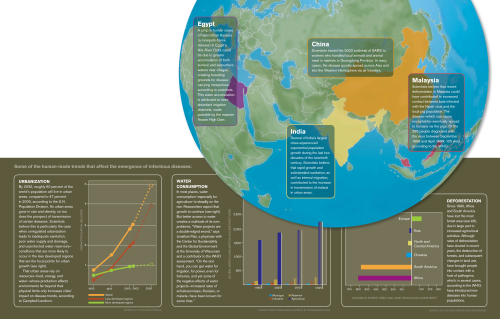
By 2030, roughly 60 percent of the world's population will live in urban areas, compared to 47 percent in 2000, according to the U.N. Population Division. As urban areas grow in size and density, so too does the prospect of transmission of certain diseases. Scientists believe this is particularly the case when unregulated urbanization leads to inadequate sanitation, poor water supply and drainage, and unprotected water reservoirs-conditions that are more likely to occur in the less developed regions that are the focal points for urban growth (see right).
That urban areas rely on resources-food, energy, and water-whose production affects environments far beyond their physical limits only increases cities' impact on disease trends, according to Campbell-Lendrum.
In most places, water consumption-especially for agriculture-is steadily on the rise. Researchers expect that growth to continue (see right). But better access to water creates a multitude of its own problems. “Water projects are a double-edged sword,” says Jonathan Patz, a physician with the Center for Sustainability and the Global Environment at the University of Wisconsin and a contributor to the WHO assessment. “On the one hand, you can get water for irrigation, for power, even for fisheries, and yet some of the negative effects of water projects-increased rates of schistosomiasis, filariasis, or malaria-have been known for some time.”
Since 1990, Africa and South America have lost the most forest area (see left), due in large part to increased agricultural activities. Although rates of deforestation have slowed in recent years, the destruction of forests, and subsequent changes in land use, have brought people into contact with a host of pathogens, which, in several cases, according to the WHO, have introduced new diseases into human populations.
Egypt
A jump in human cases of bancroftian filariasis (a mosquito-borne disease) in Egypt's Nile River Delta could be due to greater accumulation of both surface and subsurface waters near villages, creating breeding grounds for disease-carrying mosquitoes, according to scientists. This water accumulation is attributed to more abundant irrigation channels, made possible by the massive Aswan High Dam.
China
Scientists traced the 2003 outbreak of SARS to workers who handled local animals and animal meat in markets in Guangdong Province. In many cases, the disease quickly spread across Asia and into the Western Hemisphere via air travelers.
India
Several of India's largest cities experienced exponential population growth during the last two decades of the twentieth century. Scientists believe that rapid growth and substandard sanitation, as well as internal migration, contributed to the increase in transmission of malaria in urban areas.
Malaysia
Scientists believe that recent deforestation in Malaysia could have contributed to increased contact between bats infected with the Nipah virus and the local pig population. The disease-which can cause encephalitis-eventually spread to humans via the pigs. Of the 265 people diagnosed with the virus between September 1998 and April 1999, 105 died, according to the WHO.
Supplementary Material
Ecosystems and Human Well-Being: Health Synthesis