



Abstract
Driven by low risks and high profits, the global black-market trade in wildlife endangers animals and humans alike.
Steve Galster, a fit-looking 44-year-old from Wisconsin who fronts the San Francisco-based conservation group WildAid, has seen plenty of jungles in his time. Take Bokor National Park in Cambodia. Galster and his colleagues train and subsidize its 50 or so rangers, who routinely brave giant leeches and endemic malaria to protect a 540-square-mile wilderness from armed poachers. Last December, however, Galster wore a suit and tie to reflect upon the bureaucratic jungle that had to be negotiated before representatives of the 10-member Association of Southeast Asian Nations (ASEAN) met in Bangkok to launch the Wildlife Enforcement Network, or ASEAN-WEN, a body being heralded as the world's largest wildlife law-enforcement network. “It almost didn't happen,” says Galster, whose group played a key behind-the-scenes role. “Wildlife officials in different countries never really communicated before.”
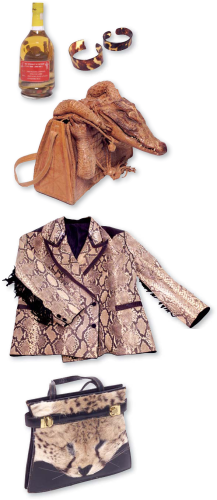
Illicit products: Wildlife parts are used in jewelry, traditional medicines, clothing, accessories-even furniture (see p. 36).
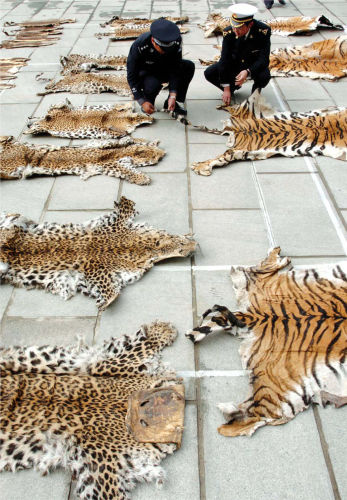
Grim contraband: Custom officers inspect confiscated pelts in Tibet.
Poor regional and international cooperation is one reason animal traffickers have been “running circles around the authorities,” says Galster. The global trade in illegal wildlife–as rare pets, traditional medicines, trophies, or meals at “exotic” restaurants–is worth $7 billion to $10 billion a year, Interpol estimates. A single tiger, for instance, can fetch thousands of dollars on the black market: The pelt may sell for as much as $15,000, while powdered tiger humerus bone (used in traditional medicines for treating typhoid fever) is worth $1,450 per pound in South Korea, and a single phallus (believed to boost virility) might go for $1,200 in Japan. While the profits in trafficking are huge, the risks are small and the penalties piffling. (The maximum penalty for wildlife trafficking in Thailand, for example, is about $1,000.) Most of those convicted are poachers driven by poverty who earn just a small percentage on the animals they hunt; few of the big-time traffickers who control them serve any time behind bars.
“If you've got the routes and got the mules, you'll shift whatever gives the highest profit at the lowest risk,” says Ben Davies, author of Black Market: Inside the Endangered Species Trade in Asia. “Wildlife fits that category. When you look at the penalties for drug smuggling, it's easy money.” An economically resurgent China is the chief destination for this contraband, but hardly the only one. The world's second biggest importer of illegal wildlife is the United States.
Illicit products: Wildlife parts are used in jewelry, traditional medicines, clothing, accessorieseven furniture (see p. 36).
Yet, regardless of whether countries supply or demand illegal wildlife products, all nations feel the impact of trafficking. Endangered species are being put at further risk as poachers thin out their ranks and leave their dwindling populations susceptible to threats both natural and human-made. Invasive species that crisscross national borders threaten to wreak havoc upon carefully balanced, indigenous ecosystems. And the alarming rise of virulent zoonotic diseases such as avian influenza, which originate in animals but could cause pandemics among humans, gives even greater urgency to curbing the wildlife trade.
Animal planet
The fight against wildlife trafficking has never been a priority for either developing or developed countries: the former are often more concerned with battling poverty and disease, the latter with combating the smuggling of drugs and people. In many countries, the authorities are corrupt or shiftless and very often run the illegal wildlife trade. In Cambodia's Bokor park, guntoting commercial loggers and poachers are employed by corrupt government officials or rogue officers of the police or military.
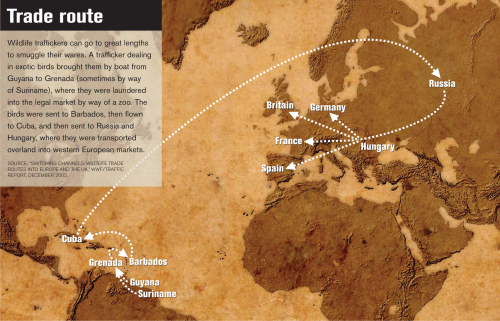
They form part of a wider network of global trafficking routes. These are “covert, sometimes run by organized criminals, and often used to smuggle other commodities such as drugs and guns,” noted a 2002 report published by the World Wildlife Fund (WWF) and TRAFFIC, a program established by the WWF and the World Conservation Union to monitor the global trade in wildlife. The sheer volume of animal contraband in circulation is startling: Between 1996 and 2000, British Customs officials seized more than 1 million wildlife items–about 570 per day–and this is believed to be a fraction of what actually passes through the nation's ports. Wildlife is sometimes smuggled into countries such as the Netherlands, Belgium, or Spain to avoid stricter scrutiny in Britain. Matters are further complicated by the divergent laws among the 25 members of the European Union (EU). Penalties range from three months to eight years imprisonment, with the lightest laws found among the ten nations that joined the EU in 2004. Wildlife traffickers choose countries that have minimal penalties as entry points and then transport their wares across the EU's increasingly porous borders.
The WWF/TRAFFIC report also observed that the worldwide legal trade in live animals, plants, products, and derivatives is worth about $15 billion annually, a huge market that traffickers exploit. Ill-trained police or customs officials at remote borders cannot make the often small distinction between a legal and an illegal animal. (For instance, WWF/TRAFFIC reports a case where rare bird chicks were mixed in with shipments of hen chicks from India.) “Sometimes it's very hard for non-experts to tell the difference,” says Davies. The situation is further complicated by the trade in tigers, orangutans, and other animals claimed to be bred in captivity, often erroneously or unprovably.
ASEAN-WEN–already nicknamed the “wildlife Interpol”–will “go after the big traders,” Galster promises. That's good news in a field that more often generates bad. Last November, conservationist Vincent Chow declared that the last five Sumatran rhinos living in a southern Malaysian forest reserve had been killed by poachers. The Sumatran rhino is one of the rarest large mammals. Fewer than 300 survive in the wild, mostly in Malaysia and Indonesia, but with a rhino's horn and body parts worth up to $25,000 for use in traditional medicines, their future looks grim. Chow, an adviser to the Malaysian Nature Society, publicly urged the authorities to police the park more aggressively. But he also admitted that the 185-square-mile reserve was “just too big to patrol,” especially when some richer poachers were escaping by helicopter. As the rhino population decreases, their black-market value increases, further hastening their demise.
November also saw bad news from India, where poorly patrolled national parks are being destroyed by human settlements; the animals plundered by poachers. Environment Minister Namo Narain Meena confirmed to India's parliament that no tigers were left in the Sariska Tiger Reserve in the western state of Rajasthan. The Central Bureau of Investigation, India's equivalent to the FBI, said two or three gangs had ravaged the reserve's tiger and leopard populations; the dozen tigers counted there in 2004 had vanished. Also last November, Indian police arrested four poachers (again, small-fry) who confessed to killing nine tigers and one leopard at the nearby Ranthambore National Park. The park now has 26 tigers, almost half the number recorded in 2003.
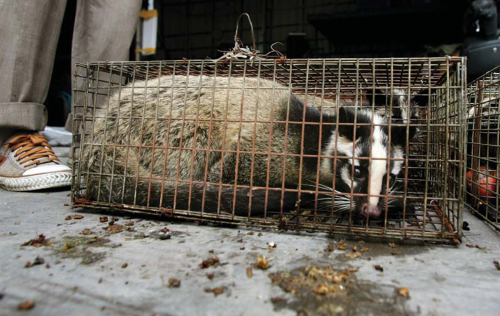
Feeding frenzy: A caged civet cat at a food market in China's southern city of Guangzhou. Civets sold in markets were found to be infected with the SARS virus.
ASEAN-WEN headquarters will be in Bangkok, which is either the best or the worst place, depending how you look at it. Thailand has a truly abysmal record in law enforcement. Ironically, the qualities that make it an obvious headquarters–good air and road links, a central geographical location–have also helped, along with porous borders and poor law enforcement, to make it a major transhipment center for trafficking. “It's also the forgery capital of the world, which means it's a good place to get false documents,” notes Davies. “It's the perfect transit point for illegal wildlife.”
Thailand is arguably the region's largest breeder and distributor of Earth's rarest animals. It not only smuggles in orangutans from Indonesia, but also rhino horns and tigers from India, leopards and turtles from Burma, macaques from Cambodia, and vast quantities of African ivory. Its police are ill-trained, underpaid, and corrupt, and have failed to solve a string of wildlife scandals in recent years. Consider the gruesome case of Luethai Tiewcharoen, a Chinese-Thai man nicknamed “Fatty.” In October 2003, Thai authorities raided a house near Bangkok and found six live tigers, two live orangutans, four frozen tiger carcasses, the bones and meat of pangolins, snakes, and turtles, and a bucket of freshly amputated bear paws. Total black-market value: more than $125,000. Likely destination: restaurants in China, Korea, and Japan. Six months later, Luethai was caught red-handed in northeast Thailand with a partially butchered tiger corpse in the trunk of his car. He was fined but never received jail time for his crimes. At the time of writing, he is still at large.
Thai police believe Luethai is part of a region-wide trafficking syndicate. Sawaek Pinsinchai, the recently resigned chief of the nation's forestry police, claimed Thai politicians and policemen were involved, too. There was evidence the syndicate had once dealt in methamphetamine pills, known in Thai as ya ba or “crazy medicine,” and had shifted to animals after more than 2,500 suspected drug dealers were shot dead in a blood-drenched antinarcotics crackdown by the authorities in 2003. Tiger carcasses found at Luethai's slaughterhouse had been declawed, which suggests they were raised on one of Thailand's many ill-regulated tiger farms, where staff routinely rip out the animal's claws with pliers while still a cub. (Tiger breeding farms are legal in the country, though the Thai government has long denied the animals are used in the wildlife trade.)
Though critically endangered in the wild, tigers breed surprisingly well in captivity, with a mother able to give birth to three or four cubs per year. In December 2002, a hundred tigers bred at Sri Racha Tiger Zoo near Bangkok and valued at $2,500 each, were flown to Sanya Love World theme park in Hainan Island, China. This unprecedented and poorly scrutinized export was legal, insisted Plodprasop Suraswadi, a senior Thai environmental official, although the Chinese ambassador to Thailand had to publicly dismiss reports that the tigers had been delivered to his omnivorous homeland for “culinary purposes.” Such fears were well-founded. An earlier investigation by the London-based group Environmental Investigation Agency alleged that tiger-bone pills were on sale in Sri Racha Tiger Zoo's gift shop.
Another zoo near Bangkok called Safari World was embroiled in a scandal involving our close cousin, the orangutan (literally translated as “jungle man”). In 2003, a raid by Thai authorities found 115 orangutans, used in boxing and other shows. Police suspected most of the apes were snatched from the wild and smuggled into the country. But while most of the orangutans are now under government care, none have been repatriated to their natural habitat, the forests of Sumatra and Borneo. And no senior official at Safari World has been prosecuted, least of all its rich and well-connected Chinese-Thai owner, Pin Kiewkacha, who told reporters that animal welfare campaigners “are out to get me.”
Even as Thai officials prepared the launch of ASEAN-WEN, yet another wildlife scandal was brewing. A new “night safari” zoo in the northern Thai city of Chiang Mai recently announced plans to serve an “exotic buffet” of tiger, lion, elephant, and giraffe for 4,500 baht (about $100). The zoo's director, who happens to be the scandal-dogged Plodprasop, defended the restaurant, while a local newspaper ran a photograph of Prime Minister Thaksin Shinawatra stroking one of the zoo's tiger cubs with the caption, “The cub's relatives may soon be on the menu.” Outraged wildlife groups pointed out the buffet made a mockery of the zoo's avowed commitment to education and conservation. The buffet has been scrapped–for now.
Law of the jungle
Bangkok was also the 2004 venue for the meeting of the much-maligned Convention on International Trade in Endangered Species of Wild Flora and Fauna (CITES). Established in 1975 and administered by the United Nations, CITES now has signatories from more than 160 nations. It is essentially a trade conference, in which country representatives decide what level of protection plants and animals should have. Endangered species–for example, orangutans, tigers, sun bears, sea turtles, and the Asian tropical lady's slipper orchids–come under a CITES category called Appendix I, which means no global trade is permitted.
The trouble is, CITES is a treaty, not a law-enforcement body, with its signatories expected to implement the treaty's provisions through domestic legislation and agencies. “CITES lacks teeth to protect these species against illegal traders,” says Galster. Author Davies is even blunter. “CITES is a disaster,” he says. “It's run by a small group of people who answer only to bureaucrats.” One resolution adopted by all signatories at the last meeting in October 2004 was to designate a law-enforcement focal point, so that countries could more effectively exchange information on trafficking. “Most countries haven't done it yet,” Galster notes.
Bureaucratic inertia has been the traffickers' best friend. The West has long regarded the problem as one for the developing world to solve. Yet after China, the West is the main destination. The United States is the biggest buyer of exotic pets: Millions of Americans own birds, snakes, turtles, or iguanas, including many rare and endangered species. According to Davies, there are more tigers in captivity in the United States (roughly 10,000) than there are in the wild (roughly 4,000). No wonder the celebrated conservationist Jane Goodall recently urged “developed nations to step in and support wildlife conservation in Asia.”
The U.S. response is the Coalition Against Wildlife Trafficking (CAWT), launched last September by Claudia McMurray, deputy assistant secretary of state for environment. CAWT brings together seven U.S.-based environmental and business groups: Conservation International, Save the Tiger Fund, the Smithsonian Institution, TRAFFIC International, Wild-Aid, Wildlife Conservation Society, and the American Forest and Paper Association. “The coalition will focus its initial efforts on Asia, a major supplier of black-market wildlife and wildlife parts to the world, including America and Europe, as well as a major market in itself,” vowed a State Department memo. CAWT is an exercise in political will-building and presumably not an empty one, considering what conservationists say is McMurray's close relationship with Secretary of State Condoleezza Rice. The United States has also pledged to support ASEAN-WEN by providing training to law enforcement and environmental officials.
It's needed. The largest market is in China, where growing prosperity is radically impoverishing the natural world. About 80 percent of wildlife contraband from Southeast Asia ends up there, reckons WildAid's Galster. Many rare mammals are served up at ye wei or “wild taste” restaurants. WildAid campaigns with the slogan, “When the buying stops, the killing can too,” and has recruited celebrities such as revered movie star Jackie Chan for public awareness campaigns. Not that it is uneducated country folk who are doing the consuming, observes Davies. “They can't afford to,” he says. Rather, it is China's newly wealthy urbanités, including government officials, who like to serve “exotic” meats at banquets to grease business deals.
Will the consumption ever stop? There have been tiny victories. For example, the recently opened Hong Kong Disneyland decided not to serve shark-fin soup in its restaurant. More significant, hopefully, is that both China and the United States joined a four-day ASEAN workshop in Thailand a month before ASEAN-WEN was launched. The Chinese delegates were “positive and open,” Galster says. “That's another reason to be excited. Here's an opportunity for the Chinese to link up with the network, start to receive information, and put the heat on some of the major traders.”
The fight is given new urgency by the advent of virulent diseases such as severe acute respiratory syndrome (SARS) and avian influenza. One cost-effective means of preventing deadly pandemics is to better control the trade in wildlife, observed the New York-based Wildlife Conservation Society in a recent study, “Wildlife Trade and Global Disease Emergence,” which was coauthored with the Colorado-based Bio-Economic Research Associates and appeared in the July 2005 issue of the journal emerging Infectious Diseases. SARS was first recorded in the southern Chinese province of Guangdong in November 2002, a major destination for illegal wildlife. It killed nearly 800 people and infected more than 8,000 in Asia, North America, and Europe. Chinese scientists believed the disease could have passed to humans from the masked palm civet cat, the flesh of which is thought to improve blood circulation. (Recent research indicates the civets contracted the virus from horseshoe bats.) This prompted the authorities to conduct a series of raids on animal markets. Fear of contracting SARS temporarily dulled China's voracious appetite for civet cats and other wild meat. “Suddenly,” notes Davies, “it looked like the deadly disease might bring about what conservationists had wanted for years: an end to the worldwide trade in wild meat.” But as the SARS outbreak subsided, so did the fear, and civet cat crept back onto Chinese menus.
The trade in big cats seemed similarly unaffected by the news last year that perhaps a hundred tigers at the Sri Racha zoo had died of avian influenza. (The animals were buried before the exact number could be independently verified.) But the global trade of millions of wild birds could well diminish in the face of growing alarm about bird flu in Europe and the United States. The highly virulent H5N1 strain, which has killed more than 70 people in Asia since late 2003, was to blame for several more deaths in Turkey in early 2006, raising concerns about a European pandemic.
Rescue operation: Malaysian wildlife officers seize live pangolins (otherwise known as “scaly anteaters”) in the southern state of Johor.

While public awareness of wildlife trafficking is huge compared to 20 years ago, says Davies, he can name only one notable success against the poachers: the “incredible” growth of the rhino population in Kaziranga National Park in northeast India. Otherwise, he confesses, “The situation is bleak. And the bleakest thing of all is the one conservationists don't really talk about–the growth of the human population.” This growth, which is destroying natural habitats, is mainly taking place in regions with the greatest poverty and the biggest concentration of wildlife. The forest habitats of orangutans, for example, are being cleared away to make room for oil palm-tree plantations. (Palm oil, which is a common ingredient in both food products and cosmetics, is a lucrative trade item for Southeast Asian countries.) The battle to save many species is “unwinnable,” contends Davies. “Ultimately, all you can do is slow the process.”
“I understand why the conservation community is pessimistic,” counters Galster. “Despite lots of expenditure and work over the years, they keep confronting apathy, corruption, and the decline in wildlife populations.” He cites WildAid's previous success in training a government task force in the Russian Far East to save the Siberian tiger. “It was rapidly moving toward extinction. They were losing 70 to 90 tigers a year, and they reckoned they only had 300 in total. Today it's got one of the most stable tiger populations in the world and poaching has gone down.”
The first meeting of ASEAN-WEN is scheduled to be held in Thailand early this year. Southeast Asia's new “wildlife Interpol” will need to produce results rather than hot air, a substance ASEAN has a reputation for generating. The regional grouping is clubby and undynamic, with an institutionalized policy of “noninterference” in other members' affairs–a policy that has effectively endorsed the brutalization of people living under Burma's military dictatorship. It remains to be seen whether animals will fare any better under an ASEAN-sponsored body. Its challenge will be to muster the sustained political support necessary to push up wildlife trafficking on national agendas and stir law enforcement officials into effective action–and finally establish that the war against traffickers must also be waged at the highest levels of government, not just in the jungles. “We're optimistic,” says Galster, who knows both terrains well. “We're optimistic because, well, you gotta be.”