



Abstract

Defining the debate
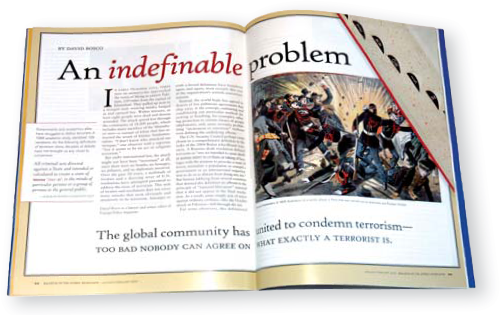
David Bosco skillfully details the inherent difficulties in arriving at a generally agreeable (and agreed upon) definition of terrorism in “An Indefinable Problem” (January/February 2006 Bulletin). As he correctly identifies, the question over what is and isn't terrorism goes to the heart of counterterrorism efforts. However, while the Palestinian-Israeli conflict is an important factor in the current imbroglio over semantics, Muslim commentators aren't the only ones to express concern about wording.
For instance, in August 2005, John Bolton, the U.S. ambassador to the United Nations, argued that any definition of a terrorist act should exclude “military activities that are appropriately governed by international humanitarian law.” Put bluntly, he meant limits should be placed on the degree to which government actions–for example, bombing civilians–should be considered terrorism. Conversely, many others throughout the world would argue that terrorism constitutes precisely such actions.
In short, terrorism, like beauty, lies largely in the eye of the beholder. Yes, disagreement over the Palestinian-Israeli conflict might be a stumbling block to the formulation of a universally accepted definition, but it's far from the only hurdle. It shouldn't be treated as such.
Mark Burgess
Director, World Security Institute Brussels Brussels, Belgium
The title of David Bosco's article and his interesting discussion of the long and varied history of terrorism would seem to point toward the almost intractable problem of defining–in law–that which we “obviously and intuitively” know to be terrorism. On closer reading, however, this isn't the problem that vexes Bosco. Indeed, Bosco is troubled by something eminently definable: Israel, by which he means radicalism and fundamentalism in the Arab and Muslim world (terms he assimilates throughout).
Bosco's central thesis is that for a wirkable definition of terrorism to be achieved at the international level, the “rhetoric of crisis that is so pervasive in many parts of the Arab and Islamic world” needs to cool. Typical of much of the contemporary writing on terrorism, which concerns itself almost exclusively with fundamentalist Islam, Bosco rehashes the tired argument that Mideast thinking is irrational. Yet, it's all too clear that Bosco's piece itself is an exercise in somewhat unnuanced rhetoric and infinite question-begging. Does he consider, for example, the current U.S. administration and its various willing allies to be equally irrational in their thinking? The rhetoric of crisis seems just as pervasive, and arguably, more dangerous, in Washington and in Westminster as it does in the places Bosco discusses.
The Clock

Sadly, as the history of terrorism he relates demonstrates, the problem of defining terrorism is far more problematic than Bosco's one-sided thesis of Arab and Muslim stumbling blocks to international cooperation would allow.
Ben Golder
Part-time law lecturer, University of East London London, England
In his otherwise informative article, David Bosco commits a minor omission with major ramifications when he briefly references the 1946 bombing of the King David Hotel in Jerusalem by the Jewish military group Irgun. He parenthetically mentions that “debate continues to this day about whether Irgun warned the hotel to evacuate.” He fails to acknowledge, however, that the hotel's basement housed a British military communications center. The debate is not only over whether Irgun released a warning about the bombing, but also if the bombing can be considered terrorism. According to almost all of the definitions Bosco presents, the bombing of a military installation is not a terrorist act.
Moshe Zvi Marvit
Chicago, Illinois
Ben Golder makes a good point. The Arab and Muslim world certainly isn't alone in employing crisis rhetoric. But whatever the missteps of the Bush and Blair governments, they don't endorse–explicitly or implicitly–intentional attacks on civilians as a war-fighting strategy; some sympathetic to the Palestinian cause still do. Moshe Zvi Marvit adds an interesting wrinkle to the King David Hotel story, but he too easily assumes that the presence of a British military facility legitimizes the attack. Bombing a primarily civilian target with a small military facility inside might still constitute a terrorist act under several of the commonly used definitions, especially if the intent was to alarm the populace as a whole.
A misguided offer?
In “Keep Your Enemy Closer” (November/December 2005 Bulletin), Jack Boureston and Charles D. Ferguson mislead readers when they write that by “pursuing a civilian nuclear program, Iran has international law on its side.” It does not. When the International Atomic Energy Agency (IAEA) Board of Governors found Iran in violation of its Safeguards Agreement after 18 years of concealed activities and continued noncooperation, Iran sacrificed certain rights.
Worse yet, Boureston and Ferguson dance around explaining how dangerous (and duplicitous) the technology comprising the nuclear fuel cycle can be. It is technology the West refused to sell to the Shah of Iran, even when the Shah was a close ally who was permitted to purchase every conventional weapon in the U.S. arsenal. Warning that fuel-cycle technology puts a country months away from possessing a nuclear weapon, IAEA Director-General Mohamed ElBaradei has proposed a worldwide moratorium on the construction of new nuclear enrichment facilities until an agreement can be reached that places any such facility under the control of an international consortium.
Finally, Boureston and Ferguson ignore the Islamic Republic of Iran's long history of creatively undermining agreements. When U.S. diplomats were taken hostage in Tehran in 1979, the Iranian government insisted it had nothing to do with the actions of “students” whom it proceeded to protect. In the Iran-Contra affair, the United States sold Iran arms in return for Iran releasing hostages held in Lebanon; Iran did, but it immediately took new hostages. Then–despite loud proclamations to the contrary–there's the nearly two decades of concealing its activities from the IAEA. Given this track record, it would be naive to provide Iran with dangerous technology in return for the promise that, this time, it will not cheat.
Patrick Clawson
Deputy Director for Research Washington Institute for Near East Policy Washington, D.C.
Jack Boureston and Charles D. Ferguson are correct when they anticipate that critics of their proposal to furnish nuclear technology to Iran under enhanced safeguards would label it appeasement. It's exactly that.
They are wrong, however, when they assert that international law supports Iran's pursuit of nuclear power. Given Iran's lack of cooperation with the International Atomic Energy Agency (IAEA), it is, at best, premature to conclude that Iran's nuclear program is justified. Extrapolated, this could mean that Iran can assert that any future actions it takes are consistent with its “inalienable right” to nuclear technologies.
Under this scenario, Iran's response would be predictable. First, Tehran will reject the proposition that it face enhanced monitoring. (If the Iranian program is found to be consistent with international standards, it cannot possibly be forced to accept a separate set of monitoring procedures.) Second, Iran will assert that the determination that its nuclear program is legal shouldn't be subject to review by the IAEA or supplier states for the indefinite future.
The authors compound the problem by failing to appreciate the menacing nature of the Iranian regime. They claim it's to the advantage of the United States to get “closer” to Iran. But what does this mean? Should the United States accept the Iranian president's proposition that Israel be destroyed? Is the execution of individuals who've insulted the Ayatollah Khomeini's memory a reasonable form of Islamic religious expression?
In the past, liberal and conservative groups have formed effective coalitions to fight nuclear proliferation. The basis for these coalitions has been the shared objective of keeping dangerous nuclear technologies and facilities out of the hands of dangerous regimes. The goal of nonprolifer-ation will be poorly served if groups from either side decide that the best approach to fostering better relations with aggressive, anti-American regimes is to provide them with nuclear technologies and facilities.
Quite simply, the United States cannot trust a regime like Iran's with nuclear technology and, as a matter of policy, should not transfer sensitive technologies to such a regime.
Baker Spring F. M. Kirby Research Fellow in National
Security Policy, The Heritage Foundation Washington, D.C.
At best, a policy of denial buys time. But as Iran's unsealing of sensitive nuclear facilities in January attests, time is running out. Worse yet, the United States has little on-the-ground intelligence capabilities inside Iran. This knowledge vacuum perpetuates worst-case thinking and could lead to military action–as in Iraq. But bombing Iran is unlikely to sway Tehran from its nuclear pursuits; it could have the perversely opposite effect of spurring Iran to develop nuclear weapons in secret, underground facilities.
“We do not support supplying nuclear technology to Iran without conditions. In our article, we outline a process that would reward Iran with built-in, proliferation-resistant nuclear technology for complying with rigorous safeguards. Concerning Clawson and Spring's objections that Iran does not have “international law on its side,” we clearly state that the right to nuclear technology is contingent on not making nuclear explosives.
Despite half-hearted Iranian interest in Russia's offer to enrich uranium for it, Tehran is determined to pursue an indigenous nuclear program. Neither repeated denials nor referral to the U.N. Security Council will stop it. In our opinion, increased engagement and transparency from both sides are urgently needed.
Protect whistleblowers
In “To Tell the Truth” (January/February 2006 Bulletin), Sibel Edmonds and William Weaver admirably outline the vital role of whistle-blowers in holding the government accountable for its misdeeds. Yet whistleblowers continue to have nowhere to turn. Since the publication of Edmonds and Weaver's article, Senate Intelligence Committee Chairman Pat Roberts has dusted off legislation that would criminalize leaks of classified information–dangerous legislation that many people worked tirelessly to kill several years ago. Copious leaks that exposed what appears to be potentially illegal U.S. activity–domestic spying and secret detention centers in Europe and elsewhere–have recently prompted the White House to launch a series of internal investigations. (FBI agents have reportedly conducted polygraphs of dozens of federal employees.) An expert quoted in the Washington Post claims that such behavior “represents perhaps the most extensive and overt campaign against leaks in a generation.”
UPDATES: A wind-wind situation
wind power R and D continues to ramp up worldwide (see “The Mighty Wind,” November/December 2005 Bulletin). In early March the Global Wind Energy Council announced that the installation of $14 billion-worth of new wind turbines across the globe in 2005 yielded a 25 percent increase in wind power compared to 2004. In its ongoing push to wean itself from fossil fuels, the United States experienced the greatest increase in wind power capacity–gaining 2,431 megawatts of wind power in 2005. Australia, Canada, and Asia also saw substantial growth in their wind power output.

All blogged out
After 18 months of serving as a forum where former and current Los Alamos National Laboratory (LANL) employees could anonymously articulate their concerns about the lab's management, the “LANL: The Real Story” blog is shutting down on July 1 (see “Los Blogamos,” May/June 2005 Bulletin). Douglas Roberts, the recently retired LANL computer scientist who conceived of and maintained the popular and controversial website, believes the blog has outlived its purpose now that the University of California is being replaced by Los Alamos National Security LLC as the lab's main steward in June. “Whetherthe problems that arose underthe University of California's tenure will be corrected remains to be seen,” Roberts says. “But if a blog is needed to assist the process, it will be someone else's.”
Whistleblowers need protection, but there isn't a safe or discreet place inside the government (Congress or otherwise) for national security employees to voice their concerns about illegal activities. Thus, whistleblowers seek the only protected entity they know–the media.
Beth Daley
Senior Investigator Project On Government Oversight Washington, D.C.
A complex recipe
Amid so much hyperbole about the bioterrorist threat, Malcolm Dando takes a refreshingly realistic view in “The Bioterrorist Cookbook” (November/December 2005 Bulletin). Dando's central tenet is accurate: Worst-case bioterrorism scenarios are far less likely to occur than smaller-scale events, but, even then, terrorists will struggle to undertake attacks that employ less lethal agents and less sophisticated production and delivery approaches.
The 1975 Biological and Toxin “Weapons Convention is designed to address the state-level bioweapons threat. While Dando's frustration with recent international efforts to strengthen bioweapon nonproliferation is understandable, his recommendations to gird that regime with more confidence-building measures will hardly make a dent in preventing bioterrorism.
To begin to hinder terrorist acquisition and use, vastly improved intelligence detection and analysis of pertinent terrorist activity is needed. Plus, the international community must truly start policing scientific conduct by institutionalizing rigorous, uniform global standards for biosafety, oversight of genetic engineering research, and biosecurity in all public and private facilities working in the life sciences. These standards must carry mandatory noncompliance penalties. This framework would use education, peer monitoring, and regulatory oversight to reduce the chance of wayward scientists operating in known facilities and would at least drive terrorists to do their dirty work in other venues at a greater cost and risk.
Amy E. Smithson
Senior Fellow, International Security Program Center for Strategic and International Studies Washington, D.C.
Malcolm Dando correctly assesses that bioterrorist attacks are more likely to be small-scale, targeted efforts rather than large-scale events with millions of people killed. In my estimation, this is for two reasons motivation and capability.
Tell us about it
Send your comments to:
Letters to the Editor
Bulletin of the Atomic Scientists
6042 South Kimbark Avenue
fax: 773-702-0725
e-mail:
Obviously, states and terrorists have different motives. Scientists in states, such as Japan during World “War II, are motivated as much by scientific inquiry as by killing state enemies. As for capability, it's much easier for a state to launch large-scale biological attacks–although, as Dando reasons, the “barriers of entry” are decreasing. However, even with diminishing barriers, the Soviet Union's massive Cold War expansion of biological weapons research, testing, and stockpiling could not be duplicated by a decentralized terrorist group hiding in a small cell.
In terms of motivation, terrorists incapacitate or kill innocent people for a specific purpose. As Dando mentions, the cult followers of Bhag-wan Shree Rajneesh wanted to influence the outcome of a local election in Oregon by making the townspeople too ill to vote; homicide was not on their agenda.
Nevertheless, an argument could be made that terrorism is most effective when committed brazenly–such as 9/11. The results are immediate and the perpetrators more quickly identified. With biological weapons, the results are delayed and responsibility is difficult to assign. Indeed, the Oregon attack wasn't determined to be a terrorist act until Rajneesh accused his followers of subterfuge a year later.
Today, while it's easier to work on pathogens in small, impromptu laboratories, there are still significant hurdles to overcome to stage a successful bioterror attack. Unlike bombs, biological agents are unpredictable and dependent on a number of variables, requiring considerable resources. Not to mention, a highly communicable agent could potentially infect millions, meaning the disease could spread to populations the terrorists never intended–namely, those they care about.
Laura H. Kahn
Researcher Woodrow Wilson School of Public and International Affairs Princeton, New Jersey